In this notebook we will use Mathematica to evaluate and derive a few finite product forms involving the generalized Beta function where the parameters involved are x a complex number and n a positive integer. In 1906, Niels Nielsen [3] wrote his famous book on the Gamma function where derived the finite product of the ratio of the Gamma function page 20 in [3 ], which simplifies to the Beta function. In this notebook, we use equation (5) in [1] to derive a product form involving the Beta function with others possible using the contour integral method in [1].
Here we start with the general theorem given in [1] in terms of Mathematica code;
In[]:=
1
k
2
1-p
4
-1+k
()
1-p
2
m
1-p
2
m
1-p
2
-1+p
2
1+2k
2
1
2
4m
1
4
1
2
1+k
()
1-n
2
m
1-n
2
m
1-n
2
-1+n
2
Here we simplify the Lerch function using after setting m=0 and simplify using equation (25.14.2) in [2].
In[]:=
1
1+k
()
1+k
()
1+k
()
1-p
2
-2+p
2
1
4
p
2
1+k
2
kπ
2
1
4
1+k
()
-n
2
-1+n
2
Next we take the first partial derivative with respect k and set k=0.
In[]:=
DHurwitzZeta[-k,1-Log[a]]-HurwitzZeta-k,(2-Log[a]),HurwitzZeta-k,1-Log[a]+2HurwitzZeta[-k,1-Log[a]],k/.{k->0}//FullSimplify//FunctionExpand//Expand
1+k
()
1-p
2
-2+p
2
1
4
p
2
2+k
2
1
4
1+k
()
-n
2
-kπ
1
2
-1+n
2
Then take the exponential function of both sides and simplify the Gamma function using the Beta function
In[]:=
Exp-Log[]-Log[-Log[a]]+Log[-2-Log[a]]-Log[Gamma[-Log[a]]]+LogGamma(-2-Log[a]),-π-2Log[2]+Log[]-πLog[a]+Log[2]Log[a]-Log[]Log[a]+2Log[2π]-Log[2π]-4Log-Log[a]+Log[-Log[a]]-4LogGamma-Log[a]+LogGamma[-Log[a]]//FullSimplify
1
2
-p
2
5-p
2
1-p
2
-2+p
2
1-p
2
p
2
1-p
2
-2+p
2
1-p
2
1
4
p
2
-1-n
2
-n
2
-n
2
1
2
-n
2
-n
2
1
4
1-n
2
-1+n
2
1
4
1-n
2
-1+n
2
In[]:=
,//FullSimplify
-
-1-p
2
()
5-p
2
-p
2
Gamma(-2-Log[a])
1
4
p
2
Gamma[-Log[a]]
-2+p
2
-2-Log[a]
p
2
-Log[a]
-2+p
2
-1-n
2
()
-1-n
2
-π/4
a
-π+Log[]Log[a]+4LogGamma-Log[a]
-2-n
2
1+n
2
-1-n
2
-1+n
2
1-
-1-n
2
π
-n
2
(-Log[a])
-1+n
2
2
Gamma1-Log[a]
1
4
Out[]=
,
-p
2
4
-
-1-p
2
()
5-p
2
-p
2
Gamma(2-Log[a])
1
4
p
2
Gamma[1-Log[a]]
-2+p
2
-1-n
2
()
-1-n
2
-π/4
a
-π+Log[]Log[a]+4LogGamma-Log[a]
-2-n
2
1+n
2
-1-n
2
-1+n
2
1-
-1-n
2
π
-n
2
(-Log[a])
-1+n
2
2
Gamma1-Log[a]
1
4
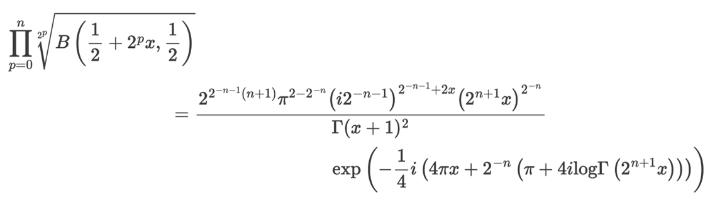
Here we use Mathematica to evaluate the finite product form involving the Beta function;
In[]:=
p1[x_,n_]:=NProduct(1+n)+2x//N
p
2
Beta+x,
,{p,0,n},1
2
p
2
1
2
-1-n
2
2
-1-n
2
()
-1-n
2
-4πx+π+4LogGamma[x]
1
4
-n
2
1+n
2
2-
-n
2
π
-n
2
(x)
1+n
2
2
Gamma[1+x]
In[]:=
p1[-1/3+/4,4]
Out[]=
{-2.24668-6.5354,-2.24668-6.5354}
In[]:=
p1[1/3+/4,5]
Out[]=
{2.6026-1.22038,2.6026-1.22038}
In[]:=
p1[1/3,2]
Out[]=
{3.28939,3.28939-2.22045×}
-16
10
Here we look at converting the gamma function to the Beta function. This simplification was also done by Nielsen.
Beta[a,b],
Gamma[a]Gamma[b]
Gamma[a+b]
In[]:=
Solvea==+x,a+b==1+x,{a,b}
1
2
p
2
p
2
Out[]=
a+x,b
1
2
p
2
1
2
In[]:=
1
π
Gamma[a]Gamma[b]
Gamma[a+b]
1
2
p
2
1
2
Out[]=
,
Beta+x,
1
2
p
2
1
2
π
Gamma+x
1
2
p
2
Gamma[1+x]
p
2
Here we look at the infinite product of the Beta function. Similar forms are also given in equation (90.1.10) in Hansen, equation (8.323) in Gradshteyn and I. M. Ryzhik and equation (1.6.9) in Nielsen. The product of the gamma function form is given by Knar’s formula; equation (7) in Pearson.
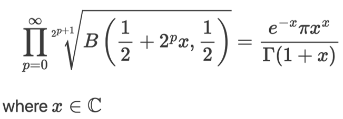
Here we use Mathematica to take the limit as n->∞ and simplify to get;
In[]:=
Limit(1+n)+2x,{n->∞}
-1-n
2
2
-1-n
2
()
-1-n
2
-4πx+π+4LogGamma[x]
1
4
-n
2
1+n
2
2-
-n
2
π
-n
2
(x)
1+n
2
2
Gamma[1+x]
Out[]=
-2x
2
π
2x
x
2
Gamma[1+x]
Here we use Mathematica to evaluate the infinite product form involving the Beta function;
In[]:=
p2[x_]:=NProductπ//N
p+1
2
Beta+x,
,{p,0,∞},VerifyConvergenceFalse,Method"WynnEpsilon",1
2
p
2
1
2
-x
x
x
Gamma[1+x]
In[]:=
p2[1/4+/5]
Out[]=
{1.77484-0.388253,1.77484-0.388253}
In[]:=
p2[-1/4+/5]
Out[]=
{1.88631-2.07977,1.88631-2.07977}
In[]:=
p2[-1/4-/5]
Out[]=
{1.88631+2.07977,1.88631+2.07977}
In[]:=
p2[/5]
Out[]=
{2.17431-0.943951,2.17431-0.943951}
In[]:=
p2[-/5]
Out[]=
{2.17431+0.943951,2.17431+0.943951}
Here we use Mathematica to look at some simple plots of the right-hand side of the infinite product involving the Beta function given above over the complex plane.
In[]:=
-x
x
x
Gamma[1+x]
In[]:=
Plot3DReπ,{a,-1,1},{b,-1,1},AxesLabelAutomatic,PlotTheme"Web",ClippingStyleNone
a+b
(a+b)
-a-b
Gamma[1+a+b]
Out[]=

In[]:=
Plot3DImπ,{a,-1,1},{b,-1,1},AxesLabelAutomatic,PlotTheme"Web",ClippingStyleNone
a+b
(a+b)
-a-b
Gamma[1+a+b]
References
References
[1] Reynolds R, Stauffer A (2022) Extended Wang sum and associated products. PLoS ONE 17(10): e0276078. https://doi.org/10.1371/journal.pone.0276078
[2] Olver, F.W.J.; Lozier, D.W.; Boisvert, R.F.; Clark, C.W. (Eds.), NIST Digital Library of Mathematical Functions; U.S. Department of Commerce, National Institute of Standards and Technology: Washington, DC, USA; Cambridge University Press: Cambridge, UK, 2010; With 1 CD-ROM (Windows, Macintosh and UNIX). MR 2723248 (2012a:33001).
[3] Nielsen, Niels. "Handbuch der Theorie der Gammafunktion." Leipzig : Teubner, 1906, pg. 20 equation 9.
[4] E. R. Hansen (1975) A Table of Series and Products. Prentice-Hall, Englewood Cliffs, N.J.
[6] I. S. Gradshteyn and I. M. Ryzhik (2000) Table of Integrals, Series, and Products. 6th edition, Academic Press Inc., San Diego, CA.
CITE THIS NOTEBOOK
CITE THIS NOTEBOOK
Nielsen finite product forms
by Robert Reynolds
Wolfram Community, STAFF PICKS, May 27, 2023
https://community.wolfram.com/groups/-/m/t/2926229
by Robert Reynolds
Wolfram Community, STAFF PICKS, May 27, 2023
https://community.wolfram.com/groups/-/m/t/2926229