Time-dependent mass and capillary depression of Mercury
Authors: Housam Binous and Ahmed Bellagi
Time-dependent mass and capillary depression of Mercury
Authors: Housam Binous and Ahmed Bellagi
Authors: Housam Binous and Ahmed Bellagi
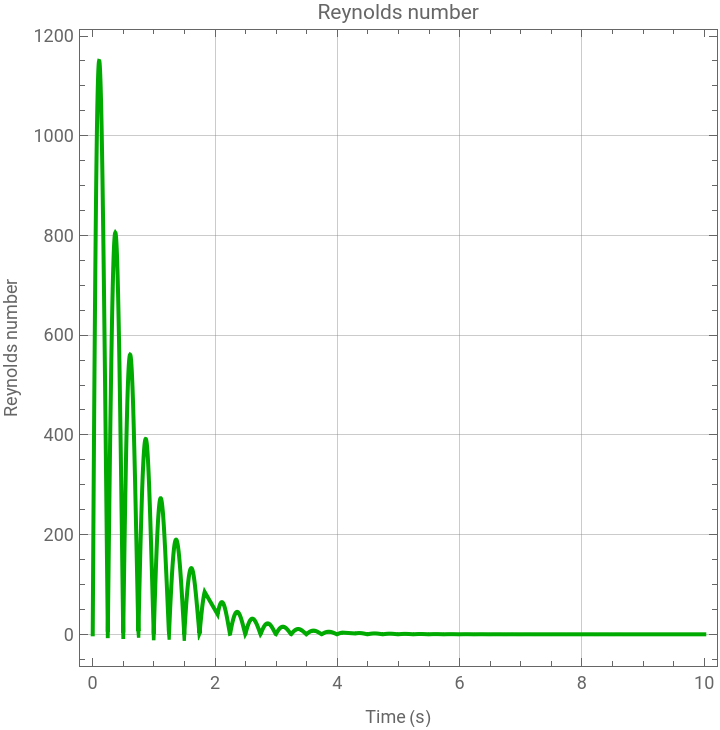
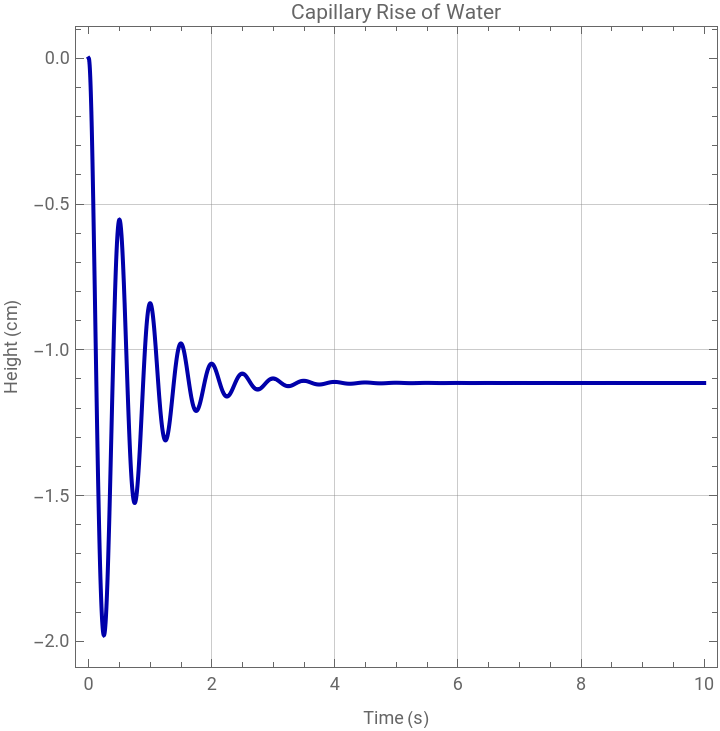
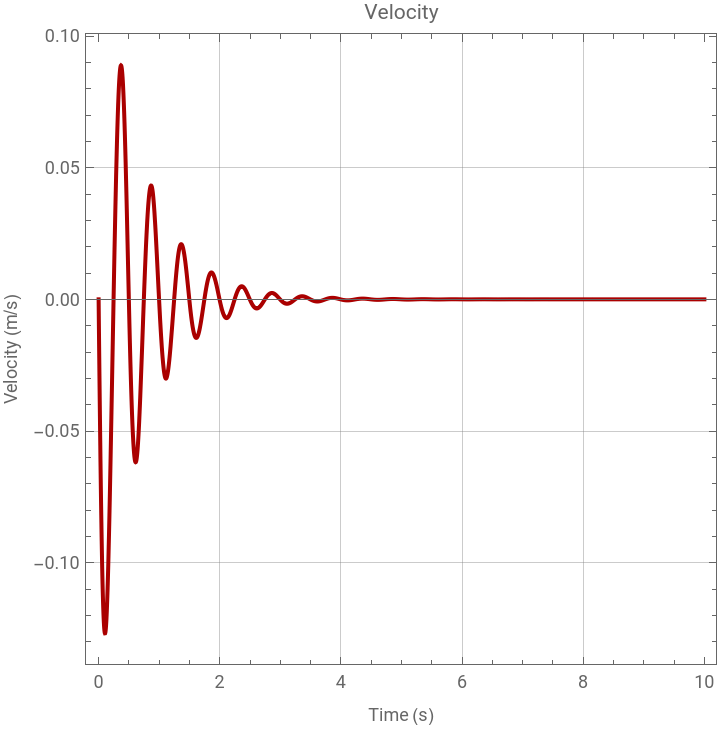
The depression of Mercury in a narrow capillary tube is governed by the combined effects of the variable effective mass of the moving column, laminar viscous damping, hydrostatic restoring force, and surface tension at the meniscus. Here, the decrease of the column height makes the inertia depend on the instantaneous displacement, which introduces a nonlinear inertial term in the equation of motion. The governing equation is derived directly from Newton’s second law of motion applied to the liquid column of height (h(t)) and cross-sectional area (A). This governing equation for mercury in a capillary tube includes:1- Inertia of the column2- Viscous damping3- Gravity4- Capillary force (mercury is non-wetting in glass (𝜃=140°C and cos𝜃<0) so this term pulls the liquid downward, producing a meniscus depression rather than a rise.Initial conditions are set to a small positive height () to avoid singularity and zero initial velocity ((t=0)=0).The equation is solved numerically using Mathematica’s NDSolve. Then,we plot the height and velocity of water column as a function of time, showing the rapid initial decrease followed by asymptotic approach to the equilibrium height: -1.114 cm. Finally, we check our laminar regime assumption by plotting the Reynolds number versus time.
h(t=0)=
-6
10
h
t
In[]:=
rho=13600;(*waterdensity,kg/m^3*)mu=1.5*10^-3;(*waterdynamicviscosity,Pa·s*)sigma=0.485;(*surfacetensionofwater,N/mor485dynes/cm*)
In[]:=
theta=Pi/180140(*contactangledegrees--assumenon-wetting*)
Out[]=
7π
9
In[]:=
R=0.5*10^-3;(*tuberadius,m*)A=PiR^2;(*tubecross-sectionalarea*)
In[]:=
g=9.81;(*gravity,m/s^2*)
In[]:=
Fcap=2PiRsigmaCos[theta](*capillaryforce---negativefornon-wetting*)
Out[]=
-0.0011672
In[]:=
(*Newton'ssecondlawofmotion*)L=0.05;(*Totalcolumnlength[m]*)(*NonlinearODEwithvariablemassm=L-h(t)*)eq=rhoPiR^2(L-h[t])h''[t]+8PimuLh'[t]+rhogPiR^2h[t]==2PiRsigmaCos[theta];(*Initialconditions*)ics={h[0]==1*10^-6,h'[0]==0};(*smallinitialheighttoavoidsingularity*)tmax=10;(*timespanof0-10seconds*)
In[]:=
sol=NDSolve[{eq,ics},h,{t,0,tmax},Method->{"StiffnessSwitching"},MaxSteps->Infinity];(*solutionofODEusingNDSolve*)
In[]:=
hfinal=h[tmax]/.sol[[1]];Print["Final water height (cm): ",100hfinal];
Final water height (cm): -1.1139
In[]:=
(*plotofWaterriseinmm*)Plot[Evaluate[100h[t]/.sol],{t,0,tmax},Frame->True,FrameLabel->{"Time (s)","Height (cm)"},PlotStyle->Darker@Blue,PlotLabel->"Capillary Rise of Water",GridLines->Automatic,AspectRatio->1,PlotRange->All]
Out[]=
In[]:=
(*plotofvelocityinm/s*)Plot[Evaluate[h'[t]/.sol],{t,0,tmax},Frame->True,FrameLabel->{"Time (s)","Velocity (m/s)"},PlotStyle->Darker@Red,PlotLabel->"Velocity",GridLines->Automatic,AspectRatio->1,PlotRange->All]
Out[]=
In[]:=
(*plotofReynoldsnumber*)Plot[Evaluate[Abs[h'[t]]2Rrho/mu/.sol],{t,0,tmax},Frame->True,FrameLabel->{"Time (s)","Reynolds number"},PlotStyle->Darker@Green,PlotLabel->"Reynolds number",GridLines->Automatic,AspectRatio->1,PlotRange->All]
Out[]=