Fed-Batch Fermentation and Quasi-steady State
Fed-Batch Fermentation and Quasi-steady State


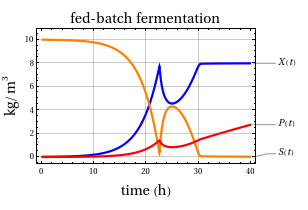
This Demonstration shows a model for fed-batch fermentation, allowing for continuous feeding of a sterile substrate. The absence of outflow from the fermenter leads to an increase in volume. We study the characteristics of a quasi-steady state, of linear growth and of alternative feed strategies.
Details
Details
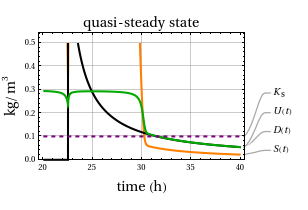
The operation begins with the selected initial batch conditions. Feeding of the substrate is started at 22.5 h. The break in the batch growth transient, as semi-batch feeding starts, is very apparent, with the transient continuing to an apparent quasi-steady-state operation condition. After 30 h, , where is the dilution rate and is the specific growth rate.
D=μ
D
μ
Under these conditions, the biomass concentration remains constant, while substrate concentration decreases below the saturation constant very slowly. The value of also decreases since the volume increases due to the incoming feed rate . Eventually, becomes equal to when falls below .
X(t)
S(t)
K
s
D=F/V
V
F
D
μ
S(t)
K
s
During the quasi-steady state, the total biomass will increase linearly with time if the feed flow rate is constant.
References
References
[1] I. J. Dunn, E. Heinzle, J. Ingham and J. E. Přenosil, Biological Reaction Engineering, Weinheim, Germany: VCH Verlagsgesellschaft mbH, 2003.
Permanent Citation
Permanent Citation
R. Ricardo Sánchez
"Fed-Batch Fermentation and Quasi-steady State"
http://demonstrations.wolfram.com/FedBatchFermentationAndQuasiSteadyState/
Wolfram Demonstrations Project
Published: January 29, 2021