Runge's Phenomenon
Runge's Phenomenon


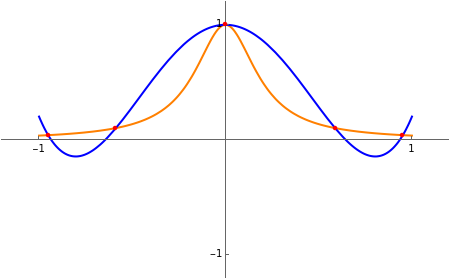

Runge's phenomenon illustrates the error that can occur when constructing a polynomial interpolant of high degree. The function to be interpolated, , is shown in orange, the interpolating polynomial in blue, and the data points in red. The difference between the interpolant and the function is shown below.
y=
1
1+25
2
x
Details
Details
Runge's function is given by . When this function is sampled at equally spaced points in the range , as the number of sample points increase the error difference theinterpolating polynomial and the function grow without bound. When Cheybshev points are used the error diminishes as the number of points increases.
f(x)=
1
1+25
2
x
x∈[-1,1]
External Links
External Links
Permanent Citation
Permanent Citation
Chris Maes
"Runge's Phenomenon"
http://demonstrations.wolfram.com/RungesPhenomenon/
Wolfram Demonstrations Project
Published: April 28, 2007