This is part of live presentation series called Mathematical Games in which we explore a variety of games and puzzles using Wolfram Language. In this episode, we explore the mathematical games and puzzles on a square grid.
demonstrations.wolfram.com
demonstrations.wolfram.com
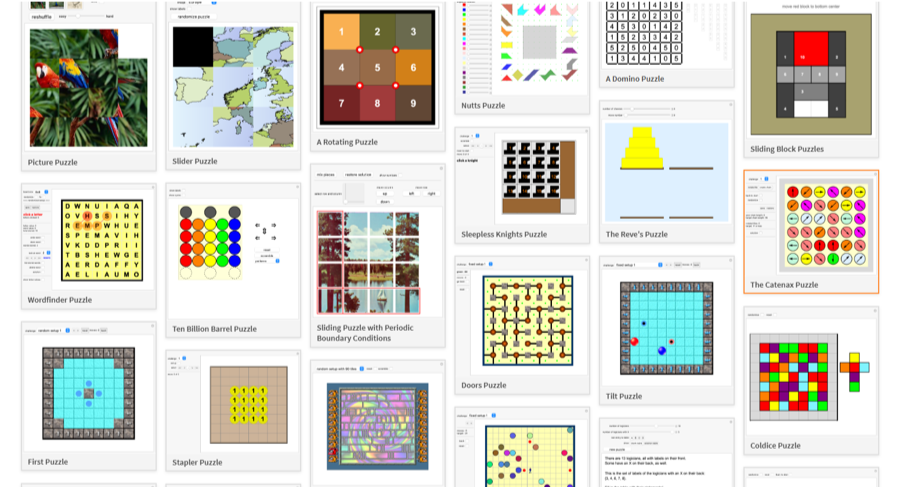
Many Demonstrations involve puzzles on square grids
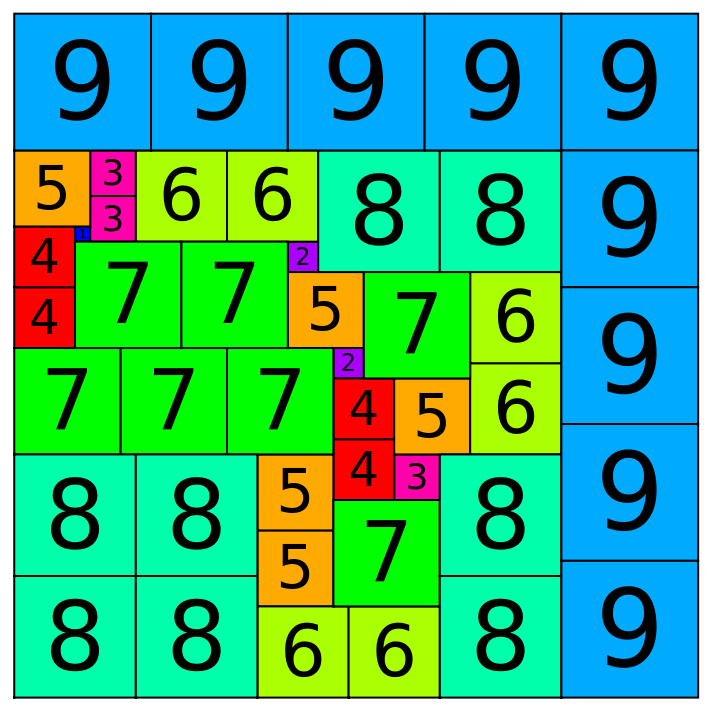
2025 is a Square Number -- Divide into squares
2025 is a Square Number -- Divide into squares
Out[]=
2025 =
| ||
Disney’s Pete turned 100 on 15 February 2025
Disney’s Pete turned 100 on 15 February 2025
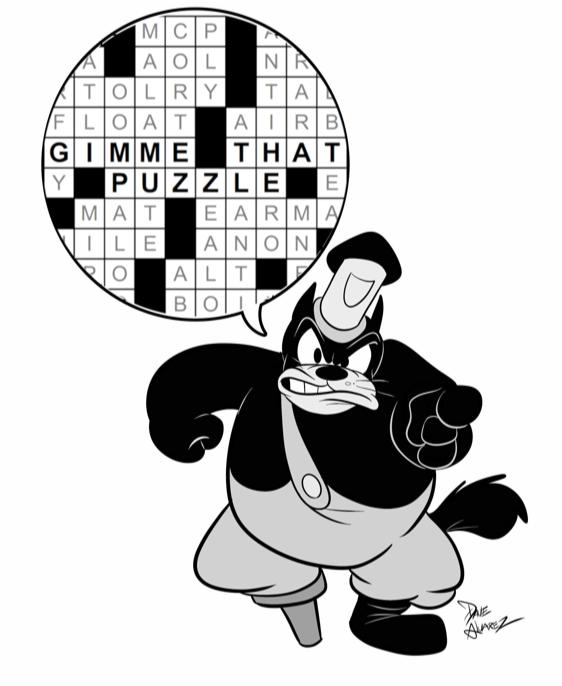
Disney’s Pete started as a collector of rare crossword puzzles.
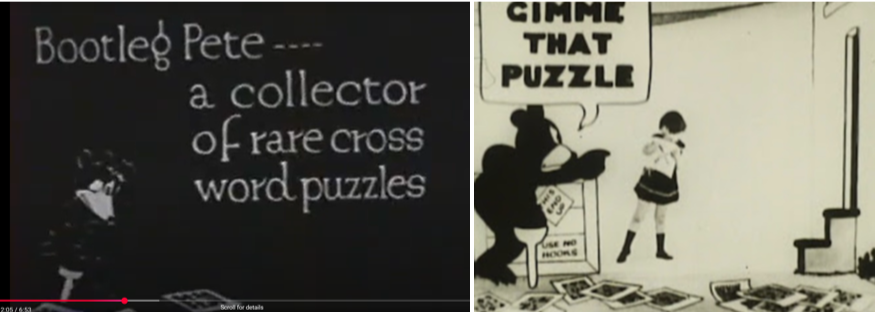
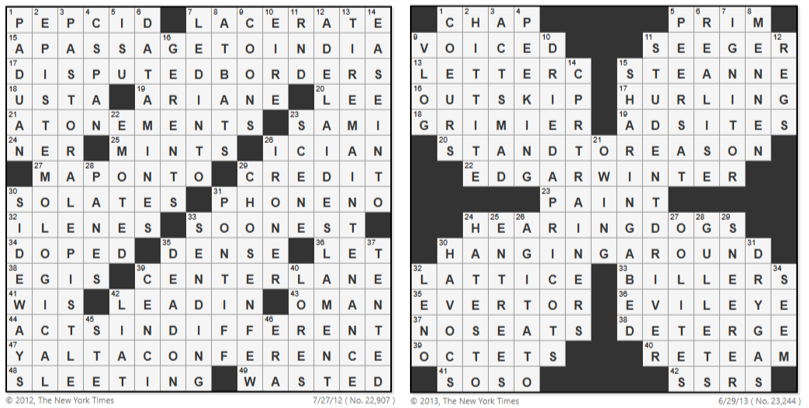
Record setting Crosswords
Record setting Crosswords
The first order-6 word square was published in Godey’s Lady’s Book and Magazine in 1862 (below).
C I R C L E
I C A R U S
R A R E S T
C R E A T E
L U S T R E
E S T E E M
I C A R U S
R A R E S T
C R E A T E
L U S T R E
E S T E E M
The rules for American crosswords are as follows:
1. The pattern of black-and-white squares must be symmetrical. Generally this rule means that if you turn the grid upside-down, the pattern will look the same as it does right-side-up.
2. Do not use too many black squares. In the old days of puzzles, black squares were not allowed to occupy more than 16% of a grid. Nowadays there is no strict limit, in order to allow maximum flexibility for the placement of theme entries. Still, “cheater” black squares (ones that do not affect the number of words in the puzzle, but are added to make constructing easier) should be kept to a minimum, and large clumps of black squares anywhere in a grid are strongly discouraged.
3. Do not use unkeyed letters (letters that appear in only one word across or down). In fairness to solvers, every letter has to be appear in both an Across and a Down word.
4. Do not use two-letter words. The minimum word length is three letters.
5. The grid must have all-over interlock. In other words, the black squares may not cut the grid up into separate pieces. A solver, theoretically, should be able to able to proceed from any section of the grid to any other without having to stop and start over.
6. Long theme entries must be symmetrically placed. If there is a major theme entry three rows down from the top of the grid, for instance, then there must be another theme entry in the same position three rows up from the bottom. Also, as a general rule, no nontheme entry should be longer than any theme entry.
7. Do not repeat words in the grid.
8. Do not make up words and phrases. Every answer must have a reference or else be in common use in everyday speech or writing.
9. (Modern rule) The vocabulary in a crossword must be lively and have very little obscurity.
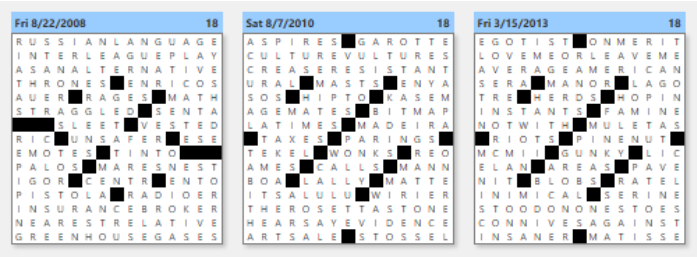
Three with 18 squares
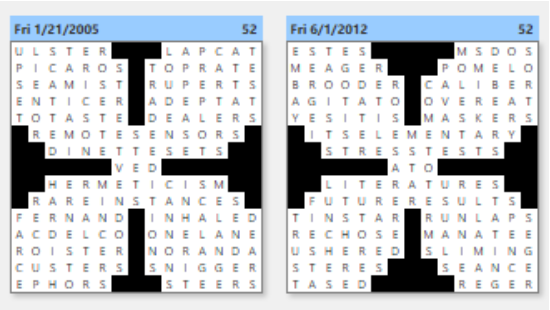
Two with 52 squares
Wide Open -- maximal squares not touching black.
Cryptic Crosswords
Cryptic Crosswords
“The grave robbing doctor whirled about a tanner’s knife.”
A cryptic crossword clue has three parts: a wordplay hint, words that are used in the wordplay, and a direct clue. Above, “the grave robbing doctor” is a direct clue for Frankenstein. An anagramming hint is given by “whirled about a”, and “tanner’s knife” is an anagram of Frankenstein.
Object: Solve the given 13 cryptic crossword puzzles.
You can also design your own with the “Freeplay” variant.
Cryptic Crosswords Demonstration
The First Number Place (Howard Garns)
The First Number Place (Howard Garns)
In the May 1979 issue of Dell Pencil Puzzles & Word Games (issue #16), page 6, something amazing appeared: Number Place. Here are the original instructions: “In this puzzle, your job is to place a number into every empty box so that each row across, each column down, and each small 9-box square within the large square (there are 9 of these) will contain each number from 1 through 9. Remember that no number may appear more than once in any row across, any column down, or within any small 9-box square; this will help you solve the puzzle. The numbers in circles below the diagram will give you a head start--each of these four numbers goes into one of the circle boxes in the diagram (not necessarily in the order given).”
Who made this puzzle? In addition to being the crossword editor of the New York Times, Will Shortz is a puzzle historian, so he did detective work to find the answer. He knew that “Number Place” puzzles had appeared in Dell Magazines, and went through his collection to find the first. Dell listed no author, but the name Howard Garns always appeared in the contributor’s list of any issue containing a “Number Place” puzzle. Also, Garns’ name did not appear in any issue lacking a Number Place, which clinched the identification. Further research revealed that Howard Garns to be a retired architect who created the puzzle at age 74. Howard Garns died in Indianapolis in 1989, and never got a chance to see his creation as a worldwide phenomenon. (Shortz, pers. comm. 2005)
Howard Garns made many Number Place puzzles for Dell, quickly simplifying the rules to those used today -- Fill in the grid so that every row, column, and 3x3 box contains the digits 1 through 9. In April 1984, Japan’s puzzle group Nikoli discovered Dell’s Number Place presented it for a Japanese audience in the pages of puzzle paper Monthly Nikolist. Originally named Suuji Wa Dokushin Ni Kagiru, (“the numbers must be single”) the puzzle became very popular. Kaji Maki, the president of Nikoli, abbreviated it to Sudoku - (Su = number, Doku = single), and trademarked the name. As the popular grew, competing companies stayed with the non-trademarked name Number Place, or “nanpure”. Even today, many Japanese puzzle magazines spell out “Number Place” in English.
Sudoku Logic (Jim Wiggins)
Sudoku Logic (Jim Wiggins)
This Demonstration lets you solve several given puzzles or create a new puzzle. The Demonstration does not make any deductions on its own; it is designed to assist in the reasoning process by illustrating various logical steps and solution techniques.
To solve a puzzle, you first analyze the clues (shown in blue) to determine the possibles (shown as small green numbers or squares), which are the potential candidates for a given cell (snapshot 5).
You then apply various techniques to make a choice (shown in red), which may be tentative. You can change a choice if it turns out to be wrong.
You can use various controls to create links (colored arcs) that connect possibles to indicate alternative choices and their logical consequences. See[1, Section 12] for details.
To make a reasoned choice, you must use various techniques (described in the References) to determine which possibles should become choices.
For instance, in snapshot 1, column three has the seven clues 2, 4, 5, 6, 7, 8, and 9 leaving 1 and 3 as possibles in i3 and b3. If the choice for i3 is 3, then h2 must be 9.
Sudoku X
Sudoku X
Diagonal Number Place. Ranking Puzzler #2 2002-08-20, Nanpure Fan #52 2004-10.
One Away (Now usually Kropki Dots)
One Away (Now usually Kropki Dots)
1-away Disallowed Number Place (Hitotsu Chigai Nanpure). Nanpure Fan #52 2004-10.
Greater Than Sudoku and Sums Sudoku
Greater Than Sudoku and Sums Sudoku
Greater Than Sudoku (Puzzler 1999-11) and Sums Sudoku by Ed Pegg Jr.
Jigsaw and Toroidal Sudoku
Jigsaw and Toroidal Sudoku
Geometry Number Place (kikagaku nanpure). WPC 9 (Stamford) and 2005 USPC, both by Michael Rios.
0 to 9 Number Place
0 to 9 Number Place
0 to 9 Number Place (Zero Tuu Nain Nanpure). Nanpure Fan #52 2004-10.
Killer Sudoku
Killer Sudoku
Sums Number Place (samu nanpure) (Puzzler 2002-02), Killer Sudoku by Tetsuya Nishio (London Times 2005-08).
Meta Sudoku
Meta Sudoku
Meta Sudoku by Wei-Hwa Huang. Cubic Sudoku (Puzzler 1999-04)
Cracking the Cryptic (YouTube)
Cracking the Cryptic (YouTube)
Cracking the Cryptic is now the leader for Sudoku variants. Along with Nikoli and the World Puzzle Federation.
Duplicate Bridge
Duplicate Bridge
Magic Sudoku and Domino Sudoku
Magic Sudoku and Domino Sudoku
A Domino Puzzle
A Domino Puzzle
A classic logic puzzle involves delineating a set of dominoes that has been arranged within a grid. Here, a grid is given on the left, and the full set of double-5 dominoes is given in a triangular array on the right. As lines between squares are clicked, dominoes in the triangular array will turn black when they are represented once, and red when they are represented more than once. Goal: turn all the dominoes in the triangular array black.
Mazes
Mazes
The ninth talk of mine was about Multistate Mazes.
Farmer Goes to Market (October 1962, Robert Abbott)
Farmer Goes to Market (October 1962, Robert Abbott)
Farmer Goes to Market (October 1962, Robert Abbott)
Farmer Goes to Market (October 1962, Robert Abbott)
October 1962, Robert Abbott
Start with a grid graph
Start with a grid graph
The arrows go from one edge to another joined edge.
Here’s a way to pick arrows by hand
Here’s the maze again:
What does the graph look like?
Interactive Maze
Interactive Maze
Create a customized maze. Click to create a locator and either drag it or keep clicking to draw a path through the maze.
Tilt Maze (Andrea Gilbert)
Tilt Maze (Andrea Gilbert)
You can tilt only to the north, south, east, or west.
Tilt Puzzle (Karl Scherer)
Tilt Puzzle (Karl Scherer)
Object: Move the marbles to their targets. There are many fixed and randomized setups to choose from.
Click an arrow at the border to make all marbles simultaneously move one step away from the arrow (if the target position is unoccupied).
Click a double arrow at the border to make all marbles simultaneously slide over empty positions away from the arrow as far as possible. All the single arrows on a border have the same function, the same is true for the double arrows.
All positions a marble has visited or moves over are marked as such and cannot be visited by any marble again.
Good luck!
Sliding Block Puzzles
Sliding Block Puzzles
Junk Kato has succinctly described a record setting series for the most moves required with n pieces. The basic underlying principle is Edouard Lucas’ Tower of Hanoi puzzle. Move the red piece to the bottom slot.
In Winning Ways, John Conway published the Century puzzle, which has long been the “hardest” old-style puzzle. Here’s the solution:
The Loculus of Archimedes
The Loculus of Archimedes
2200 years ago, Archimedes invented a puzzle variously called the Loculus, the Stomachion, the Ostomachion, the Syntemachion, or Archimedes’ Box. In November of 2003, Bill Cutler used a computer program to enumerate all solutions. Barring rotations and reflections, there are 536 distinct solutions.
Mrs. Perkins’s Quilt
Mrs. Perkins’s Quilt
Minimally Squared Rectangles
Minimally Squared Rectangles
Possible Counterexamples to the Minimal Squaring Conjecture
Possible Counterexamples to the Minimal Squaring Conjecture
Mondrian Art Problem
Mondrian Art Problem
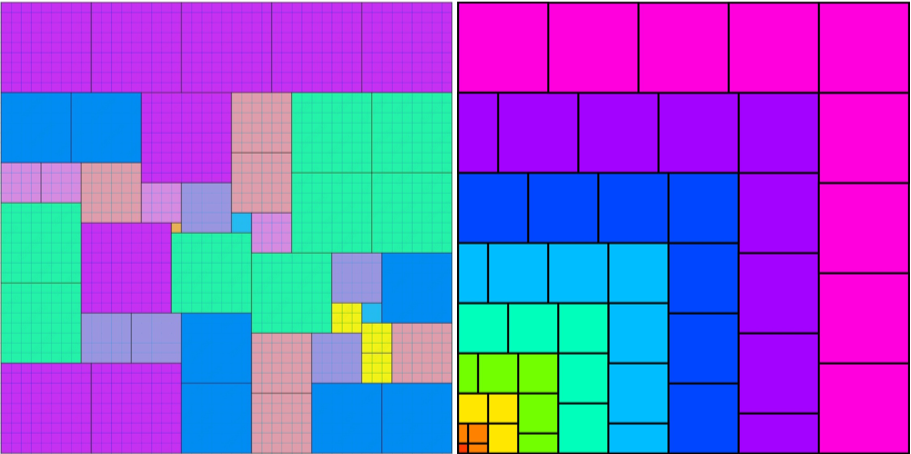
Divide a square into non-congruent rectangles. If all the sides are integers, what is the smallest possible difference in area between the largest and smallest rectangles? This is known as the Mondrian art problem. This Demonstration shows optimal solutions up to size 65 and best known solutions up to 900.
Up to the square of side 100, check the "analysis" box to see the possible improvements. If all of those possibilities can be checked in a packing program without a new solution turning up, the given solution is optimal.
Curry Triangle Paradox
Curry Triangle Paradox
When reassembling the four pieces in the figure to another triangle, one square is left empty. How is this possible? This problem was invented by Paul Curry in 1953.
The 49 8-dot patterns -- a Grid of Grids
The 49 8-dot patterns -- a Grid of Grids
A complete set of 8-dot patterns. Rotations and Reflections are excluded. Proper subsets only, so All and Nothing are excluded.
This is an easy set to make and I know many that have done so. I made my set with index cards and a hole punch.
Polyominoes
Polyominoes
The 108 heptominoes would be a nice 12-color set:
Knight’s Tour
Knight’s Tour
A classic chess problem is to find a sequence of moves for a knight to land on every square exactly once. With a knight initially positioned at the center of an infinite chess board, drag the slider to see a portion of an infinite knight’s tour, either as a broken line path or by numbering the squares in order. You can change the size of the displayed portion of the board.
Max length of uncrossing knight path https://oeis.org/A003192
The 12x12 Queens Problem
The 12x12 Queens Problem
2*floor(2n/3) queens on a nxn board each attacking 1 other.
The solution for the 9x9 board is unique.
CITE THIS NOTEBOOK
CITE THIS NOTEBOOK
Mathematical Games: puzzles on a square grid
by Ed Pegg
Wolfram Community, STAFF PICKS, February 21, 2025
https://community.wolfram.com/groups/-/m/t/3398855
by Ed Pegg
Wolfram Community, STAFF PICKS, February 21, 2025
https://community.wolfram.com/groups/-/m/t/3398855