This is part of live presentation series called Mathematical Games in which we explore a variety of games and puzzles using Wolfram Language. In this episode, we explore the game of life circuitry.
demonstrations.wolfram.com
demonstrations.wolfram.com
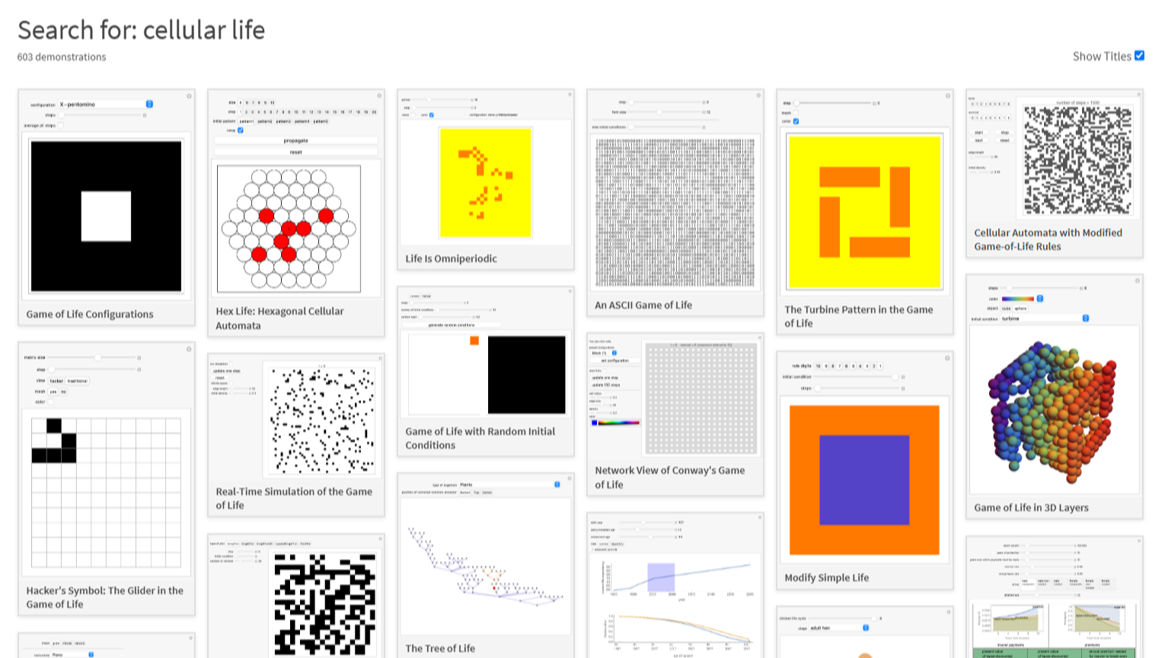
Many Demonstrations feature the Game of Life.
What is the Game of Life?
What is the Game of Life?
1. Living cells survive if they touch 2 or 3 other living cells. Otherwise they die.
2. Empty spaces have a birth if they touch exactly 3 other cells.
2. Empty spaces have a birth if they touch exactly 3 other cells.
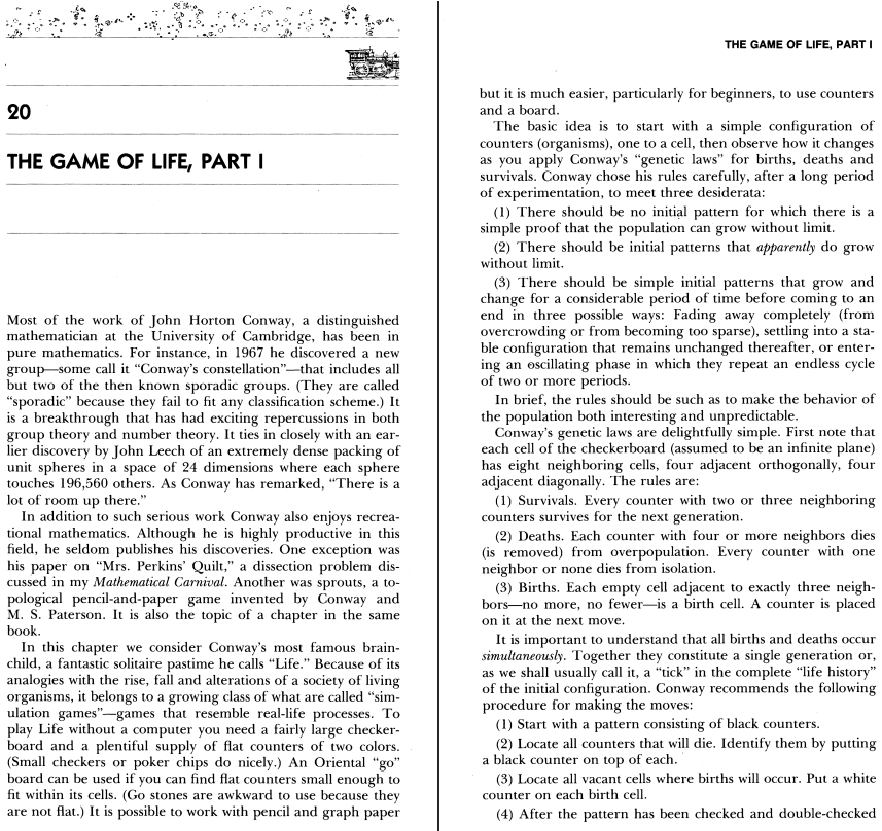
Gardner
Gardner
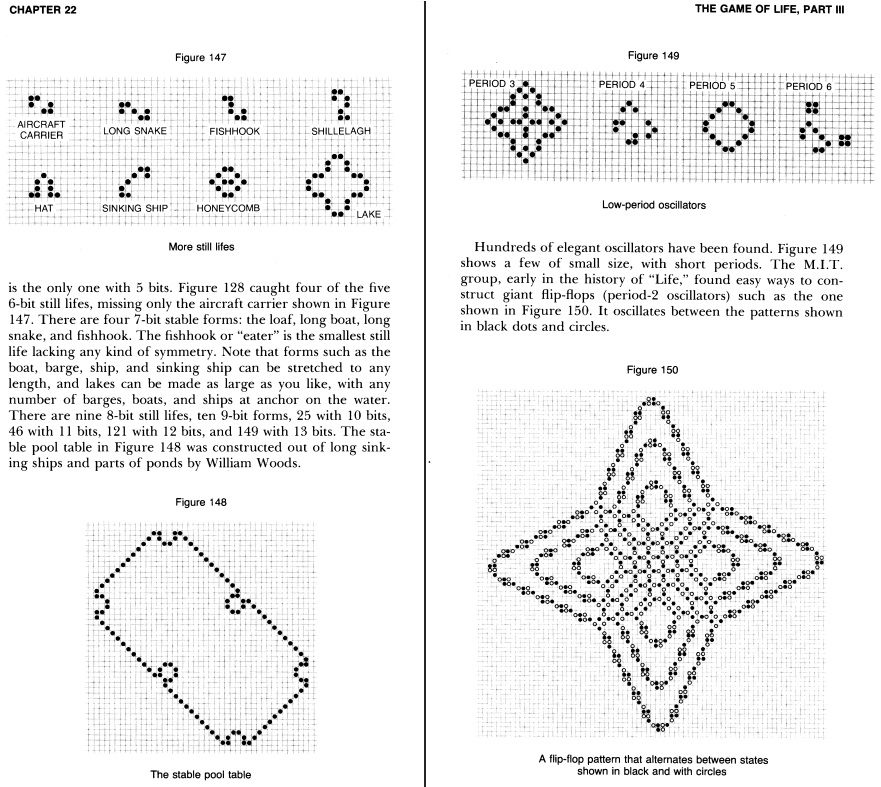
Still lifes and Oscillators
Still lifes and Oscillators
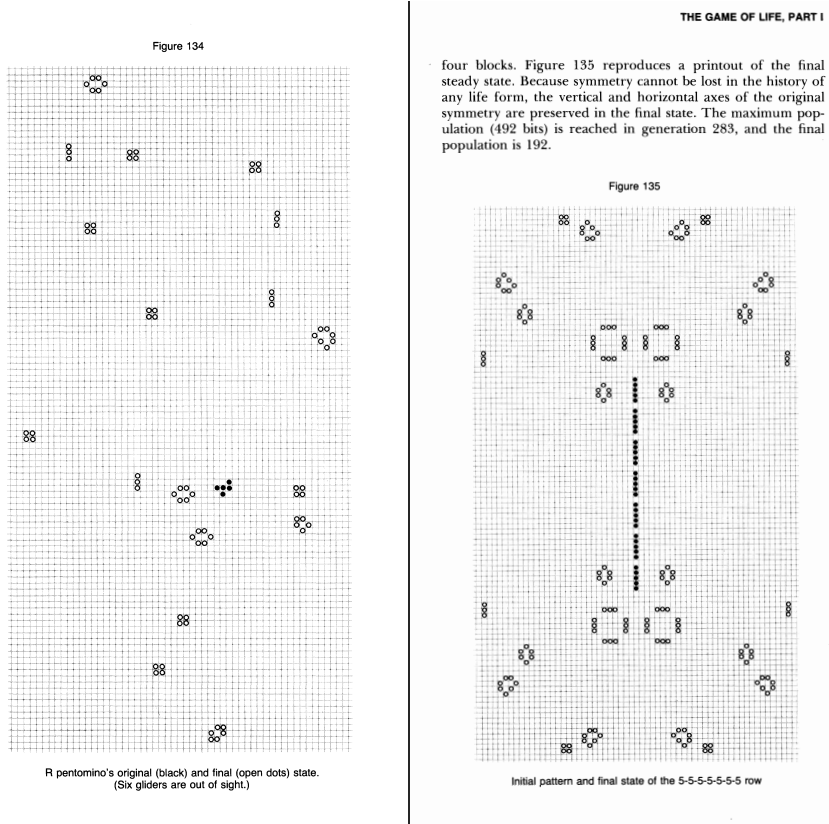
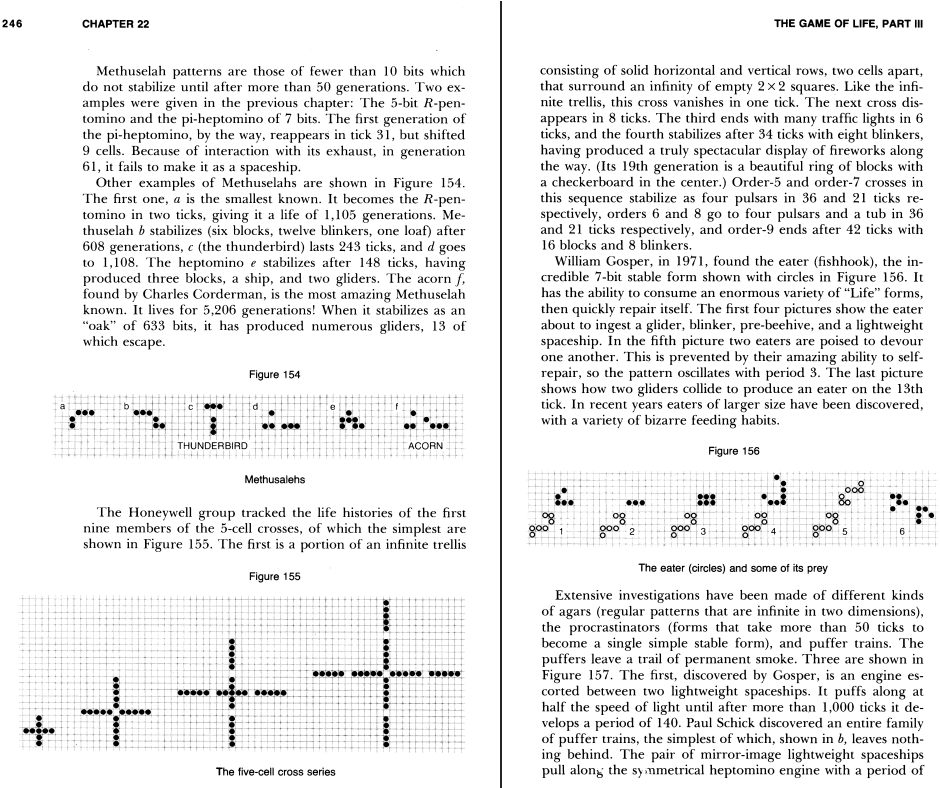
Methuselehs and Eaters
Methuselehs and Eaters
Game of Life Configurations
Game of Life Configurations
The well known shapes from Game of Life are still lifes, oscillators, spaceships, methuselahs and and guns. But there is another class of objects that has become important.
Explore named objects in the Game of Life cellular automaton.
Walking Away From the Explosion
Walking Away From the Explosion
What is a signal?
A signal is a shape that can replicate itself elsewhere after some number of steps.
With help from Blinkers, the R-pentomino can do that 5 times. But not 6.
A signal is a shape that can replicate itself elsewhere after some number of steps.
With help from Blinkers, the R-pentomino can do that 5 times. But not 6.
The Lucky Experiment: R-pentomino
The Lucky Experiment: R-pentomino
A first experiment in the Game of Life was to try pentominos. Here’s the R:
Here’s the first 80 steps.
In the first experiment, in the first 80 steps, four important signals for the Game of Life were found:
1. The R-pentomino.
2. The B-heptomino.
3. The Herschel.
4. The Glider.
1. The R-pentomino.
2. The B-heptomino.
3. The Herschel.
4. The Glider.
At step 785, the Queen Bee shows up.
Switch Engine
Switch Engine
Another early self-replicating shape was the switch engine:
Game of Life Signal Alphabet
Game of Life Signal Alphabet
There are currently 16 recognized signals in the Game of Life.
Another necessary item for constructions is still life objects, which stay the same after a step in GoL.
An early (1970) “that’s interesting” evolution was the 20 step conversion of B into H + block:
Another evolution turns H + beehive into G + beehive in 75 steps:
Conduit 1 (David Buckingham, 1996)
Conduit 1 (David Buckingham, 1996)
B converted to H. In the initial screen, a Ghost Herschel is shown.
This discovery led to many new discoveries in Game of Life.
This discovery led to many new discoveries in Game of Life.
G is for Glider
L is for Lightweight Spaceship
G is for Glider
L is for Lightweight Spaceship
L is for Lightweight Spaceship
2G’s are converted to 2L’s. 2 L’s are converted to 2G’s.
Herschel Circuit Oscillator
Herschel Circuit Oscillator
Adjustable Oscillators and Guns
Adjustable Oscillators and Guns
Removing one of the eaters on the outside lets the oscillator turn into a gun.
This gun / oscillator can be adjusted to any period 78 or over.
Life is Omniperiodic
Life is Omniperiodic
Conduit Collection
Conduit Collection
Or if you prefer a grid.
A close-up on H to H circuits.
Sparkers
Sparkers
There are a variety of objects that make sparks. Most constructions use a mix of signals, conduits, still lifes and sparkers.
Stephen Wolfram wrote about Game of Life
Stephen Wolfram wrote about Game of Life
A few hours after he finalized content, the true period-14 glider gun was found.
2-engine Cordership
2-engine Cordership
Two switch engines can make a spaceship.
A glider to the above
Diehard
Diehard
Here’s a configuration that vanishes to nothing.
Here’s a diehard that vanishes in 30,274 steps.
The 17↑↑↑3 Diehard
The 17↑↑↑3 Diehard
Here’s a diehard that lasts for a ridiculously large number of steps. That number of steps is:
Golly
Golly
Here are samples of some conduits:
FREE BOOK Conway’s Game of Life, Mathematics and Construction
FREE BOOK Conway’s Game of Life, Mathematics and Construction
2D Cellular Automaton Animations
2D Cellular Automaton Animations
This Demonstration explores patterns generated by 2D cellular automaton rules depending only on the number of black cells surrounding a given cell. Each rule exhibits a distinctive behavior when run for a large number of steps.
Generations Cellular Automata
Generations Cellular Automata
In the “Generations” cellular automata, a cell can have these values: off (0), on (1), or dying (2 or more). The number of generations is the total number of cell states. For example, “Meteor Guns” has eight possible colors or generational states. At each step, the eight cells neighboring each cell are evaluated for the total number of cells that are on, giving some value 0 to 8.
1. Any off cell that touches a “birth” value of on cells will become an on cell.
2. Any on cell that touches a “survival” value of on cells will continue to stay on, otherwise it becomes a dying cell.
3. Any dying cell increments to the next value. Cells matching the generation count turn into off cells.
Some rules, such as Brian’s Brain, are well studied.
Unsolved
Unsolved
1. Can fuses be bent?
2. What other conduits can be found?
2. What other conduits can be found?
CITE THIS NOTEBOOK
CITE THIS NOTEBOOK
Mathematical Games: game of life circuitry
by Ed Pegg
Wolfram Community, STAFF PICKS, March 20, 2025
https://community.wolfram.com/groups/-/m/t/3420832
by Ed Pegg
Wolfram Community, STAFF PICKS, March 20, 2025
https://community.wolfram.com/groups/-/m/t/3420832