Generate a random Wolfram Model
Generate a random Wolfram Model
In[]:=
Out[]=
{{1,2},{2,1}}{{3,1},{1,3},{2,3}}
Plot the resulting multiway system for this random model. Found a model with a branch pair in the 2nd step. Postulate that this branch pair is like a spin 1/2 particle. The only difference between the branches is the direction a single edge. Might this be the direction of spin? The ancestor state is also a pair of vertices with a looping structure.
In[]:=
LayeredGraphPlot[{{1,2},{2,1}}{{3,1},{1,3},{2,3}}],{{0,0},{0,0}},4,"EvolutionEventsGraph",VertexSize1
Out[]=
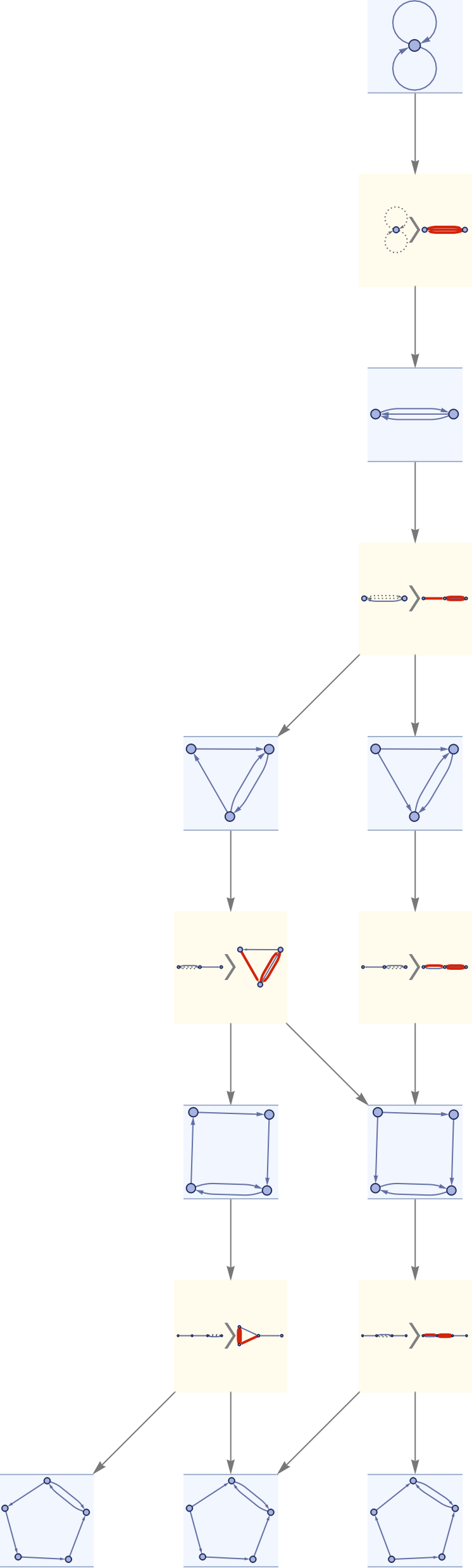
Lets investigate this model further in the evolution process:
In[]:=
WolframModelPlot[{{1,2},{2,1}}{{3,1},{1,3},{2,3}},{{0,0},{0,0}},10,"FinalState"]
Out[]=
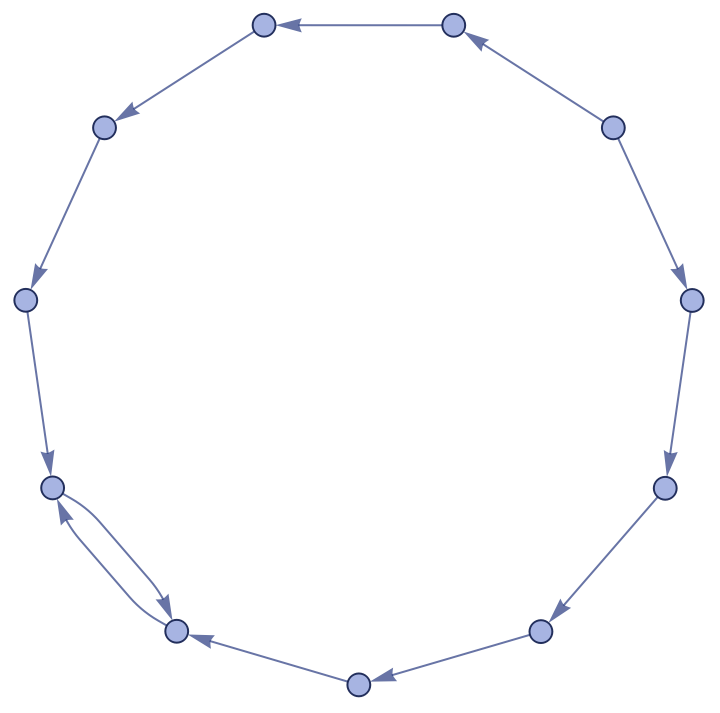
It looks like it converges to a circular structure with a loop. Presumably this loop is a spin 1/2 particle?
Lets try another model
Lets try another model
Split up the computation because of cloud limitations
In[]:=
Out[]=
In[]:=
Out[]=
In[]:=
LayeredGraphPlot[%,VertexSize1]
Out[]=
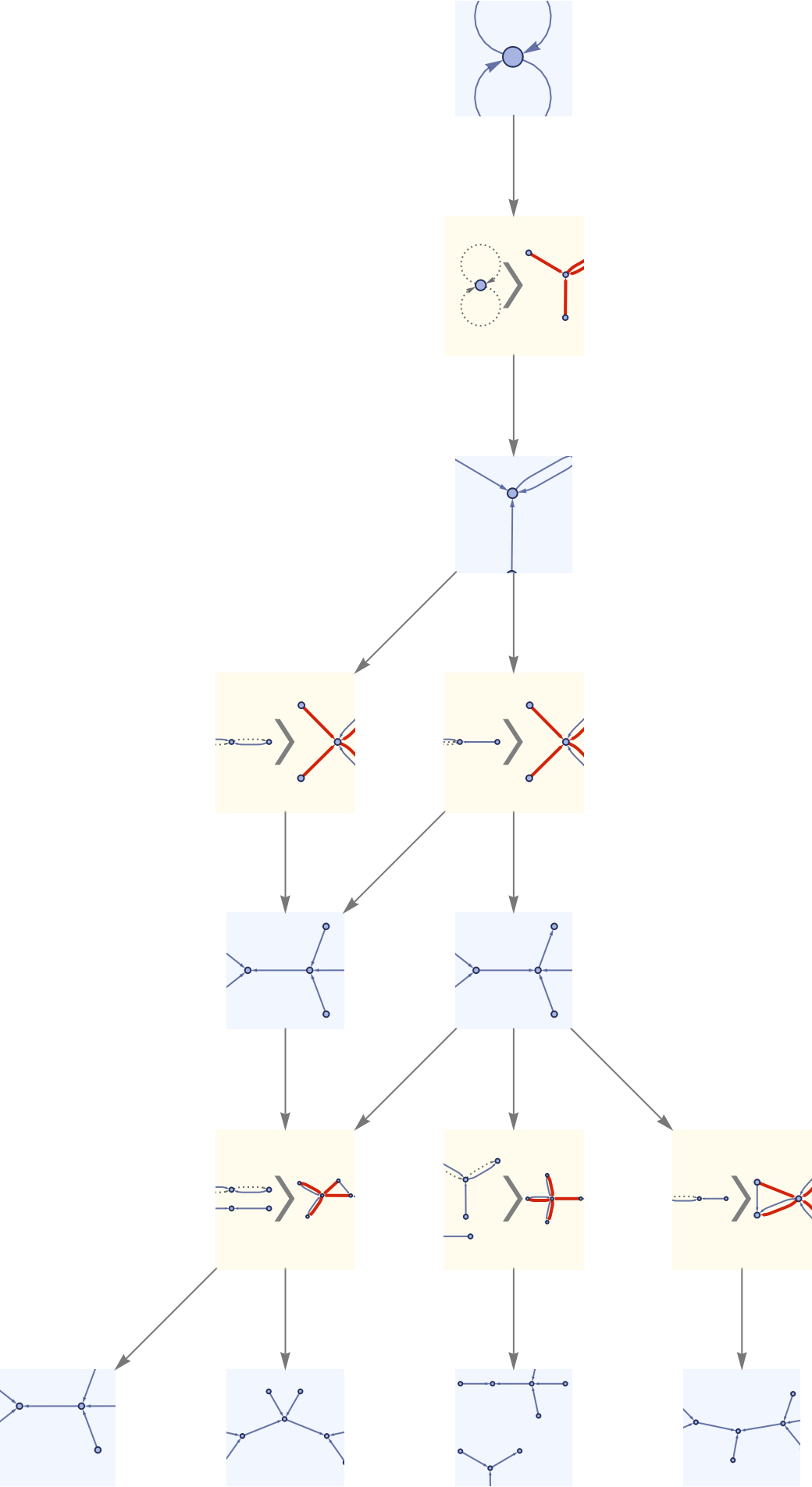
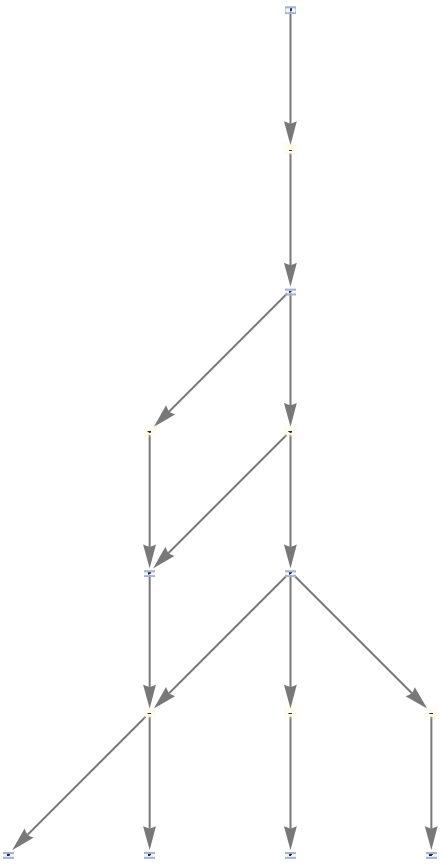
Not as clear as the previous case, but it seems like the first branch pair also involves reversal of edges, this time there are two reversed edges. However the 2nd branch pair involves a splitting of the graph completely.
Lets try one more system
Lets try one more system
Again, each branch pair is associated with a reversal of an edge.
Lets go back to the original model and try a different initial condition
Lets go back to the original model and try a different initial condition
This model seems like the bare minimum for a meaningful identification of particles. What if we introduce two looping structures?
Lets try to track the changes starting from top to bottom, left to right as (x,y).
The (1,1) state leads to a single branch pair.
The (2,1) state leads to one branch pair, and one branch triplet, for a total of 5 states.
The (2,2) state leads to the same configuration as the (2,1) state.
The (3,1) state leads to a similar branching as the level 2 states, for a total of 5 states.
The (3,2) state generates only a single branch pair.
The (3,3) state generates a branch triplet.
The (3,4) state generates a branch triplet and branch pair, one state which is degenerate, for a total of 4 states.
The (3,5) state generates 2 branch pairs for a total of 4 states.
The (3,6) state generates a branch triplet and branch pair, for a total of 5 states.
It is unclear if a pattern is emerging, however the number of "particles" is conserved.
Lets try another 2 loop initial condition to try to sort this out:
Unclear of understanding of multiway evolution. It seems like the initial condition is just the (2,1) state of the previous graph, yet there are only 4 states emerging. The state with the two loops in the middle is missing?