Quotients and Remainders Wheel
Quotients and Remainders Wheel


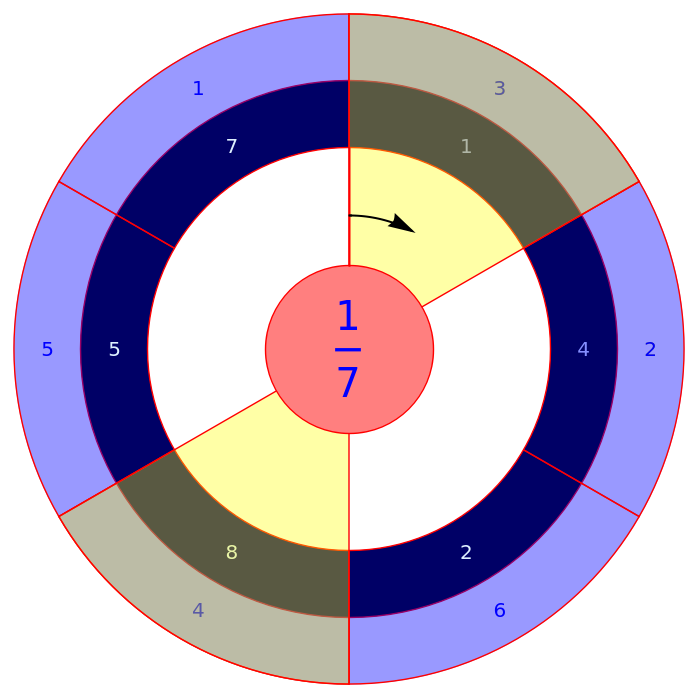
Take the fraction 1/7 as an example. Do long division:
. | 1 | 4 | 2 | 8 | 5 | 7 | |
7 | 1. | 0 | 0 | 0 | 0 | 0 | 0 |
3 | 0 | ||||||
2 | 0 | ||||||
6 | 0 | ||||||
4 | 0 | ||||||
5 | 0 | ||||||
1 |
The digits 1, 4, 2, 8, 5, 7 are the quotients (inner ring) and 3, 2, 6, 4, 5, 1 are the remainders (outer ring). Notice that and .
1+8=4+5=2+7=9
3+4=2+5=6+1=7
In general, let be the denominator of a fraction. If is prime and the multiplicative order of is even, then this fraction has the property that the digits of its decimal expansion repeat in cycles. The length of the period is equal to the smallest integer such that ≡1(modq). In the particular case that 10 is a primitive root of this prime, the length of the cycle is .
q
q
q(mod10)
e
e
10
q-1
Also, because there are an even number of them, the digits can be divided into two halves. The digits of the decimal expansion can be regarded as quotients arising from the long division algorithm. The remainders in the long division appear in cycles too, then. Arranging the digits of the fraction with the remainders in two circles, diametrically opposite directions sum to 9 in the inner ring and to the denominator in the outer ring. The first digit is at the top and the digits are arranged clockwise, as indicated by the black arrow.
Details
Details
Snapshot 1: in the case of fractions of the form , the decimal digits of 1/7 appear cyclically
k/7
Snapshot 2: with the denominator 49, if is prime to 49, all fractions have the same cyclic arrangement of their digits; there are 42 such fractions and each has 42 digits in its period
k
k/49
Snapshot 3 and 4: other examples with long period and different selected digits
Snapshot 5: the longest period for a denominator less than 100
External Links
External Links
Permanent Citation
Permanent Citation
Enrique Zeleny
"Quotients and Remainders Wheel"
http://demonstrations.wolfram.com/QuotientsAndRemaindersWheel/
Wolfram Demonstrations Project
Published: November 27, 2007