Complementary interactions reward participants for adopting different roles. In a symmetric population, this creates a problem of role assignment: independently chosen actions can coincide even when both participants would benefit from differentiation. We study a finite game in which individuals exchange observable tokens before choosing between two complementary actions. For equal rewards to the two roles, a convention that uses every token uniformly, assigns complementary actions after unequal tokens, and randomises after equal tokens is an evolutionarily stable strategy in the reduced normal form. Its payoff falls short of the efficient outcome by a collision term that decreases with the number of tokens. An explicit decomposition identifies the two sources of resistance to invasion: concentration of token use and departures from the equilibrium response to token collisions. This supplies a transparent special case of established work on communication and role conventions. We then examine how the assignment problem changes when signals are costly, labels persist, roles repeat, or ecological traits are inherited. These comparisons suggest a framework for studying behavioural and biological devices of differentiation, while leaving their evolutionary transitions to models that include development, matching and reproduction.
Introduction
Introduction
Suppose you and I win money by choosing different numbers. We would simply agree who chooses what - but what if we cannot communicate? This small problem motivates the paper and computational notebook attached here.
The starting point is a symmetric 2×2 game in which both participants benefit from taking different roles. A preliminary exchange of tokens can help assign those roles. I give an explicit evolutionary-stability proof for an equal-role-payoff convention and show how its efficiency depends on token collisions. The notebook adds experiments exploring collision rates, simple response programs, population dynamics and the cost of listening.
The broader question is whether communication, persistent specialisation and inherited differences can be investigated as alternative devices for generating and maintaining useful differentiation. Connections to biological dimorphism and speciation motivate further models incorporating inheritance, ecology and partner choice.
This is a working paper and computational exploration. I would welcome scrutiny of the mathematics, the biological interpretation, and especially the choice of simple computational rules for investigating how such conventions become established.
Reading the notebook
The paper is reproduced in full. Teal experiment groups sit beside the relevant arguments; they can be collapsed while reading. Evaluate the initialization cells once, then use Shift+Enter on an experiment input to open its controls. The notebook is self-contained and requires a Wolfram kernel for evaluation.
Preparation status: manuscript conversion and numerical benchmarks checked independently. Interactive Wolfram cells and front-end appearance await execution in Mathematica. Preview graphics are labelled reference calculations. Figure/result slots contain no unrun findings.
Simulation definitions
Simulation definitions
1 The problem of choosing differently
1 The problem of choosing differently
Suppose you and I can each win a sum of money by choosing different integers between one and ten. We would simply talk about it. I could choose three, you could choose seven, and we would collect our money. But what if we cannot talk?
The answer depends on what else we share. A prior agreement would still settle the matter. So might an observable distinction: the older person chooses three, the younger seven. Even the opportunity for one person to move first can establish who should do what. Prohibiting conversation leaves each of these devices available unless the rules exclude it too.
Consider the harder version. We choose simultaneously, cannot observe each other’s choice, have no prior assignment of roles, and have no usable distinction between us. If we both follow the same deterministic rule, we choose the same number and lose. Independent randomisation improves matters. If we use the same distribution , our probability of winning is
p=(,…,)
p
1
p
10
1−≤.
10
∑
i=1
2
p
i
9
10
(1)
Equality holds when both distributions are uniform. We can achieve certainty if we have an agreed asymmetry, such as distributions with disjoint supports. The restriction in (1) is therefore substantive: the participants use the same rule and their random choices are independent. An exchange of signals, or another commonly understood way of assigning roles, can relax that restriction.
This small game illustrates a recurrent biological problem. Two participants may benefit from performing different tasks, taking different positions, or contributing different resources. Knowing which actions are useful does not settle who should take each action. A behavioural convention can assign the roles anew at every encounter. Persistent differences can assign them across many encounters. Ecological diversification raises a related question about how differences are maintained within a population or across lineages.
The paper develops the behavioural case precisely and uses it to organise the wider comparison. Its formal model has two functional roles; the ten possible choices in the opening example are only an illustration of the assignment problem. In particular, an alphabet of ten signals in the model is distinct from a game with ten payoff-relevant actions. Keeping signals separate from roles allows us to ask what a larger signalling repertoire contributes when the underlying task remains unchanged.
The approach takes up the programme of modelling language acquisition through discoordination in Harrald (1994). It also belongs to an established literature on communication and evolutionary role assignment. Hurkens and Schlag (2003) analyse communication before task allocation. Herold and Kuzmics (2020) study observable labels, conditional action choices and stable social structures in a closely related class of games. Their results already establish that cheap talk can support evolutionarily stable role conventions. The formal contribution here is an explicit proof for equal role payoffs, including a decomposition of the stability margin. The broader contribution is a comparison of devices that generate or preserve differentiation.
2 Complementarity and incentive compatibility
2 Complementarity and incentive compatibility
Let be a finite symmetric two-player game. A player choosing against receives ; the other player receives . Symmetry of the game means that the players have the same action set and payoff rule. It does not, in general, imply .
G=(A,u)
a
b
u(a,b)
u(b,a)
u(a,b)=u(b,a)
Define
D=u(a,a),=.
max
a∈A
W
off
max
a≠b
u(a,b)+u(b,a)
2
(2)
We call the game welfare complementary when >D. Some asymmetric pure outcome then has higher mean payoff than every symmetric pure outcome. The same comparison extends to identical independent mixtures: their mean payoff is at most . A symmetric distribution that correlates the players’ actions can attain the off-diagonal maximum. Welfare superiority alone does not establish that either player will comply with an assignment.
W
off
D+1−<
∑
a
2
p
a
W
off
∑
a
2
p
a
W
off
An efficient role assignment also needs incentive compatibility. Suppose a pair maximises off-diagonal welfare and is a strict Nash equilibrium, and suppose the two roles give equal payoffs:
(,)
*
a
*
b
u(,)=u(,)=.
*
a
*
b
*
b
*
a
W
off
A lottery assigning probability one half to each orientation of this pair is a correlated equilibrium. Conditional on a recommendation, each player has a strict incentive to take the recommended action when the other complies. The lottery gives both players the payoff . This is an immediate application of the obedience conditions for correlated equilibrium (Aumann 1974, 1987).
W
off
Existence of this distribution and implementation of it are separate questions. A mediator could assign the roles. Observable identities could do so. The finite, simultaneous signalling protocol studied below generates the assignment within the encounter, but it also produces collisions. It therefore does not attain the efficient payoff exactly in one round.
2.1 The binary model
2.1 The binary model
The stability result concerns the two-action payoff matrix
W>max{a,b}.
a | W |
W | b |
(3)
Rows and columns are ordered . The two asymmetric action pairs are strict Nash equilibria, and each gives both players . The unique symmetric Nash equilibrium assigns probability to , where
X,Y
W
*
p
X
L=2W−a−b>0,=,V=−ab.
*
p
W−b
L
2
W
L
(4)
Write =(,1−). Since , we have . Each pure action earns against , so every mixture does too. The numerical payoff matrix in (3) is also symmetric under transposition. Consequently, for every action mixture ,
*
σ
*
p
*
p
W>a,b
0<<1
*
p
V
*
σ
τ
u(τ,)=u(,τ)=V.
*
σ
*
σ
(5)
For a mixture choosing with probability , a direct calculation gives
X
t
u(τ,τ)=V−L.
2
(t−)
*
p
(6)
Thus is an ESS of the base game. Also,
*
σ
W−V=>0.
(W−a)(W−b)
L
(7)
The mixed-equilibrium payoff also exceeds both diagonal payoffs, since and . Equation (6) gives the exact self-play loss from any departure from and will be used in the stability proof.
V−a=L>0
2
(W−a)
V−b=L>0
2
(W−b)
*
p
The simplest benchmark is and . Then =1/2 and . This is a game of task differentiation with equal role rewards. Ordinary Hawk-Dove games often give unequal rewards to the two roles; the equal-payoff restriction in (3) is stronger than their usual best-response structure.
a=b=0
W=1
*
p
V=1/2
3 A finite signalling convention
3 A finite signalling convention
Extend the base game by one round of simultaneous token exchange. Each player emits a token from , with . Both observe the emitted pair before choosing a base-game action. Tokens are perfectly discriminable and directly costless. The players remember their own token, and their private random choices are independent.
M={1,…,k}
k≥2
A behaviour strategy is , where is a distribution over tokens and is the action mixture used by a player who emitted and observed . Responses following a token emitted with zero probability do not affect that strategy’s realised behaviour. Two strategies are realisation equivalent if their token probabilities and their response probabilities at all reachable histories agree.
(π,ρ)
π
ρ(m,n)
m
n
Choose a role-assignment rule for unequal tokens. If the holder of plays against , the holder of plays against . The rule may use token order, with the larger token assigning , or any other orientation of the unequal pairs. Nothing in the equal-payoff theorem requires a linear ordering.
χ
m
X
n
n
Y
m
X
Let denote the following convention. Emit each token with probability . At unequal tokens, take the role assigned by . At equal tokens, play . The convention combines independent randomisation with complementary responses to the resulting distinction. A token has an effect through its relation to the other token. It need not report a private fact about the sender.
x=
χ
s
k
1/k
χ
*
σ
3.1 Payoff and the distribution of actions
3.1 Payoff and the distribution of actions
For two users of the same convention with common emission distribution , define the collision probability
π
c(π)=.
k
∑
m=1
2
π
m
Unequal tokens give to each player. Equal tokens give the mixed-equilibrium payoff . Hence
W
V
U(π)=W−(W−V)c(π),=W−.
U
k
W−V
k
(8)
The uniform distribution minimises collisions, since . In the benchmark, =1−1/(2k). Two tokens give , and ten give . The latter calculation concerns two actions preceded by ten signals, whereas (1) concerns ten actions with no signalling phase.
c(π)≥1/k
U
k
3/4
19/20
At uniform emission, the induced action distribution is
q
k
1
k
1
2
δ
(X,Y)
1
2
δ
(Y,X)
1
k
*
σ
*
σ
(9)
Here denotes a point mass and an independent product. Each component is a Nash-equilibrium distribution of the base game. Their mixture is therefore a correlated equilibrium. The finite protocol yields <W; it approaches the efficient correlated equilibrium as increases.
δ
⊗
U
k
k
EXPERIMENT 01 / Token collisions
Change the alphabet, skew token frequencies, and replay a seeded encounter sample. The static curve below is the exact benchmark; the live cell adds simulated encounters.
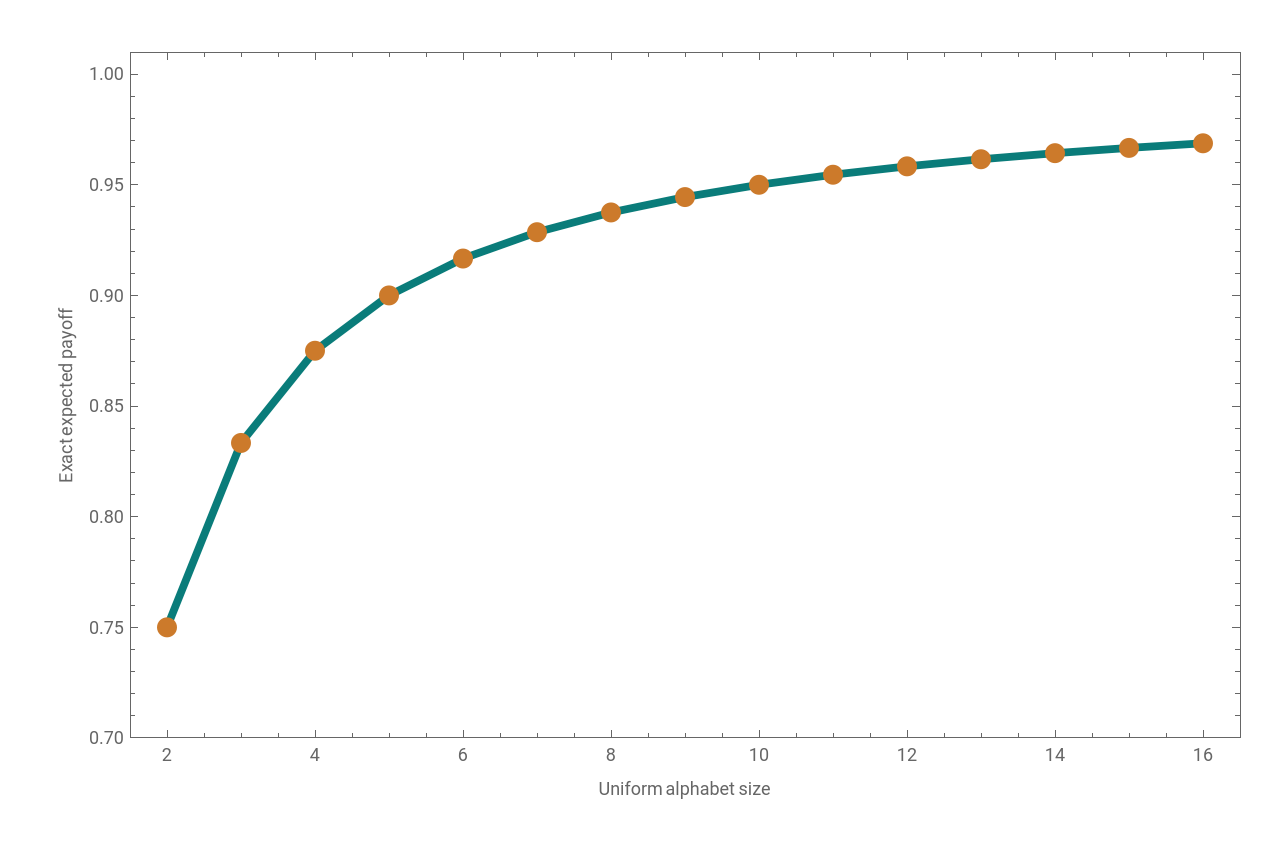
PREVIEW: exact calculation / reference integration, prepared independently of Wolfram. Interactive output is generated when the input cell is evaluated.
In[]:=
DevicesOfDifference`CollisionPlayground[]
Out[]=


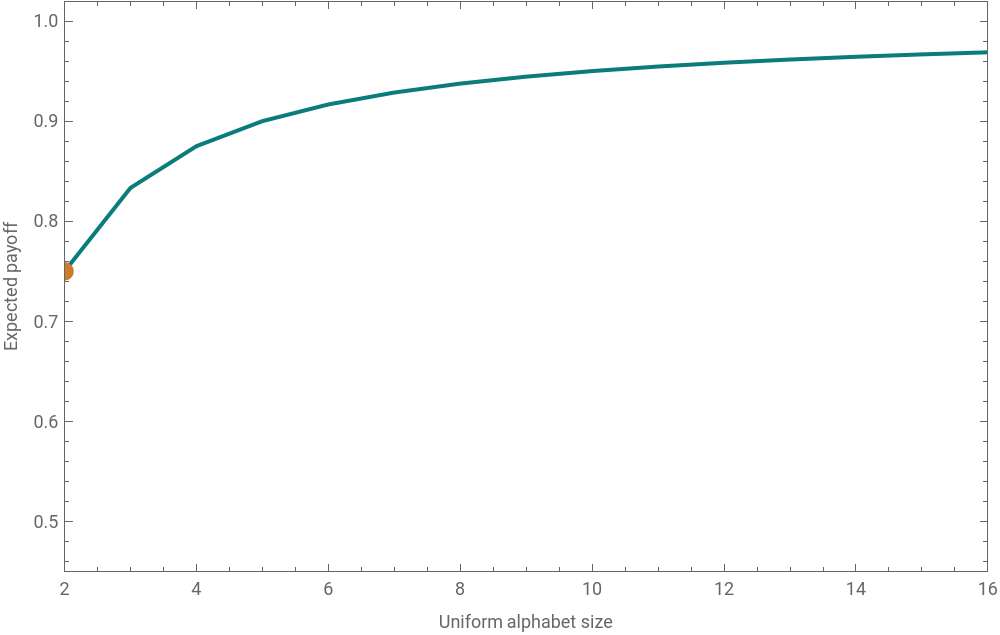
F1 / R1 — Figure and result slot: select the final parameter values, specify the run protocol, export the chosen figure, and record the result after validation.
3.2 Frequency dependence within a recognised repertoire
3.2 Frequency dependence within a recognised repertoire
Rarity reduces the probability of meeting the same token. Under the token replicator equation,
uniform frequencies are the unique interior stationary state. For strictly positive initial frequencies, the function
satisfies
Equation (13) is an invasion calculation; (14) compares two established monomorphic conventions. They answer different evolutionary questions. Neither implies monotonic growth of repertoire size in a finite population with mutation, loss and recognition errors.
4 Evolutionary stability
4 Evolutionary stability
The second condition matters when a rare mutant initially performs as well as the resident. It compares the mutant’s performance against its own kind with the resident’s performance against that mutant.
4.1 Strategy representation
4.1 Strategy representation
4.2 Stability theorem
4.2 Stability theorem
Equality holds precisely when the mutant uses the complementary action at every unequal pair reachable under its own emission distribution. Token frequencies and tie responses are unrestricted by this first-order equality.
The theorem isolates two sources of resistance to invasion. Concentrating emission increases collisions among mutants. Changing collision behaviour moves their self-play away from the base-game ESS. Full use of the available tokens also makes every opponent token relevant to every emitted-token component of the resident convention.
The result establishes local resistance to invasion. It does not establish that every initial population converges to this convention or classify all equilibria of larger behavioural models. The standard implication from ESS to local asymptotic stability applies to the corresponding state of the finite reduced-normal-form replicator equation (Maynard Smith 1982). An individual-based model with a different genotype representation, inheritance rule or mutation process requires its own dynamic analysis.
EXPERIMENT 02 / The complete eight-program universe
Explore the exact payoff matrix, one-bit mutation graph and replicator-mutator trajectories. Program reception cost is charged only to response rules that depend on the received token; this differs from the restricted two-type cost convention in Experiment 03.
F2 / R2 — Figure and result slot: select the final parameter values, specify the run protocol, export the chosen figure, and record the result after validation.
4.3 Babbling and the origin of conditional responses
4.3 Babbling and the origin of conditional responses
A single sufficiently rare type has a small advantage that tends to zero with its frequency. At an exactly monomorphic, mutation-free babbling state, no conditional type is present and deterministic selection cannot create one. Introduction, drift and the construction of a compatible emission-and-response protocol are therefore separate parts of an origin account. The proposition identifies selection once compatible conditional behaviour is present. It does not establish a necessary fitness valley or a specific route across one.
4.4 Ignoring signals can be initially neutral
4.4 Ignoring signals can be initially neutral
The mutant is first-order neutral and second-order disadvantaged. For any larger ordered repertoire, an extreme token likewise permits a constant action to complement every unequal-token resident encounter. Increasing the alphabet beyond two does not eliminate this possibility. For a general assignment rule, the existence of such a constant response depends on how that token’s pairs are oriented.
EXPERIMENT 03 / When listening has a cost
The restricted resident-versus-constant-Y model follows equation (21). Change cost and initial frequency; the dashed line is the analytic coexistence prediction. The static example has cost 0.06 and initial frequency 0.02.
F3 / R3 — Figure and result slot: select the final parameter values, specify the run protocol, export the chosen figure, and record the result after validation.
4.5 Different conventions
4.5 Different conventions
In the restricted two-convention population, both pure convention states are locally attracting and the equal mixture is unstable. This creates a mechanism for selection of a locally common convention. Spatial separation could sustain different conventions in different regions, but the existence and movement of their boundaries depend on the spatial model. Interpreting such regions as dialects is a hypothesis about signalling populations, rather than a result of the nonspatial game.
5 What the formal result contributes
5 What the formal result contributes
The stability of communication depends on the base game, the allowed messages, the strategy representation and the stability concept. The literature contains stable communication systems under several such specifications. Selten (1983, 1988) examines evolutionary stability in extensive games. Blume, Kim and Sobel (1993) study games of communication. Hurkens and Schlag (2003) explicitly treat task-allocation games, and Herold and Kuzmics (2020) give a closely related analysis of labels and conditional roles. The existence result here should be read alongside those precedents.
Equations (16) and (20) sharpen the interpretation of the equal-role-payoff case. An ESS can admit mutants that initially do equally well. Its protection can come from their poor performance against one another. Conversely, a small cost saving can turn that neutrality into an invasion advantage. A claim that useful communication must be strictly rewarded in every resident-mutant encounter would miss both effects.
Finally, the theorem concerns role assignment through a recognised token relation. It supplies a model of a limited communicative function. The emergence of reference, syntax, displaced communication or the range of human language requires additional structure. Models such as Nowak and Krakauer (1999) address other components of language evolution. The present construction makes the benefit of an encounter-specific distinction explicit without deriving those further capacities.
6 Behavioural and biological devices
6 Behavioural and biological devices
The formal model treats the signal distribution and the response rule as the relevant strategic variables. Biological implementations can add developmental investment, persistent identity, inheritance and partner choice. These additions determine which individuals meet, what roles they can perform, and whether their descendants retain the necessary combinations of traits. They change the evolutionary problem.
The proposed comparison concerns four features. First, role rewards may be unequal. Second, an assignment may last for one encounter, for a partnership, or for an individual’s lifetime. Third, differentiation may benefit a particular pair or reduce competition across a population. Fourth, inheritance and recombination may preserve or disrupt the traits on which differentiation depends. Each feature can be varied independently; together they define a space of models rather than a universal sequence of devices.
There is no general reason to rank these devices by cost. Developmental differentiation may be cheap in one environment and costly in another. Stable identity may save repeated assessment while reducing flexibility. Reproductive isolation may preserve ecological differentiation but also impose mate-finding costs. A prediction that selection favours the cheapest feasible device requires explicit measures of these benefits and costs.
6.1 Unequal role rewards
6.1 Unequal role rewards
Equal role rewards remove a conflict over which assigned role a player receives. With unequal rewards, the induced token game usually has different off-diagonal payoffs, and uniform emission need not be a best reply. A role assignment may still be stable, as established in the broader label-game literature, but the proof must include incentives at the emission stage as well as obedience after an observed pair.
Repeated interaction offers another possibility. Partners can alternate between unequal roles and condition continued participation on reciprocation. The attractiveness of alternation depends on the distribution of future encounters, discounting and the ability to detect a failure to reciprocate. Persistent morphology offers different commitment opportunities. Unequal rewards alone establish neither the failure of cheap talk nor the necessity of an unfakeable signal.
6.2 Persistent badges and the meaning of an ESS
6.2 Persistent badges and the meaning of an ESS
A population of individuals that randomise their token anew in each encounter can have the same one-encounter token frequencies as a population of fixed-badge individuals. If their conditional response probabilities are also the same, the encounter payoff calculation is unchanged. Indeed, a mixed ESS in the reduced normal form can be interpreted as a stable population distribution over fixed pure plans. Per-encounter randomisation by every individual is therefore not, by itself, a proved dividing line between communication and morphology.
Persistent badges can change what is inherited, the costs of changing identity, and correlations across repeated encounters. Those changes may affect evolution, but they require a model that represents them. In particular, the signal-ignoring mutant in (20) is available in the signalling model itself. Its existence cannot be used as evidence that fixing a badge uniquely opens a neutral route to morphological specialisation.
Nor does poor performance in same-badge encounters establish the evolution of disassortative matching. A preference for unlike partners can improve encounter outcomes in a suitable model. Whether that preference invades depends on search costs, partner availability, mutual acceptance and the genetic association between the preference and the role. Calling the resulting arrangement sexual dimorphism additionally requires reproductive roles and the relevant developmental biology.
6.3 Ecological dimorphism and speciation
6.3 Ecological dimorphism and speciation
Bolnick and Doebeli (2003) show, within a frequency-dependent ecological model, that disruptive selection can produce either ecological sexual dimorphism or adaptive speciation. Their analysis identifies conditions under which divergence between the sexes can reduce the selection pressure favouring speciation. This supports a comparison between alternative ways of sustaining ecological differentiation; it does not identify every instance of dimorphism and speciation with the token protocol.
The mating structure is especially important. Complementary reproductive partners may benefit from disassortative matching between roles. Ecological divergence can instead favour assortative mating within a specialised type when intermediate offspring perform poorly. Dieckmann and Doebeli (1999) model sympatric speciation with evolving mating preferences. A marker used in mate choice is an observable trait, but its participation in assortative mating does not make speciation an instance of cheap talk without further assumptions about its inheritance and strategic use.
These models can share frequency-dependent benefits of differentiation while differing in the relevant interaction and transmission mechanisms. The useful comparison asks which differences are maintained, among whom, and by what means. Demonstrating equivalence to a correlated equilibrium would require an explicit strategic mapping in each case.
6.4 Genetic associations and the ruff
6.4 Genetic associations and the ruff
The ruff provides a concrete example of a genetic association among reproductive behaviour and other phenotypic traits. Küpper et al. (2016) and Lamichhaney et al. (2016) identify an inversion associated with alternative male reproductive morphs. The system shows how linked traits can participate in persistent reproductive strategies.
It does not establish that a small signalling repertoire evolved into those morphs. The ruff has three alternative male morphs within an already sexually differentiated species, and the studies identify genomic structure rather than the historical transition proposed here. They can motivate models of inheritance and linkage without serving as a test of Theorem 1 or a prediction that badge systems should be binary.
7 Testable extensions and simulation design
7 Testable extensions and simulation design
A third stage can permit recognised and unrecognised new tokens, explicit production and reception costs, and perception errors. Equations (13), (14) and (21) supply separate benchmarks. With noisy recognition, the rule must specify what each player perceives: disagreements about the pair can cause both to choose the same action, so noise cannot simply be assumed to reinforce stability.
To examine persistent roles, the model must then track identity across encounters and specify inheritance. A meaningful comparison holds the ecology and available actions fixed while allowing either transient signals, developmental switches or inherited labels. Mate choice, recombination and hybrid performance should be introduced only when reproductive or ecological differentiation is actually being studied. The outcomes to explain are maintenance of polymorphism, association of labels with roles, matching patterns and gene flow. A token game alone cannot generate evidence for the emergence of sexes or species.
This staged design makes the proposed comparison falsifiable. If a claimed transition disappears when omitted strategies or realistic search costs are admitted, the transition depends on those restrictions. If persistent specialisation survives across a documented parameter region, it can be compared with a behavioural convention under the same ecological conditions. Simulation would then establish results about the additional model, with a clear boundary between those results and the theorem proved here.
EXPERIMENT 04 / Finite populations and evolutionary accessibility
Replay seeded Moran birth-death paths with random matching, focal-self exclusion, one-bit mutation and explicit selection strength. One path illustrates a mechanism; establishment probabilities require a predeclared protocol and independent replicates.
F4 / R4 — Figure and result slot: select the final parameter values, specify the run protocol, export the chosen figure, and record the result after validation.
8 Discussion
8 Discussion
Complementary interactions can reward the use of distinctions that assign roles. The finite token protocol provides an especially simple example: equal role rewards support complementary responses to unequal tokens, while negative frequency dependence spreads token use. The convention resists invasion through the explicit second-order terms in (16), even though some mutants can match its payoff when initially rare.
This mechanism gives a precise starting point for comparing communication with persistent differentiation. It also identifies the additions needed for a biological explanation. Costs can favour simpler response rules. Repeated encounters can favour alternation. Development and inheritance can constrain which roles are available. Matching determines whether differentiation benefits partners, competitors or offspring. Each addition changes the strategic variables and can change the stable outcome.
The opening game is easy because people can agree who chooses what. The biological question concerns how such assignments are generated, maintained and transmitted when agreement itself must evolve. A correlated equilibrium describes an incentive-compatible pattern of play. Explaining its biological implementation requires specifying the device that produces that pattern and testing the evolutionary pressures acting on the device.
References
References
Aumann, R. J. (1974). Subjectivity and correlation in randomized strategies. Journal of Mathematical Economics, 1(1), 67-96. https://doi.org/10.1016/0304-4068(74)90037-8
Aumann, R. J. (1987). Correlated equilibrium as an expression of Bayesian rationality. Econometrica, 55(1), 1-18. https://doi.org/10.2307/1911154
Blume, A., Kim, Y.-G., and Sobel, J. (1993). Evolutionary stability in games of communication. Games and Economic Behavior, 5(4), 547-575. https://doi.org/10.1006/game.1993.1031
Bolnick, D. I., and Doebeli, M. (2003). Sexual dimorphism and adaptive speciation: two sides of the same ecological coin. Evolution, 57(11), 2433-2449. https://doi.org/10.1111/j.0014-3820.2003.tb01489.x
Dieckmann, U., and Doebeli, M. (1999). On the origin of species by sympatric speciation. Nature, 400, 354-357. https://doi.org/10.1038/22521
Harrald, P. G. (1994). Numbers externalities. PhD thesis, Simon Fraser University. https://summit.sfu.ca/item/4973
Herold, F., and Kuzmics, C. (2020). The evolution of taking roles. Journal of Economic Behavior & Organization, 174, 38-63. https://doi.org/10.1016/j.jebo.2020.03.014
Hurkens, S., and Schlag, K. (2003). Evolutionary insights on the willingness to communicate. International Journal of Game Theory, 31, 511-526. https://doi.org/10.1007/s001820300136
Küpper, C., et al. (2016). A supergene determines highly divergent male reproductive morphs in the ruff. Nature Genetics, 48, 79-83. https://doi.org/10.1038/ng.3443
Lamichhaney, S., et al. (2016). Structural genomic changes underlie alternative reproductive strategies in the ruff (Philomachus pugnax). Nature Genetics, 48, 84-88. https://doi.org/10.1038/ng.3430
Maynard Smith, J. (1982). Evolution and the Theory of Games. Cambridge University Press.
Nowak, M. A., and Krakauer, D. C. (1999). The evolution of language. Proceedings of the National Academy of Sciences of the United States of America, 96(14), 8028-8033. https://doi.org/10.1073/pnas.96.14.8028
Selten, R. (1983). Evolutionary stability in extensive two-person games. Mathematical Social Sciences, 5(3), 269-363. https://doi.org/10.1016/0165-4896(83)90012-4
Selten, R. (1988). Evolutionary stability in extensive two-person games: correction and further development. Mathematical Social Sciences, 16(3), 223-266. https://doi.org/10.1016/0165-4896(88)90040-6
Computational checks and figure handover
Computational checks and figure handover
Evaluate the cell below before using experimental output in the paper. It checks the exact eight-program matrix, convention payoff, neutral mutant, mutation operator and seed reproducibility.
Figures F1–F4 and results R1–R4 correspond to the numbered paper slots. The bundle includes the Wolfram source and a LaTeX/PDF working paper with marked placeholders. For a selected Wolfram graphic, use DevicesOfDifference`ExportFigure[graphic, "F1_collisions"] to save a vector PDF alongside this notebook.
CITE THIS NOTEBOOK
CITE THIS NOTEBOOK
Devices of difference in games of complementarity
by Paul Harrald
Wolfram Community, STAFF PICKS, October 14, 2026
https://community.wolfram.com/t/28337
by Paul Harrald
Wolfram Community, STAFF PICKS, October 14, 2026
https://community.wolfram.com/t/28337