ABSTRACT: In relativistic quantum mechanics we need to use E = energy in ψ ~ exp(-i E t/ℏ ) phase behavior, leading to its periodic time evolution already in the lowest energy state, literally being propelled by mass m of the particle. For electron such periodic process is called de Broglie clock/zitterbewegung and was directly confirmed experimentally through its resonance with spatial lattice. Observation of neutrino oscillations has motivated to analogously introduce their 3 masses for exp(-i t/ℏ ) evolution of 3 mass eigenstates. From the other side, in 2012 Frank Wilczek has started pursue of time crystals - originally as objects having periodic process already in the lowest energy state, exactly as observed for electron and neutrinos. However, they were unsuccessful in search of its mechanism. Here we finally present such, appearing e.g. in skyrmion models, Lorentz-invariant curvature coupling mechanism ( in Hamiltonian for ), which leads to oscillations propelled by structure of particle through energy minimization: nonzero spatial derivative ϕ of field (structure of particle), brings energetic tendency for ψ temporal evolution of local phase. It is applied here in 1+1D toy model extending popular -kink model. This mechanism was extracted from discussed further skyrmion-like candidate for complete model using topological charge as quantized electric charge, where coupling between electromagnetism and gravity ( in Hamiltonian) brings combined energetic tendency for local boosts leading to non-quantized gravitational mass of particle, together with nonzero spatial rotations for the discussed clock of particle. CITATION: Jarek Duda (2025), Time crystal kinks by curvature coupling as toy model for mechanism of oscillations propelled by mass, like observed for electron and neutrinos, arXiv:2501.04036. https://doi.org/10.48550/arXiv.2501.04036Complete model candidate: Jarek Duda (2021), Framework for liquid crystal based particle models, arXiv:2108.07896. https://doi.org/10.48550/arXiv.2108.07896https://community.wolfram.com/groups/-/m/t/2856493
2
mc
(t)
ν
j
E
j
(0)
ν
j
-
2
R
Rϕψ-ϕψ
∂
0
∂
1
∂
1
∂
0
∂
1
∂
0
4
ϕ
-
2
-
a
Γ
μ
b
Γ
0
a
Γ
0
b
Γ
μ
a
Γ
μ
b
Γ
0
4
ϕ
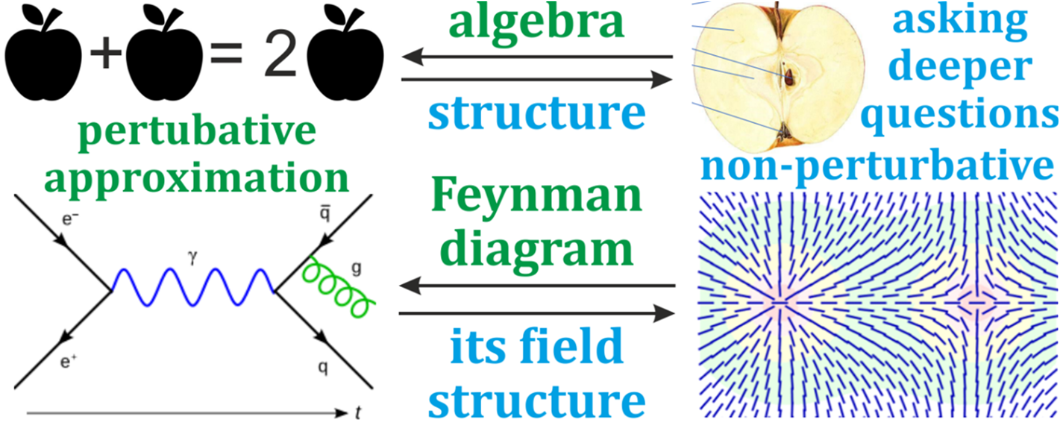
The Standard Model of particle physics is focused on perturbative approximation, which like “apple + apple = 2 apples” is correct, but does not ask about their (field) structures and evolution, what requires more fundamental non-perturbative picture - with continuous fields described by discrete Feynman diagrams. For example electron is effectively represented as a point, but has electric field configuration. Or recently neutrino has turned out thousands of times larger than nucleus. Here we focus on mechanism behind observed oscillations of electron or neutrinos, which should be periodic processes of their fields - starting with 1+1D time crystal kink toy model from arXiv:2501.04036, then introduce the skyrmion-like candidate for complete model from arXiv:2108.07896 (notebook), in which this mechanism automatically appeared.
E∼1/
2
r
1+1D toy model: time crystal kink
1+1D toy model: time crystal kink
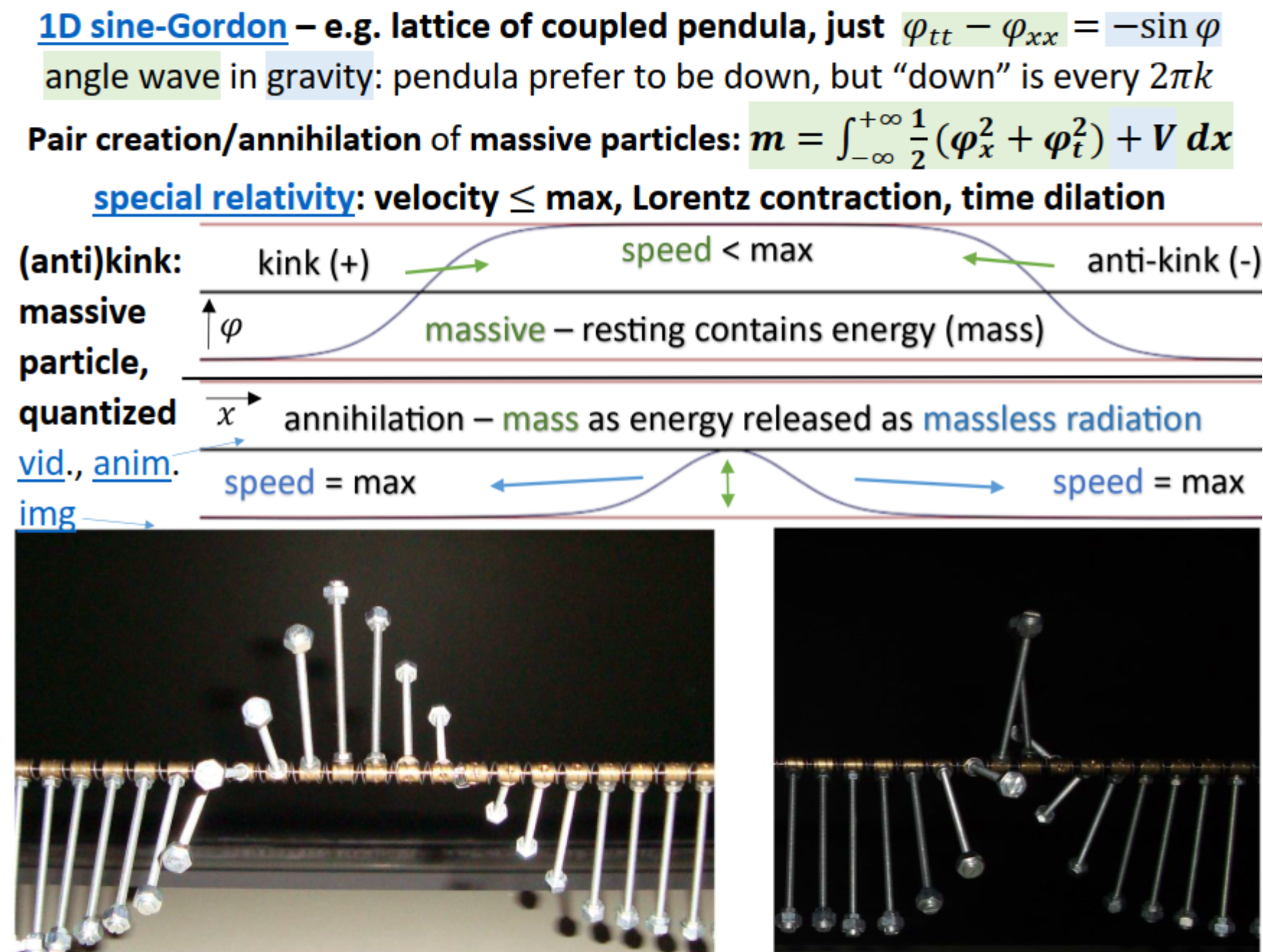
Particles are stable localized field configurations like solitons, being one of approaches for non-perturbative picture. Many similarities between particles and especially topological defects/solitons are already brought by such basic 1+1D sine-Gordon model, which can be realized by just lattice of coupled pendula like in below photos (nice introductory video), and contains quantized particle-like massive solitons (kinks) with pair creation and annihilation releasing its mass/energy as massless radiation like photons - travelling with maximal propagation speed (animation). This model also contains special relativity due to this maximal propagation speed: has Lorentz contraction, time dilation, relativistic mass/momentum scaling. Below is a slide (source), with photos (source) of such resting kink (left, wide) and moving (right, narrow), exactly as in Lorentz contraction (same formulas).
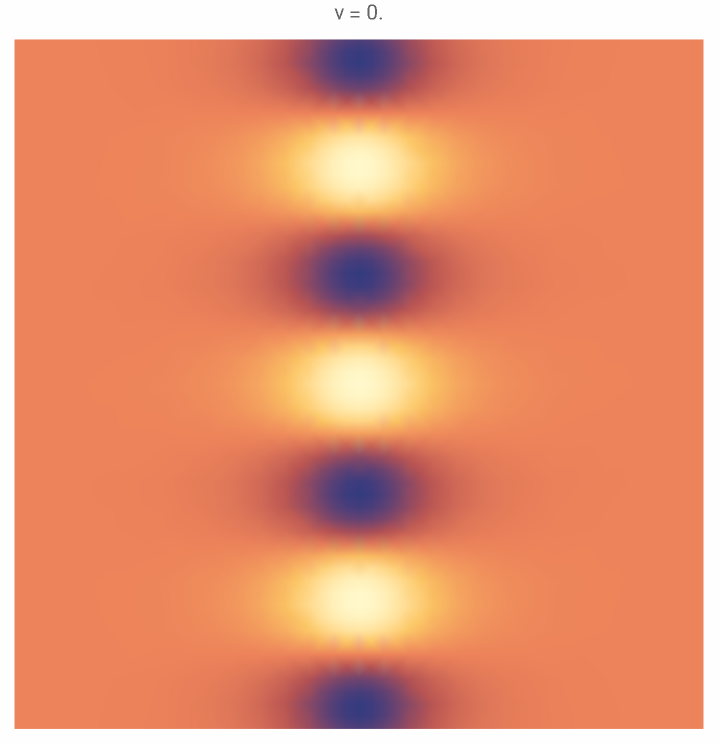
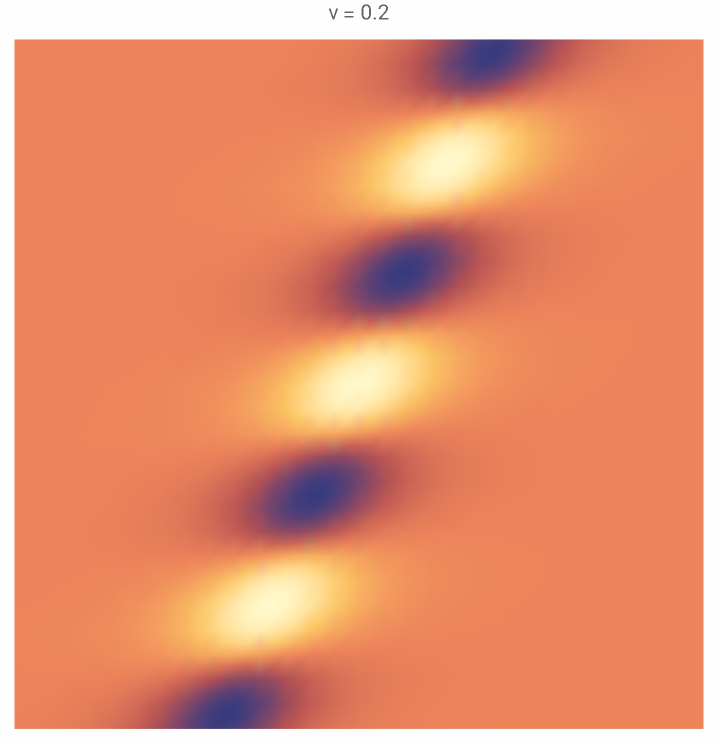
Pulling and releasing one of such coupled pendulum in lattice, would create local oscillations, can be without radiation for so called breathers. Here we can see plots of angles of such pendulums in lattice for position (horizontal axis) vs time (vertical axis) for resting breather (velocity v = 0) and travelling with growing velocity v below the maximal propagation speed (of sound, v = 1), allowing to observe relativistic time dilation - number of ticks reduced with velocity for such clock of this simple model of particle:
In[]:=
γ=;ϕ0=4ArcTan;(*resting
1
1-
2
v
1-
Cos[ωt]2
ω
ωCosh
1-
x2
ω
breather
*)ϕ=ϕ0/.{x->γ(-tv+x),t->γ(t-vx)};(*Lorentztransform
*)Row[Table[DensityPlot[ϕ/.{vV,ω0.5,tT},{x,-10,10},{T,-20,20},PlotRange->All,Frame->False,PlotLabel->Row[{"v = ",V}]],{V,0,0.8,0.2}]]Out[]=
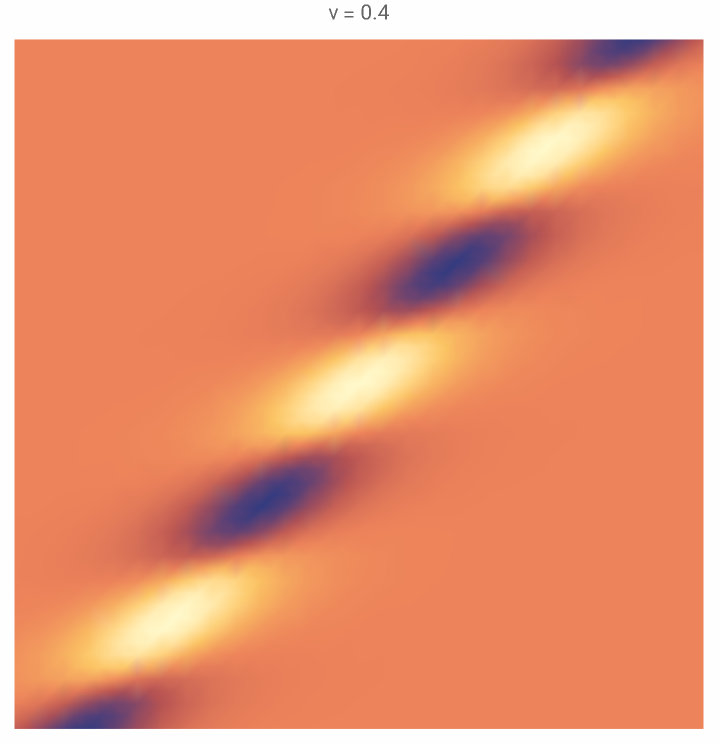
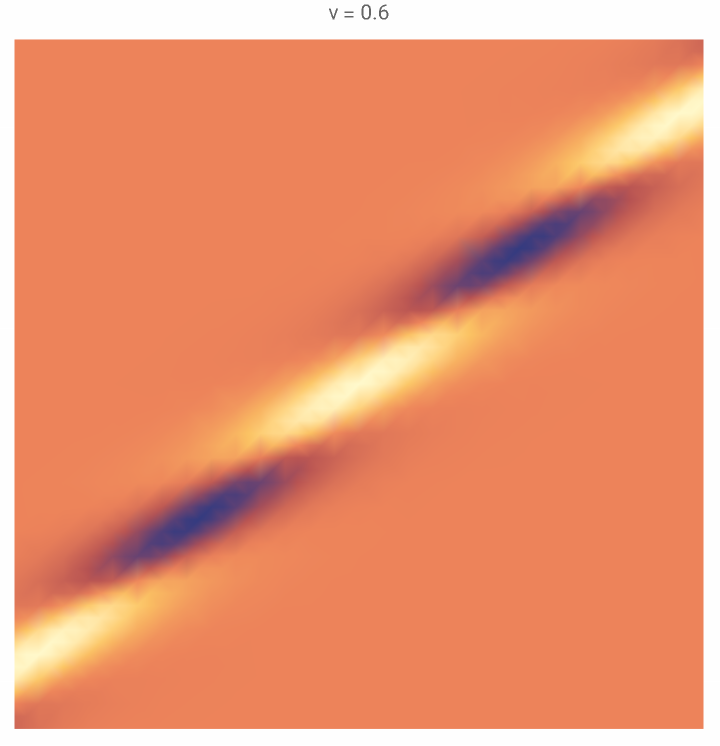
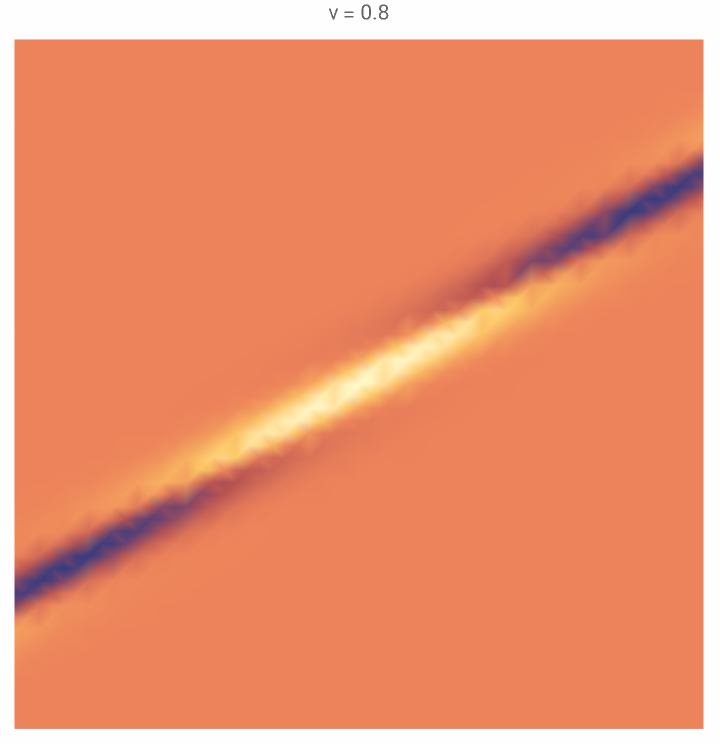
However, such oscillations come with additional kinetic energy from nonzero time derivatives - energy minimization would calm these pendula down to resting. In contrast, both for time crystals and electron clock/neutrino oscillations, we need a mechanism to make energy minimization lead to oscillations. To get such oscillations by energy minimization, the proposed toy model from arXiv:2501.04036 uses coupling of ϕ particle’s field through curvature with the second field corresponding to quantum phase by negative term in Hamiltonian (energy density). It automatically appeared in the discussed further candidate for complete model, and literally brings energetic preference for evolution of ψ by its nonzero time derivative ≡ψ, in presence of nonzero ≡ϕ spatial derivative of : field structure of the particle. For simplicity the arXiv has used -model with ℒ Lagrangian as in sine-Gordon, differing only by use of potential with two minima {-1,1}, instead of periodic potential in sine-Gordon. The proposed coupling with field as quantum phase adds (for some ) to Hamiltonian (energy density): where negative squared curvature coupling is the main term: energetically preferring periodic process due to structure of particle. However, it alone would lead to infinite oscillation frequency here, what in further 3+1D complete model candidate will be prevented by appearing also in positive squared curvature terms in 3D space. In 1+1D we need a different way to prevent it, like the used positive term. Finally, below is the considered Lagrangian, test of its Lorentz invariance, and corresponding Hamiltonian from the arXiv:
Rϕψ-ϕψ≡-
∂
0
∂
1
∂
1
∂
0
ϕ
0
ψ
1
ϕ
1
ψ
1
ψ
-
2
R
ψ
0
∂
0
ϕ
1
∂
1
ϕ
4
ϕ
ϕϕ-V(ϕ)
∂
μ
μ
∂
V(ϕ)
2
1-
2
ϕ
ψ
-α+β
2
R
4
R
α,β>0
-
2
R
4
R
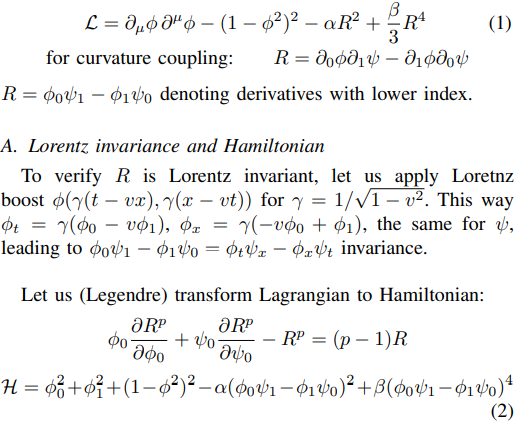
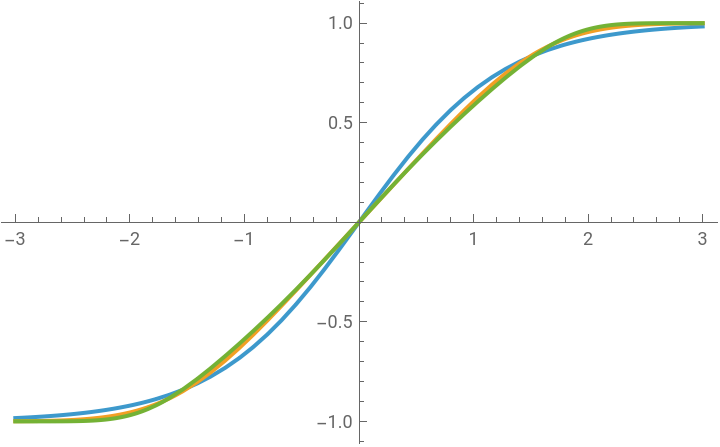
For simplicity, let us assume and parametrization: phase evolution (e.g. for wavefunction behavior), and resting kink of time independent shape: monotonous This way we search for (, ω) jointly minimizing energy : The original -model minimizes +dx energy instead, leading to analytic solution as resting kink of width and center in zero: . Adding the proposed curvature coupling deforms its shape - below code searches for kink assuming parametrization, with frequency ω minimizing energy. It checks polynomial degree from 1 to 5, optimized only odd power coefficients have turned out non-negligible, making this kink anti-symmetric. As expected, energy minimizing frequency ω is nonzero and finite - we can call it time crystal kink.
αβ1
ψ(t)ωt
exp(iψ)
ϕ≡ϕ(x),ϕ(-∞)-1,ϕ(+∞)1.
ϕ(x)
E
EHdx(1-)++dx
∞
∫
-∞
∞
∫
-∞
2
ϕ
x
2
ω
2
1-
2
ϕ
4
ω
4
ϕ
x
4
ϕ
∞
∫
-∞
2
ϕ
x
2
1-
2
ϕ
w
ϕ(x)tanh(x/w)
ϕ(x)tanh(polynomial ofx)
In[]:=
Eω={};ϕs=Tableϕ=Tanh[Sum[*a[p],{p,d}]];(*kinkparametrization*)H=Simplify[(1-)+*+];(*Hamiltonian*)min=Quiet[FindMinimum[NIntegrate[H,{x,-∞,+∞}],Join[{{ω,1.},{a[1],1}},Table[{a[p],0},{p,2,d}]]]];AppendTo[Eω,{Row[{"E = ",min[[1]]}],Row[{"ω = ",ω/.min[[2]]}]}];Chop[ϕ/.min[[2]]],{d,1,5,2};Print["found {minimal energy, ω}: ",Eω];Plot[ϕs,{x,-3,3},PlotLegends->"Expressions"]
p
x
2
D[ϕ,x]
2
ω
4
D[ϕ,x]
4
ω
2
(1-)
2
ϕ
found {minimal energy, ω}: {{E = 2.12568,ω = 1.07123},{E = 2.03638,ω = 1.24938},{E = 2.02515,ω = 1.28975}}
Out[]=


Complete model candidate combining Landau-de Gennes and Skyrme Lagrangian
Complete model candidate combining Landau-de Gennes and Skyrme Lagrangian
Mathematica code used to generate such field configurations of proposed non-perturbative electron field evolution (animation at the top):
CITE THIS NOTEBOOK
CITE THIS NOTEBOOK