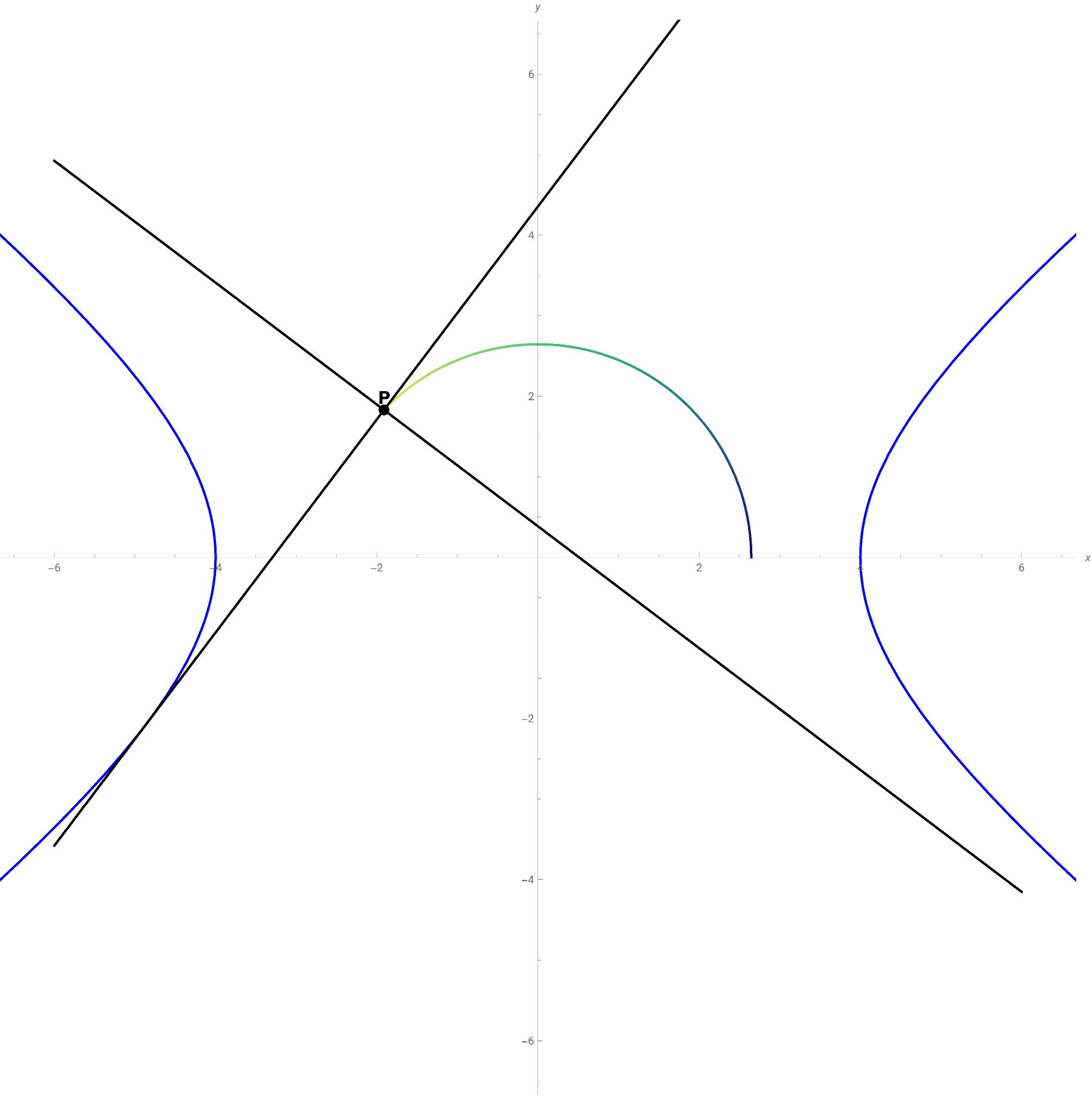
OrthopticCurveHyperbola::usage="It is the geometric locus of the intersection point of two tangent lines to a curve and orthogonal to each other. References: mathecurve.com: Orthoptic curve; AI Assistant; Personal.";
Development:
Obtaining the cartesian equation from the orthoptic curve to the hyperbola:
In[]:=
2
x
2
a
2
y
2
b
y
0
x
0
y
0
x
0
2
x
2
a
2
(+mx-m)
y
0
x
0
2
b
2
b
2
x
2
a
2
(+mx-m)
y
0
x
0
2
a
2
b
2
b
2
x
2
a
2
m
2
x
2
a
2
m
x
0
2
a
2
m
2
x
0
2
a
y
0
2
a
x
0
y
0
2
a
2
y
0
2
a
2
b
(-)+2-2mx-+2m--==0;
2
b
2
a
2
m
2
x
2
a
2
m
x
0
2
a
y
0
2
a
2
m
2
x
0
2
a
x
0
y
0
2
a
2
y
0
2
a
2
b
Due to the condition of tangency, the discriminant must be zero:
In[]:=
SimplifyExpand-4(-)-+2m--==0
2
2-2m
2
a
2
m
x
0
2
a
y
0
2
b
2
a
2
m
2
a
2
m
2
x
0
2
a
x
0
y
0
2
a
2
y
0
2
a
2
b
abmm+2ab++;mm+2++;
2
a
x
0
y
0
2
b
2
m
2
x
0
2
y
0
2
a
x
0
y
0
2
b
2
m
2
x
0
2
y
0
-+(2)m--==0;
2
a
2
x
0
2
m
x
0
y
0
2
y
0
2
b
By Vieta’s theorem:
m
1
m
2
c
a
Due to the perpendicularity condition:
--
2
y
0
2
b
2
a
2
x
0
2
x
0
2
y
0
2
a
2
b
2
x
2
y
2
a
2
b
Animation:
In[]:=
Manipulatea=4;b=3;Module{p,slopes,m1,m2,t1Line,t2Line},p=-Cos[t1],-Sin[t1];slopes=m/.Solve[(-)+2p[[1]]p[[2]]m-(+)==0,m]//Simplify;{m1,m2}=slopes;t1Line[x_]:=p[[2]]+m1(x-p[[1]]);t2Line[x_]:=p[[2]]+m2(x-p[[1]]);ShowParametricPlot{aCosh[θ],bSinh[θ]},θ,-,,PlotStyle->{Blue,Thick},ParametricPlot{-aCosh[θ],bSinh[θ]},θ,-,,PlotStyle->{Blue,Thick},ParametricPlot-Cos[θ],-Sin[θ],{θ,0,t1},ColorFunction->Function[{x,y,u},ColorData["BlueGreenYellow"][u]],ColorFunctionScaling->True,Plot[t1Line[x],{x,-6,6},PlotStyle->Black],Plot[t2Line[x],{x,-6,6},PlotStyle->Black],Graphics[{Black,PointSize[0.01],Point[p],Text[Style["P",14,Bold],p,{0,-1.2}]}],AspectRatio->Automatic,Axes->True,AxesOrigin->{0,0},AxesLabel->{x,y},PlotRange->6,ImageSize->900,{{t1,0.00002,"Value t1"},0.000001,2π,0.00001}
2
a
2
b
2
a
2
b
2
a
2
p[[1]]
2
m
2
b
2
p[[2]]
π
2
π
2
π
2
π
2
2
a
2
b
2
a
2
b
Out[]=