This is part of live presentation series called Mathematical Games in which we explore a variety of games and puzzles using Wolfram Language. In this episode, we explore games that involve sporadic similar triangles.
demonstrations.wolfram.com
demonstrations.wolfram.com
Many Demonstrations talk about triangles.

AI mathematics release
AI mathematics release
On October 7, OpenAI released 719 manuscripts for proofs in 372 families. Since then, 17 proofs have been withdrawn or corrected.
But not many of these led to good illustrations.
Related to this, Kate Stange and Edmund Harriss ask what pictures contribute to mathematical understanding.
Sources: Guest post, October 11, 2026: https://terrytao.wordpress.com/2026/10/11/illustration-beyond-proof/ ;
Snaky
Snaky
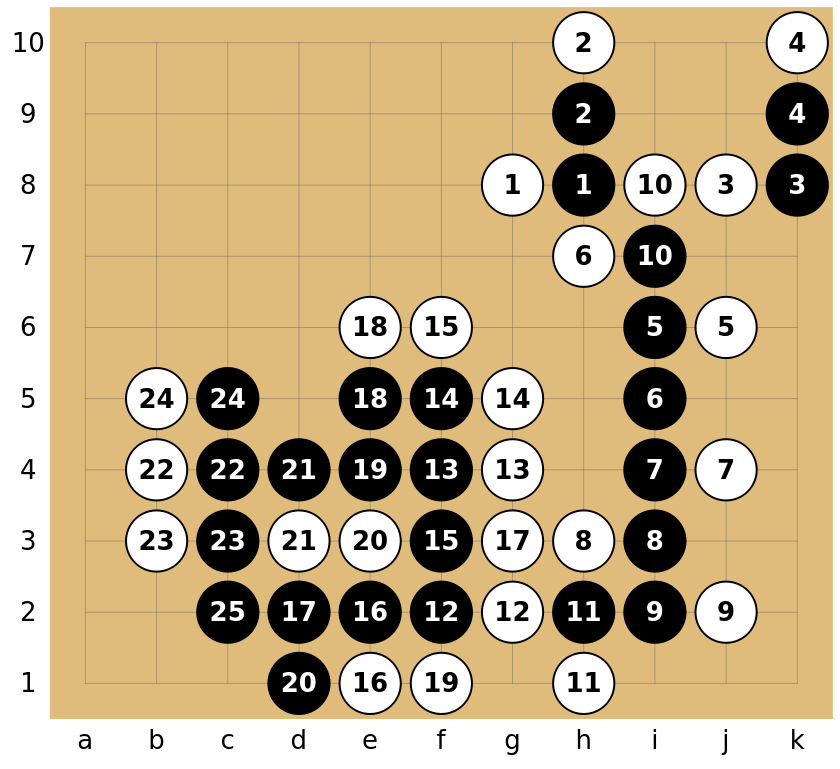
Black and White alternately mark squares; Black aims to occupy the six cells of Snaky.
This was part of the big AI release. Initially, it was proven that Snaky had a win on the 17x17 board.
Trevor Morris worked with Claude and that showed a 15x15 board was enough, as Frank Harary predicted.
Sources: https://snaky.gotrevor.org/ and Gardner’s Fractal Music.
For Snaky, Frank Harary got the board size correct. Here is an optimal game. Sources: https://snaky.gotrevor.org/
Out[]=


Gaussian moats: can we walk to infinity?
Gaussian moats: can we walk to infinity?
Gaussian primes are the prime numbers of the Gaussian integers a+b i. Plot them as points on a square grid. Starting at one of these points, can you travel arbitrarily far by hopping between Gaussian primes without ever exceeding a fixed step length?
This is the Gaussian moat problem. OpenAI’s manuscript “Bounded-Step Walks on Gaussian Primes” claims that the answer is no: for any fixed maximum step, every connected group of reachable primes is finite. It also claims a bound on the group’s size that depends only on the maximum step.
Out[]=

Cyclic Steiner quadruple system
Cyclic Steiner quadruple system
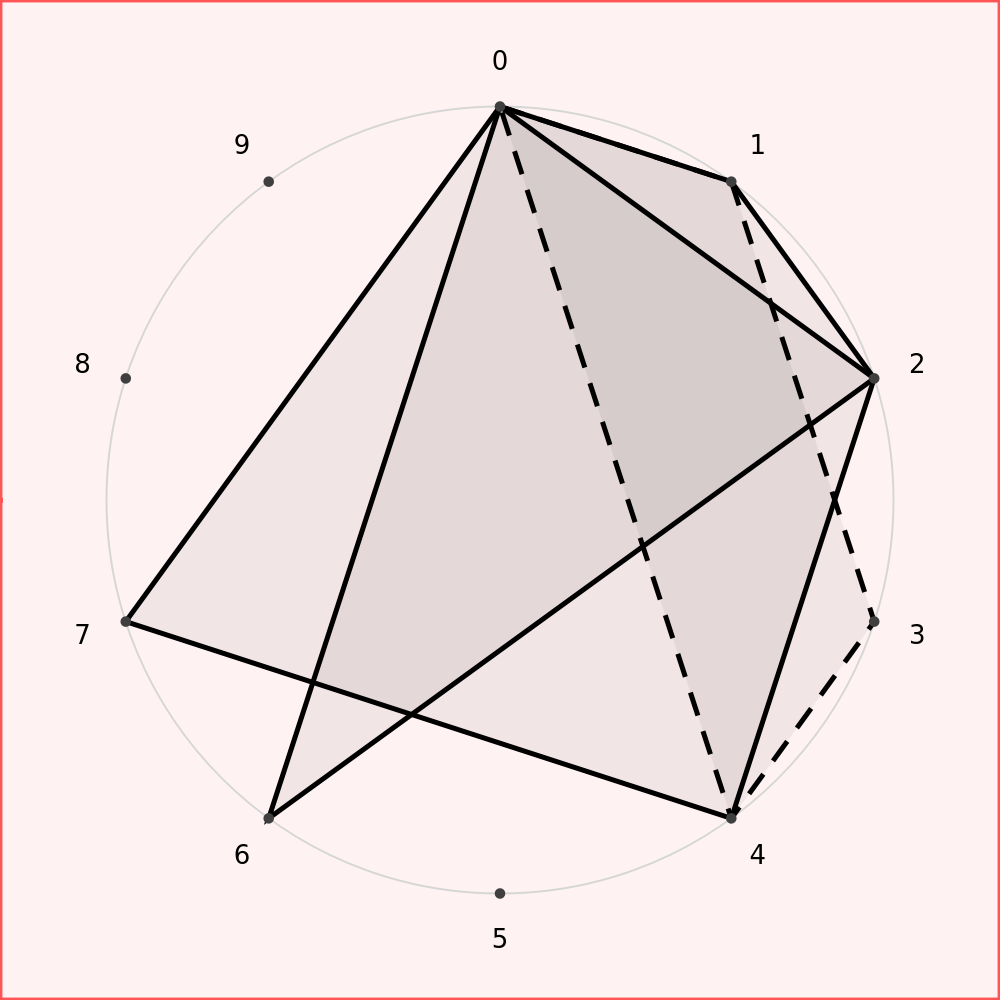
Liu and Feng (2026) proved that a symmetric cyclic Steiner quadruple system of order v>=4 exists iff v=2,4,10,20 (mod24) and every odd prime divisor p of v satisfies p=1 or 5 (mod12).
https://arxiv.org/abs/2610.25951v1
Here's a demo that shows the cyclic blocks, but I’ll stop at 34 instead of infinity.
Out[]=




Littlewood Cylinder Problem
Littlewood Cylinder Problem
Can seven infinite cylinders mutually touch? https://arxiv.org/abs/1308.5164
Also known as the Equidistant Lines problem.
I include this because several of the posted papers were about cylinders, but this (more interesting) solution was found earlier.
Out[]=

Single Track Gray Code
Single Track Gray Code
Dzoba, C. “Optimal Single-Track Gray Codes from Gray-Ordered Necklaces.” 17 Oct 2026. https://arxiv.org/abs/2610.24758.
Almost all possible patterns, only one change at a time, and all tracks are the same.
Busy Beaver: S(5)=47,176,870
Busy Beaver: S(5)=47,176,870
We prove that S(5)=47,176,870 using the Coq proof assistant. The proof enumerates 181,385,789 Turing machines with 5 states and, for each machine, decides whether it halts or not. Our result marks the first determination of a new Busy Beaver value in over 40 years and the first Busy Beaver value ever to be formally verified, attesting to the effectiveness of massively collaborative online research (bbchallenge.org).
23 Mar 2026 -- I missed the verification. https://arxiv.org/abs/2509.12337
Cubes in cubes
Cubes in cubes
Almost all solutions were improved in one week. Source: https://erich-friedman.github.io/packing/cubincub/
Chair44
Chair44
Chair44 is a three-dimensional aperiodic monotile: copies tile space, but do not permit a periodic tiling under the paper’s rules.
Sources: I. Tsiokos, https://arxiv.org/abs/2609.19214 ; C. Goodman-Strauss, https://arxiv.org/abs/2609.24779
The original huge paper was by an AI... and it was quickly made much shorter.
Crossing numbers
Crossing numbers
How few crossings are possible when drawing all the edges of a complete graph?
The Harary–Hill formula was recently proven correct.
How few crossings are possible when drawing all the edges of a complete bipartite graph?
The Zarankiewicz formula was recently proven correct.
A table of values :
Breaking every cycle
Breaking every cycle
How few squares need to be removed from a grid to break every cycle?
Sources: G. Alkauskas, https://arxiv.org/abs/2610.20034
OEIS reaches 400,000
OEIS reaches 400,000
The On-Line Encyclopedia of Integer Sequences (OEIS) has reached 400,000 entries. Each entry records a number sequence, with explanations, formulas, references, and often code. It is a resource for identifying patterns and finding connections between mathematical problems.
A399633: The City-building sequence. Imagine adding buildings along a straight street, one at each integer position. The next building must have an integer height equal to the number of earlier rooftops visible from its top. If several heights work, choose the smallest.
Equivelar octahedron of genus 3
Equivelar octahedron of genus 3
An octahedron with eight nonagonal faces. Sources: Ruslan Mizhaev realization; https://mathworld.wolfram.com/EquivelarOctahedronofGenus3.html
Quantitative Monsky
Quantitative Monsky
Monsky’s theorem says a square cannot be dissected into an odd number of equal-area triangles.
Quantitatively, minimize the largest area minus the smallest.
Muxi Li (2026), https://arxiv.org/abs/2609.22693
Small rhombicosidodecahedron is Nopert
Small rhombicosidodecahedron is Nopert
A red cube with size 3/4 sqrt(2) ~ 1.06 can pass through a unit cube, as shown by Prince Rupert.
Most polyhedra have this property.
Hervay (2026) gives a computer-assisted proof that the small rhombicosidodecahedron is a nopert polyhedron, meaning that it does not have Rupert’s property.
The Zome ball is a good next polyhedron to look at.
Wheels of Powered Triangles
Wheels of Powered Triangles
A while ago, I asked how similar triangles could surround a point. That led to many findings.
I now know a lot more.
Symmedian Point (K)
Symmedian Point (K)
Reflections of the median planes in the dihedral angle bisectors.
Reflections of the median planes in the dihedral angle bisectors.
Also the least-squares point, which is the point with minimal total distance squared to the four faces.
We can do this in tetrahedra, as well.
Similar Triangle Dissections
Similar Triangle Dissections
A general triangle can be divided into 4 similar triangles in four ways.
Brocard Points
Brocard Points
The first Brocard point gives three equal angles measured cyclically at the vertices.
Its isogonal partner reverses the cyclic direction.
For side lengths a,b,c and area Δ, cot(ω)=(a²+b²+c²)/(4Δ).
Some tetrahedra can have Brocard points, but not all of them.
If anyone wants a problem to work on, Brocard tetrahedra are not well categorized.
The 36 ways to cut a general triangle into 6 similar pieces.
The 36 ways to cut a general triangle into 6 similar pieces.
Is there some math behind these to explain them?
6-piece dissections.
6-piece dissections.
A generic scalene non - right triangle has 36 dissections into six triangles similar to the original.
They occur in 12 cyclic families of three dissections each.
https://demonstrations.wolfram.com/SixPartSimilarTriangleDissections/
A cevian of triangle ABC is a line segment from a vertex to a point on the opposite side.
A median is the cevian that meets the opposite side at its midpoint; the three medians meet at the centroid G.
The three internal angle bisectors are cevians that meet at the incenter.
If the cevians through a point P are reflected across the corresponding angle bisectors, they meet at a point called the isogonal conjugate of P.
The isogonal conjugate of the centroid is the symmedian point K.
The cevians through K are the symmedians.
In the six piece dissections, there is a median and a symmedian family. There are also four families for median-symmedian intersections.
A triangle has two Brocard points where the three cevian-to-side angles, clockwise or counterclockwise, are equal. The two points are isogonal conjugates of each other. The cevians of the two Brocard points intersect at the first Brocard triangle, which has the third Brocard triangle as the isogonal conjugate.
In the six piece dissections, three families come from the first Brocard triangle and one from the third Brocard triangle. The last two families come from intersections of the medians with cevians through the two Brocard points.
How many ways to cut a triangle?
How many ways to cut a triangle?
Here is a count on the number of ways a triangle can be dissected into copies similar to itself.
2-piece Substitution Systems
2-piece Substitution Systems
For coprime integers a > b > 0, solve x^a = x^b + 1
Draw the altitude for the right triangle with sides 1 : sqrt(x^b) : sqrt(x^a).
A largest-piece substitution system for this triangle will have a maximum of a different sizes.
x^2 = x+1 gives the Kepler triangle, for example.
4-piece Substitution Systems.
4-piece Substitution Systems.
The positive root x>1 solves x^a=x^b+1.
The side choices are acute 1:x^(b/2):x^((a+b)/4), right 1:x^(b/2):x^(a/2), and obtuse 1:x^(b/2):x^(a-b/2).
24 substitution systems
24 substitution systems
The more interesting substitution systems are those with infinite orientations. I put them into a movie I call Orientation Express.
Convergent triangles
Convergent triangles
These are triangles with merged solutions.
Five Triangle Similarity (Andrzej Żak)
Five Triangle Similarity (Andrzej Żak)
There are only a few ways to divide a triangle into 5 similar pieces
Other similarity dissections
Other similarity dissections
Here’s a set of similarity dissections compiled by Vesa Timonen.
The 30-60-90 three piece dissections and the first Sporadics.
The 30-60-90 three piece dissections and the first Sporadics.
Virtually all non-isosceles right triangles have two different dissections into three triangles similar to the 30-60-90 triangle.
The 45-45-90 triangle has just one such dissection due to symmetry.
The 30-60-90 has a third dissection, the first shown here. This is an example of a sporadic similar triangle dissection, not possible with other triangles.
From the earlier table, we can calculate the number of sporadic solutions.
Here are more of the sporadic 30-60-90 solutions.
The 18 4-piece Drafters
The 18 4-piece Drafters
Here are the 18 ways a 30-60-90 can be divided into 4 similar parts. I’m pretty sure anyone could find all of these with enough work.
Was this first solved a few weeks ago? Or was this first solved by a student of Euclid?
So I tried to find all the Sporadic Similar Triangles
So I tried to find all the Sporadic Similar Triangles
I started out with dozens. Eventually, it turned into hundreds. Triangles can get very weird.
The Sporadic Similar Triangle Demo
The Sporadic Similar Triangle Demo
1,569 stored dissections of 106 special triangle shapes. The program is a bit large to scroll through.
The Sporadic Similar Triangle Movie
The Sporadic Similar Triangle Movie
There were so many discoveries, they wouldn’t fit nicely in a few pages. So I made a movie instead.
Unsolved
Unsolved
1. Did I miss any sporadic solutions up to 9 pieces?
2. Are there any other sporadic right triangles?
3. Are any of the regular polygon triangles ever sporadic, such as the heptagon triangle?
4. Is there a general formula for any of these counts?
5. Do any non-spacefilling tetrahedra divide into similar parts?
6. How much does Kakutani’s Fixed Point Theorem affect substitution tilings?
CITE THIS NOTEBOOK
CITE THIS NOTEBOOK
Mathematical Games: sporadic similar triangles
by Ed Pegg
Wolfram Community, STAFF PICKS, October 22, 2026
https://community.wolfram.com/t/28388