1. Gamebooks and art: participation, agency, decision-making
1. Gamebooks and art: participation, agency, decision-making
Gamebooks revolutionized artistic practice in general, and printed fiction in particular by explicitly requiring readers to make choices during the exposition of the narrative. For those unfamiliar to the genre: gamebooks are (originally: printed) books that, at certain points, ask the reader to decide among a certain number of fixed options, and continue the story from that point. For example:
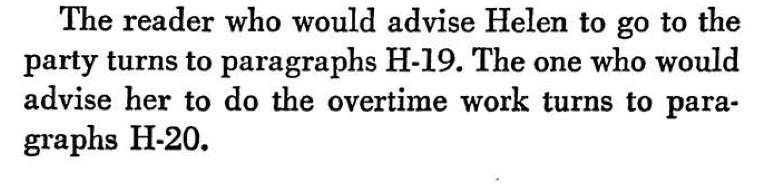
Was allowing for reader’s choices really such a revolution? We may grant that nearly all art requires spectator participation in at least some form, including activities such as perceiving and analyzing the work, buying tickets, applauding or booing at the end etc. Nearly, but not all; it is conceivable that there will be no human to listen to the closing notes of John Cage’s As Slow as Possible, intended to end on September 5, 2640. Likewise, if the Voyager Golden Record is ‘art for aliens’, it is almost certainly bound to remain without an audience. Counter-examples of this sort certainly exist; likewise, the artist/spectator or author/reader distinction can be, and has many times been, thoroughly deconstructed. Still, art spectator participation is a plausible generalization.
->
If this is so, what is distinct about gamebooks then? Here, I want to reflect on three aspects:
1
.The imperative of decision-making. The story does not continue until the reader makes up their mind, and proceeds on one of the possible branches. This creates both a sense of agency and of ‘individualization’: the experience read is the reader’s own in a stronger sense than, for example, in a traditional novel.
2
.The partial nature of the experience. Under the ‘standard’ (intended?) progression, only one of many possible narratives develops. The author’s role is to create not one, but a collection of narratives. (Note: when this collection becomes large enough, it is likely that no one will experience all possibilities, and the artwork becomes a sort of transcendental limit of all feasible individual choice-sequences; this creates an analogy with artworks of the As Slow as Possible-sort).
Before we discuss the third aspect, let us look at some facts regarding the first gamebook.
2. Beginnings
2. Beginnings
What shall we regard as the first gamebook? I found surprisingly little about the origins of the genre. This is surprising, because, through an intricate genealogy, gamebooks are crucial precursors of, among others, the entire Dungeons & Dragons genre, the Warhammer franchise, as well as of all interactive digital art involving storytelling. The first gamebook can thus boast of an impressive set and range of offspring.
“And He brought him outside and said, ‘Look toward heaven, and number the stars, if you are able to number them.’ Then He said to him, ‘So shall your offspring be.’” (Genesis 15:5).
Under the section Origins, the earliest work listed on Wikipedia is Consider the Consequences by Doris Webster and Mary Alden Hopkins. The book’s own page claims ‘it is the earliest known gamebook’. It was published by The Century Company in 1930 in hardcover for $1.50 (~$29 in 2026); in the middle of the Great Depression, this must have been an expensive title.
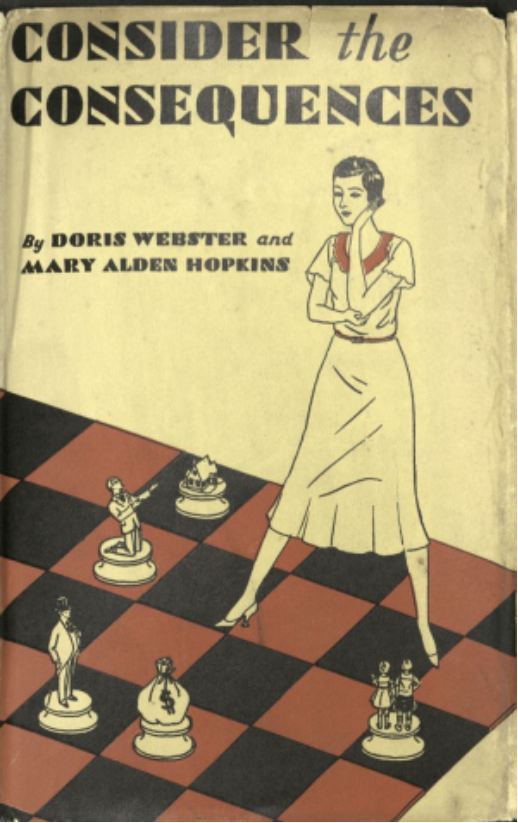
The front cover of the first gamebook.
Mary Alden Hopkins was an influential feminist essayist. Concerning Doris Webster, I could not find anything online other than the list of six books she co-authored with Hopkins between 1927 and 1937, Consider the Consequences being the fifth.
At any rate, the first gamebook runs a semantically transparent title and cover: The reader indeed needs to consider the consequences of their actions at each decision node. On the cover, a tall woman stands on a chessboard, hovering above a number of pieces emphasizes both choice and the game-like nature of the book. The pieces—a bit like Monopoly figurines—represent the choices: possible suitors; two children; a bag of money; a detached house. The woman, no-nonsense, is domineering the scene. Her left hand support her chin; she is thinking, strategizing, that is, considering the consequences.
The first page introduces the reader to the concept of a gamebook. In view of its conceptual innovativeness and impact on literature and art, I find this introduction surprisingly succinct, terse, somewhat like I imagine the woman on the cover. Yet, in a few sentences, it manages to outline some broad conceptual links:
“LIFE is not a continuous line from the cradle to the grave. Rather, it is many short lines, each ending in a choice, and branching right and left to other choices, like a hunch of seaweed or a genealogical table. No sooner is one problem solved than you face another growing out of the first.
You are to decide the course of action of first Helen, then Jed, then Saunders, at each crisis in their lives. Give your first thought, without pausing to ponder.
This game may he played as solitaire, a courting game, or a party stunt. When the players disagree, follow the choice of the majority, but make a note of the dissenting opinion, so that you can return later and find out what happens to Helen—or Jed or Saunders—when other advice is followed.”
There are some striking aspects of this description. First, as the authors see it, the book would be used not merely by solo readers as a pastime, but also, possibly, in the context of courting(!), or at a party. In such cases, it would invoke additional questions on collective decision-making and discussing the consequences of minority opinions. Second, there is not one protagonist, but three characters whose lives may intersect, but are nevertheless distinct. As far as I am aware, this feature and design possibility disappeared from later gamebooks, where you typically play as one character, or perhaps a small party of adventurers in a single story. The first of these characters is a woman. The book is assertively on the side of free will and feminism, and, as we have seen, advocates for democratic decision-making.
We are now ready to consider the third aspect of gamebooks, a feature that (again, to the extent of my knowledge) has been overlooked: their structure lends itself naturally to computational analysis.
3. Computational analysis
3. Computational analysis
Why the amenability of the genre to the computational approach has been missed is quite mysterious, given that each of the three sections dedicated to the three characters one can play as opens with a graph representing the connections between choices.
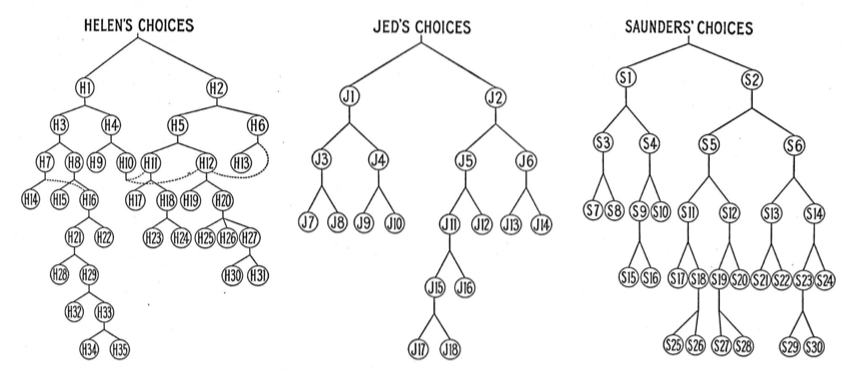
The three protagonists’ possible paths as presented in the book, pp. 2, 64, 110.
We recode these graphs below, using 0s for the root nodes. We will call these graphs ‘playgraphs’.
In[]:=
Rasterize[Row[display/@{helenDisplay,jedDisplay,saundersDisplay}],ImageSize->Scaled[0.8]]
Out[]=
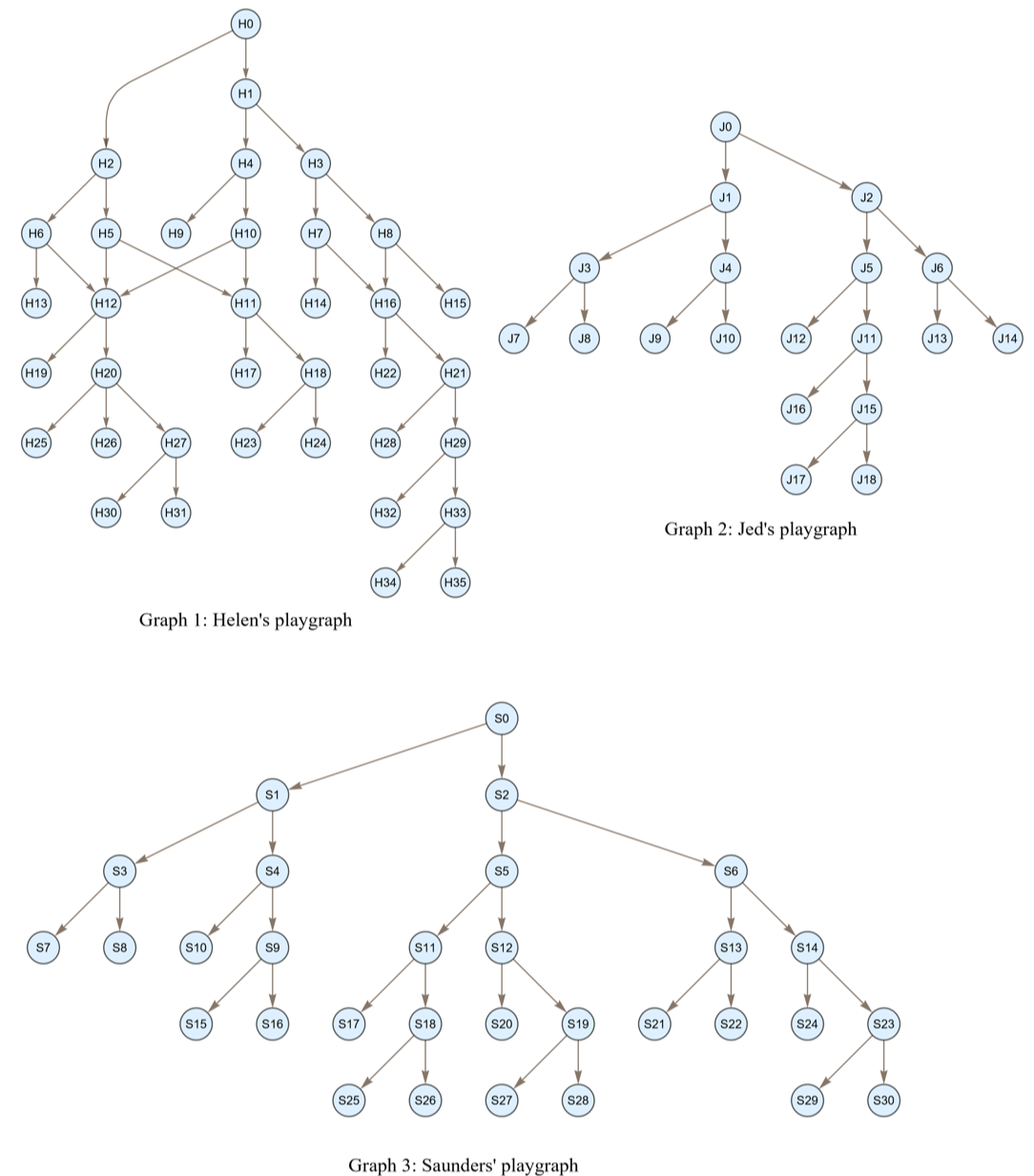
Remarkably, the layout chosen by the editor at The Century Company is similar to what we get by using “LayeredDigraphEmbedding”, while paragraph numbering follows breadth-first indexing. Thus our WL representations are visually quite similar to those used almost a century ago!
3.1 Jed
3.1 Jed
We start the analysis with Jed’s playgraph, which is the simplest of the bunch. It’s an arborescence, i.e., a directed tree with a root such that each node can be reached by exactly one directed path:
In[]:=
TreeGraphQ[jed]
Out[]=
True
The story is composed of 19 paragraphs (vertices). Of these, 10 are endings (leaves), and 9 are decision-nodes. Each decision-node allows for a binary choice (since at least Plato, binary division is paradigmatic for ‘choice’).
In[]:=
choices@jed
Out[]=
| ||||||
|
Due to the arborescence structure, each ending is reached through a unique path; there are thus 10 possible full playthroughs. 7 have a length of 4, 1 a length of 5, and 2 a length of 6.
In[]:=
lengths[jed]
Out[]=
| ||||||||
|
3.2 Saunders
3.2 Saunders
Saunders’ graph is again an arborescence, made up of 31 vertices. Just like for Jed, roughly half of these are leaves, half allow for a binary decision.
In[]:=
choices@saunders
Out[]=
| ||||||
|
In[]:=
TreeGraphQ[saunders]
Out[]=
True
The shortest (longest) readthrough still has length 4 (6). This playgraph is thus structurally very similar to Jed’s; it could be characterized as a purely extensive change: there are somewhat more possibilities/storylines, and the average playthrough is a tiny bit longer.
In[]:=
lengths[saunders]
Out[]=
| ||||||||
|
3.3 Helen
3.3 Helen
Helen’s playgraph is the most involved, and presents some structural innovations. We have 36 nodes, with somewhat less than half being end-nodes. As the number of nodes increases, the space for agency—arguably, the ‘meat’ of genre—expands, and the share of endings naturally starts to shrink. The first novelty is that we now have a node, node H20, with 3 possible continuations.
Second, and perhaps more significantly, the graph is no longer an arborescence:
The arborescence property is lost because some nodes can now be reached by more than one path:
The resulting structure is a connected directed acyclic graph with a single root (the starting paragraph H0).
In particular, sometimes, different choice sequences will lead to identical endings. It is at least arguable, and certainly beyond the scope of our discussion here to ask whether this is a better model of life than the arborescence structure displayed above, where the rule of events appears to be ‘every choice matters’.
Each ending may now have its own path-distribution, including shortest and longest paths leading up to it:
All in all, we have 36 nodes generating 35 possible playthroughs, an almost beautiful coincidence. Undoubtedly, Helen’s story is intended to present the reader with the most elaborate, daring ideas in this book of literary innovations.
4. Conclusion
4. Conclusion
If there was a global repository of ideas called ‘Someone should Write a PhD about This’, I would propose to include the title: A computational history of gamebooks. (Of course, perhaps someone already did just this, in which case, please let me know!) The first section of the first chapter in that PhD could start along what we outlined here.
Was Consider the consequences! popular? Did Doris Webster and Mary Alden Hopkins realize the import of their innovations? Did they follow the development of gamebooks, and, more broadly, of agency in art in the following years? I hope their work made them proud, but I do not know; and I suspect they could not witness the rise and popularization of the genre. Hopkins died in 1960, at the start of decade in which gamebooks began to spread internationally, and right before the inception of the tabletop wargaming revolution in the United States.
Additional reading
Additional reading
CITE THIS NOTEBOOK
CITE THIS NOTEBOOK
The First Gamebook: a graph-theoretic computational analysis of Consider the Consequences (1930)
by Zsombor Méder
Wolfram Community, STAFF PICKS, March 12, 2026
https://community.wolfram.com/groups/-/m/t/3657330
by Zsombor Méder
Wolfram Community, STAFF PICKS, March 12, 2026
https://community.wolfram.com/groups/-/m/t/3657330