In this computational article, I explore the persistence structure of elementary elements (emes) in multiway hypergraph rewriting systems. I define the concept of an eme as an experimental element representing a fundamental unit in the computational structure, and develop numerical methods to track it across both single-way paths and multiway branches. I present a systematic definition of eme lifetime measured in two temporal frameworks: computational time and causal/proper time, and employ simplified statistical measures (averages, survival distributions, exponential fitting) to extract the dispersion/decay parameter λ as an estimate of the diffusion/decay constant. I provide experimental examples for three typical rewriting rules (expanding, contracting, and approximately size-preserving) and discuss the distinctions between computational EMEs and intrinsic/innate EMEs. I conclude with directions for future research and potential connections to deeper physical concepts.
Motivation
Motivation
One core question in the Wolfram Physics Project is how particle-like or persistent structures can arise in a fundamentally computational foundation. Instead of focusing on large-scale emergent geometry or particle spectra, this project asks a microscopic question: how long do basic components of a hypergraph (emes) survive under local rewriting dynamics, and what statistics describe that survival? Measuring eme lifetimes and their distributions can reveal effective decay or diffusion behavior that links local rewriting rules to coarse-grained dynamical constants.
Background / Concepts
Background / Concepts
Hypergraphs and Rules
Hypergraphs and Rules
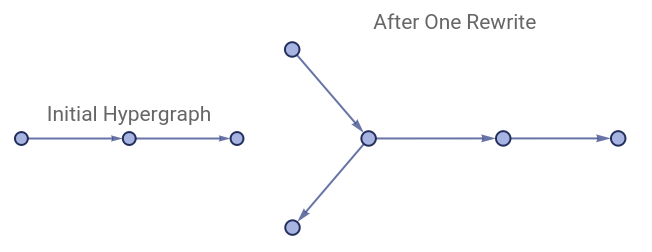
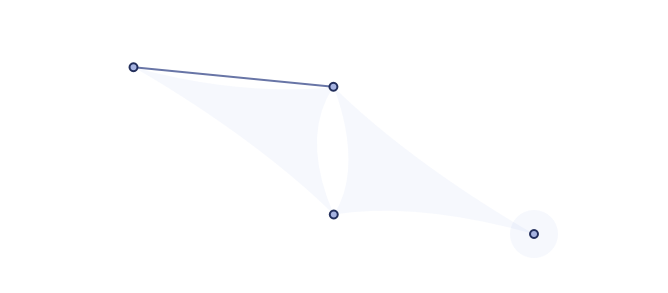
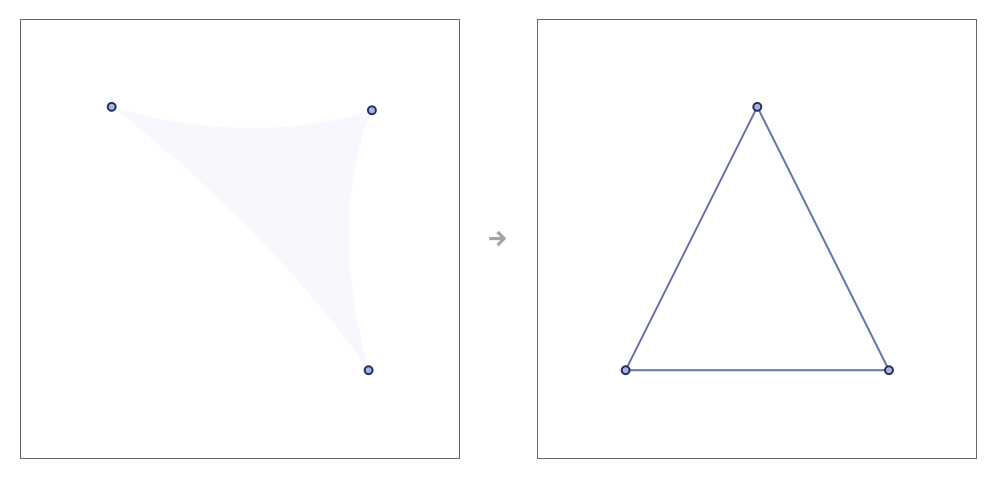
A hypergraph is a generalization of a graph where hyperedges can connect any number of vertices. A rewriting rule specifies how to replace a pattern with another pattern.
Multiway, Single-way, and ECG
Multiway, Single-way, and ECG
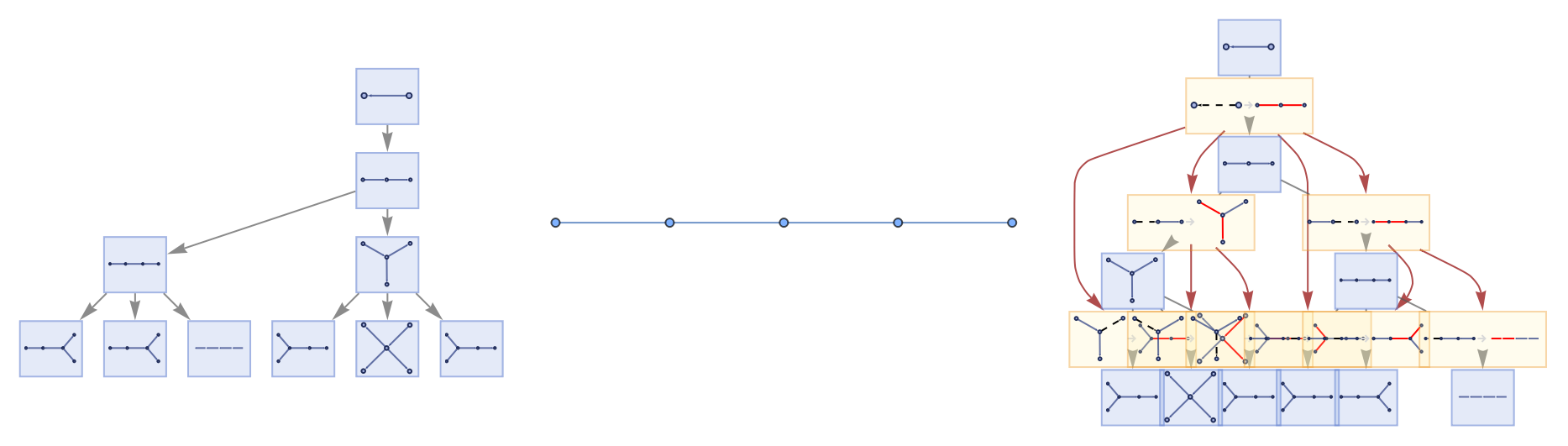
A multiway system generates all possible evolutions when different rule applications are taken in all allowable orders. A single-way system is the restriction to one particular updating order (one of which is the canonical order used by WolframModel). The evolution causal graph (ECG) encodes causal dependencies between events.
What is an “eme”? (computational vs Structural)
What is an “eme”? (computational vs Structural)
An eme is a fundamental atom of computation in a rewriting system. It is an abstract entity that possesses no intrinsic properties beyond its identity and its participation in rewriting events. Emes can be created, persist for some duration, and be destroyed as the system evolves.
This notion is motivated by the idea that the most primitive elements of a computational universe are defined solely by their role in the evolution of structure, rather than by any internal attributes (see Wolfram, Going Below Axiomatic Mathematics).
https://www.wolframscience.com/metamathematics/going-below-axiomatic-mathematics/#p-132
To make this notion precise in practice, we distinguish between two complementary notions of emes:
◼
Computation emes: Concrete vertices/hyperedges in the data representation (are what the system stores.).
◼
Structural emes: Equivalence classes or isomorphic subgraph patterns that are properties of the structure itself (are what the system means).
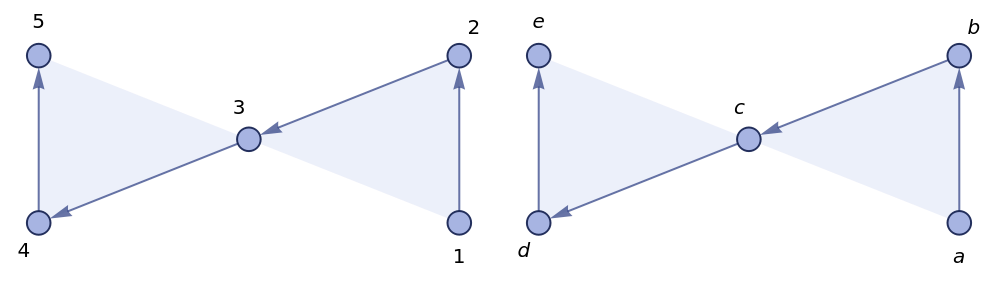
There are two computational representations of the same structural eme. Although the vertices are labeled differently (numerical labels on the left, alphabetical labels on the right), the underlying hypergraph structure is isomorphic . These correspond to distinct computational emes but a single structural eme. Computational eme labels (e . g ., 1–5 or a–e) are representation-dependent and do not affect the underlying structural identity .
Tracking lifetime of vertex emes in individual branches of a multiway system
Tracking lifetime of vertex emes in individual branches of a multiway system
We analyze the persistence of vertex emes along individual branches (histories) of a multiway system by measuring their lifetimes between creation and destruction events.
We consider an eme to be destroyed as soon as it enters a rewriting event. However, we have the option to track emes copied by a rewriting event, which often leads to infinite lifetimes (not counted in the statistics) unless the rules are strictly destructive.
We consider an eme to be destroyed as soon as it enters a rewriting event. However, we have the option to track emes copied by a rewriting event, which often leads to infinite lifetimes (not counted in the statistics) unless the rules are strictly destructive.
Time conventions and lifetime definition
Time conventions and lifetime definition
Computational time: The index of update events in a canonical ordering.
Causal (proper) time: The length of the longest causal path from an origin event to the event in question (computed on the causal graph).
Lifetime: For an eme born at time and destroyed at lifetime is: − .
Emes surviving to the final computed step are excluded.
Causal (proper) time: The length of the longest causal path from an origin event to the event in question (computed on the causal graph).
Lifetime: For an eme born at time
t
start
t
end
T
t
end
t
start
+1
Emes surviving to the final computed step are excluded.
Algorithm for analyzing the mean lifetime of emes
Algorithm for analyzing the mean lifetime of emes
◼
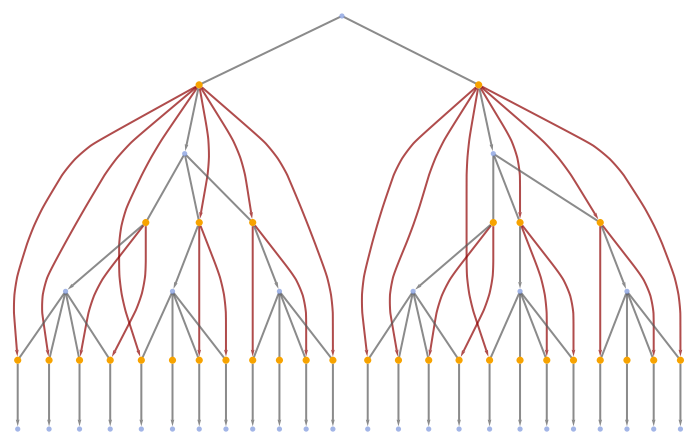
Generate the multiway evolution causal graph.
◼
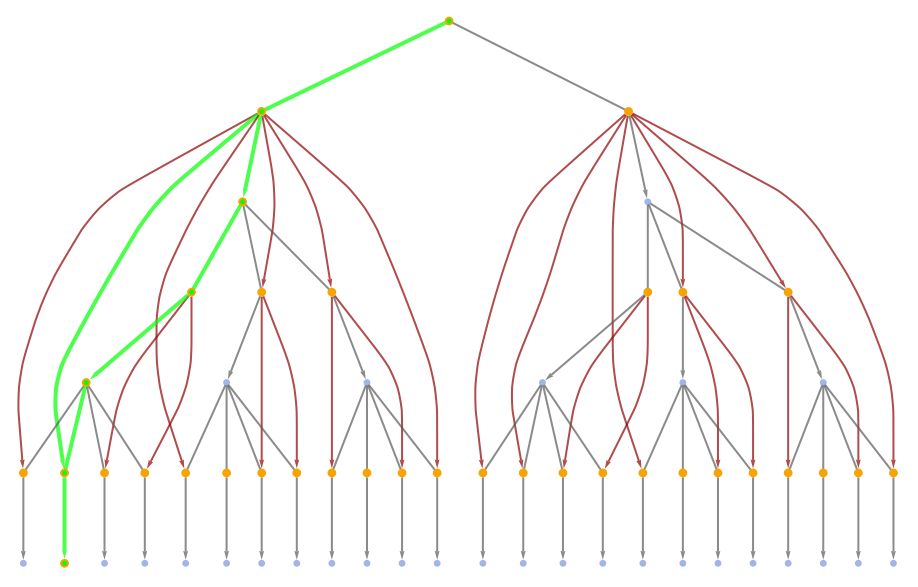
Select a branch (one updating order).
◼
For each event, identify created and destroyed vertices.
◼
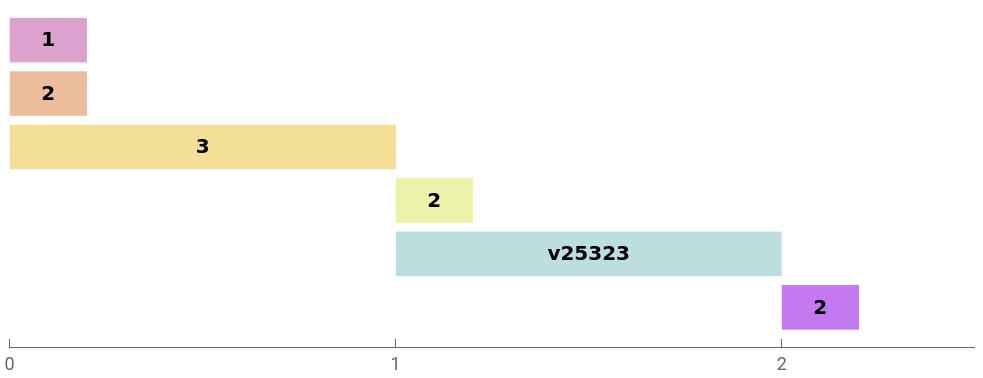
Compute the lifetime of vertices between the events.
◼
Output triples {eme, startTime, endTime} for emes with both times recorded.
◼
Construct a histogram of the lifetime durations and determine the decay‑rate estimator.
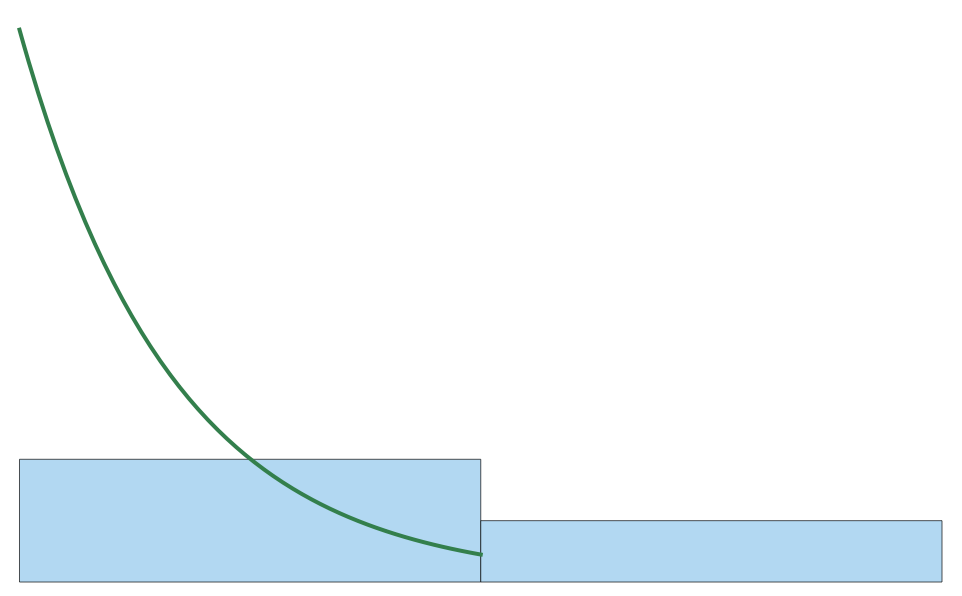
Tracking lifetime of hyperedge emes in the Wolfram Model
Tracking lifetime of hyperedge emes in the Wolfram Model
In this section, we focus on tracking the lifetime of hyperedge emes in the Wolfram Model .
◼
The Wolfram Model evolves according to a single canonical updating order, which makes it possible to follow the system to greater depth and generate a large amount of sequential data along a well-defined history. This structure is especially suitable for extracting lifetime statistics.
◼
Due to the way the Wolfram Model is currently implemented, hyperedge emes are easier to track than vertex emes. Hyperedges are directly referenced in rule applications, while vertex identity is more subtle and requires additional bookkeeping. For this reason, the analysis in this project is restricted to hyperedge emes. Tracking lifetimes of vertex emes is left for future work.
◼
In summary, focusing on hyperedge emes allows reliable lifetime tracking within the canonical Wolfram Model evolution, enabling deeper exploration of persistence and turnover in multiway systems, while more refined tracking of vertex emes remains a natural next extension.
Discussion
Discussion
Comparing outcomes across rules yields qualitative expectations:
◼
Expanding rule: Many short-lived emes, higher λ estimates, right-skewed distributions with short mean lifetimes.
◼
Contracting rule: Fewer emes overall; longer lifetimes for surviving structures but smaller sample sizes.
◼
Approximately size-preserving rule: Intermediate behavior; better suited for observing stationary statistics and reliable λ estimation.
Computational emes may overcount or split structural patterns into multiple computational objects . Future work should convert to structural emes via pattern matching/isomorphism grouping . The physical interpretation of lifetimes measured in computational versus causal time warrants discussion regarding appropriateness for different applications.
Future Directions
Future Directions
◼
Group computational emes into structural equivalence classes via graph isomorphism/pattern matching, recomputing lifetime statistics.
◼
Broaden rule survey: automate analysis across larger rule atlases, clustering rules by observed λ and other statistics.
◼
Investigate relationships between λ and physics-like quantities (local curvature proxies, causal density).
Concluding Remarks
Concluding Remarks
This study presents a concrete computational pipeline for tracking the lifetimes of elementary microscopic elements (emes) in hypergraph rewriting systems. In multiway systems, following vertex emes along individual branches makes it possible to study persistence across alternative histories, while in the WolframModel the canonical single-way evolution enables deep statistical analysis of hyperedge emes. Even when restricted to representation-dependent computational emes and computational time, lifetime distributions already provide insight into microscopic dynamics, for example in terms of the rate of decay and diffusion. This suggests that persistence is a meaningful structural observable, not merely an artifact of computation. Extending this framework by considering the proper time of different observers, intrinsic structural emes, and conditional decay rates would move closer to characterizing emergent dynamical constants of rewriting systems. Ultimately, such measurements provide a bridge between low-level rewriting rules and higher-level effective physical behavior.
Acknowledgments
Acknowledgments
I thank Pavel Hájek for providing the computational infrastructure and visualization code; Ahmed Azmy for conceptual contributions and discussions; and Stephen Wolfram for suggesting the decay/diffusion rate interpretation and enabling this research through the Wolfram Physics Project framework.
The Winter School organizers and participants created an invaluable collaborative environment for this work.
The Winter School organizers and participants created an invaluable collaborative environment for this work.
References
References
1
.S. Wolfram, A Class of Models with the Potential to Represent Fundamental Physics. https://arxiv.org/abs/2004.08210
2
.Wolfram Physics Project. https://www.wolframphysics.org/technical-introduction/
3
.S. Wolfram, Multicomputation: A Fourth Paradigm for Theoretical Science. https://writings.stephenwolfram.com/2021/09/multicomputation-a-fourth-paradigm-for-theoretical-science/
4
.Multicomputation paclet. https://resources.wolframcloud.com/PacletRepository/resources/Wolfram/Multicomputation/
6
.Register of notable universes. https://www.wolframphysics.org/universes/
CITE THIS NOTEBOOK
CITE THIS NOTEBOOK
Tracking EMEs: a persistence view of multiway hypergraph rewriting
by Mahmoud AbdelHalim
Wolfram Community, STAFF PICKS, January 15, 2026
https://community.wolfram.com/groups/-/m/t/3607623
by Mahmoud AbdelHalim
Wolfram Community, STAFF PICKS, January 15, 2026
https://community.wolfram.com/groups/-/m/t/3607623