CylinderRevolutionArea::usage="Find the equation of the cylinder of revolution whose axis is the line x = 2y = - z, and whose radius is 4. Find the area of your section by the XY plane. References: Usunáriz, U et al.Problemas de Geometría Analítica y Diferencial.; Personal.";
Development:
Cylinder’s equation:
In[]:=
Expand==
2
Norm1,,-1{x,y,z}
1
2
2
4Norm1,,-1
1
2
In[]:=
Expand++36
2
-+y
x
2
2
(-x-z)
2
y+
z
2
5
2
x
4
2
y
5
2
z
4
2
x
2
y
2
z
Area of your section with the XY plane (z = 0):
5+8-4xy-144==0;
2
x
2
y
Using my notebook Conicas6.nb:
In[]:=
Conicas[5,-4,8,0,0,-144,{-10,10},{-10,10}]
Los valores de a, b, c, y e son:
LL´
6 | 4 | 2 5 | 16 3 | 5 3 |
Eje mayor en x''
Después de la rotación la ecuación es:
-144+4+9= 0
´2
x
´2
y
El ángulo de rotación es:
θ = 26.5651°
Después de la traslación la ecuación es:
-144+4+9= 0
´´2
x
´´2
y
Las coordenadas del nuevo origen son:
´´
O
Out[]=
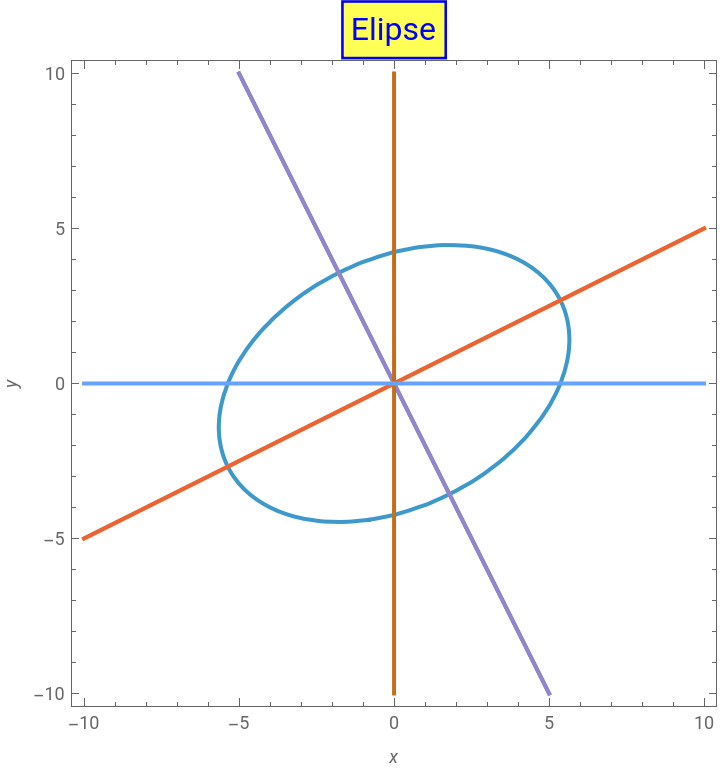
It is an ellipse, the area of an ellipse is π a b:
In[]:=
Área=π(6)(4)
Out[]=
24π
We are going to find a line parallel to the axis:
A point on the cylinder is:
1,-2-1;
1
2
5
,4
5
A line parallel to the axis would be:
ℒ:1,-2-1+t1,,-1;
1
2
5
,4
5
1
2
In[]:=
ManipulateShowRevolutionPlot3D1+t,+t-2-1-t,{t,-5,5},{θ,0,θ1},RevolutionAxis{2,1,-2},PlotStyle->Opacity[0.6],MeshFalse,BoundaryStyleDirective[Black,Thick],PerformanceGoal"Quality",ColorFunction"BlueGreenYellow",ContourPlot3D[z==0,{x,-12,12},{y,-12,12},{z,-6,6},ContourStyle->{Opacity[0.9],Yellow},MeshFalse,PerformanceGoal"Quality"],ParametricPlot3D[{2y,y,-2y},{y,-5,5},ColorFunction->"BlueGreenYellow"],ParametricPlot3Dx,,0,x,-4,0,x,-4
1
2
1
2
5
,4
5
4x+
4608-144
2
x
16
2
,42
,PlotStyle->{Thickness[0.005],Black},ParametricPlot3Dx,4x-
4608-144
2
x
16
2
,42
,PlotStyle->{Thickness[0.005],Black},AxesLabel->(Style[#,15,Blue]&/@{"X","Y","Z"}),AxesOrigin{0,0,0},AxesTrue,BoxedFalse,BoxRatiosAutomatic,PlotRange10,ViewPoint{-8,-3,3},ImageSize700,Style["Cylinder of revolution:",Bold,Large],{{θ1,1,"Value (θ)"},0.1,2π,0.1},ControlPlacementLeftOut[]=


