The Power-Dependence Solution to Five Exchange Networks
The Power-Dependence Solution to Five Exchange Networks


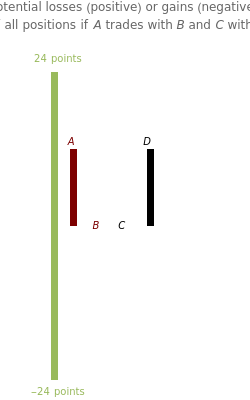
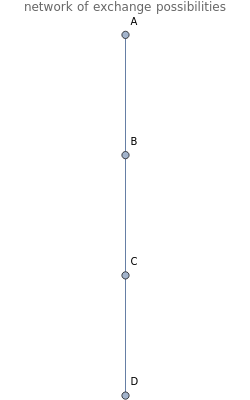
The power-dependence solution to exchange networks assumes that both members of every exchange have equally good alternatives outside the exchange; this solution is an application of the game-theoretic concept of the kernel[2] to exchange networks. All the illustrated networks have four or five nodes and all exchanges are worth 24 points. In every network, nodes and divide 24 points, as do nodes and . You can try to equalize dependence within exchanging pairs by controlling the amounts earned by nodes and .
A
B
C
D
B
C
For example, in the 4-line network let earn 16 in a trade with , who earns 8, and let earn 16 in a trade with , who earns 8. If leaves for , his only alternative partner, he will have to offer at least 16 points and will earn the remaining 8, 8 less than he was earning. , who has no alternative partner, will receive nothing, 8 less than what he was earning. and , then, are equally harmed by a change, as are and . This is the power-dependence solution.
B
A
C
D
B
A
C
C
B
A
A
B
C
D
Details
Details
[1] K. S. Cook and T. Tamagishi, "Power in Exchange Networks: A Power-Dependence Formulation," Social Networks, 14(3-4), 1992 pp. 245–265.
[2] R. B. Myerson, Game Theory: Analysis of Conflict, Cambridge: Harvard University Press, 1991 p. 454.
Permanent Citation
Permanent Citation
Phillip Bonacich
"The Power-Dependence Solution to Five Exchange Networks"
http://demonstrations.wolfram.com/ThePowerDependenceSolutionToFiveExchangeNetworks/
Wolfram Demonstrations Project
Published: March 7, 2011