Nuclear Magnetic Resonance Spectrum of Ethanol
Nuclear Magnetic Resonance Spectrum of Ethanol


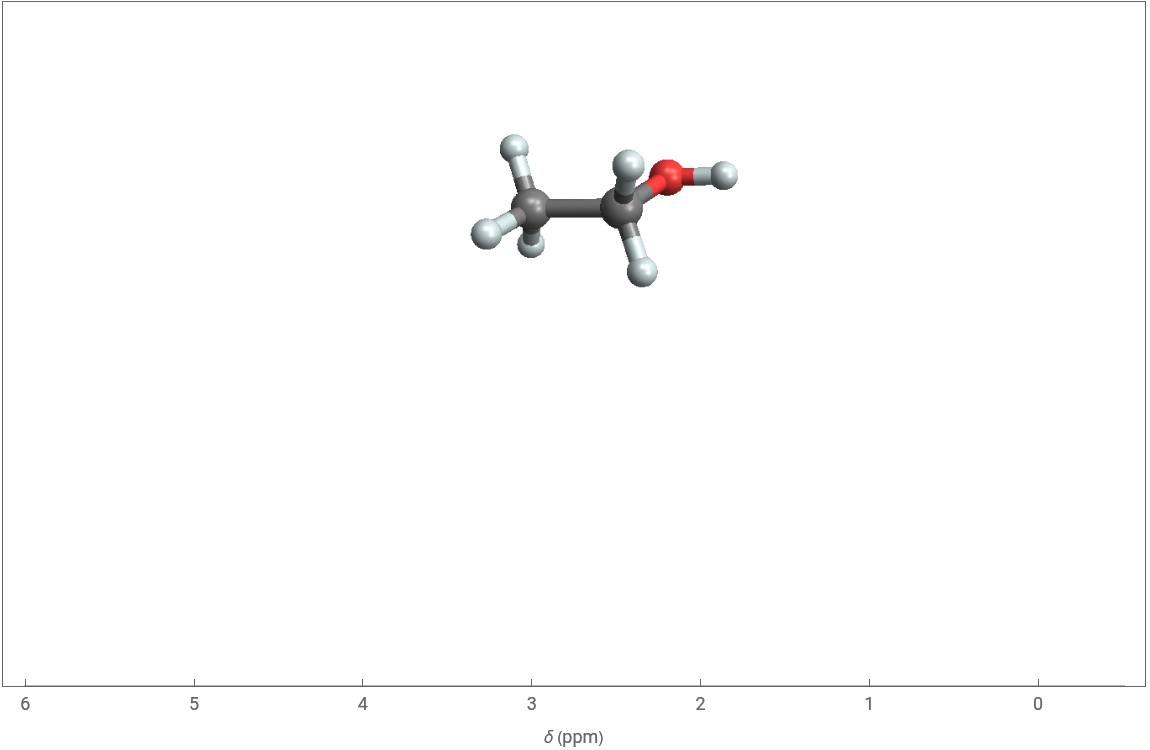
Nuclear magnetic resonance (NMR) spectroscopy can measure radio-frequency Zeeman transitions of proton spins in a magnetic field. It is more convenient to sweep the magnetic field through the resonances at a fixed frequency, typically 60 MHz. The resonances are sensitive to the chemical environment of nonequivalent protons, an effect known as the chemical shift. A classic example is the ethanol molecule CCOH, which shows three chemically-distinct hydrogen atom sites, thus three NMR peaks with intensity ratios 3:2:1. The relevant parameter is , representing the fractional deviation of the chemical shift measured in parts per million (ppm) from that of tetramethylsilane (TMS), a convenient standard assigned the reference value . A small amount of TMS is often added to the sample being measured to calibrate the -scale.
H
3
H
2
δ
δ=0
δ
At higher resolution, it is possible to identify further splitting of the chemically-shifted peaks due to spin-spin interactions with neighboring groups of protons. Thus the C resonance is split into a 1:2:1 triplet by interactions with the two C protons. Correspondingly, the C resonance is split into a 1:3:3:1 quartet by interactions with the three C protons. The OH resonance is not usually split because of the rapid exchange of these protons via hydrogen bonding.
H
3
H
2
H
2
H
3
The spectroscopic procedures described in this Demonstration are intended as a simplified introduction to the principles of NMR. Modern NMR spectroscopy makes use of Fourier-transform techniques, which produce the entire spectrum simultaneously.
Details
Details
Snapshot 1: the earliest detection of the chemical shift, obtained at Stanford University in 1951; the three peaks in ethanol have approximate values of 4.85, 3.75 and 1.25, with relative intensities identifying these with the OH, C, and C protons, respectively
δ
H
2
H
3
Snapshot 2: at higher resolution, spin-spin splittings can be observed; the peak at is from a trace amount of TMS
δ=0
Snapshot 3: resonance absorption and emission of protons in the C group; the different possible orientations of the C protons are also indicated
H
3
H
2
Reference: S. M. Blinder, Introduction to Quantum Mechanics, Amsterdam: Elsevier, Academic Press, 2004 p. 247ff.
External Links
External Links
Permanent Citation
Permanent Citation
S. M. Blinder
"Nuclear Magnetic Resonance Spectrum of Ethanol"
http://demonstrations.wolfram.com/NuclearMagneticResonanceSpectrumOfEthanol/
Wolfram Demonstrations Project
Published: March 7, 2011