CITE THIS NOTEBOOK: Tetris for Proteins–Shape Based Molecular Chemistry by Logan Hallee. Wolfram Community JAN 13 2023.
Protein-protein interactions are difficult to predict with coarse grain molecular dynamics or natural language processing techniques. Therefore, researchers seek to combine aspects of these methods by utilizing physically informed deep neural networks, otherwise known as neurosymbolic programming. We envision a simplistic shape-based molecular chemistry in the Wolfram Language: Tetris for Proteins. Our solvers optimize a custom metric of inscribed perimeter divided by combined area to approximate the efficient packing of “Tetris-like” random pseudo-molecules. Statistics of these packing properties allow us to induce a lock and key dynamic between our generated structures. We further study their behavior by combining them into complexes on multiway graphs, showcasing their propensity for aggregation. We hypothesize that extending this metric in 3D, inscribed surface area divided by combined volume, could be a useful physical property to guide the learning of neural networks. Future work involves extending our generation and solvers to 3D, and studying our metric on actual protein structures.
Introduction
Introduction
Coarse grain prediction of protein-protein interactions (PPIs) is difficult due to the dynamic and charged behavior of these macromolecules. Natural language processing (NLP) architectures attempt to combat this by translating the “biological language” into a high dimensional numerical feature space [1]. However, while NLP approaches correctly comprehend the proteins 3-dimensional shape, they typically lack in predicting qualities from this knowledge. To combat this, researchers seek to design neurosymbolic tools: Physically or mathematically informed constraints to guide the learning neural networks towards specific goals [2]. We hypothesize that the addition of structural relationships from pairs of proteins could better inform a neural network to predict PPIs than with just sequence information alone. Encoding information from coarse grain models alongside NLP architectures is a potential solution, but would add a considerable computational toll. We propose adding a simpler structural feature for PPIs: The minimized inscribed surface area that two proteins can share.
To study structural relationships we develop the framework of a new system from the Wolfram Language: Tetris for Proteins. By optimally orienting "Tetris-like" structures within an inscribed region we are able to induce a lock and key enzyme-substrate relationship. Our main contributions are as follows:
To study structural relationships we develop the framework of a new system from the Wolfram Language: Tetris for Proteins. By optimally orienting "Tetris-like" structures within an inscribed region we are able to induce a lock and key enzyme-substrate relationship. Our main contributions are as follows:
◼
Building a function to generate random topological structures with a given components, resembling larger Tetrominoes.
◼
Implementing an efficient solver for a 2D packing problem using a convolution like scanning approach.
◼
Designing a shape-based metric for comparing the packing of random objects.
◼
Analyzing the statics of this metric for many instances and sizes of structures.
◼
Taking sets of these structures as pseudo-molecules, representing proteins in a simplistic model.
◼
Studying the behavior of sets of pseudo-molecules, allowing them to "react" and combine given a specific packing efficiency.
◼
Visualizing the aggregation and complex formation of these pseudo-molecules with multiway graphs, showcasing a preliminary shape-based molecular chemistry.
Random Structure Generation and 2D Packing
Random Structure Generation and 2D Packing
We utilize a random walk to generate 2D orthogonally connected squares. The blocks of these structures are represented by 1s in a matrix while the background is 0, where a size of 10 has 10 total blocks. Additionally, we opted to fill in any holes generated by the random walk cross back on itself. This gives the objects a more concise representation without random holes. This setup is ideal for utilizing a convolutional like operation that slides one structure to every possible orientation. The code for this structure generation and scanning operation are in the Code section below.
Example of Convolution-Like Scanning
Example of Convolution-Like Scanning
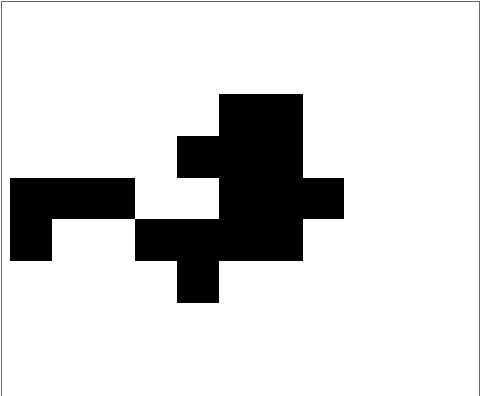
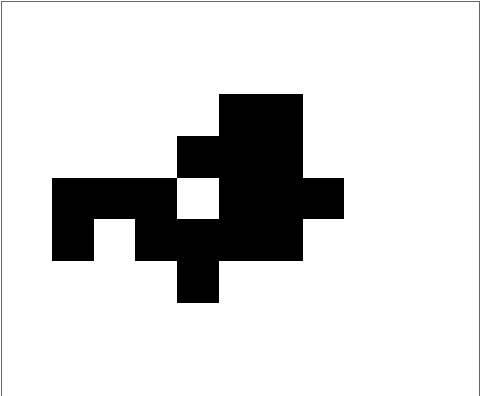
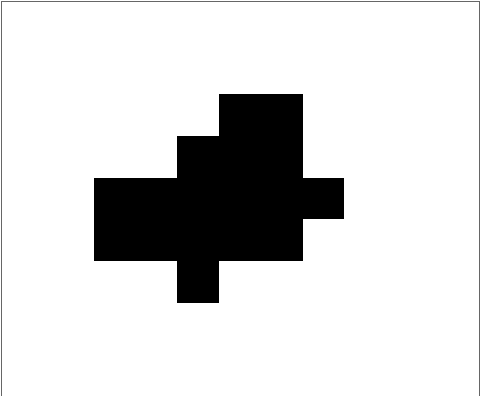
To optimize the orientation of two pseudo-molecules we treat it like a packing problem: An attempt to pack two random in as small of a region as possible. In this 2D case with block-like units, we minimize the perimeter of the inscribed rectangle. Firstly, we throw out all intersecting orientations. Then, we score the remaining orientations for comparison; take the perimeter of the inscribed rectangle and divide by the summed area of both structures. This metric or score scales with the over size of the structures, allowing us to use one score for any size of object. We take the orientation with the minimal score as the approximated optimal packing for two particular structures.
Score
Re
d
Perimeter
Gre+Blac
y
Area
k
Area
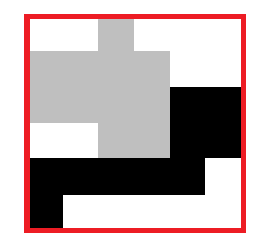
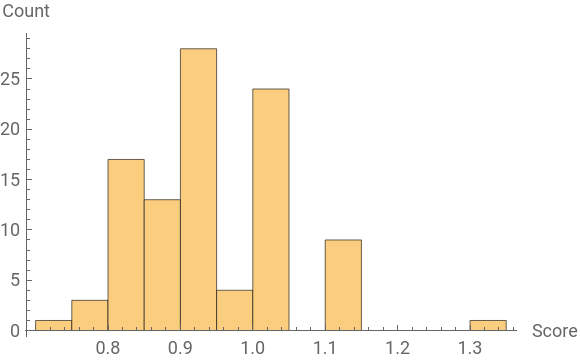
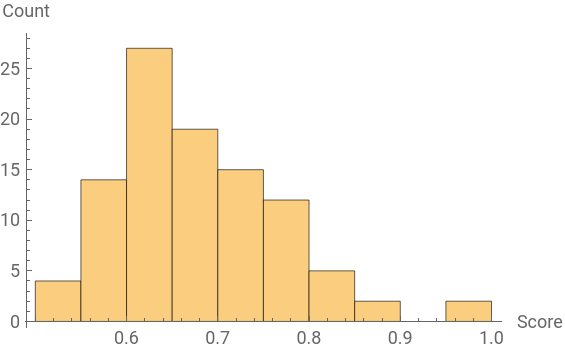
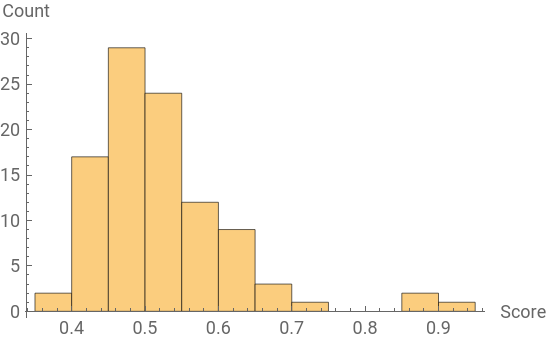
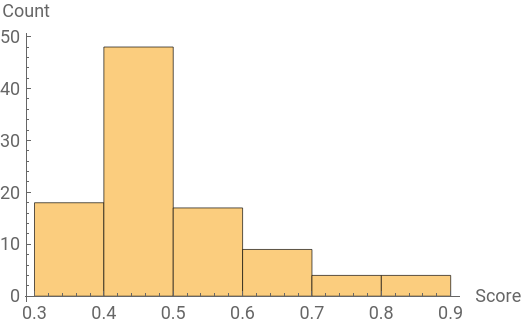
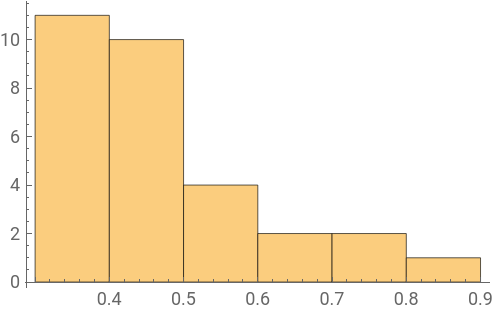
Initially, our score was calculating the area of the inscribed rectangle. This metric lead to similar results but with many more alternative equivalent orientations. Many of the approximated optimal orientations did not qualitatively mimic the lock and key model which we were hoping to accomplish as a simplistic protein model. If two structures mimic a lock and key in their solved orientations, we can let them "react" or combine into larger structures to study on multiway graphs. This multiway graph would highlight the propensity of our simplistic molecules to form into larger complexes with a shape-based molecular chemistry. This is potentially analogous to any shape-based complex formation or protein aggregation in biological systems. In order to classify which orientations were particularly good and allow those to combine, we needed to calculate some statistics on how well random shapes can fit together given their size. Our statistical procedure generates two random structures of size , finds their optimal orientation and score, and records that information. Repeating this many times allows for a sense of the distribution of our score across many possible structures.
Distribution of Score for Packing
Distribution of Score for Packing
ContactStats is set up as follows: [Number of times repeated, Size, Proposed Criteria for Reaction]
{distribution,structures}=ContactStats[100,10,0.8];Histogram[distribution,AxesLabel{"Score","Count"}]
{distribution,structures}=ContactStats[100,25,0.6];Histogram[distribution,AxesLabel{"Score","Count"}]
{distribution,structures}=ContactStats[100,50,0.5];Histogram[distribution,AxesLabel{"Score","Count"}]
{distribution,structures}=ContactStats[100,75,0.45];Histogram[distribution,AxesLabel{"Score","Count"}]
{distribution,structures}=ContactStats[30,100,0.4];Histogram[distribution]
Lock and Key Behavior
Lock and Key Behavior
Shown are some random examples that exhibit behavior similar to a lock and key dynamic that is common in molecular biology. We selected for these outcomes by constraining the criteria/score found from the distributions above.
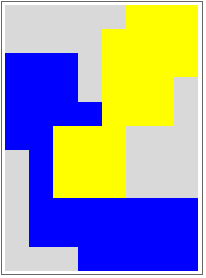
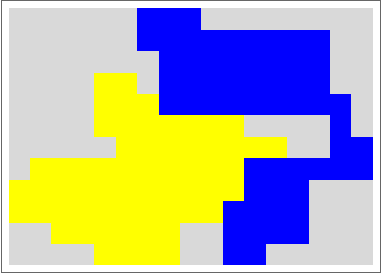
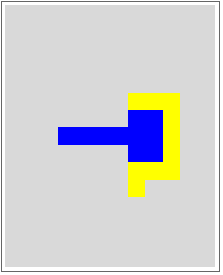
Importantly, we rotate our scanning molecule by 90, 180, and 270 degrees to test all orientations. However, we do not superimpose the structures to maintain a sense of chirality. We also allow for regions of empty space in between the molecules. Regions like this are often important for substrates, cofactors, or structure in general.
Complex Formation
Complex Formation
Individual Examples
Individual Examples
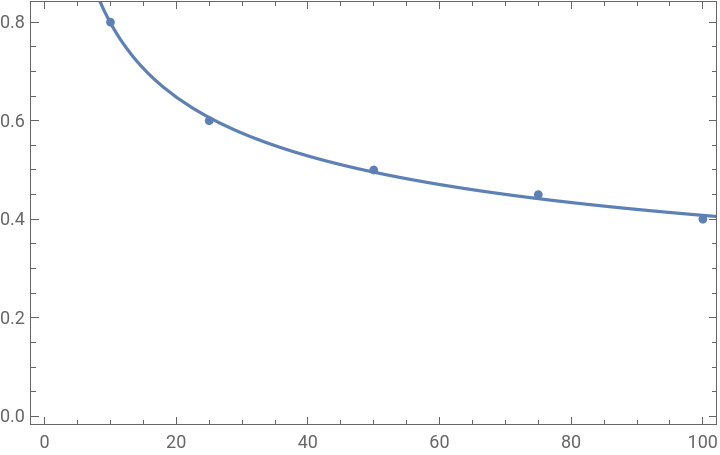
In our simplistic protein model, we allow for binding or the combination of two structures to occur when the score is low enough. According to the statistics above, the specific criteria to constrain efficient packing gets smaller as the overall structure gets bigger. Therefore, it is advantageous to have a function to predict criteria for efficient packing given the current size of the structure. To accomplish this, we ran a nonlinear regression on data derived from our histograms above to predict the optimal score to use given the size.
data={{10,0.8},{25,0.6},{50,0.50},{75,0.45},{100,0.4}};nlm=NonlinearModelFit[data,a/x^b+c,{a,b,c},x]Show[ListPlot[data],Plot[nlm[x],{x,0,110}],FrameTrue]
Out[]=
FittedModel
Out[]=
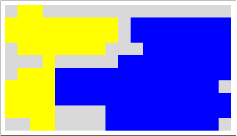
To visualize complex formation in our simplistic protein model, we first generate many initial structures with the same number of squares. Then, we allow for structures to combine given a minimum score required by the function output. The code is included in the Code section below. This is visualized below: The blue structure is the previously existing complex or protein, while the yellow structure is the newest addition.
Example 1: 10 steps of 10 sized objects.
Example 2: 15 steps of 10 sized objects.
Example 3: 10 steps of 25 sized objects.
An important note is that because we restrict the generation of the objects to orthogonal squares, the random walk can occasionally get halted. This is more common the larger the number of squares input is. When this happens, we save the object like normal. This is included in our statistical comparison, so we believe the behavior of the metric holds for this process. However, for very large structures it will be common to have a heterogeneity among a set of generated objects.
Example 4: 5 steps of 35 sized objects.
Example 4: 5 steps of 35 sized objects.
Example 5: 3 steps of 50 sized objects.
Interestingly, the larger the objects get the more gaps they tend to leave in between structures. This can often allow for a part of another structure or a smaller structure to fit inside. Remarkably, there are some aspects in biological systems that act in this exact way. For instance, the complement system is a combinatorial mess of orientations of several proteins that allow for the inclusion of proteins in a cascade of effects [3]. Other biological pathways can also act like this, one combination and/or reaction leading to another effect [4]. Perhaps this comes naturally from looking at biology as random generation as well, through the constant battle with entropy random mutations define the space of biological structures.
The same criteria and logic used to combined these individual examples is used to construct our multiway graphs below, and view these combinations at a much larger scale.
The same criteria and logic used to combined these individual examples is used to construct our multiway graphs below, and view these combinations at a much larger scale.
Multiway Graphs
Multiway Graphs
Outline of our multiway system:
Create an initial pool of k pseudo-molecules.
Create an initial pool of k pseudo-molecules.
In essence, these have an infinite concentration, so they can constantly be added to a given growing complex given they bind well enough according to our criteria. When two molecules are combined and do not pack efficiently enough given our criteria, the other larger molecule is discarded and the protein is returned. This state is of a protein or complex with a different colored edge than the one it was assigned. When two molecules are combined and do pack efficiently enough, their combined state is returned. The color of the edge shows which initial protein was added, and it is also highlighted in yellow. The growing complex is kept blue.
Define our rule system and edge tracking.
Here, a red edge means that the associated initial protein was just added to the complex (same for green and purple respectively). Each of these three protein is of size 10.
Here is a 3 step multiway graph (rules applied 3 times) applying our rules and criteria for combination on the 3 pools of initial proteins. Even with only 3 options shown above to build larger structures, our simplistic system shows a high likelihood of protein aggregation and/or complex formation.
We also tried a more elaborate initial pool of 10 molecules of size 20, with the corresponding edge coloring shown below.
10 initial protein of size 20 with 1 step:
10 initial protein of size 20 with 2 steps:
10 initial protein of size 20 with 3 steps:
The combinatorial explosion of different kinds of complexes formed from 10 unique random objects is quite astounding. Our system shows a high propensity of aggregation or complex formation under strict packing requirements with only a small pool of molecules. The situation gets much more complicated when structures are flexible and charged like real proteins, but no wonder protein aggregation is a problem for biological cells: random objects can combine readily with simplistic criteria.
Future Work
Future Work
Due to the expedited nature of the Wolfram Winter School there are numerous ways to continue or improve this research. Firstly, equivalent perimeters in slightly different conformations are treated the same way. It would be advantageous to add a system that further optimizes the contact of the two objects so that there is a single deterministic solution of best orientation for two of our structures. Another natural continuation is to extend to 3D random-walk structures and minimize the inscribed surface area in proportion to the sum of volumes of the structures. In 3D, it would be interesting to see if minimizing the surface area of an inscribing sphere or cuboid gives better results. After accomplishing this, it would be vital to try on actual PDB protein files to see if this metric is useful for directing the learning of neural networks. We suspect that a deep neural network could learn the importance of such physical metrics and guide more useful learning for predicting PPIs or other applications. It would likely be useful to impose a sparse mesh on real protein structures for ease of computation. We also noticed that when using directed random walks the structures can often appear qualitatively as long lipid structures. Tracking the aggregation of randomized pseudo-lipids with shape-based metrics may also have extended applications.
Concluding remarks
Concluding remarks
In summary, we sought to study the properties of random "Tetris-like" pseudo-molecules. We developed a framework to generate and measure the packing of these pseudo-molecules in 2D space. Utilizing nonlinear regression, we are able to take advantage of the statistics behind the combination of random structures, and build a scalable criteria that only allows well packed complexes to be formed. This simplistic enzyme model is shown throughout our individual complex generation and multiway graph setup. The combinatorial nature of our multiway graphs highlight behavior analogous to protein aggregation or complex formation in biological systems; many combined structures emerge with similar shape and components despite various paths to get there. We hope that similar shape-based metrics could be fed alongside neural networks to guide learning from proteins sequences towards useful tasks. Our work is easily extendable by implementing 3D solvers, and then meshing and calculating scores for actual protein structures.
Keywords
Keywords
◼
Packing Problems
◼
Protein-protein interactions
◼
Shape-based chemistry
Acknowledgment
Acknowledgment
A huge thanks to my mentors Eric James Parfitt and James Boyd who were instrumental in guiding me throughout this project. In addition, Sotiris Michos and Nik Murzin were extremely helpful with their code improvements and project directions. I would also like to thank Stephen Wolfram for helping me define this project within the "Molecular Computing" track and also WWS 2022 for this unique opportunity. Lastly, I would like to express my gratitude towards my mentor Jason Gleghorn at the University of Delaware for his constant support in all avenues of my research.
References
References