Liquid–Liquid Equilibrium Analysis of the Water–Methanol–n-Hexane–n-Heptane System
Authors: Siwar Labidi and Housam Binous
Liquid–Liquid Equilibrium Analysis of the Water–Methanol–n-Hexane–n-Heptane System
Authors: Siwar Labidi and Housam Binous
Authors: Siwar Labidi and Housam Binous
The liquid–liquid equilibrium (LLE) behavior of the quaternary system water (1) + methanol (2) + n-hexane (3) + n-heptane (4) is investigated at 298.15 K using the Non-Random Two-Liquid (NRTL) model with temperature-dependent interaction parameters.
The feed composition considered is:
* Water = 0.40
* Methanol = 0.10
* n-Hexane = 0.25
* n-Heptane = 0.25
A Tangent Plane Distance (TPD) stability analysis was first carried out to assess the thermodynamic stability of the feed mixture. The minimum TPD value obtained was −0.539068, which is significantly lower than zero and therefore indicates that the feed composition is thermodynamically unstable as a single liquid phase. Consequently, the mixture undergoes liquid–liquid phase separation.
The equilibrium phase compositions were subsequently determined by solving the phase-equilibrium equations together with the overall material balance constraints. The calculated compositions of the coexisting liquid phases were:
Liquid Phase 1 (water-rich phase)
Water = 0.820114
Methanol = 0.179354
n-Hexane = 0.000530
n-Heptane = 0.000002
Liquid Phase 2 (hydrocarbon-rich phase)
Water = 0.001622
Methanol = 0.024752
n-Hexane = 0.486562
n-Heptane = 0.487064
The calculated phase fraction was β = 0.486722, indicating that approximately 48.7% of the overall mixture forms the water-rich phase, while the remaining 51.3% forms the hydrocarbon-rich phase.
The results show a pronounced separation between the polar components (water and methanol) and the nonpolar hydrocarbons (n-hexane and n-heptane). The strongly negative TPD value and the large compositional differences between the two liquid phases confirm the existence of a stable liquid–liquid equilibrium region for the selected feed composition. These findings demonstrate the effectiveness of combining TPD stability analysis with the NRTL model for predicting phase splitting and equilibrium compositions in multicomponent partially miscible systems.
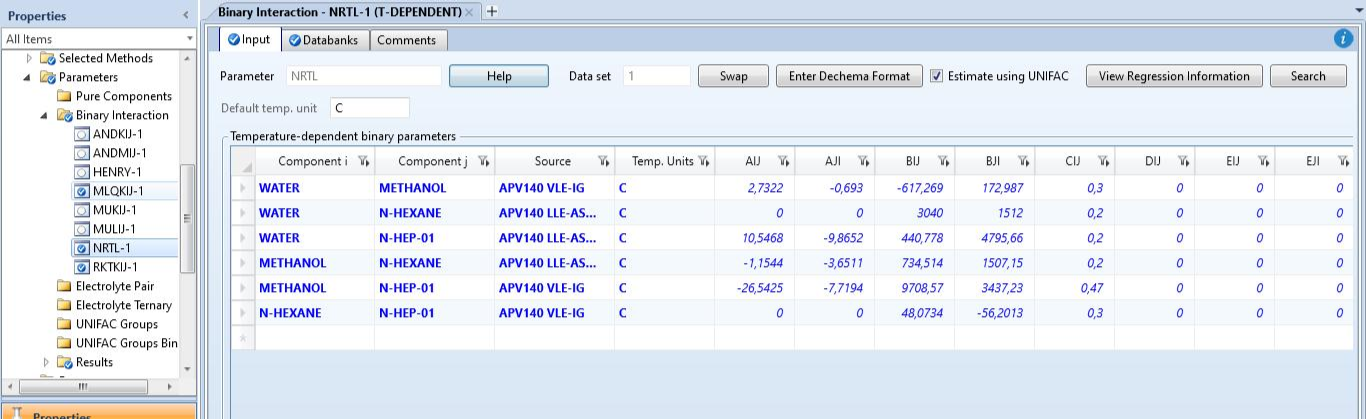
Mathematica results show excellent agreement with their counterparts obtained using Aspen-Plus.
In[]:=
(*============================================================NRTLParametersfromAspenPlusAPV140Source:BinaryInteractionNRTL-1(T-Dependent)Convention:tau_ij=Aij+Bij/T(K)alpha_ij=CIJ(constant)Componentorder:1=Water2=Methanol3=n-Hexane4=n-Heptane============================================================*)(*----Aijmatrix(rows=i,cols=j)----*)aNRTL={{0,2.7322,0,10.5468},(*Water*){-0.693,0,-1.1544,-26.5425},(*Methanol*){0,-3.6511,0,0},(*n-Hexane*){-9.8652,-7.7194,0,0}(*n-Heptane*)};(*----Bijmatrix(K)----*)bNRTL={{0,-617.269,3040,440.778},{172.987,0,734.514,9708.57},{1512,1507.15,0,48.0734},{4795.66,3437.23,-56.2013,0}};(*----alphaNRTL(CIJ)—symmetric----*)alphaNRTL={{0,0.30,0.20,0.20},{0.30,0,0.20,0.47},{0.20,0.20,0,0.30},{0.20,0.47,0.30,0}};(*----Corefunctions(unchangedfrompreviouscode)----*)tauMatrix[T_]:=aNRTL+bNRTL/T;gMatrix[T_]:=Exp[-alphaNRTL*tauMatrix[T]];lnGammaNRTL[x_List,T_?NumericQ]:=Module[{tau=tauMatrix[T],G=gMatrix[T],n=4},Table[Module[{num1,den1,s2},num1=Sum[x[[j]]tau[[j,i]]G[[j,i]],{j,1,n}];den1=Sum[x[[k]]G[[k,i]],{k,1,n}];s2=Sum[Module[{dj=Sum[x[[k]]G[[k,j]],{k,1,n}],nj=Sum[x[[m]]tau[[m,j]]G[[m,j]],{m,1,n}]},x[[j]]G[[i,j]]/dj(tau[[i,j]]-nj/dj)],{j,1,n}];num1/den1+s2],{i,1,n}]];gammaNRTL[x_List,T_?NumericQ]:=Exp[lnGammaNRTL[x,T]];
In[]:=
z={0.40,0.10,0.25,0.25};
In[]:=
gammaZ=gammaNRTL[z,298.15]
Out[]=
{4.21873,1.1997,2.87274,2.64578}
In[]:=
Clear[TPD];TPD[w1_?NumericQ,w2_?NumericQ,w3_?NumericQ]:=Module[{w4,w,gammaW},w4=1-w1-w2-w3;If[w1<=0||w2<=0||w3<=0||w4<=0,Return[10^10]];w={w1,w2,w3,w4};gammaW=gammaNRTL[w,298.15];Sum[w[[i]]*(Log[w[[i]]*gammaW[[i]]]-Log[z[[i]]*gammaZ[[i]]]),{i,1,4}]];
In[]:=
sol=NMinimize[{TPD[w1,w2,w3],w1>=10^-6,w2>=10^-6,w3>=10^-6,1-w1-w2-w3>=10^-6},{w1,w2,w3},Method->{"DifferentialEvolution"}];TPDmin=sol[[1]];Print[" TPDmin = ",NumberForm[TPDmin,{12,8}]]
TPDmin = -0.53906814
In[]:=
eqns[xa1_,xa2_,xa3_,xb1_,xb2_,xb3_,beta_]:=Module[{xa4,xb4,xa,xb,ga,gb},xa4=1-xa1-xa2-xa3;xb4=1-xb1-xb2-xb3;xa={xa1,xa2,xa3,xa4};xb={xb1,xb2,xb3,xb4};ga=gammaNRTL[xa,298.15];gb=gammaNRTL[xb,298.15];{(*equilibrium*)xa[[1]]ga[[1]]-xb[[1]]gb[[1]],xa[[2]]ga[[2]]-xb[[2]]gb[[2]],xa[[3]]ga[[3]]-xb[[3]]gb[[3]],xa[[4]]ga[[4]]-xb[[4]]gb[[4]],(*massbalances*)z[[1]]-betaxa[[1]]-(1-beta)xb[[1]],z[[2]]-betaxa[[2]]-(1-beta)xb[[2]],z[[3]]-betaxa[[3]]-(1-beta)xb[[3]]}];
In[]:=
sol=FindRoot[eqns[xa1,xa2,xa3,xb1,xb2,xb3,beta]==ConstantArray[0,7],{{xa1,0.82},{xa2,0.18},{xa3,0.0003},{xb1,0.0016},{xb2,0.025},{xb3,0.48},{beta,0.50}},AccuracyGoal->12,PrecisionGoal->12,MaxIterations->1000]
Out[]=
{xa10.820114,xa20.179354,xa30.000530465,xb10.00162235,xb20.0247519,xb30.486562,beta0.486722}
In[]:=
Graphics[{Text[Style["liquid 1 :",Black,14],{2.2,3.75},{-1,0}],Text[Style["water = "<>ToString[NumberForm[xa1/.sol,{7,6},ExponentFunction(Null&)]]<>"",Darker@Blue,12],{2.2,3.35},{-1,0}],Text[Style["methanol = "<>ToString[NumberForm[xa2/.sol,{7,6},ExponentFunction(Null&)]]<>"",Darker@Blue,12],{2.2,2.95},{-1,0}],Text[Style["n-hexane = "<>ToString[NumberForm[xa3/.sol,{7,6},ExponentFunction(Null&)]]<>"",Darker@Blue,12],{2.2,2.55},{-1,0}],Text[Style["n-heptane = "<>ToString[NumberForm[1-xa1-xa2-xa3/.sol,{7,6},ExponentFunction(Null&)]]<>"",Darker@Blue,12],{2.2,2.15},{-1,0}],Text[Style["liquid 2 :",Black,14],{2.2,-2.25},{-1,0}],Text[Style["water = "<>ToString[NumberForm[xb1/.sol,{7,6},ExponentFunction(Null&)]]<>"",Darker@Red,12],{2.2,-2.65},{-1,0}],Text[Style["methanol = "<>ToString[NumberForm[xb2/.sol,{7,6},ExponentFunction(Null&)]]<>"",Darker@Red,12],{2.2,-3.05},{-1,0}],Text[Style["n-hexane = "<>ToString[NumberForm[xb3/.sol,{7,6},ExponentFunction(Null&)]]<>"",Darker@Red,12],{2.2,-3.45},{-1,0}],Text[Style["n-heptane = "<>ToString[NumberForm[1-xb1-xb2-xb3/.sol,{7,6},ExponentFunction(Null&)]]<>"",Darker@Red,12],{2.2,-3.85},{-1,0}],Text[Style["phase fraction = "<>ToString[NumberForm[beta/.sol,{7,6},ExponentFunction(Null&)]]<>"",Purple,16],{2.4,0},{-1,0}],Text[Style["feed",Black,16],{-2.75,0.6},{-1,0}],Text[Style["water = "<>ToString[NumberForm[z[[1]],{4,2},ExponentFunction(Null&)]]<>"",Black,12],{-2.75,0.15},{-1,0}],Text[Style["methanol = "<>ToString[NumberForm[z[[2]],{4,2},ExponentFunction(Null&)]]<>"",Black,12],{-2.75,-0.25},{-1,0}],Text[Style["n-hexane = "<>ToString[NumberForm[z[[3]],{4,2},ExponentFunction(Null&)]]<>"",Black,12],{-2.75,-0.65},{-1,0}],Text[Style["n-heptane = "<>ToString[NumberForm[z[[4]],{4,2},ExponentFunction(Null&)]]<>"",Black,12],{-2.75,-1.05},{-1,0}],{EdgeForm[Thick],Opacity[0.5],Green,Rectangle[{0,0},{2,2}]},{Thick,Black,Arrow[{{1,2},{1,4},{5,4}}]},{Thick,Black,Arrow[{{1,0},{1,-2},{5,-2}}]},{Thick,Black,Arrow[{{-3,1},{-0.001,1}}]}}]