Vertically coupled cylindrical quantum dots
Vertically coupled cylindrical quantum dots
A. Samsonyan
Wolfram Labaratory, Russian-Armenian University, Yerevan, Armenia
In our laboratory we are engaged in numerical modeling of processes in nanostructures, using Wolfram Language. In particular, we study optical and light phenomena to quantum dots, such as: interband absorption, photoluminescence, intraband absorption, nonlinear absorption, harmonic generations in quantum dots and much more. In this paper, we will show how to compare numerical and analytical results.
Introduction
Introduction
Progress in semiconductor nanoelectronics has made it possible to fabricate zero-dimensional structures, the so-called quantum dots (QDs). These structures are interesting because of the fact that particles motions are confined in all three directions, which gives the possibility for physical characteristic effective control of those structures. A strong dependence of the energy spectrum of particles on the geometrical shape and sizes of QD allows to manipulate the energy spectrum and consequently, the physical characteristics of QD [1-3].
A correct approximation of quantum dots confinement potential plays the main role at the study of physical parameters of such systems. The confining potential in most cases can be approximated with a high accuracy by a parabolic potential [4-6]. However, in reality, the parabolic potential is realized only for the lowest energy levels. It is obvious that with the increase of quantum number the course of confining potential diverges from the parabolic potential. For a more successful and realistic approximation of the formed confining potential in z direction the use of the different potentials has been proposed [7-9]. One of successful symmetric potential is modified Pöschl–Teller potential (MPTP) [10-11].
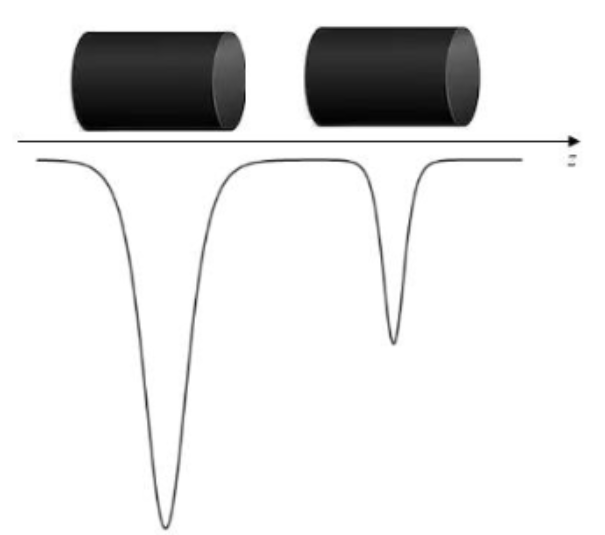
Recently, the problem of studying vertical coupled quantum dots is relevant [12-14]. This is due to the usability of lasers based on these coupled systems. So investigations of the direct light absorption of vertical coupled semiconductor structures are a powerful tool for determination of many characteristics of QDs. The presence of size quantization essentially influences the absorption mechanism. In fact, the formation of new energy levels of the size quantization makes possible new interlevel transitions. In this paper the electronic states, interband absorption and photoluminescence (PL) coefficients in vertical coupled cylindrical QDs with double MPTP in axial direction (Figure 1) are discussed. Absorption and PL coefficients are obtained in a strong size quantization regime.
Constants
Constants
In[]:=
m0 = 9.1*; (* Free electron mass in [kg] *)me = 0.023*m0; (* Effective electron mass in [kg] *)mh = 0.026*m0; (* Effective hole mass in [kg] *)e = 1.6*; (* Elementary charge in [C] *)ℏ = 1.054*; (* Plank constant in [J*s] *)ϵ0 = 8.85*; (* Electric constant in [F/m] *)ϵr = 13.18;ϵ = ϵ0*ϵr;abohr = 8.859*; (* Bohr constant in [m] *)RydbergEnergy = 6.1924;(* Rydberg Energy in [meV] *)Γ[T_] := 0.1+0.00135*T+0.00005* (* meV *);eg = 354;(* Band gap in [meV] *)k = 0.08617328149741;(* meV *)μchem[T_] := -+*k*T*Log[mh/me];(* Chemical potential in [meV] *)
-31
10
-19
10
-34
10
-12
10
-9
10
2
T
eg
2
3
4
Electron states in Nanoplatelets
Electron states in Nanoplatelets
Consider the motion of electron in a two-connected cylindrical QDs, with double modified Pöschl - Teller potential (Figure 1) in z-axis, and in a radial direction by the infinitely deep potential
In[]:=
doublewell[U1_,U2_,t_,β1_,β2_,x1_,x2_,x_]:=--+t;
U1
2
Cosh
x+x1
β1
U2
2
Cosh
x-x2
β2
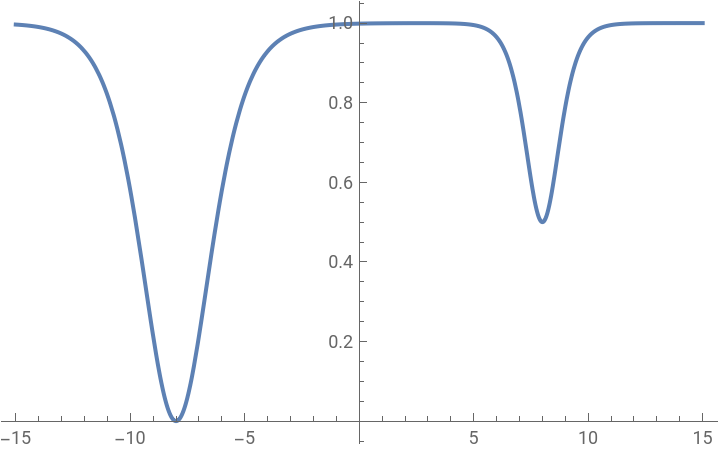
where where U1, U2 and β1, β2 are depths and half-widths of the first and second well respectively.
In[]:=
Plot[doublewell[1,0.5,1,2,1,8,8,x],{x,-15,15},PlotRangeAll]
Out[]=
Hamiltonian
In[]:=
ClearAll[eigensystem];eigensystem[U1_, U2_, t_, β1_, β2_, x1_, x2_, holeQ_, state_] := Quiet @ Module all, current, wf, norm , all = Transpose @ NDEigensystem -Laplacian[ψ[x],{x}]+IfholeQ, ,1*--+t*ψ[x], DirichletCondition[ψ[x] 0, True], ψ[x], {x,-20, 20}, 10 ; current = all[[state]]; norm = ; {current[[1]], norm*current[[2]]}
me
mh
U1
2
Cosh
x+x1
β1
U2
2
Cosh
x-x2
β2
1
NIntegrate[, {x, -Infinity, Infinity}]
2
current[[2]]
2D Density Plot
Calculations show that by changing the depths and widths of the potential wells, we can control the position of the electron or hole in quantum dots, as shown below:
In[]:=
Manipulate If!showDensityPlotQ, Plot[ Evaluate[], {x,-15, 15}, PlotRange -> All, Frame -> True, FrameLabel -> {"x, [nm]", "||, [abr.units]"}, FrameStyle -> Directive[Black, Italic, 18], PlotTheme -> "Scientific", PlotStyle -> Automatic, ImageSize -> Large, PlotLabel -> ToString[eigensystem[U1, U2, 40, b1, b2, 10, 10, holeQ, state][[1]]] <> " meV" ], DensityPlot Evaluate[], {x, -15, 15}, {y, 0, 1}, ColorFunction "SunsetColors", PlotLegends -> BarLegend[Automatic, LegendLabel -> "||, [abr.units]", LegendFunction -> (Framed[#, Background -> LightGray] &)], AspectRatio -> 12, Frame -> False, Axes -> {True, False}, AxesLabel -> {"x, [nm]", None}, AxesStyle -> Directive[Black, Italic, 18], PlotTheme->"Marketing", ImageSize -> Large , {{U1, 40, "First well depth (in )"}, 20, 40, 1}, {{U2, 40, "Second well depth (in )"}, 20, 40, 1}, {{b1, 2, "First well half-width (in )"}, 1, 5, 1}, {{b2, 2, "Second well half-width (in )"}, 1, 5, 1}, {{showDensityPlotQ, False, "Show Density Plot"},{True, False}, ControlType Checkbox}, {{holeQ, False, "Show Reslts for Hole"},{True, False}, ControlType Checkbox}, {{state, 1, "Check Quantum State"},Range[1, 10], ControlType PopupMenu} , ControlPlacement -> Bottom, SaveDefinitions -> True
2
eigensystem[U1, U2, 40, b1, b2, 10, 10, holeQ, state][[2]]
2
ψ
2
eigensystem[U1, U2, 40, b1, b2, 10, 10, holeQ, state][[2]]
2
ψ
E
R
E
R
E
R
E
R
References
References
[1] Bastard, D., “Wave Mechanics Applied to Semiconductor Heterostructures”, Les Editions de Physique, Paris (1989).
[2] Atoyan, M.S., Kazaryan, E.M., and Sarkisyan, H.A., “Direct interband light absorption in a cylindrical quantum dot in quantizing magnetic field.” Physica E: Low-dimensional Systems and Nanostructures 22.4, 860-866 (2004).
[3] Harrison P., Quantum Wells, Wires and Dots: Theoretical and Computational Physics, John Wiley & Sons Ltd., New York, (2005).
[4] Peeters, F.M., “Magneto-optics in parabolic quantum dots.” Physical Review B 42.2, 1486 (1990).
[5] Halonen, V., Chakraborty T., and Pietiläinen P., “Excitons in a parabolic quantum dot in magnetic fields.” Physical Review B 45.11, 5980 (1992).
[6] Wang, G., Kangxian G., “Interband optical absorptions in a parabolic quantum dot.” Physica E: Lowdimensional Systems and Nanostructures 28.1, 14-21 (2005).
[7] Hayrapetyan, D.B., Kazaryan, E.M., Tevosyan, H.Kh., “Impurity states in a cylindrical quantum dot with the modified Pöschl-Teller potential.” Journal of Contemporary Physics (Armenian Academy of Sciences) 49.3, 119-122 (2014).
[8] Hayrapetyan, D.B., Kazaryan, E.M., Kotanjyan, T.V., Tevosyan, H.Kh., “Exciton states and interband absorption of cylindrical quantum dot with Morse confining potential.” Superlattices and Microstructures 78, 40-49 (2015).
[9] Hayrapetyan, D.B., Amirkhanyan, S.M., Kazaryan, E.M., Sarkisyan, H.A., “Effect of hydrostatic pressure on diamagnetic susceptibility of hydrogenic donor impurity in core/shell/shell spherical quantum dot with Kratzer confining potential.” Physica E: Low-dimensional Systems and Nanostructures 84, 367-371 (2016).
[10] Wang, G., et al. “Optical response and local-field distribution in a Pöschl-Teller quantum well: Nonlocal effects.” Physical Review B 75.20, 205337 (2007).
[11] Hayrapetyan, D.B., Kazaryan E.M., Tevosyan H.Kh., “Direct interband light absorption in the cylindrical quantum dot with modified Pöschl–Teller potential.” Physica E: Low-dimensional Systems and Nanostructures 46 274-278 (2012).
[12] Martínez-Orozco, J.C., Mora-Ramos, M.E., Duque C.A., “Electron-related linear and nonlinear optical responses in vertically coupled triangular quantum dots.” Physica B: Condensed Matter 452, 82-91 (2014).
[13] Anisimovas, E., Peeters F.M., “Excitonic trions in vertically coupled quantum dots.” Physical Review B 68.11, 115310 (2003).
[14] Emary, C., Sham L.J., “Optically controlled logic gates for two spin qubits in vertically coupled quantum dots.” Physical Review B 75.12, 125317 (2007).