Abstract: We investigate connections between FQFT and the Wolfram Model by looking at possible notions of cobordisms within graphs and hypergraphs. In addition, we seek to construct category diagrams with a multiway functorial QFT and look at Lorentzian spacetime as objects, morphisms as causal relations and use category algebra as observables assigned to a localized subgraph. The project seeks in this way to also develop a connection with AQFT.
Functorial Quantum Field Theory
Functorial Quantum Field Theory
FQFT is an approach for providing a precise mathematical formulation of QFT through concepts and ideas from category theory. The fundamental idea is to translate statements about the path integral and the S-matrix into statements about functors. One hopes in this way to create an equivalence between the consistency conditions that these objects must follow in QFT and simple properties that the functor, suitably chosen to represent quantum propagation, will satisfy. More specifically, we are interested in functors from categories whose objects are (n − 1)- dimensional manifolds and whose morphisms are n-dimensional cobordisms between these to a category of vector spaces. Z : nCob ⟶ VectIt can be shown that the functor chosen obey the axioms of TQFT originally proposed by Atiyah [1] and reproduced below:1. Z is functorial with respect to orientation preserving diffeomorphisms of Σ (a n-dimensional manifold) and M (the boundary of Σ).2. Z is involutory, i.e. Z(Σ*) = Z(Σ)* where Σ* is Σ with opposite orientation and Z(Σ)* denotes the dual module.3. Z is multiplicative.4. Z(ϕ) = Λ (the ground ring) for the d-dimensional empty manifold and Z(ϕ) = 1 for the (n + 1)-dimensional empty manifold.5. Z(M*) = Z(M) (the hermitian axiom). If so that Z(M) can be viewed as a linear transformation between hermitian vector spaces, then this is equivalent to Z(M*) being the adjoint of Z(M).Intuitively, we can think of the functor as assigning space to a vector space of quantum states. We see then how FQFT allows us to reduce the apparent complexity of QFT and formalize the concept of the quantum propagator acting on the space of quantum states via the Atiyah-Segal axioms. As a further motivating example, consider the case of the Schrödinger picture in FQFT.
The Schrödinger Picture in FQFT
The Schrödinger Picture in FQFT
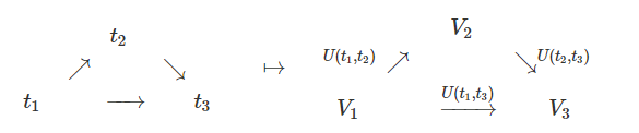
In the Schrödinger picture of quantum mechanics operators are fixed and states evolve through time via the action of the time evolution propagator U(,). In the language of FQFT this corresponds to the functor: U : 1Cob ⟶ Vectmapping the category of time instants, whose morphisms are time intervals, to the category of Vector spaces: We note that this preserves the notion of locality in quantum mechanics, which corresponds to the condition that if <<, then: U(,) = U(,)∘U(,)We can turn this statement into a statement about functoriality. Our system is such that composition within the instants of time category correspond to the concatenation of time intervals and the homomorphisms in Vect in turn can also be composed so that the functor property is satisfied.
t
1
t
2
t
1
t
2
t
3
t
1
t
3
t
2
t
3
t
1
t
2
FQFT as the dual of AQFT
FQFT as the dual of AQFT
The relation between FQFT and AQFT is captured by the following endomorphism functor: End : Vect → Algebras sending each vector space to its algebra of endomorphisms and each isomorphism of vector space to the corresponding isomorphism of algebras.As it has been shown, this functor satisfies the axioms of AQFT in one and two dimensions [2].We note for instance, how it codifies the passage from the Schrodinger picture to the Heisenberg picture: The functor translates the unitary transformation between representations by sending any operator A on E to A .

itH
e
-itH
e
Relation to the Wolfram Model
Relation to the Wolfram Model
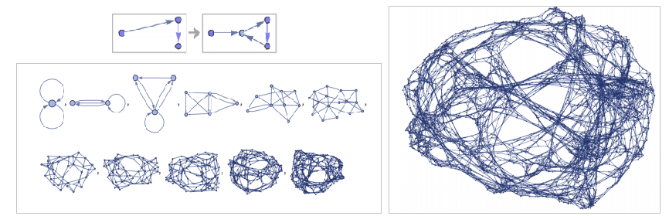
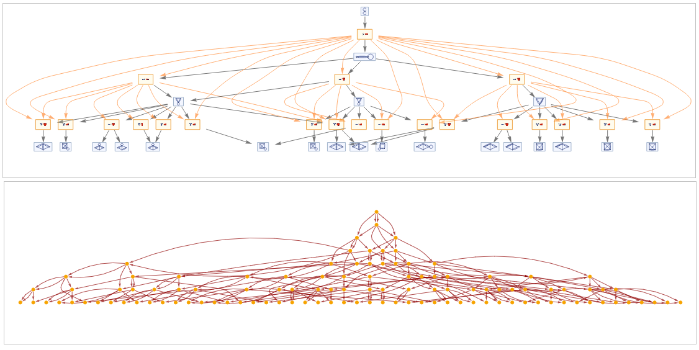
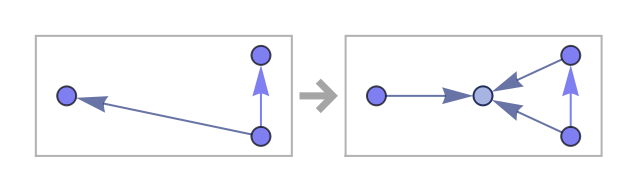
In the Wolfram model space is represented by spatial hypergraphs which evolve according to an update rule: Fig.1: Evolution history for the rule {{x, y} , {y, z}} → {{w, y} , {y, z} , {z, w} , {x, w}}. Extracted from [3].The arbitrariness involved in the application of the rule can be fixed when one considers the notion of causality within the multiway evolution of the graph and construct a causal network which in turn gives an approximation to the Lorentzian manifold structure of special relativity. Fig.2: Multiway evolution for the rule shown previously and its causal graph which in the limit should correspond to a Lorentzian manifold. Looking for cobordisms within this system translates to identifying morphisms as disjoint unions of space-like separated events. A less defined notion of cobordism exist within spatial hypergraphs as well. We can look for particular rules exhibiting splitting behaviour and apply it to graphs, subsequently investigating its evolution behavior.
In[]:=
RulePlot[ResourceFunction["WolframModel"][{{x,y},{x,z}}{{x,z},{x,w},{y,w},{z,w}}]]
Out[]=
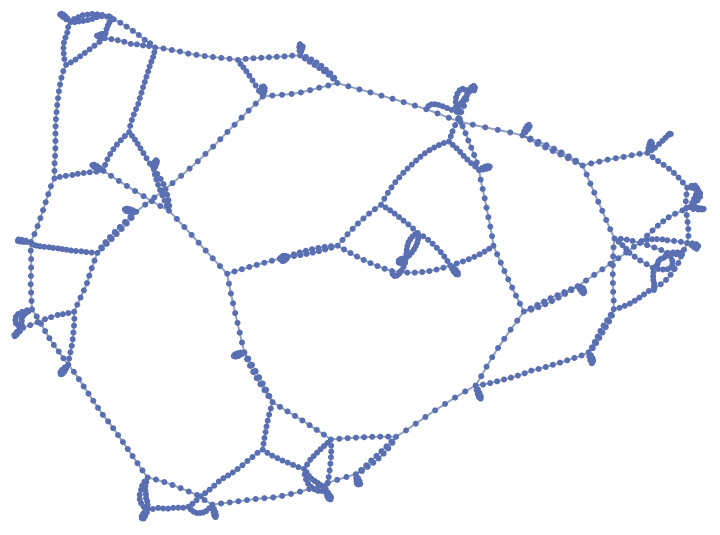
The function below allows us to apply the rule to all vertices of a given hypergraph:
The function below allows us to apply the rule to all vertices of a given hypergraph:
In[]:=
SimpleCobordism[rule_,init_,t_,tc_,a_]:=Block[{b},b=a;If[b==1,Return[ResourceFunction["HypergraphToGraph"][SetReplace[ResourceFunction["WolframModel"][rule,init,t,"FinalState"],{{v1_,v2_}}Module[{v3},{{v1,v3},{v3,v2}}],tc]]]];If[b==2,Return[ResourceFunction["HypergraphToGraph"][SetReplace[ResourceFunction["WolframModel"][rule,init,t,"FinalState"],{{v1_,v2_}}Module[{v3=2},{{v3 v1,v3 v2}}],tc]]]];]
In[]:=
SimpleCobordism[{{{1,2},{2,3}}{{4,4},{4,1},{2,4},{3,4}}},{{1,1},{1,1}},8,1000,1]
Out[]=
1D TQFT
1D TQFT
We start with the causal graph for the rule {"A""BBB","BB""A"} with initial state "A". The points which are space-like separated with respect to a certain origin vertex can be found with the help of the function:
2D TQFT
2D TQFT
The path towards AQFT
The path towards AQFT
Concluding remarks
Concluding remarks
We investigated possible connections between FQFT and AQFT with the Wolfram Model. Although the approach taken through Lorentzian cobordisms within the causal graph seems fair, a more appropriate model can likely be constructed through cobordisms within the spatial hypergraphs, and the investigation of pattern rules which generate these is something worth investigating in the future. A more general approach also exists in the form of homotopy type theory and the cobordism hypothesis with relation to gauge field theories. A number of additional remarks can be made with respect to future work to be developed.
◼
Endomorphism between FQFT and AQFT: There is not yet a definite notion of what the endomorphism relating FQFT and AQFT should correspond to in the Wolfram Model, although it is believed that it should involve some map within branchial graphs. More investigation is required in this regard.
◼
Spectral triples: A possible connection with spectral triples and the Connes-Lott model of particle physics exist through cobordisms within a Cob(1,1) category and a functor of the form (t,θ)↦exp(−tD²+θD) which would characterize the action of the Dirac operator.
◼
Spin chain structures: The study of triangulations and simplicial complexes within spatial hypergraphs may provide a way of defining spin chain structures and Spin TQFTs in the Wolfram Model.
Acknowledgment
Acknowledgment
The author would like to thank Tobías Canavesi and Xerxes Arsiwalla for all the helpful suggestions and advice as well as Max Piskunov for all the help provided with programming related questions.
References
References
◼
[1] Michael Atiyah, "Topological quantum field theory", Publications Mathématiques de l’IHÉS, 68 p. 175-186 (1988)
◼
[2] U. Schreiber, "AQFT from n-Functorial QFT". Commun. Math. Phys. 291, 357–401 (2009)
◼
[3] J. Gorard, “Algorithmic Causal Sets and the Wolfram Model”, arXiv preprint: https://arxiv.org/abs/2011.12174. (2020)
◼
[4] J. Gorard, M. Namuduri, X. D. Arsiwalla, “ZX-Calculus and Extended Hypergraph Rewriting Systems I: A Multiway Approach to Categorical Quantum Information Theory”, arXiv preprint. https://arxiv.org/abs/2010.02752. (2020)
◼
[5] Benini, M., Schenkel, A."Higher structures in algebraic quantum field theory". Fortschr. Phys. 67(8–9), 1910015 (2019).
◼
[6] E. Hawkins, F. Markopoulou, H. Sahlmann, "Evolution in Quantum Causal Histories", hep-th/0302111 (2003)