This is part of live presentation series called Mathematical Games in which we explore a variety of games and puzzles using Wolfram Language. In this episode, we explore the mathematical games and puzzles involving hexagrammum mysticum.
Demonstrations related to Conic Sections
Demonstrations related to Conic Sections
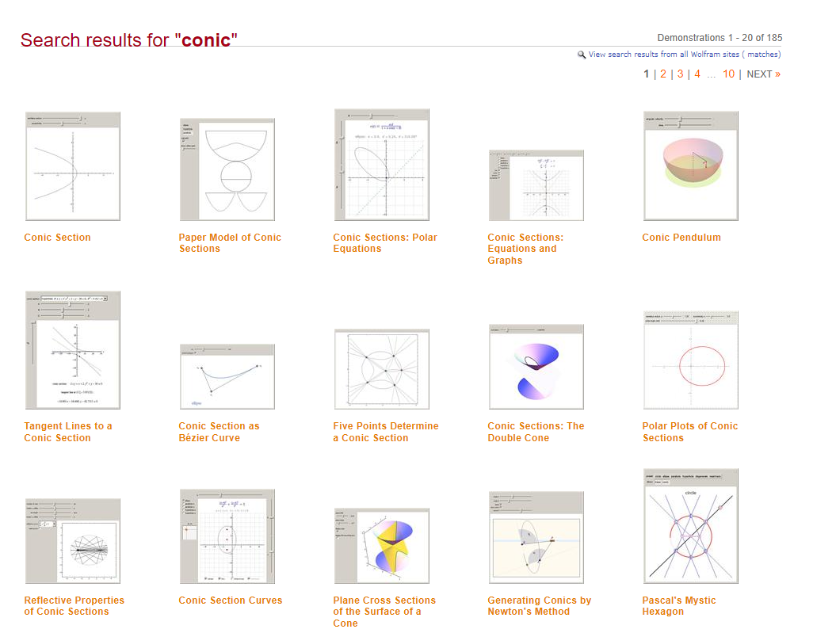
Many demonstrations involve conic sections: https://demonstrations.wolfram.com/search.html?query=conic
Like many research projects, this one took an odd turn
Like many research projects, this one took an odd turn
But first, one of the Conway $1000 problems has been solved.
Beggar-my-neighbour
Beggar-my-neighbour
A standard 52-card deck is divided equally between two players, and the two stacks of cards are placed on the table face down. The first player lays down their top card face up to start a central pile, and the opponent plays their top card, also face up, on it, and this goes on alternately as long as no Ace or court card (King, Queen, or Jack) appears. These cards are called “penalty cards”.
If either player turns up such a card, their opponent has to pay a penalty: four cards for an Ace, three for a King, two for a Queen, or one for a Jack. They do this playing the required number of cards to the central pile. When they have done so, if all the cards are numerals, the player of the penalty card wins the hand, takes all the cards in the pile and places them under their pack. The game continues in the same fashion, the winner having the advantage of placing the first card. However, if the second player turns up another Ace or court card in the course of paying to the original penalty card, their payment ceases and the first player must pay to this new card. This changing of penalisation can continue indefinitely. When a single player has all of the cards in the deck in their stack, they have won.
Brayden Casella found an infinite cyclic game on 10 February 2024.
The game begins ---K---Q-KQAJ-----AAJ--J-- and ----------Q----KQ-J-----KA.
The game begins ---K---Q-KQAJ-----AAJ--J-- and ----------Q----KQ-J-----KA.
A link to check out.
Five Point Conic (from last month’s talk)
Five Point Conic (from last month’s talk)
Five points define a conic section. For random, uniformly-distributed points in a rectangle, the probability of a hyperbola is and the probability of an ellipse is .
95
144
49
144
The above is wrong. Where did I get those values?
The above is wrong. Where did I get those values?
In[]:=
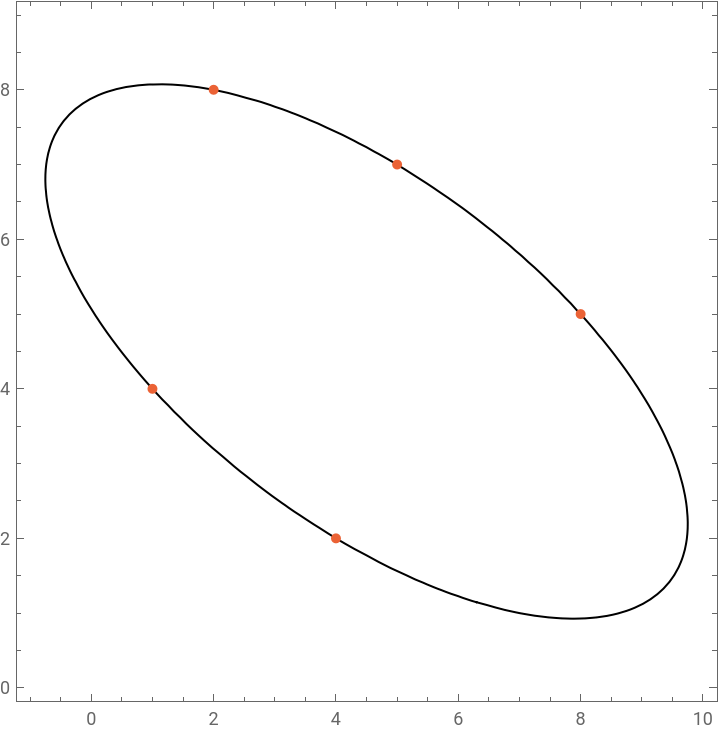
p5={{1,4},{4,2},{2,8},{8,5},{5,7}};conic=ResourceFunction["FivePointConic"][p5,{x,y}]
Out[]=
1638-333x+19-531y+36xy+41
2
x
2
y
In[]:=
ContourPlot[conic==0,{x,-1,10},{y,0,9},Epilog->{Directive[AbsolutePointSize[5],RGBColor[0.922526,0.385626,0.209179]],Point[p5]}]
Out[]=
Four points define two parabolas (Universal Arithmetick by Isaac Newton)
In[]:=
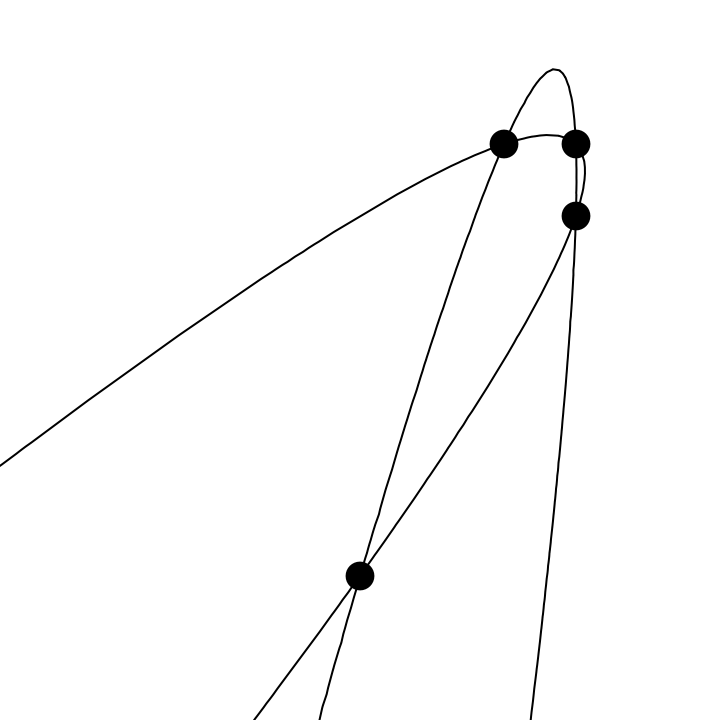
set1={{-2,-5},{0,1},{1,0},{1,1}};para1=ResourceFunction["FourPointParabolas"][set1]
Out[]=
-2+x.+y.+,-10-15x.+9y.+
2
(-x.+y.)
2
-5x.+y.
In[]:=
cp=ContourPlot{para1[[1]]==0,para1[[2]]==0},x.,-7,3,y.,-7,3;Graphics[{cp[[1]],Disk[#,.2]&/@set1},PlotRange->{{-7,3},{-7,3}}]
Out[]=
Sylvester’s Four-Point Problem
Sylvester’s Four-Point Problem
Pick random points from a region, then find the convex hull. What are the odds that all the generating points are on the boundary of the hull? In 1865, Sylvester stated, “This problem does not admit of a determinate solution.” Actually, the answer depends on the region. Four points from a triangular region have odds of of making a quadrilateral. Four points from a rectangular region have odds of of making a quadrilateral.
n
2/3
25/36
For Five Points the probability of a convex hull is49144 if the region is rectangular1136 if the region is triangular
For Five Points the probability of a convex hull is if the region is rectangular if the region is triangular
49
144
11
36
In[]:=
ManipulateModule[{mesh,meshpoints,len,sides,polygon,kept,unkept},mesh=MeshCells[ConvexHullMesh[r],2][[1,1]];kept=First/@MeshPrimitives[ConvexHullMesh[r],0];unkept=Complement[r,kept];polygon=GraphicsComplex[kept,Polygon[mesh]];Graphics[{polygon,White,Point/@{{-2,-2},{2,2}},Green,Disk[#,.1]&/@kept,Red,Disk[#,.1]&/@unkept,White,Table[Text[k,r[[k]]],{k,1,Length[r]}],Gray,If[region"square",Sequence@@{},Line[{{-2,2},{2,-2}}]]},ImageSize{450,450},PlotRange{{-2.1,2.1},{-2.1,2.1}}]],{{r,RandomReal[{-2,2},{5,2}]},{-2,-2},{2,2},Locator,AppearanceNone,LocatorAutoCreate{5,6}},"region for randomness",{{region,"square",""},{"square"Graphics[{EdgeForm[Black],Gray,Rectangle[]},ImageSize{40,40}],"triangle"Graphics[{EdgeForm[Black],Gray,Polygon[{{0,0},{1,0},{0,1},{0,0}}]},ImageSize{40,40}]}},Delimiter,"random point selection","odds of all green",ButtonColumn"random 4",DynamicIfregion"square",,,AlignmentCenter,r=If[region"square",RandomReal[{-2,2},{4,2}],Take[Select[RandomReal[{-2,2},{100,2}],Total[#]≤0&],4]],ImageSize{60,50},ButtonColumn"random 5",DynamicIfregion"square",,,AlignmentCenter,r=If[region"square",RandomReal[{-2,2},{5,2}],Take[Select[RandomReal[{-2,2},{100,2}],Total[#]≤0&],5]],ImageSize{60,50},ButtonColumn"random 6",DynamicIfregion"square",,,AlignmentCenter,r=If[region"square",RandomReal[{-2,2},{6,2}],Take[Select[RandomReal[{-2,2},{100,2}],Total[#]≤0&],6]],ImageSize{60,50},ButtonColumn"random 7",DynamicIfregion"square",,,AlignmentCenter,r=If[region"square",RandomReal[{-2,2},{7,2}],Take[Select[RandomReal[{-2,2},{100,2}],Total[#]≤0&],7]],ImageSize{60,50},ButtonColumn"random 8",DynamicIfregion"square",,,AlignmentCenter,r=If[region"square",RandomReal[{-2,2},{8,2}],Take[Select[RandomReal[{-2,2},{100,2}],Total[#]≤0&],8]],ImageSize{60,50},ButtonColumn"random 9",DynamicIfregion"square",,,AlignmentCenter,r=If[region"square",RandomReal[{-2,2},{9,2}],Take[Select[RandomReal[{-2,2},{100,2}],Total[#]≤0&],9]],ImageSize{60,50},ControlPlacementLeft,SaveDefinitionsTrue
25
36
2
3
49
144
11
36
49
400
91
900
121
3600
17
675
20449
2822400
323
66150
20449
16257024
4807
6350400
Newton’s Four-Point Parabolas Solution
Newton’s Four-Point Parabolas Solution
Isaac Newton explicitly constructed 4-point parabolas in Arithmetica Universalis (1707).
Given four points, figure out if a fifth point will make an ellipse or a hyperbola. If the convex hull is 4 points, it’s automatically a hyperbola.
Given four points, if a fifth point is inside exactly one parabola then the five points make an ellipse.
Unsolved: Chance of an Ellipse
Unsolved: Chance of an Ellipse
It’s possible for 5 points to make a convex hull but to not make an ellipse.
What is that probability?
What is the probability five points make an ellipse?
Pascal’s Mystic Hexagon
Pascal’s Mystic Hexagon
Pascal discovered that if hexagon ABCDEF is inscribed in a conic section, the points of intersection RST of the pairs of opposite chords are collinear. You can generate the conic through points A, B, C, D, E, since F can be derived from an arbitrary line AX through A. Moving X and F traces the conic. Move A, B, C, D, or E to get a new conic that passes through them.
Brianchon’s Theorem
Brianchon’s Theorem
Brianchon’s theorem was published in 1810 by the French mathematician Charles-Julien Brianchon (1783–1864). The theorem asserts that if a hexagon is circumscribed about a circle, then the lines joining the opposite vertices are concurrent. This Demonstration shows that the hexagon is considered to circumscribe the circle if each edge, possibly extended, is tangent to the circle. You can use the sliders or drag one of the vertices to vary the hexagon, which can self-intersect, be outside the circle it circumscribes, or both!
Brianchon’s theorem has many important corollaries. For instance, in every pentagon circumscribed about a circle, the lines joining two pairs of nonadjacent vertices and the line through the fifth vertex and the point of tangency with its opposite side are concurrent. In every quadrilateral circumscribed about a circle, the two diagonals and the two lines joining points of tangency on opposite sides are concurrent. In every triangle circumscribed about a circle, the lines connecting the vertices with points of tangency of the opposite sides are concurrent. The dual of Brianchon’s theorem is Pascal’s theorem. Brianchon’s theorem also applies to ellipses and more generally, to any conic section.
Dandelin Spheres for an Ellipse
Dandelin Spheres for an Ellipse
Dandelin, 1826, “Hyperboloids of revolution and the hexagons of Pascal and Brianchon”
The spheres are tangent to the ellipse at the foci!
Hexagrammum Mysticum: 95 lines and 95 points
Hexagrammum Mysticum: 95 lines and 95 points
Lines are in Hessian Line form.
Hexagon: 15 lines and 45 points
Hexagon: 15 lines and 45 points
From six points on a conic section (circle, ellipse, parabola or hyperbola), label them B L A I S E and connect them to form a hexagon. There are 15 ways to choose two points, leading to 15 lines that intersect at 45 points.
However, the 45 generated points can create new lines.
Here the length is 17, but this is not consistent with random points.
How many hexagons are there with six given points?
Canonical Hexagons
Canonical Hexagons
There are 720 ways to select six points
Each starts with 1 and has a second digit lower than the last digit.
We can use code to add all of the Pascal lines:
60 Pascal Lines
60 Pascal Lines
If opposing sides (BL-IS, LA-SE, AI-EB) are extended, the three intersections are collinear, forming what is called a Pascal line. Six points give 60 possible hexagons, with a Pascal line for each hexagon. L(BLAISE) is one of these 60 Pascal lines.
Pascal made this discover and published a paper about them while still a teenager.
Show the Pascal lines:
60 Kirkman Points
60 Kirkman Points
For a given hexagon on six points, consider the three other hexagons that share no edges with the first. For the hexagon BLAISE, the three others are BASLEI, BAEILS and BILEAS. These three hexagons define three Pascal lines that concur on a Kirkman point. Each of the 60 hexagons defines a Kirkman point. P(BLAISE) is one of these 60 Kirkman points.
Compute the Pascal lines and Kirkman points for a set of six points on a conic:
Find the three hexagons that don't share an edge with a given hexagon:
What do those hexagons that don’t share an edge look like?
Use the three hexagons to identify three Pascal lines:
Pull those lines out of the Hexagrammum Mysticum:
Next, obtain the particular Kirkman point:
Put a blue circle around the Kirkman point where three red Pascal lines intersect:
Can we cheat?
Can we cheat?
There are 95 lines and 95 points in the Hexagrammum Mysticum
Generate the 95 lines and 95 points:
For every point, identify the index for every line containing that point:
For every line, identify the index for every point on that line:
It turns out that the indexes are identical. They are self-dual.
The self-dual indexing looks like this:
60 Kirkman Points
60 Kirkman Points
For a given hexagon on six points, consider the three other hexagons that share no edges with the first. For the hexagon BLAISE, the three others are BASLEI, BAEILS and BILEAS. These three hexagons define three Pascal lines that concur on a Kirkman point. Each of the 60 hexagons defines a Kirkman point. P(BLAISE) is one of these 60 Kirkman points.
We can now look at all the Kirkman points and the associated Pascal lines automatically.
More on Blaise Pascal (1623 – 1662)
More on Blaise Pascal (1623 – 1662)
"I would have written a shorter letter, but I did not have the time."
Developed one of the first mechanical computers
Pascal’s Law
Pascal’s Law
“I walked to the top of Puy-de-Dôme, about 500 fathoms higher than the monastery, where upon experiment...found that the quicksilver reached a height of only 23” and 2 lines...I repeated the experiment five times with care...each at different points on the summit...found the same height of quicksilver...in each case.”
Pascal’s Triangle
Pascal’s Triangle
More on Thomas Kirkman (1806 – 1895)
More on Thomas Kirkman (1806 – 1895)
Fifteen young ladies in a school walk out three abreast for seven days in succession:it is required to arrange them daily,so that no two shall walk twice abreast.
Social Golfer Problem (Cayley, Kirkman, Steiner)
Social Golfer Problem (Cayley, Kirkman, Steiner)
In 1850, Reverend Thomas Kirkman sent a related query to the readers of a popular math magazine, Lady’s and Gentleman’s Diary: Fifteen young ladies in a school walk out three abreast for seven days in succession: it is required to arrange them daily, so that no two will walk twice abreast. Arthur Cayley and Jakob Steiner solved the problem. For groups of three, solutions are called either a resolvable Steiner triple system (RSTS) or a Kirkman triple system (KTS).
Introducing Arthur Cayley (1821 – 1895)
Introducing Arthur Cayley (1821 – 1895)
27 lines on a cubic surface. Worked with George Salmon ( 1819 – 1904)
This is the Cayley graph connecting the 24 elements of a permutation group defined by two generators, the first represented in blue and the second in green:
20 Cayley Lines
20 Cayley Lines
Consider the vertices of a hexagon as a cyclic permutation and square that as a permutation. For example, BLAISE, BLSEAI and BISLAE have permutations (123456), (125634) and (145236), all with the same permutation square BAS.LIE or (135)(246). There are 20 possible results in sets of three, always giving a pair of 3-cycles. In any of these sets, the three corresponding Kirkman points are collinear, forming what is called a Cayley line. L(BAS.LIE) is one of these 20 Cayley lines.
Cayley was the first drawn a diagram of the sixty Pascal lines but found it “almost unintelligible”.
We want the three Kirkman points on line “L135.246”. Since we now have a cheat, lets try that with indexing.
Here are the indices of points on line 71. These are also the indices of lines through point 71, due to duality.
Permutations (123456), (125634) and (145236) have the same permutation square (135)(246).
We can now look at all the Cayley lines and the associated Kirkman points.
20 Steiner Points
20 Steiner Points
Note: Steiner’s one-page paper contains as many false assertions as true ones.
Just as in Cayley’s case, consider a hexagon as a cyclic permutation and square that as a permutation. There are 20 possible results in sets of three. In any of these sets, the three corresponding Pascal lines concur on a Steiner point. P(BAS.LIE) is one of these 20 Steiner points.
We want the three Steiner lines on point “P135.246”. Since we now have a cheat, lets try that with indexing.
Here are the indices of lines on point 71. These are also the indices of points through line 71, due to duality.
Permutations (123456), (125634) and (145236) have the same permutation square (135)(246).
We can now look at all the Steiner points and the associated Pascal lines.
Jakob Steiner (1796 – 1863)
Jakob Steiner (1796 – 1863)
Representations of the real projective plane are called Steiner surfaces. A classification based on real parameters and transformations results in 10 types [1, 2].
Given two fixed nonintersecting circles (shown here in red and blue), a Steiner chain is a sequence of circles, each tangent to the two given circles and each tangent to their neighboring circles in the sequence. When the chain is closed, the first and last circles in the chain are also tangent to each other. If a closed chain can be found for a given pair of circles, then infinitely many such chains can be found—use the rotation slider. Also, regardless of whether the chain is open or closed, the centers of circles of the chain lie on an ellipse, shown in green.
Steiner Trees
Steiner Trees
by: Ferenc Beleznay
We would like to find an optimal way of connecting a given finite set of points in the plane, in the sense that the total length of the line segments joining the points is minimal. This optimization problem is referred to as the Steiner tree problem. This Demonstration supports a manual search for such a network of line segments. It can be proved that an optimal network is achieved by adding some points (called Steiner points) to the original set of so-called regular points and finding the minimal spanning tree of the resulting complete graph, where the weights of the edges are the Euclidean distances between the endpoints.
15 Plücker Lines
15 Plücker Lines
Consider one of the 15 triplets of 2-cycles, such as BL.AI.SE or (12)(34)(56). Find the four Steiner points that commute with the given cycle under permutation products. In this case, (12)(34)(56)×(135)(246)(135)(246)×(12)(34)(56), and similarly for (136)(245), (145)(236) and (146)(235). These four Steiner points are collinear, forming what is called the Plücker line. L(BL.AI.SE) is one of these 15 Plücker lines.
We want the four Steiner points on line “L12.34.56”. Since we now have a cheat, lets try that with indexing.
Here are the indices of lines on point 81. These are also the indices of points through line 81, due to duality.
Permutations (135)(246), (136)(245), (145)(236) and (146)(235) all commute with (12)(34)(56).
We can now look at all the Plücker lines and the associated Steiner points.
15 Salmon Points
15 Salmon Points
As shown in Plücker, consider one of the 15 triplets of 2-cycles. The four corresponding Cayley lines concur on a Salmon point. P(BL.AI.SE) is one of these 15 Salmon points.
We want the four Cayley lines on point “P12.34.56”. Since we now have a cheat, lets try that with indexing.
Here are the indices of lines on point 81. These are also the indices of points through line 81, due to duality.
Permutations (135)(246), (136)(245), (145)(236) and (146)(235) all commute with (12)(34)(56).
We can now look at all the Cayley lines and the associated Salmon points.
John Conway’s Mystic H
John Conway’s Mystic H
All together
All together
Along with the original six points, show the 20 Cayley lines in green and the 15 Plücker lines in red:
Find the lines through four points, which happen to be the 20 Cayley lines and 15 Plücker lines:
The Original Demo
The Original Demo
Unsolved: Chance of an Ellipse
Unsolved: Chance of an Ellipse
It’s possible for 5 points to make a convex hull but to not make an ellipse.
What is that probability?
What is the probability five points make an ellipse?
This problem is likely solvable.
CITE THIS NOTEBOOK
CITE THIS NOTEBOOK
Mathematical Games: Hexagrammum Mysticum
by Ed Pegg
Wolfram Community, STAFF PICKS, February 15, 2024
https://community.wolfram.com/groups/-/m/t/3122034
by Ed Pegg
Wolfram Community, STAFF PICKS, February 15, 2024
https://community.wolfram.com/groups/-/m/t/3122034