This project aims to create a practical toolkit for use in designing and developing a fabric pattern or print that can produce unique items in a limited edition. I discuss and implement a conceptual and computational approach for identifying appropriate basic cellular automata rules for such a pattern, and I show how to test the patterns for uniqueness. I outline a digital platform and authentication process to allow owners to identify the piece they own, placing it within the limited edition. I include consideration of an optional anti-counterfeit blockchain element, and discuss a range of implementations, from mass-market to luxury items. This toolkit can support future collaboration efforts, along with manufacturing partners, to implement a version of these ideas.
Limited Editions → Maximum Editions
Limited Editions → Maximum Editions
Motivation and process overview
Motivation and process overview
Limited editions and counterfeit in fashion
Limited editions and counterfeit in fashion
In luxury goods, consumers pay significant premiums not just for distinctive products, but for the stories that come with them. They buy into narratives of design excellence, craft heritage, and exclusivity. Luxury brand patrons seek the assurance that their purchases represent something genuinely limited and authentic. Yet this very desirability creates a persistent problem: the aspirational appeal of luxury brands is an irresistible incentive to counterfeiters to replicate designs and flood markets with cheaper imitations, undermining both exclusivity and brand integrity.
A possible solution lies in moving beyond traditional scarcity models to leveraging computational irreducibility and the impossibility of replication. Despite operating on simple underlying rules, cellular automata can generate patterns of apparent infinite complexity that could serve as an inexhaustible source of provably-unique but intrinsically-related designs. Each pattern swatch represents a specific region in computational space. When the pedigree and origin of these regions can be identified upon request, counterfeiting becomes exponentially more difficult than simply copying visual aesthetics.
The approach discussed in this Wolfram Community post enables a new model of luxury product development. It provides a toolkit for partnering with brands to design and launch collections for buyers who want more than simple ownership of exclusive items; they can propose collections for buyers who would enjoy being recognized as part of computationally-defined “pattern families” of connoisseurs. Through branded digital registration platforms, owners can verify authenticity, discover others who share variants of their pattern, and participate in conversations about what computational uniqueness means in an age of mass production. The result transforms luxury from mere scarcity into a fusion of algorithmic design, carefully controlled limited-run manufacturing, verified authenticity, and curated community.
The cellular automata advantage
The cellular automata advantage
Cellular automata patterns offer a computationally guaranteed source of relative uniqueness that are virtually impossible to replicate without knowing the exact initial conditions and rule sets. Unlike traditional luxury patterns that can be photographed and copied, each cellular automaton evolution represents a specific region of an infinite computational landscape. Even slight variations in starting conditions can produce dramatically different outcomes, making counterfeiting exponentially more difficult.
The beauty lies in a paradox: simple rules creating apparently infinite complexity. For example, a luxury wheelie bag featuring a pattern generated from rule 30 wouldn’t just be a unique travel fashion statement. Its originality would be demonstrable, with its “genetic code” consisting of the initial conditions, the rule deployed, and the specific generation heritage for this piece, all serving as both authentication and provenance.
The beauty lies in a paradox: simple rules creating apparently infinite complexity. For example, a luxury wheelie bag featuring a pattern generated from rule 30 wouldn’t just be a unique travel fashion statement. Its originality would be demonstrable, with its “genetic code” consisting of the initial conditions, the rule deployed, and the specific generation heritage for this piece, all serving as both authentication and provenance.
Uniqueness and community-building through narrative
Uniqueness and community-building through narrative
In addition to anti-counterfeit design, cellular automata offer an intriguing social dimension. Imagine a luxury fashion house releasing a limited edition of a dozen to a few hundred items, wherein the pattern on each item can be found in a shared spacetime cellular automata landscape, all originating in the same set of initial conditions and built over successive generations of the same cellular automata rule. A single bolt of fabric made from such a set of specifications could be used to create a small number of distinct but similar products that are related in novel ways, relative to those traditionally promoted by designers.
In addition to their distinctive purchases, buyers could access an exclusive digital platform where they:
- Input their item’s unique PIN or QR code, or perhaps a photo of the pattern, to verify authenticity
- Register their pattern specifications as a hashed key, along with user authentication such as SSO, or on the blockchain for added security
- See the mathematical and spatial relationship between their pattern and others in the collection - the computational “family tree” connecting their pattern to others
- Access exclusive content about their pattern’s generation story, the rule that generated their design, and a digital visualization of how their pattern evolved
- Discover how many others share a pattern based on the same initial conditions (in the case of duplicate runs)
- Connect with fellow owners of the same limited edition
This creates multiple layers of exclusivity: owning any item from the collection, belonging to a specific pattern family within a growing computational design collection, and possessing a unique generational and spatial patch within that family. Each piece becomes a conversation starter with deep narrative potential. The owner isn’t just wearing a designer item; they’re carrying a piece of computational art with a documented spacetime history.
Anti-counterfeiting through programmatic complexity
Anti-counterfeiting through programmatic complexity
Counterfeiters typically rely on visual copying, but late-generation cellular automata patterns, or those with complex initial conditions, are computationally irreducible. Even if someone could reverse-engineer a pattern rule, they’d need to know the initial conditions and the generations required to reach each specific patch of the pattern. This information could be cryptographically protected and verified to the owner through a registration platform.
The registration system could create a permanent, public record of authentic items while building a community of verified owners. This transforms authentication from a technical process into a social experience, where ownership becomes part of a larger story about mathematical beauty and may even allow exclusive access to other algorithmic art.
This approach could revolutionize how luxury brands think about uniqueness—moving from scarcity through limited production to scarcity through the mathematical impossibility of replication.
Approach to this project
Approach to this project
The following discusses the approach undertaken for this project. This toolkit address issues related to:
1) Identifying candidate rules, considering the scale of the limited edition, spatiotemporal relations across the limited edition, and additional design possibilities
2) Authenticating uniqueness
3) Discovery platform and community features
4) Security opportunities
4) Applications
1) Identifying candidate rules, considering the scale of the limited edition, spatiotemporal relations across the limited edition, and additional design possibilities
2) Authenticating uniqueness
3) Discovery platform and community features
4) Security opportunities
4) Applications
Identifying the rules and authenticating uniqueness
Identifying the rules and authenticating uniqueness
Spacetime Tradeoffs in Pattern Generation
Spacetime Tradeoffs in Pattern Generation
In order to generate a bolt of fabric, one would need a pattern that is sufficiently wide and long, to cover the full fabric surface. Our challenge is to identify rules and initial conditions that create patterns of sufficient size and complexity, across a bolt of fabric, within which we can computationally guarantee that there are no patches larger than a certain size which are duplicated anywhere else in the fabric pattern.
Starting with the canonical depiction of cellular automata patterns based on a single initial cell with padding often leads to identifiable patterns, especially for those familiar with these forms.
Starting with the canonical depiction of cellular automata patterns based on a single initial cell with padding often leads to identifiable patterns, especially for those familiar with these forms.
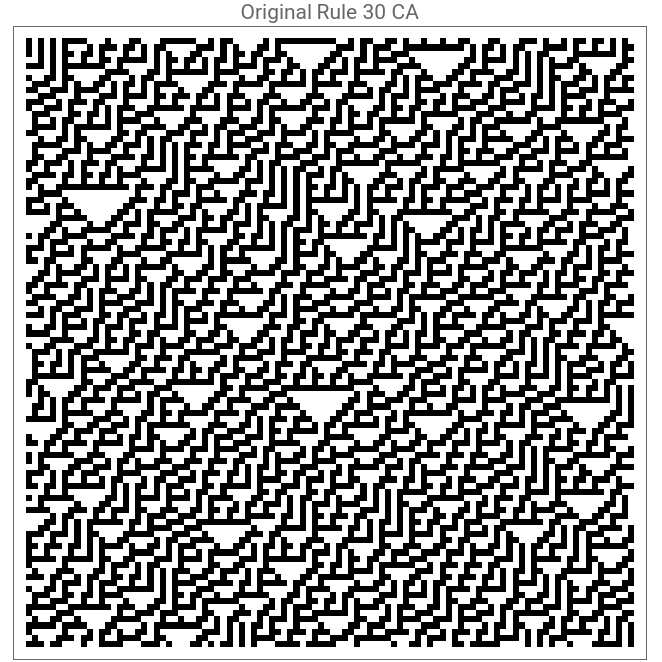
The canonical cellular automata (rule 30) from a single initial cell, shown over 100 rows, is highly recognizable in some communities, and relies on potentially infinite padding to propagate from one generation to the next:
Out[]=
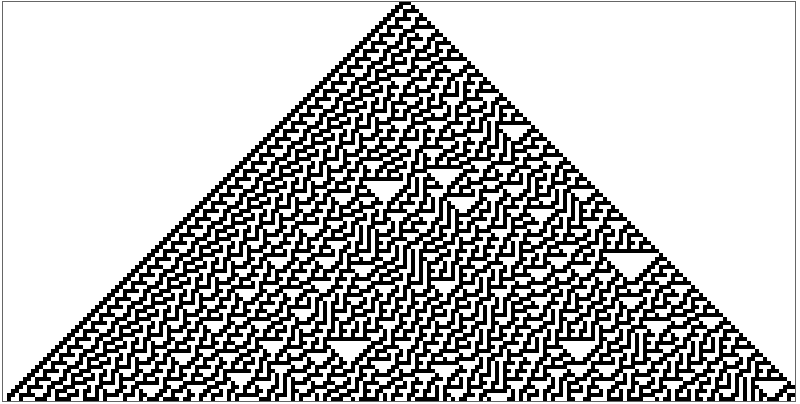
Obviously, a single initial seed is not sufficient for the kind of uniqueness we seek. Cellular automata fans will immediately recognize a rule 30 plot when it is initiated with a single initial cell. Instead, our approach will be to start with random initial conditions that are sufficient to cover the width of the fabric surface. In practice, random initial conditions could be generated from a secret seed, or could be based on a public seed using a proprietary hashing algorithm. If we specify initial conditions with a wide enough spatial span, we can cover the surface of our fabric with a sufficiently complex pattern.
Here, a rule 30 CA pattern starts from 100 random cells, and is shown over 100 rows. This uses a commemorative seed that is created from a hashed statement: “Wolfram Summer School 2025”:
Out[]=
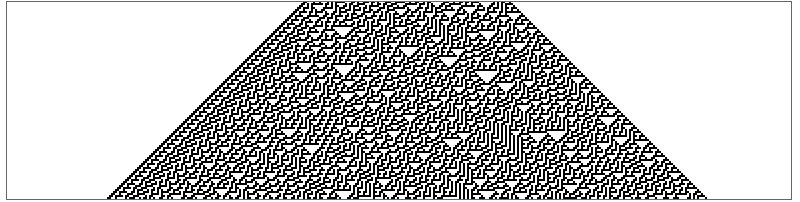
The pattern generated above has some areas that appear to be distinct, with other areas that may contain duplicate submatrices, notably to the left. However, the vertical central strip offers a promising basis for creating a fabric pattern with unique regions. For a fabric bolt that is 100 cells wide and 1600 cells long, one could generate a pattern like this and run it over 1600 generations, and then eliminate the information on the sides. This approach may accommodate more rules, but it will compromise the quality of connection between the different patches. This tradeoff will be discussed further in subsequent sections.
Another obvious approach is to maintain the width of the pattern in every generation, while defining cyclic boundary conditions that simulate the effect of a consistent pattern on a tube. All the information that is generated by each application of the cellular automaton rules is contained within the pattern, and nothing is eliminated. This approach may limit the number of appropriate rules, relative to the approach above, but it optimizes the aesthetic quality of the conceptual connection between the different patches.
Another obvious approach is to maintain the width of the pattern in every generation, while defining cyclic boundary conditions that simulate the effect of a consistent pattern on a tube. All the information that is generated by each application of the cellular automaton rules is contained within the pattern, and nothing is eliminated. This approach may limit the number of appropriate rules, relative to the approach above, but it optimizes the aesthetic quality of the conceptual connection between the different patches.
Here, a rule 30 CA pattern starts from 100 random cells, and is shown over 100 rows. This uses a commemorative seed that is created from a hashed statement: “Wolfram Summer School 2025”, but uses “cyclic” edge conditions:
Out[]=
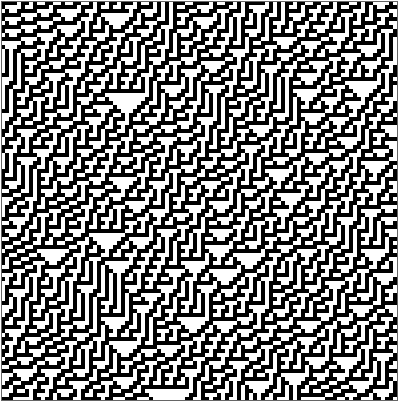
As we can see, with random initial conditions and either unbounded or bounded edge conditions, we have a promising system for designing non-repeating patterns. However, as indicated above, one must also engage with a fundamental tension between temporal evolution and spatial expansion in cellular automata systems. There is also an aesthetic conceptual appeal to optimizing the connection between each patch of the fabric; throwing away large sections of a pattern means that we reduce the density of conceptual connection across all the patches. Nonetheless, when generating patterns with surfaces that are sufficiently large for limited edition products, there are three distinct strategies for harvesting unique patterns from the computational landscape generated by CAs. Long cyclic, wide cyclic, and a “lightcone” version. Each have variations.
To explore the differences between these approaches, we can appeal to the concept of spacetime patches discussed in NKS as a note to Chapter 7, Section 6.
To explore the differences between these approaches, we can appeal to the concept of spacetime patches discussed in NKS as a note to Chapter 7, Section 6.
1
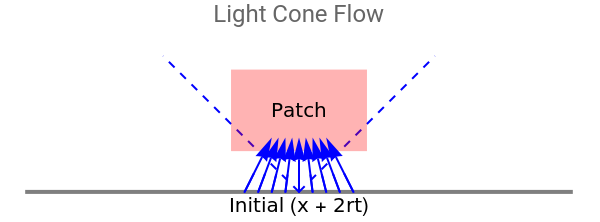
This is code from an illustration on NKS page 960. Copying the symbolic graphics results in a labelling error that drops the lambda, so I used the code to generate the image:
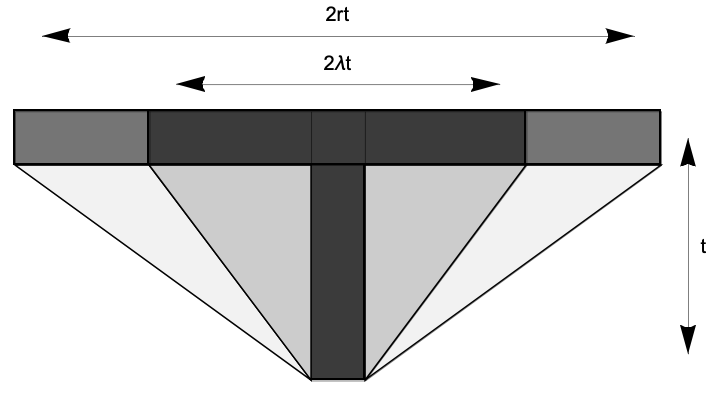
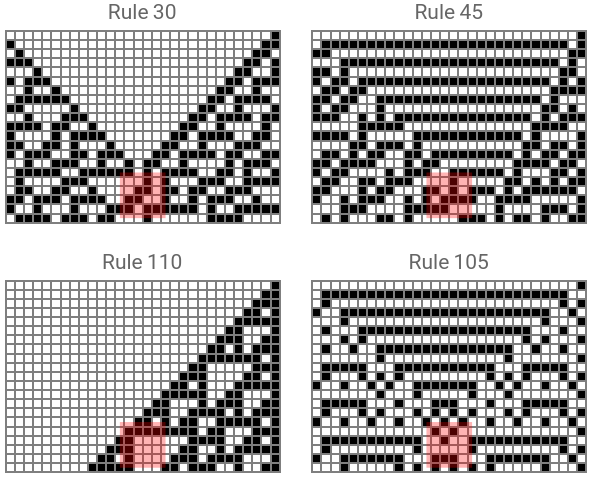
Each patch in a cellular automata pattern derives from all the information in the lightcone above it. As the cone propagates over time, every cell in the light gray area specified in the illustration above will determine the evolution of the darker set of central columns. For the elementary cellular automata rules like rule 30, λ = 3, which is the size of the relevant rule neighborhood, and the width of the light gray area grows symmetrically by 6 with each generation.
In the illustrations below, I aim to illustrate how a patch in the cellular automata pattern landscape relies on the cells in a lightcone formation that spans previous generations in time and space :
Out[]=
Entropy and Shared Information in Space, Time, and Spacetime Patches
Entropy and Shared Information in Space, Time, and Spacetime Patches
Autocorrelation in Space, Time, and Spacetime Patches
Autocorrelation in Space, Time, and Spacetime Patches
After observing that Shannon entropy measurements consistently remained near 1 bit despite clearly visible regular patterns in the rule 110 cellular automata evolution, it became apparent that traditional Shannon entropy was inadequate for capturing the type of structural regularity present in these systems. While entropy measures the unpredictability of symbol frequencies, essentially answering “how balanced are the 0s and 1s?”, it completely ignores the spatial and temporal correlations that create the visual patterns we observe. A cellular automaton can exhibit highly structured, deterministic behavior with repeating motifs, traveling patterns, and periodic boundaries while maintaining an approximately equal distribution of binary states, resulting in misleadingly high entropy values.
Autocorrelation analysis addresses this limitation by measuring how similar patterns are to shifted versions of themselves, directly quantifying the periodicity within rows (spatial), the temporal cycles within columns, and how 2D structures repeat across the entire spacetime diagram. This approach provides a more appropriate metric for the type of “regularity” that we human observers recognize visually. Rather than balanced symbol counts, this method reports actual structural correlation and pattern coherence that characterizes complex cellular automata like rule 110.
The autocorrelation analysis exposes periodicity in the “long” version of rule 110 that the entropy analysis completely missed. Spatially, there’s a clear fundamental period of 14 cells, with harmonic peaks at 28 and 42 cells, offering evidence of repeating spatial structures. Temporally, the pattern exhibits a 7-step cycle with strong correlations, along with harmonics at 14, 21, and 28 steps, indicating complex but regular temporal evolution. The 2D pattern autocorrelation reveals even more striking structure: the shift (2,3) produces a correlation of ≈ 0.892 in one simulation, meaning the pattern is nearly 90% similar to a version shifted by just 2 cells horizontally and 3 time steps vertically. The high (0,7) shift correlation confirms the temporal period of 7 generations. These are extraordinarily high correlations, considering what entropy suggested was “random” data. The relationship with multiples of 7 is also surprising, but at this stage will remain a topic for further study.
Expected, but noteworthy, the autocorrelation results of the “wide” rule 110 pattern reveal dramatically different structural characteristics compared to the long implementation, highlighting how spacetime geometry fundamentally affects pattern formation. In particular, the complete absence of spatial periodicity is apparent. Where the long version showed clear 14-cell periodicities, the wide version exhibits essentially random spatial distribution with very weak correlations/anti-correlation.
This suggests that in the wide configuration, rule 110’s eventual spatial patterns remain aperiodic and chaotic in the early generations, rather than forming the regular lattice structures seen in narrow, long evolutions. We note that the fundamental 7-step temporal cycle persists, confirming this as an intrinsic property of rule 110 regardless of spatial configuration. However, it’s significantly weaker than the long version and lacks the harmonic structure, with no peaks at 14, 21, or 28 steps. This indicates that while the basic temporal dynamics remain, the coherent long-range temporal patterns are disrupted by the wide geometry, and so this system still retains the randomness of the initial conditions. The 2D autocorrelations are dramatically weaker, especially when compared to the long version. The shift patterns (6,9) and (4,6) suggest some residual structure, but the overall pattern coherence is largely destroyed.
This comparison between long and wide implementations reveals that rule 110’s behavior is highly dependent on geometric constraints at the early stages. The narrow “long” configuration forces interactions that create coherent spatial periodicities and strong 2D correlations, while the wide configuration allows patterns to dissipate spatially, resulting in more chaotic but less structured evolution. The wide version trades organized complexity for entropic randomness. The pattern is still deterministic, but with fundamentally different emergent properties.
This example illustrates an entropy paradox: rule 110 maintains roughly balanced 0s and 1s (high Shannon entropy ≈ 1 bit) while simultaneously exhibiting highly structured, predictable spatial and temporal patterns. The visual regularity we observe corresponds to these strong autocorrelations. With rule 110, patterns repeat across space and time, but the repetition involves complex structures rather than simple uniform blocks. Autocorrelation captures the structural complexity that entropy, focused solely on symbol frequencies, completely overlooks. Rule 110 is probably not a candidate for this limited edition investigation, especially if long temporal runs are required, but we will now see that other rules remain.
Other design considerations and constraints
Other design considerations and constraints
Cell size: A fundamental tension lies in balancing computational complexity with practical image recognition. Cell size becomes critical: smaller cells enable more intricate, non-repeating patterns and higher uniqueness density, but create significant challenges for image recognition systems. Each cell must be large enough to remain visually distinct when photographed under varying lighting conditions, distances, and angles. Optimal cell sizing likely falls within 2-5mm range for luxury goods like handbags or scarves. These areas may be large enough to be photographed clearly with smartphone cameras, yet small enough to create genuinely complex patterns across typical luxury item dimensions. Obviously this constrains pattern resolution: a 30cm square area would yield roughly 60x60 to 150x150 cell grids, determining the complexity ceiling for each piece. For this project, we suggest a 1 cm x 1 cm cell size, with a 1 meter fabric width, a 1 meter patch height, and a 16 meter bolt length. Of course, these units can be altered for eventual implementation analysis.
Color: Single-color patterns (black on white, embossed textures) maximize recognition reliability but limit aesthetic appeal. Multi-color systems enable brand expression: imagine kawaii variants with pastel cellular automata, or heritage luxury versions using traditional brand colorways. However, these variants may exponentially complicate authentication algorithms.
Layers: Base cellular automata patterns in high-contrast colors for recognition could be overlaid with secondary decorative elements (metallic accents, texture variations, traditional brand motifs) layered on top. This preserves authentication capability while enabling seasonal collections and brand personality expression. A playful kawaii version is shown below.
Authentication: Users must capture decent photos in well-lit, properly framed, minimal distortion situations. If photo-based authentication is required, recognition tolerance levels would become crucial design parameters. The system must accommodate natural wear and aging of patterns, varying photo quality and lighting, partial visibility (folded bags, draped scarves), and intentional styling variations (accessories, layering).
Implementation: Patterns must balance uniqueness with practical production. Too much complexity overwhelms manufacturing capabilities; too little reduces anti-counterfeiting effectiveness. These would need to be explored along with a manufacturing partner.
Documentation requirements: Each pattern needs initial conditions, generation parameters, and rules clearly defined for the registration platform. This requires standardized rule sets and reproducible generation processes to ensure the viability of the digital authentication platform and any enhanced features.
Overall, the goal becomes one of creating patterns complex enough to prevent counterfeiting, simple enough to manufacture consistently, and distinctive enough to photograph reliably, all while maintaining the computational elegance and design appeal that makes the concept compelling.
Checking patterns for minimal patch duplication
Checking patterns for minimal patch duplication
I developed a uniqueness analysis system for cellular automata, designed to systematically measure when patterns become mathematically guaranteed to be unique. While it can be used for any rule, below I test a Rule 30 cellular automaton evolved for 100 generations on a 1600-cell width, and one evolved for 1600 generations on a 100-cell width. The system progressively analyzes square pattern blocks of increasing size, beginning at 10 x 10 pixels, to identify duplicate occurrences across the entire spacetime diagram. Using the BlockMap function, it extracts all possible overlapping patterns of each size, tallies their frequencies, and calculates duplication rates.
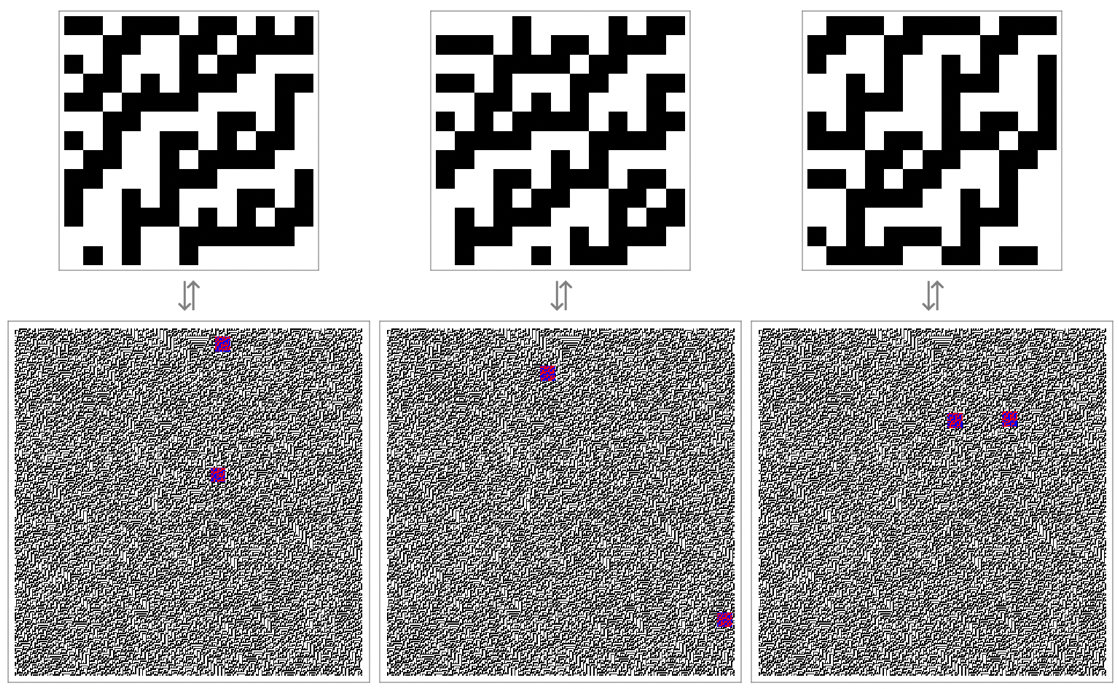
The analysis continues until it reaches the critical “first no duplicate size” where every pattern appears exactly once, representing the minimum guaranteed uniqueness threshold. For pattern sizes that still contain duplicates, the code provides visual identification by color-coding each duplicate pattern type across the entire cellular automaton diagram, allowing rapid inspection of how and where repetitions occur. The system generates comprehensive statistical summaries including duplicate rates, total pattern counts, and detailed breakdowns by size, along with charts tracking the evolution of duplication as pattern size increases. This analysis is crucial for the luxury goods application, as it identifies the exact pattern dimensions needed to guarantee that every item in a limited edition collection contains genuinely unique, mathematically non-repeating design elements, thus solving the fundamental challenge of creating authentic scarcity through computational uniqueness rather than artificial production limits.
This is code explores enables the user to explore a wide implementation for any chosen elementary cellular automata. It shows the size of the smallest non-duplicated square patch across the entire pattern, and highlights the location of the largest duplicated patches:
This is code explores enables the user to explore a long implementation for any chosen elementary cellular automata. It shows the size of the smallest non-duplicated square patch across the entire pattern, and highlights the location of the largest duplicated patches:
This is code tests Rule 30 for minimum non-duplicated patch size, and nominates a patch for an overlay:
Out[]=
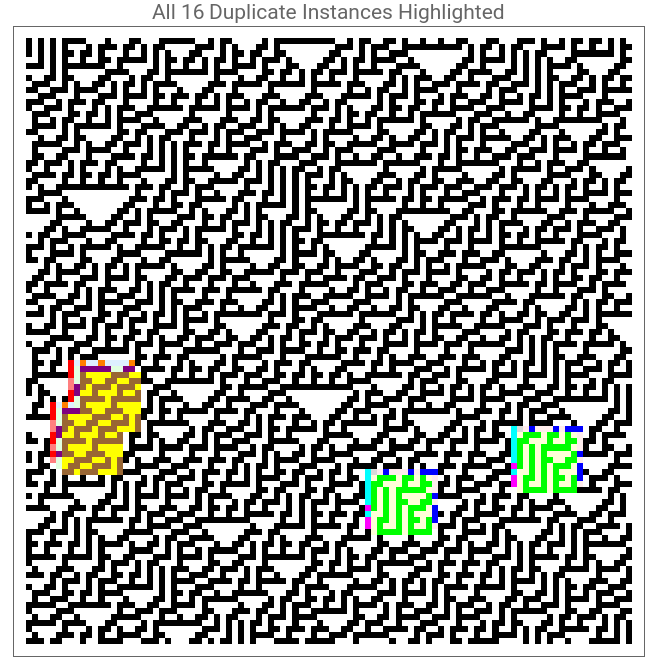
Identifying the appropriate rules when cutting a strip from the center of a light cone
Identifying the appropriate rules when cutting a strip from the center of a light cone
I used a multi-stage filtering system to identify which cellular automaton rules are optimal for generating unique patterns. The process systematically narrows down from all 256 possible elementary cellular automaton rules to a final set of just six rules that demonstrate exceptional pattern diversity. The core analysis function generates a cellular automaton evolution, then progressively examines square patch blocks of increasing size (starting from 10×10 pixels) to find the first square patch size where every patch appears only once across the whole of the pattern run. This essentially measures how quickly each rule generates unique, non-repeating design elements. Rules that achieve pattern uniqueness at smaller patch sizes are preferred because they can virtually guarantee distinctiveness across many luxury items without requiring enormous pattern blocks. The filtering process operates through five successive rounds with increasingly stringent requirements: starting with modest 100 × 100 analysis windows and 20-pixel maximum pattern sizes, then escalating to 5000-generation evolutions with 30-pixel patterns. This multi-round approach ensures that the surviving rules (22, 30, 86, 135, 149, 151) not only generate diverse patterns initially, but maintain their uniqueness properties even under extended evolution and larger analysis scales. This makes them ideal candidates for producing mathematically guaranteed unique designs across an entire limited edition collection where every item must demonstrate a genuinely distinct visual expression.
In the following section, I successively test all cellular automata rules in a configuration in which a long strip is cut from the middle of a spacetime lightcone to produce suitably unique patterns for a sixteen-and fifty- swatch limited edition. This way of building the pattern is a hybrid of the long approach and the spacetime patch/light cone approach.
In the following section, I successively test all cellular automata rules in a configuration in which a long strip is cut from the middle of a spacetime lightcone to produce suitably unique patterns for a sixteen-and fifty- swatch limited edition. This way of building the pattern is a hybrid of the long approach and the spacetime patch/light cone approach.
For a limited edition of sixteen 100 x 100 patches from a single cellular automata lightcone pattern, we can identify ten rules that can sustain a unique pattern, with duplicate areas that are no greater than 20 x 20 cells. These rules are 22,30,45,75,86,89,101,135,149,151. For a longer run with 50 patches, only six of these rules will work: 22,30,86,135,149,151.
Here are images of 100 x 100 patches of eight potential limited edition lightcone strip CAs, with the largest non-duplicated square patches highlighted (note that other rules are shown in previous or subsequent illustrations). As we know, many rules have distinct repeated elements - especially triangles! One would think that the duplicated squares across a pattern would include large triangles or other identifiable repeated motifs. Nonetheless, it is a surprising result that, when identifying the maximum duplicated patch size, the maximum repeated submatrix does not tend to include these larger visual elements. In the relevant illustrations below, one can see that the highlighted areas do not tend to include the larger triangles in the overall pattern.
Here are images of 100 x 100 patches of eight potential limited edition lightcone strip CAs, with the largest non-duplicated square patches highlighted (note that other rules are shown in previous or subsequent illustrations). As we know, many rules have distinct repeated elements - especially triangles! One would think that the duplicated squares across a pattern would include large triangles or other identifiable repeated motifs. Nonetheless, it is a surprising result that, when identifying the maximum duplicated patch size, the maximum repeated submatrix does not tend to include these larger visual elements. In the relevant illustrations below, one can see that the highlighted areas do not tend to include the larger triangles in the overall pattern.
Overlays and kawaii example
Overlays and kawaii example
Even though the black-and-white patterns explored here are themselves fairly austere, there is a computational elegance that elevates even a plain implementation. Other two-color patterns would obviously be trivial variants. Nonetheless, as a bit of fun, I generated a computational overlay of the type that could be used to add playful visual interest to contrast with the regularity of a black-and-white pattern. This was used with Sora, to generate some of the product images that appear later in this document.
Other design ideas include adding an identifiable mesh, perhaps in a third color. With the right brand and manufacturing partners, a woven plaid version could be developed. Similarly, varying the mesh row and column sizes, which maintaining the cellular automata fill patterns, could create unexpected visual interest.
Other design ideas include adding an identifiable mesh, perhaps in a third color. With the right brand and manufacturing partners, a woven plaid version could be developed. Similarly, varying the mesh row and column sizes, which maintaining the cellular automata fill patterns, could create unexpected visual interest.
This is code generates a random flower pattern and overlays it on a rule 45 patch
This is code shows a hash-seeded rule 45 patch with a blue and orange mesh overlay:
This is code allows you to play with a hash-seeded rule 45 patch in red and white, with a range of grid size transitions:
Here is an example with a linear transition. Using this approach, there is an vast variety of appealing effects that could be achieved, while retaining the fundamental cellular automata rule relationships across the pattern area. If the parameters are varied across the whole of the limited edition pattern generation, and then encoded as part of the fundamental generative data, this offers additional anti-counterfeit protection beyond the computational irreducibility of cellular automata alone.
Digital Platform: Community engagement and pattern discovery
Digital Platform: Community engagement and pattern discovery
While cellular automata patterns can provide products with a powerful unique visual identity, they fundamentally cannot function as data-encoding devices like QR codes. A separate PIN or QR-based access system would probably be required for the digital platform. QR codes are engineered for reliable machine interpretation with error correction algorithms, standardized positioning markers, and redundant data encoding that allows accurate reading even when damaged. Their geometric structure deliberately sacrifices visual complexity for computational reliability. Cellular automata patterns prioritize emergent computational rules: while each pattern represents a specific computational state, extracting information requires knowing exact generation rules, initial conditions, and generation time spans, making them unsuitable for direct digital access.
The information density challenge further distinguishes CA patterns from traditional encoding systems. QR codes reliably encode hundreds of characters because every pixel serves a defined informational purpose, while cellular automata contain implicit computational information rather than explicit data. A 100 x 100 cellular automaton might represent the state after hundreds of rule applications, but reconstructing original parameters would require computationally intensive or irreducible reverse engineering. Additionally, error tolerance presents fundamental barriers: QR codes function with up to 30% damage through built-in redundancy, while cellular automata patterns are sensitive systems where single pixel errors could represent cascading generational differences, making reliable data extraction impossible.
Given these limitations, a digital platform could serve as a branded discovery experience that transforms ownership from simple possession into active participation in a computational community. Using PIN- or QR-based access, owners can explore an interactive interface showing their pattern’s position within the complete cellular automata evolution, visualizing how their specific swatch relates to neighboring regions and understanding the spacetime “neighborhood” they inhabit. The platform could display temporal genealogy, showing how their pattern evolved from earlier generations, and highlight spatial relationships with adjacent patterns owned by other collectors, creating natural connection points for brand-sponsored, secure social interaction.
Social features could include messaging systems for owners of related patterns (temporal neighbors from the same evolution sequence, or spatial neighbors from adjacent swatches), forums organized by cellular automaton rule types, and collaborative projects where pattern holders might even contribute to larger computational art pieces. Users could suggest and/or vote on phrases that can be used to generate random seeds for future limited editions. The platform’s didactic component might offer interactive visualizations of cellular automata principles, allowing owners to experiment with the same rules that generated their patterns and understand the elegance behind their unique designs.
Core platform features might include a pattern explorer allowing users to navigate through the complete cellular automata evolution, zooming from their specific swatch to see the detailed computational landscape. A pattern “DNA viewer” could display the exact generation parameters, rule explanations, and mathematical properties that characterize their unique design. Virtual pattern labs could let owners experiment with cellular automata rules, generating new patterns and understanding the computational principles behind their purchases. The platform might also feature augmented reality tools that overlay mathematical information when users photograph their physical items, creating an immersive educational experience.
For luxury brands, digital platforms create unprecedented customer engagement depth and data insights. Such platforms provide rich behavioral analytics showing how customers interact with the brand. To date, traditional luxury goods have offered limited post-purchase interaction, but digital ecosystems generate continuous touchpoints through community features, educational content, and exclusive access to new collections. One might anticipate that customer lifetime value increases dramatically if owners become invested in the social community surrounding their purchases. In this case, customers with particular interest in mathematical concepts might feel a special connection to the computational storyline. The interests of this niche-within-a-niche might suggest further unique content and generate sharing and referrals.
The system also enables sophisticated personalization and upselling opportunities. Brands can offer owners first access to new cellular automata rules, limited-edition pattern families, or collaborative art projects. Owners might nominate text phrases or concepts to act as random generator seeds for future limited editions. Community-generated content through pattern photography, rule suggestions, and social interactions creates authentic marketing material while building brand loyalty. The educational component positions the brand as a thought leader in generative art and computational design, attracting customers who value intellectual engagement alongside luxury aesthetics.
For consumers, the platform transforms a single purchase into ongoing intellectual and social value. Owners gain access to a community, interested in content about cellular automata, complexity theory, and mathematical art that extends far beyond their individual items: like-minded individuals who appreciate both luxury design and mathematical elegance, creating networks that could persist across multiple purchases and years of ownership. Social features could include messaging systems for owners of related patterns (temporal neighbors from the same evolution sequence, or spatial neighbors from adjacent swatches), forums organized by cellular automaton rule types, and collaborative projects where pattern holders might even contribute to larger computational art pieces. Users could suggest and/or vote on phrases that can be used to generate random seeds for future limited editions. The platform’s didactic component might offer interactive visualizations of cellular automata principles, allowing owners to experiment with the same rules that generated their patterns and understand the elegance behind their unique designs. Gamification elements could include pattern collection achievements, mathematical milestone rewards, and exclusive access to special events or content based on engagement levels. The platform essentially creates the sense of a luxury learning community where mathematical curiosity enhances rather than competes with aesthetic appreciation, appealing to consumers who seek intellectual stimulation alongside exclusive ownership.
It is important to identify that this approach still presents some fundamental security limitations: the PIN system provides discovery and engagement functionality rather than robust authentication, since theoretically anyone with access to both the physical pattern and PIN could replicate the digital experience for others. This represents the core trade-off between accessibility and security in community-focused platforms.
Image-based authentication presents both opportunities and challenges within this platform context. Image authentication is feasible, but it is technically complex due to lighting variations, wear patterns, and the computational difficulty of detailed pattern recognition that is sufficient to match intricate CA patterns. Nonetheless, image uploads could be a charming gimmick if the functionality can be developed. The platform could implement guided photography tools with lighting recommendations and pattern alignment assistance, using machine learning trained on controlled samples to provide feedback on image quality. Though insufficient for complete cryptographic security, image verification adds a social proof layer that enhances community trust and creates engaging user-generated content showcasing the mathematical beauty of cellular automata patterns in real-world luxury applications.
Cryptographic Authentication: Blockchain-secured provenance
Cryptographic Authentication: Blockchain-secured provenance
The transition from community engagement to secure authentication requires implementing blockchain-based PIN registration that prevents unauthorized replication while maintaining the user experience benefits. Each PIN becomes cryptographically linked to a unique smart contract containing the mathematical generation parameters (rule number, initial conditions, spacetime coordinates) along with ownership history and transfer records. Unlike the open community platform, this system requires private key authentication where legitimate owners possess cryptographic signatures that cannot be forged or duplicated, even if counterfeiters access the physical pattern and republish the same PIN.
The blockchain implementation creates immutable ownership provenance by time-stamping the original registration at manufacture and tracking any subsequent transfers through cryptographically signed transactions. When users authenticate their items, the system verifies not only that the pattern parameters can reproduce the expected design, but that the current user possesses legitimate cryptographic claim to that specific region of the computational space. This prevents “computational counterfeiting” scenarios where bad actors might discover the cellular automata generation process but lack the blockchain-verified authority to claim ownership of those coordinates.
Integration between platforms allows users to access community features after completing cryptographic authentication, creating a seamless experience that combines social engagement with robust security. The blockchain system serves as the authoritative registry while the community platform provides the rich interactive experience, with automatic verification ensuring that only legitimate owners can participate in pattern-specific discussions or transfer ownership rights. This dual-layer approach addresses both the desire for accessible community features and the necessity of preventing unauthorized authentication, creating a comprehensive ecosystem where mathematical beauty, social interaction, and cryptographic security work together to establish new paradigms for luxury goods authentication.
Potential applications
Potential applications
Limited Editions: Luxury applications for visibility and authentication
Limited Editions: Luxury applications for visibility and authentication
The discussion above was motivated by the interests of hypothetical luxury fashion brands to protect their products from counterfeit and the associated brand erosion created by cheaper imitations. However, the versatility of cellular automata patterns enables scalable authentication across diverse luxury sectors, with pattern complexity and verification requirements adapting to product characteristics, price points, and customer expectations.
Fashion applications span from subtle interior authenticity markers to bold exterior design statements. For high-end handbags or the lining of neckties, interior lining patterns could feature intricate cellular automata designs that serve dual authentication and aesthetic purposes, invisible to casual observers but discoverable by owners and authentication services. These interior applications allow unlimited pattern complexity, assuming that photo-based authentication isn’t required for hidden elements. These applications would enable the use of intricate mathematical designs that would be computationally impossible to counterfeit without access to the exact generation parameters.
Exterior fashion applications might require balancing visual appeal with authentication functionality. Silk scarves, luxury watch faces, or jewelry elements could feature carefully scaled patterns where cellular automata designs integrate seamlessly with brand aesthetics. For these visible applications, pattern selection becomes crucial. Rules like 30, 45, and 86 (among others) generate visually striking designs that maintain luxury appeal while providing mathematical uniqueness. Seasonal collections could explore different cellular automata rules, or different initial conditions based on a public seasonal text seed, creating pattern families that become collectible series.
Pattern complexity scales with product size and value, creating a tiered authentication system. Smaller accessories like jewelry or watch components might use small pattern patches with PIN-based digital verification, where the physical pattern serves primarily as visual authentication for trained experts or specialized equipment. Medium-scale products like handbags or shoes could employ slightly larger patches with patterns that balance counterfeit resistance with manufacturing feasibility, potentially supporting guided photo authentication for customer engagement.
Large-format applications on suitcases, garment bags, or furniture could feature larger cellular automata patterns based on a 1cm x 1cm grid, where photo-based authentication becomes not just feasible but a premium product feature. Customers could use photographs of their luggage to prove ownership, connect with other like-minded travellers, or access exclusive services, transforming authentication from a security necessity into a branded experience enhancement. These larger patterns allow for higher-resolution counterfeit resistance but limit the rule set and edition size, so these would be limited to higher-margin products.
Wine and spirits represent compelling applications, where label integration addresses significant counterfeiting challenges in luxury alcohol markets. Wine bottles could feature cellular automata patterns printed with specialized security inks to reveal different aspects of the pattern under various lighting conditions, combining uniqueness with traditional anti-counterfeiting techniques. Vintage-specific patterns could encode the year and vineyard location within the mathematical generation parameters, creating vintage-authenticated labels that are both beautiful and computationally unique.
Luxury watches and jewelry could incorporate micro-scale patterns etched or engraved onto metal surfaces, where cellular automata designs serve as both decorative elements and authentication markers. Watch movements could feature laser-etched patterns visible only under magnification, providing authentication for service technicians while maintaining aesthetic appeal. Limited edition jewelry pieces could use cellular automata patterns in gem settings or metal textures, where the mathematical uniqueness parallels the exclusivity of precious materials.
Automotive and technology luxury markets could integrate patterns into dashboard elements, speaker grilles, or interior fabric weaves in limited edition vehicles or high-end electronics. Yacht interiors, private aircraft details, or luxury home furnishings could feature cellular automata patterns in textiles, metal work, or decorative elements, where the mathematical provenance enhances the bespoke craftsmanship narrative essential to ultra-luxury markets.
Each application requires customized authentication approaches, from simple PIN verification for hidden patterns to sophisticated image recognition for prominent design elements and/or cryptographic authentication, but all leverage computational irreducibility and the fundamental impossibility of replicating most cellular automata patterns without access to the exact generation parameters. The limited edition approach serves as the ultimate anti-counterfeiting protection.
Maximum Editions: Global community through computational connection
Maximum Editions: Global community through computational connection
The transition from exclusive luxury applications to mass-market community building represents a fundamentally different value proposition for cellular automata patterns. Rather than emphasizing scarcity and exclusivity, maximum editions leverage mathematical uniqueness to create global connection networks among millions of consumers who share specific pattern sequences, transforming individual purchases into participation in worldwide mathematical communities.
Fast fashion brands could implement “pattern families”, where each production run generates (for example) 50 distinct cellular automata patches from a single rule evolution, creating natural consumer tribes based on mathematical relationships rather than traditional demographics. One can imagine a global t-shirt release where customers worldwide purchase one of 50 sequential pattern segments from a Rule 30 evolution. Owners of each pattern would discover mathematical siblings, cousins and neighbors, whose designs evolved from the same or adjacent spacetime coordinates, creating instant conversation starters and connection opportunities across continents. The “United Colors of Mathematics” could enable a Bangladeshi student wearing pattern segment 23 to connect with a Norwegian artist wearing segment 24, bonding over their adjacent positions in the same mathematical landscape. Branded social platforms would facilitate these connections, allowing users to discover their pattern relatives globally and share photos showing how the same mathematical sequence appears across different cultures, body types, and styling choices. The platform could even generate mathematical compatibility scores showing how closely related different users’ patterns are within the broader cellular automata evolution.
Intentional geographic distribution could create structured international exchange programs. Brands might seed specific pattern segments in particular regions, distributing patterns 1-10 across South America, 11-20 across Southeast Asia, 21-30 across Europe, broadcasting the strategy to encourage travel, cultural exchange, and international friendship through “pattern tourism” where people seek out their mathematical neighbors in other countries.
Seasonal global campaigns could coordinate pattern releases with cultural events, distributing complementary pattern sequences during international festivals or awareness campaigns. Imagine Earth Day collections where environmentally-conscious consumers worldwide receive patterns from the same cellular automata evolution, creating a global community unified by both environmental values and computational aesthetics. Olympic year editions could distribute national team colors using cellular automata patterns, where athletes and fans share mathematical connections transcending traditional sporting rivalries.
Educational initiatives could distribute cellular automata pattern notebooks, textbooks, or school supplies globally, creating international classroom connections where students learn about computational science, complexity, and global citizenship simultaneously. Schools could partner across continents based on shared pattern families, facilitating cultural exchange programs organized around mathematical rather than purely geographic relationships.
Tech accessories like phone cases, laptop skins, or charging cables could feature cellular automata patterns enabling professional networking across industries. Software developers, designers, or researchers worldwide could discover shared pattern sequences and connect over professional interests amplified by mathematical aesthetics. Conference merchandise could use cellular automata patterns to facilitate networking, and attendees could identify others with related patterns to initiate conversations about both professional topics and computational aesthetics.
Home goods and lifestyle products could create neighborhood and community building opportunities. Cellular automata patterns on coffee mugs, water bottles, or tote bags could help identify like-minded community members in local cafes, gyms, or public spaces. Urban planning applications could even coordinate pattern distributions within cities to encourage local connections and community building through shared computational interests.
The “world peace through mathematics” concept recognizes that cellular automata patterns transcend traditional cultural, linguistic, and national boundaries. Unlike symbols or text that carry cultural baggage, mathematical patterns provide a universal language that can unite people across difference while celebrating the beauty of computational emergence. Maximum edition strategies could intentionally foster global mathematical literacy, introducing millions to concepts of emergence, complexity, and computational beauty through everyday consumer goods. Charitable applications could coordinate pattern releases with global causes, distributing complementary cellular automata sequences on items supporting clean water initiatives, literacy programs, or climate action, creating activism communities organized around both social impact and science-forward aesthetics. These approaches provide another way to transform consumption from individual expression into collective participation, where purchasing decisions contribute to global networks of connection and understanding.
The scale economics of maximum editions make cellular automata authentication accessible to billions rather than thousands, democratizing access to mathematical beauty while creating unprecedented opportunities for global community building through computational art integrated into everyday life.
Romantic Editions: PatternMatch.com
Romantic Editions: PatternMatch.com
Social platforms for intellectually curious individuals who also happen to be interested in dating might represent the most intriguing application of maximum edition cellular automata patterns. Rather than relying on superficial photo matching or algorithmic compatibility scores, computational compatibility could provide authentic connection points for people who appreciate the beauty of science, complexity, and mathematical elegance in their everyday lives. Mathematical dating platforms could distribute cellular automata patterns through wearable accessories, phone cases, or even temporary tattoos, allowing real-world pattern recognition to initiate conversations. Imagine coffee shops, bookstores, or university campuses where spotting someone with a mathematically related pattern becomes a natural conversation starter. Digital dating integration could analyze pattern relationships to motivate matches. Users with spatio-temporally adjacent patterns might enjoy the connection, given their shared appreciation for computational thinking. Rule family compatibility could match people based on shared cellular automata preferences. Rule 30 enthusiasts might appreciate complexity, while Rule 110 fans gravitate toward structured emergence.
Networking Editions: Rules for nerd conferences that rule
Networking Editions: Rules for nerd conferences that rule
The social benefits don’t only accrue to those who are interested in dating. Conference organizers could distribute related cellular automata patterns to facilitate professional connections among researchers, mathematicians, computer scientists, and complex systems enthusiasts. Academic speed networking events could organize participants by pattern families, ensuring conversations start with shared mathematical interests rather than awkward small talk about research areas. STEM meetups and maker spaces could use cellular automata patterns on membership cards or project badges, helping to pair random collaborators for mathematical art projects, computational research, or interdisciplinary initiatives. Math museum events, science festivals, cultural events or academic conferences could distribute pattern accessories that serve dual purposes as conversation starters and community identifiers. Raffles and social games could be designed around pattern-based groups that form, based on the random assignment of patches to participants.
Gaming communities could incorporate cellular automata patterns into character designs, guild identifications, or team formations, creating mathematical clans within larger gaming ecosystems. Board game cafes, escape rooms, or puzzle competitions could use patterns to match participants for game play sessions. Bookstore reading groups, philosophy cafes, or science communication events could organize breakout or subgroup activities around pattern families. These applications recognize that mathematical beauty appreciation often correlates with broader intellectual curiosity, creating efficient filtering mechanisms for finding like-minded individuals in an increasingly connected but often superficial social landscape.
Gaming communities could incorporate cellular automata patterns into character designs, guild identifications, or team formations, creating mathematical clans within larger gaming ecosystems. Board game cafes, escape rooms, or puzzle competitions could use patterns to match participants for game play sessions. Bookstore reading groups, philosophy cafes, or science communication events could organize breakout or subgroup activities around pattern families. These applications recognize that mathematical beauty appreciation often correlates with broader intellectual curiosity, creating efficient filtering mechanisms for finding like-minded individuals in an increasingly connected but often superficial social landscape.
Viticultural Editions: Terroir as initial conditions, time as mathematical evolution
Viticultural Editions: Terroir as initial conditions, time as mathematical evolution
Wine and spirits represent compelling applications, where label integration can address significant counterfeiting challenges in the luxury alcohol markets while creating profound conceptual resonance between computational and viticultural complexity. The parallels between cellular automata generation and winemaking processes offer elegant metaphorical frameworks that enhance both authentication security and brand storytelling.
Initial seed conditions in cellular automata directly parallel the concept of terroir—the unique combination of soil, climate, elevation, and microenvironment that gives wine its distinctive character. Just as a specific initial random seed (derived from coordinates like latitude 47.1234°N, longitude 7.2468°E) generates unique mathematical evolution, vineyard-specific seeds could encode precise geographic and environmental data into the cellular automata generation process. The label for a Burgundian Pinot Noir from Gevrey-Chambertin could use initial conditions derived from that specific plot’s soil pH, elevation, slope orientation, and historical weather data, creating patterns that are mathematically impossible to replicate without access to those exact terroir parameters.
Vintage-specific pattern families could encode temporal complexity alongside spatial uniqueness. A 2018 Barolo could use initial seeds incorporating that year’s precipitation patterns, temperature fluctuations, and harvest date decisions, creating cellular automata evolution that reflects not just the place but the specific environmental narrative of that growing season. Different vineyard blocks could generate spatially related but distinct patterns. Adjacent plots creating mathematically neighboring cellular automata sequences could mirror their physical proximity while maintaining individual authentication signatures.
The cellular automata rules themselves could represent winemaking philosophy and environmental influences. Traditional Burgundian techniques might employ Rule 110’s structured complexity in a “wide” implementation, while innovative New World approaches could use Rule 30’s chaotic emergence over a long cyclic pattern run. Weather pattern data from each vintage could influence rule selection: drought years generating more constrained, crystalline triangular patterns like those from rule 151, while abundant rainfall years producing more expansive, flowing designs such as rules 75 and 101. Microclimate variations within individual vineyards could drive spatial pattern generation, where different sections of the same wine label display related but distinct cellular automata regions corresponding to specific vine rows or terroir micro-zones. This creates potential for authentication granularity down to individual barrel lots while maintaining aesthetic coherence across the wine’s visual identity.
Time evolution in cellular automata directly parallels the aging process that transforms young wine into mature complexity. Labels could feature patterns representing different temporal stages. Young wines might display early-generation cellular automata with simpler structures, while aged reserves showcase later-generation patterns with accumulated complexity from extended computational evolution from teh same initial conditions. Vintage dating becomes computationally verifiable through temporal coordinates in the pattern space. Specialized security inks could also reveal different aspects of the pattern under various lighting conditions, mimicking how wine character changes with aeration, temperature, and time. UV-reactive inks might expose deeper pattern layers representing tertiary flavors that emerge only with extended aging, while thermal-sensitive elements could shift pattern aspects like wine expressing different characteristics at various serving temperatures.
Winery heritage may thus find expression through cellular automata rule patterns that span generations of winemaking tradition. Century-old Champagne houses could declare their own house rule and initial conditions, that then evolve slowly over time, creating mathematical lineage that parallels viticultural heritage. Blend authentication could even use multiple cellular automata rules representing different grape varieties or vineyard sources, mathematically encoding the precise proportions and sources that create each wine’s unique character.
Collector verification becomes multidimensional, authenticating not just the wine’s origin and vintage, but its position within the mathematical terroir space that represents the winery’s complete production history. Wine investment markets could leverage these patterns for provenance tracking, creating immutable mathematical records that follow bottles from vineyard to cellar to auction house, with each transfer cryptographically verified through blockchain integration of the pattern parameters.
This approach transforms wine labels from simple identifiers into computational art pieces that encode the complete environmental, temporal, and cultural narrative of each bottle’s creation, making counterfeiting not just difficult but conceptually meaningless, since reproducing authentic patterns would require accessing the exact same terroir, vintage conditions, and winemaking decisions that originally created the wine itself. Of course, these benefits are not limited to viticulture, but can also be used for fine spirits, craft beef, or cider production, where the poetic metaphors can stretch to captivate a discerning, intellectually playful customer base.
Next Steps
Next Steps
This project points to a range of paths forward, but a priority might be to develop a Wolfram authentication platform using a PIN or QR code, and demonstrate visualizations and brand identity for public-facing pattern-finding functionality. At the same time, aesthetically-pleasing designs could be produced with a manufacturing partner, and the fabric-and-digital-platform system could be submitted for prestigious luxury design awards. Developing more accurate image recognition solutions could also open up photo-based authentication features.
In parallel, one can refine marketing messages and identify partners who would be interesting in piloting aspects of this project, across a range of applications.
In parallel, one can refine marketing messages and identify partners who would be interesting in piloting aspects of this project, across a range of applications.
Concluding Remarks
Concluding Remarks
There is clear potential for “Wolfram Design” to develop a digital platform and a design process to use cellular automata patterns in a range of applications. Wolfram Design could partner with luxury brands, niche and mass-market retailers, vintners, dating and social networking organizations, and large conference organizations to create visually distinctive, memorable and effective limited editions and computational connection platforms. These platforms could create value by celebrating uniqueness and reducing counterfeit, while increasing community connection.
Acknowledgments
Acknowledgments
I want to thank my mentor, the inimitable Zsombor Méder, and well as the matchless Bowen Ping for coding help in the early stages of this project. And I want to heap praise and gratitude upon our peerless peers and organizers, who made Wolfram Summer School 2025 an unparalleled and demonstrably unique experience!
References
References
1
.S. Wolfram (2002), A New Kind of Science. Wolfram Media.
Cite This Notebook
Cite This Notebook
Limited Edition - Using CAs to Create Distinct Design and Connect Community
by Ellynne DEC
Wolfram Community, STAFF PICKS, July 9, 2025
https://community.wolfram.com/groups/-/m/t/3494864
by Ellynne DEC
Wolfram Community, STAFF PICKS, July 9, 2025
https://community.wolfram.com/groups/-/m/t/3494864