CITE THIS NOTEBOOK: Investigating changes in Arctic Sea ice levels by Wolfram Emerging Leaders Program. Wolfram Community FEB 16 2023.
The Wolfram Emerging Leaders Program is a 4-month long, project-based program designed for gifted high school students to take a deep dive into a topic of their choice. Students work remotely in small groups to take their project from ideation to completion, with the guidance of Wolfram experts. Wolfram Emerging Leaders Program participants are selected from the Wolfram High School Summer Camp, which is open to talented, STEM-oriented students age 17 and under. This essay was written by:
Human activities have been the root of the phenomenon of climate change. Since the industrial revolution, carbon dioxide and other greenhouse gas emissions have resulted in ever-increasing temperatures [1]. Because sea ice is white and reflects more light compared to the ocean, the sea absorbs supplementary radiation and heat [2]. Consequently, glaciers are rapidly melting, calving off into the sea. Therefore, a loophole is developed, and temperatures enhance as they no longer have a structure to reflect off. The goal achieved measured the ratio between sea ice and the sea by looking at satellite images from Wolfram. Manipulating the surface area of white sea ice and the surface area of the blue ocean identifies the trend of the given ratios. Gathered data will provide the code with a prediction of future enhancements.
Introduction
Introduction
Polar ice caps are rapidly melting as a result of global warming. The Arctic Sea ice is being lost at a rate of approximately 13% per decade [3]. At the moment, the oldest and thickest ice in the Arctic has declined by a stunning 95% [4]. This fears scientists as they worry about past pathogens from years ago being re-released. If emissions continue to rise unchecked, the Arctic has the potential to have no ice in the summer by 2040 [4]. Aside from conflicts in the Arctic, there are additional counter conflicts. Ice directly correlates to reflected heat; hence, less ice means less reflected heat, meaning more intense heatwaves worldwide [4]. However, winters will also be escalated as the polar jet stream is destabilized by warmer air, dipping south, bringing bitter cold with it. Change in temperature creates a domino effect on coastal communities, food availability, wildlife, and permafrost. We hope to act as a contributor to scientific study on global climate change and achieve an accurate prediction to compare with predictions by other scientists.
Background Information
Background Information
In the coming decades, the amount of greenhouse (heat-trapping) gases emitted globally will play a significant role in determining how much climate change will occur. With significant reductions in greenhouse gases, the impacts of climate change will be less severe. Trends in average global temperatures, sea level rise, heat content in the upper oceans, land-based ice melting, arctic sea ice, and the depth of the ocean are all changing more rapidly than the natural variations that occurred throughout Earth’s history.
Methodology
Methodology
We took screenshots of the NASA video each year and saved them. An example of a photo is attached below.
In[]:=
june1991=CloudGet[CloudObject["https://www.wolframcloud.com/obj/summercamp/WELP23Group1Images/1991"]]june1992=CloudGet[CloudObject["https://www.wolframcloud.com/obj/summercamp/WELP23Group1Images/1992"]];june1993=CloudGet[CloudObject["https://www.wolframcloud.com/obj/summercamp/WELP23Group1Images/1993"]];june1994=CloudGet[CloudObject["https://www.wolframcloud.com/obj/summercamp/WELP23Group1Images/1994"]];june1995=CloudGet[CloudObject["https://www.wolframcloud.com/obj/summercamp/WELP23Group1Images/1995"]];june1996=CloudGet[CloudObject["https://www.wolframcloud.com/obj/summercamp/WELP23Group1Images/1996"]];june1997=CloudGet[CloudObject["https://www.wolframcloud.com/obj/summercamp/WELP23Group1Images/1997"]];june1998=CloudGet[CloudObject["https://www.wolframcloud.com/obj/summercamp/WELP23Group1Images/1998"]];june1999=CloudGet[CloudObject["https://www.wolframcloud.com/obj/summercamp/WELP23Group1Images/1999"]];june2000=CloudGet[CloudObject["https://www.wolframcloud.com/obj/summercamp/WELP23Group1Images/2000"]];june2001=CloudGet[CloudObject["https://www.wolframcloud.com/obj/summercamp/WELP23Group1Images/2001"]];june2002=CloudGet[CloudObject["https://www.wolframcloud.com/obj/summercamp/WELP23Group1Images/2002"]];june2003=CloudGet[CloudObject["https://www.wolframcloud.com/obj/summercamp/WELP23Group1Images/2003"]];june2004=CloudGet[CloudObject["https://www.wolframcloud.com/obj/summercamp/WELP23Group1Images/2004"]];june2005=CloudGet[CloudObject["https://www.wolframcloud.com/obj/summercamp/WELP23Group1Images/2005"]];june2006=CloudGet[CloudObject["https://www.wolframcloud.com/obj/summercamp/WELP23Group1Images/2006"]];june2007=CloudGet[CloudObject["https://www.wolframcloud.com/obj/summercamp/WELP23Group1Images/2007"]];june2008=CloudGet[CloudObject["https://www.wolframcloud.com/obj/summercamp/WELP23Group1Images/2008"]];june2009=CloudGet[CloudObject["https://www.wolframcloud.com/obj/summercamp/WELP23Group1Images/2009"]];june2010=CloudGet[CloudObject["https://www.wolframcloud.com/obj/summercamp/WELP23Group1Images/2010"]];june2011=CloudGet[CloudObject["https://www.wolframcloud.com/obj/summercamp/WELP23Group1Images/2011"]];june2012=CloudGet[CloudObject["https://www.wolframcloud.com/obj/summercamp/WELP23Group1Images/2012"]];june2013=CloudGet[CloudObject["https://www.wolframcloud.com/obj/summercamp/WELP23Group1Images/2013"]];june2014=CloudGet[CloudObject["https://www.wolframcloud.com/obj/summercamp/WELP23Group1Images/2014"]];june2015=CloudGet[CloudObject["https://www.wolframcloud.com/obj/summercamp/WELP23Group1Images/2015"]];
Out[]=
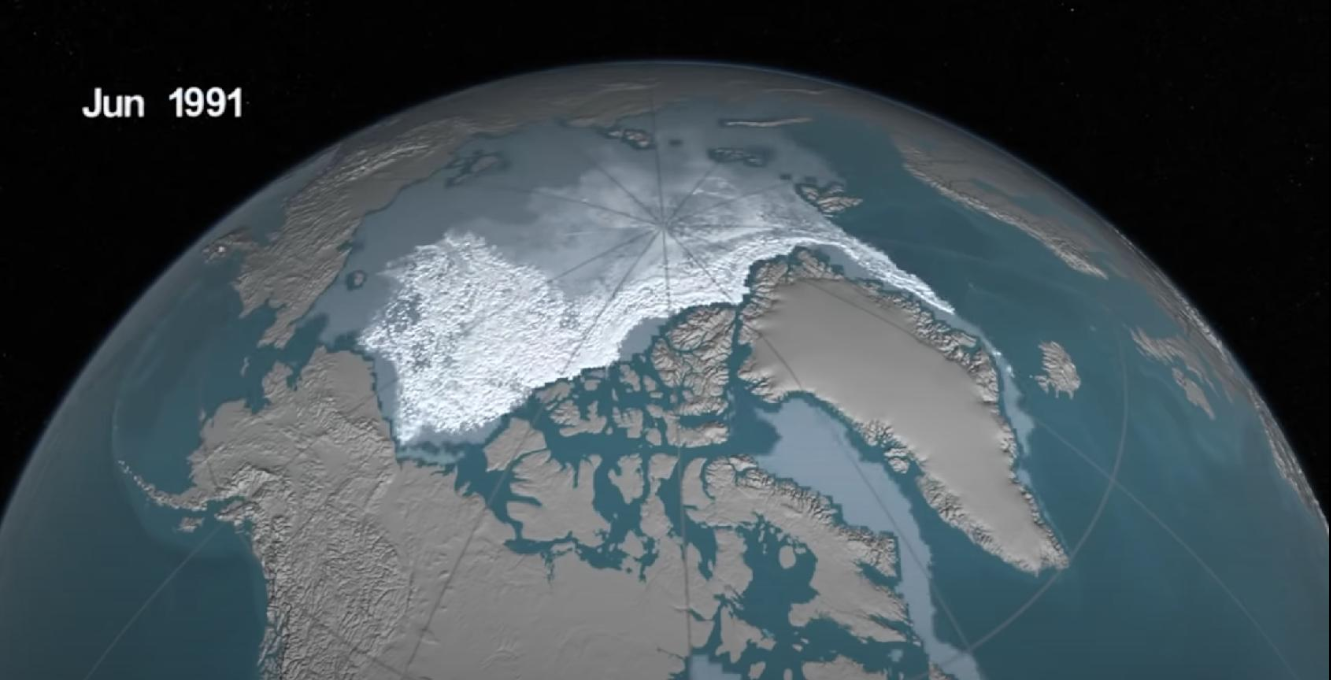
Because we wanted to find how many white space there is in this photo in comparison to the surface area of the earth, we attempted to binarize find the image so that we would only see the white space.
In[]:=
binarizedJune1991=Binarize[june1991,0.7]
Out[]=
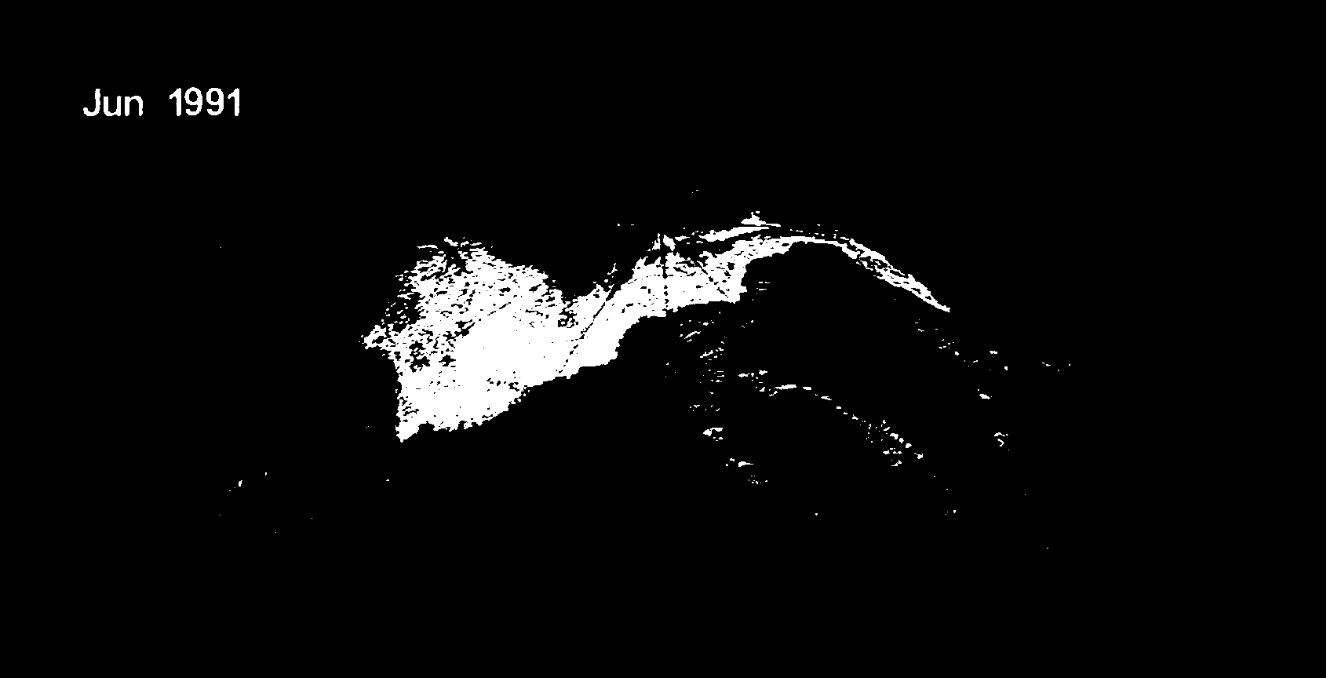
Now that we changed the image into space that is white and black, we attempted to find the number of white pixels in the image and we used the ImageLevels function to do so.
In[]:=
totalWhitePixels=ImageLevels[binarizedJune1991][[2]][[2]];
However, because we have to subtract the number of white pixels in the left corner, we found the number of white pixels that said Jun 1991.
We used {0, 180} and {0, 320} to isolate the date. These numbers may need to be adjusted on different computers
In[]:=
june1991Date=ImageTake[Binarize[june1991,0.7],{0,180},{0,320}]
Out[]=

In[]:=
ImageLevels[june1991Date]
Out[]=
{{0,55295},{1,2305}}
Thus, the number of white pixels of the white space is
In[]:=
pixelsWeWant=ImageLevels[binarizedJune1991][[2]][[2]]-ImageLevels[june1991Date][[2]][[2]]
Out[]=
58132
Now we have to find the total number of pixels of the earth in the image so that we can find the percentage of white space in the image.
In[]:=
Binarize[june1991,0.2]
Out[]=
Binarizing it by 0.2 gives us the pixels of the earth. However, we must remember to subtract the number of white pixels in Jun 1991.
In[]:=
blackWhite={ImageLevels[Binarize[june1991,0.2]][[1]][[2]],ImageLevels[Binarize[june1991,0.2]][[2]][[2]]}
Out[]=
{411424,1048736}
In[]:=
whitePixelsHemisphere=blackWhite[[2]]-ImageLevels[ImageTake[Binarize[june1991,0.2],{0,180},{0,320}]][[2]][[2]]
Out[]=
1045000
Thus, finding the percentage gives,
In[]:=
100.0(pixelsWeWant/whitePixelsHemisphere)
Out[]=
5.56287
We create a function to get the percentage right away once we insert a photo.
In[]:=
percentageFunction[img_Image]:=Module[{binarize1,binarize2,pixelsWeWant,whiteHemispherePixels},binarize1=Binarize[img,0.7];pixelsWeWant=ImageLevels[binarize1][[2]][[2]]-ImageLevels[ImageTake[binarize1,{0,180},{0,320}]][[2]][[2]];binarize2=Binarize[img,0.2];whiteHemispherePixels=ImageLevels[binarize2][[2]][[2]]-ImageLevels[ImageTake[binarize2,{0,180},{0,320}]][[2]][[2]];100.0(pixelsWeWant/whiteHemispherePixels)]
Thus, we can confirm that this function does indeed work. In the next section, we show the statistical analysis of the results.
Results
Results
The above graphic shows the photos of Arctic sea ice from June of each year.
We then ran the function finding the percentage of sea ice on each image, matched each image with its percentage, and put it all into a grid.
We then ran the function finding the percentage of sea ice on each image, matched each image with its percentage, and put it all into a grid.
A graph of the percentages each year:
Prediction
Prediction
We used the Predict function to help make predictions of future sea ice levels.
For example, the prediction for the sea ice levels in 2025:
Let's see what the graph does for future predictions:
Time Series Model
Time Series Model
We also decided to use a TimeSeriesModel to see if it would predict differently.
First, we made a TimeSeries of the data:
We plotted the data:
Then we used the TimeSeriesModelFit function to make a predictor based on the time series.
Now we can use the model to predict the sea ice percentage for a given year:
This gives a slightly different prediction than our predictSeaIceLevels function:
However, the predictions both showed that sea ice is rapidly decreasing. Then we used that model to predict 12 years beyond 2015:
The TimeSeriesModelFit function predicts a steeper decline in the sea ice levels.
Conclusion
Conclusion
◼
The main result from this research is that sea ice levels are rapidly decreasing and that by using the linear regression and time series modelling, we are able to find that in 2025, sea ice levels will be rapidly decreased.
◼
For future work, it would be possible to find if there is more precise data of the change in sea ice levels and we could possibly find a more accurate predictor model instead of using the linear trend-line.
References
References
◼
[1]: “Changes since the Industrial Revolution.” American Chemical Society, www.acs.org/climatescience/greenhousegases/industrialrevolution.html.
◼
[2]: “The Arctic Is Absorbing More Sunlight.” NASA, NASA, earthobservatory.nasa.gov/images/84930/the-arctic-is-absorbing-more-sunlight.
◼
[3]: Scott, Rebecca Lindsey AND Michon. “Climate Change: Arctic Sea Ice Summer Minimum.” NOAA Climate.gov, www.climate.gov/news-features/understanding-climate/climate-change-arctic-sea-ice-summer-minimum.
◼
[4]: “Six Ways Loss of Arctic Ice Impacts Everyone.” WWF, World Wildlife Fund, www.worldwildlife.org/pages/six-ways-loss-of-arctic-ice-impacts-everyone.