ABSTRACT (original article): A chain of magnetic impurities deposited on the surface of a superconductor can form a topological Shiba band that supports Majorana zero modes and holds a promise for topological quantum computing. Yet, most experiments scrutinizing these zero modes rely on transport measurements, which only capture local properties. Here we propose to leverage the intrinsic dynamics of the magnetic impurities to access their nonlocal character. We use linear response theory to determine the dynamics of the uniform magnonic mode in the presence of external ac magnetic fields and coupling to Shiba electrons. We demonstrate that this mode, which spreads over the entire chain of atoms, becomes imprinted with the parity of the ground state and, moreover, can discriminate between Majorana and trivial zero modes located at the ends of the chain. Our approach offers a noninvasive alternative to the scanning tunneling microscopy techniques used to probe Majorana zero modes. Conversely, the magnons could facilitate the manipulation of Majorana zero modes in topological Shiba chains. CITATION (original article): P.-X. Shen, V. Perrin, M. Trif, and P. Simon, Majorana-magnon interactions in topological Shiba chains, Phys. Rev. Res. 5, 033207 (2023). https://doi.org/10.1103/PhysRevResearch.5.033207
Introduction
Introduction
This notebook presents a comprehensive study on Majorana-magnon interactions in topological Shiba chains. The primary focus is on the application of the tight-binding effective Hamiltonian for the Yu-Shiba-Rusinov chain, which is widely used to model Majorana zero modes. This Hamiltonian is derived from the pioneering work by Pientka et al. [Phys. Rev. B 91, 064505 (2015)], which introduced several closed-form integrals crucial for computing matrix elements. However, certain terms in these integrals were corrected by a Debye convergence factor in our recent paper [Phys. Rev. Res. 5, 033207 (2023)].
The notebook not only supports the findings of our paper but is also applicable to a broader range of studies involving Yu-Shiba-Rusinov chains. Specifically, it offers explicit calculations of overlap integrals, as detailed in the “Overlap Integrals” section, which can significantly streamline the work of other researchers in the field. By providing these corrected integrals and additional computational tools, this notebook aims to save time and effort for scientists conducting similar research.
The notebook not only supports the findings of our paper but is also applicable to a broader range of studies involving Yu-Shiba-Rusinov chains. Specifically, it offers explicit calculations of overlap integrals, as detailed in the “Overlap Integrals” section, which can significantly streamline the work of other researchers in the field. By providing these corrected integrals and additional computational tools, this notebook aims to save time and effort for scientists conducting similar research.
Overlap Integrals
Overlap Integrals
This section provides detailed calculations and useful identities for overlap integrals essential in the study of Yu-Shiba-Rusinov chains. These integrals are critical for understanding the matrix elements in the tight-binding effective Hamiltonian. The corrected terms, as discussed in our paper, ensure accurate results for researchers working with these models.
Useful Identities
Useful Identities
We first introduce these following identities that are helpful to simplify the integrals of Appendix G.
In[]:=
Clear["Global`*"];$Assumptions=r∈;Integrate,{θ,-π/2,+π/2}IntegrateCos[θ],{θ,-π/2,+π/2}IntegrateSin[θ],{θ,-π/2,+π/2}Integrate,{θ,π/2,3π/2}IntegrateCos[θ],{θ,π/2,3π/2}IntegrateSin[θ],{θ,π/2,3π/2}
θ+rCos[θ]
rCos[θ]
rCos[θ]
θ+rCos[θ]
rCos[θ]
rCos[θ]
Out[]=
π(BesselJ[1,r]+StruveH[-1,r])
Out[]=
π(BesselJ[1,r]+StruveH[-1,r])
Out[]=
0
Out[]=
π(BesselJ[1,r]+StruveH[-1,r])
Out[]=
π(BesselJ[1,r]+StruveH[-1,r])
Out[]=
0
I1(x)
I
1
In[]:=
Clear["Global`*"];
All notations are consistent with Appendix G. The assumptions to derive the integrals are as follows:
In[]:=
$Assumptions=ℏ>0&&Δ>ω>0&&kF>0&&vF>0&&ωD>0;
Define the integrand for the overlap integral (x) in Equation (G3):
I
1
In[]:=
integrandωD=--+;
ν
2π
ξExp[+(kF+ξ/(ℏvF))xCos[θ]]
2
ω
2
ξ
2
Δ
2
ωD
2
ξ
2
ωD
Define the auxiliary variables and as
ξ
v
ξ
ω
In[]:=
ξv=ℏvF-;ξω=ℏvF/ωD;
2
Δ
2
ω
Compute the positive and negative terms using the Residue theorem:
xcos(θ)
In[]:=
positiveCosX=+2πResidueSum[{integrandωD,Im@ξ>0},ξ];negativeCosX=-2πResidueSum[{integrandωD,Im@ξ<0},ξ];
Define the rule for simplifying the overlap integral:
In[]:=
rule=->-,r0->x(kF+kv),r1->x(kF+kω);
ν
2
ωD
2(-++)
2
Δ
2
ω
2
ωD
Check the equality of positive and negative terms with the expected results from the paper,
xcos(θ)
In[]:=
positiveCosX==+(-)/.rule/.{kv->+1/ξv,kω->+1/ξω}//SimplifynegativeCosX==-(-)/.rule/.{kv->-1/ξv,kω->-1/ξω}//Simplify
r0Cos[θ]
r1Cos[θ]
r0Cos[θ]
r1Cos[θ]
Out[]=
True
Out[]=
True
Compute the exact positive component of the overlap integral (x),
x
I
1
In[]:=
I1ωDExactPositiveX=Integrate+(-),{θ,-π/2,π/2},Assumptions->{r0∈,r1∈}/.rule/.{kv->+1/ξv,kω->+1/ξω}+Integrate-(-),{θ,π/2,3π/2},Assumptions->{r0∈,r1∈}/.rule/.{kv->-1/ξv,kω->-1/ξω};
r0Cos[θ]
r1Cos[θ]
r0Cos[θ]
r1Cos[θ]
Check the equality of the exact positive component of the overlap integral (x) with the expected result in Equation (G4):
x
I
1
In[]:=
I1ωDExactPositiveX==-(BesselJ[0,x(kF+/ξv)]+StruveH[0,x(kF+/ξv)]-BesselJ[0,x(kF-/ξv)]+StruveH[0,x(kF-/ξv)]+BesselJ[0,x(kF-/ξω)]-StruveH[0,x(kF-/ξω)]-BesselJ[0,x(kF+/ξω)]-StruveH[0,x(kF+/ξω)])//Simplify
πν
2
ωD
2(-++)
2
Δ
2
ω
2
ωD
Out[]=
True
Compute the exact negative component of the overlap integral (x):
x
I
1
In[]:=
I1ωDExactNegativeX=Integrate+(-),{θ,π/2,3π/2},Assumptions->{r0∈,r1∈}/.rule/.{kv->+1/ξv,kω->+1/ξω}+Integrate-(-),{θ,-π/2,π/2},Assumptions->{r0∈,r1∈}/.rule/.{kv->-1/ξv,kω->-1/ξω};
r0Cos[θ]
r1Cos[θ]
r0Cos[θ]
r1Cos[θ]
Check the equality of the exact negative component of the overlap integral (x) with the expected result in Equation (G4):
x
I
1
In[]:=
I1ωDExactNegativeX==-(BesselJ[0,x(kF+/ξv)]-StruveH[0,x(kF+/ξv)]-BesselJ[0,x(kF-/ξv)]-StruveH[0,x(kF-/ξv)]+BesselJ[0,x(kF-/ξω)]+StruveH[0,x(kF-/ξω)]-BesselJ[0,x(kF+/ξω)]+StruveH[0,x(kF+/ξω)])//Simplify
πν
2
ωD
2(-++)
2
Δ
2
ω
2
ωD
Out[]=
True
Compute the limit of the integral as ,
x0
In[]:=
Limit[#,x->0]&/@{I1ωDExactPositiveX,I1ωDExactNegativeX}
Out[]=
{0,0}
Assuming , compute the asymptotic overlap integral (x) for large and large , and check the equality of the asymptotic overlap integral (x) with the expected result in Equation (G5):
x>0
I
1
k
F
ω
D
I
1
In[]:=
Off[Limit::alimv];Assumingx>0,I1ωDApproxPositiveX=Limit[Asymptotic[FullSimplify@Asymptotic[I1ωDExactPositiveX,kF->∞],kF->∞],ωD->∞];I1ωDApproxPositiveX==πνSin+kFx-//TrigExpand//PowerExpand//Simplify
2
+kFπx
π
4
-x/ξv
Out[]=
True
Assuming , compute the asymptotic overlap integral (x) for large and large , and check the equality of the asymptotic overlap integral (x) with the expected result in Equation (G5):
x<0
I
1
k
F
ω
D
I
1
In[]:=
Assumingx<0,I1ωDApproxNegativeX=Limit[Asymptotic[FullSimplify@Asymptotic[I1ωDExactNegativeX,kF->∞],kF->∞],ωD->∞];I1ωDApproxNegativeX==πνSin-kFx-//TrigExpand//PowerExpand//Simplify
2
-kFπx
π
4
+x/ξv
Out[]=
True
I2(x)
I
2
I3(x)
I
3
I4(x)
I
4
Normalization of Wavefunctions
Normalization of Wavefunctions
Fourier Transform of Integrals
Fourier Transform of Integrals
Robustness of Visibility
Robustness of Visibility
In this section, we explore the robustness of the visibility of the spin susceptibility, a key indicator of Majorana zero modes in topological Shiba chains. The visibility oscillates between -1 and 1 in the topological regime, while it does not in the trivial regime. This significant difference can be attributed to the symmetry of the pristine one-dimensional system. Our numerical results reproduce the findings from our paper, showcasing the behavior of visibility under various conditions.
V(ω)
Definition of Functions
Definition of Functions
Random Realizations
Random Realizations
One can change the “SeedRandom” to obtain more realizations such as Figure 4(c).
In[]:=
ϵ0=0.;SeedRandom[0608];Row@*plotVisibility@@dataForPlot[ϵ0]
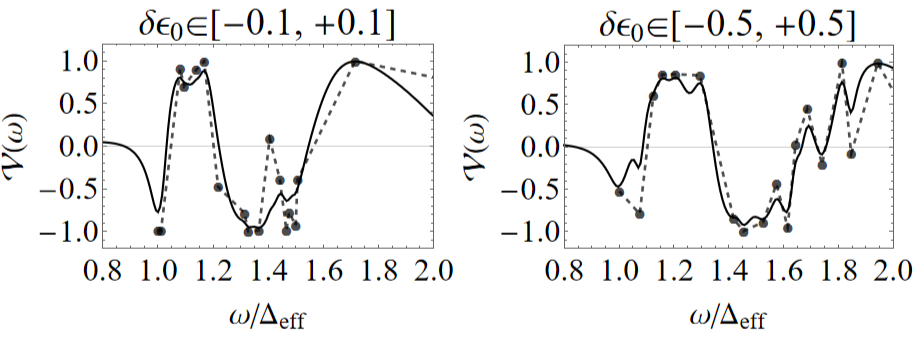
The figures above illustrate the frequency dependence of the visibility in the presence of random onsite disorder. The left and right columns depict the topological and trivial regimes, respectively. The robustness against moderate onsite disorder demonstrates the potential of using visibility as a reliable measure for identifying Majorana zero modes.
V(ω)
Paper Realizations
Paper Realizations
Figure 4 (a)(c)
Figure 4 (a)(c)
Here we use the iconized saved data.
In[]:=
Row@plotVisibility,,,
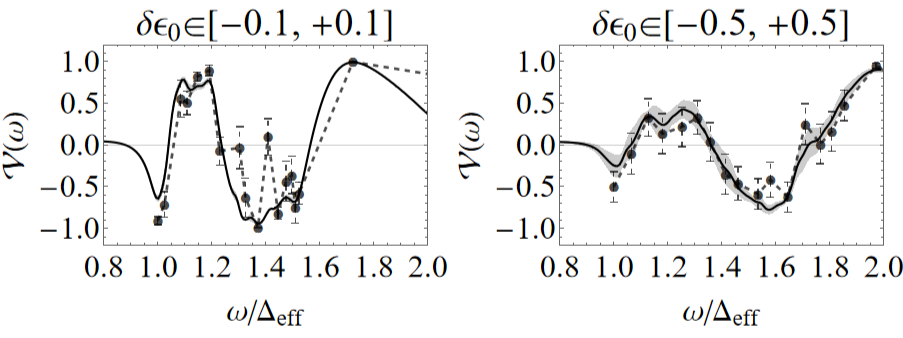
Figure 4 (b)(d)
Figure 4 (b)(d)
Here we use the iconized saved data.
Figure S3 (a)(c)
Figure S3 (a)(c)
Here we use the iconized saved disorders.
Figure S3 (b)(d)
Figure S3 (b)(d)
Here we use the iconized saved disorders and fine-tuned impurity.
Figure S4 (b)(d)
Figure S4 (b)(d)
Here we use the iconized saved disorders and fine-tuned impurity.
Conclusion
Conclusion
In this notebook, we have studied the interaction between Majorana zero modes and magnons in ferromagnetically aligned magnetic impurities coupled to a spin-orbit-coupled s-wave superconductor. We uncovered the nonlocal Majorana zero modes’ imprints onto the uniform magnonic mode and demonstrated their intimate connection with the spatial symmetry of the chain. Furthermore, we discriminated the effects of Majorana zero mode and trivial zero modes from the magnonic response and showed the robustness of this response against moderate onsite disorder.
Our findings can be naturally extended to various other systems, such as two-dimensional magnetic clusters harboring chiral Majorana zero modes, superconducting-semiconducting nanowires covered by magnetic insulators, and carbon nanotubes proximitized by ferromagnets. The nonlocal Majorana-magnon coupling and the resultant parity-dependent spin susceptibility form the core of our study, presenting a novel method for detecting and characterizing Majorana zero modes.
Our findings can be naturally extended to various other systems, such as two-dimensional magnetic clusters harboring chiral Majorana zero modes, superconducting-semiconducting nanowires covered by magnetic insulators, and carbon nanotubes proximitized by ferromagnets. The nonlocal Majorana-magnon coupling and the resultant parity-dependent spin susceptibility form the core of our study, presenting a novel method for detecting and characterizing Majorana zero modes.
CITE THIS NOTEBOOK
CITE THIS NOTEBOOK
Majorana-magnon interactions in topological Shiba chains
by Pei-Xin Shen
Wolfram Community, STAFF PICKS, June 12, 2024
https://community.wolfram.com/groups/-/m/t/3192232
by Pei-Xin Shen
Wolfram Community, STAFF PICKS, June 12, 2024
https://community.wolfram.com/groups/-/m/t/3192232