I am pleased to announce that the Wolfram Notebook version of Essentials of Complex Analysis: A Computational Approach was published by Wolfram Media on December 16, 2025, ISBN-13: 978-1-57955-096-7. You can get your free copy of the e-book here: https://www.wolfram-media.com/products/essentials-of-complex-analysis/
This e-book is the companion to the free course on complex analysis on Wolfram U, and is an introduction to the subject for a first undergraduate course.
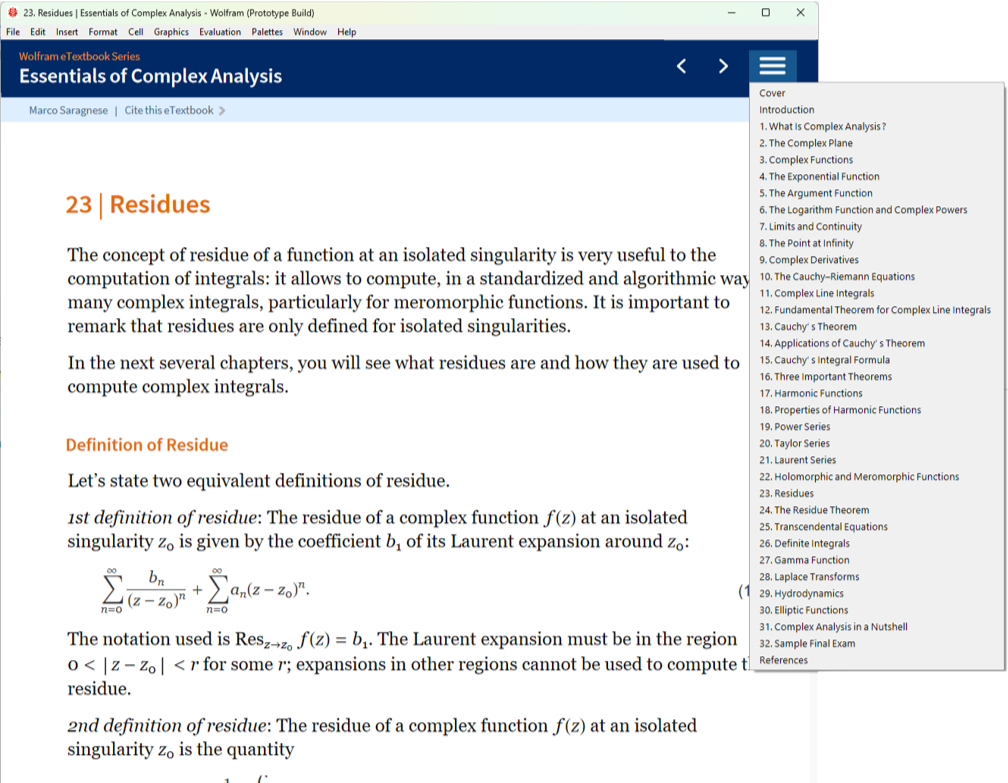
Readers can fully view all code used in the book:
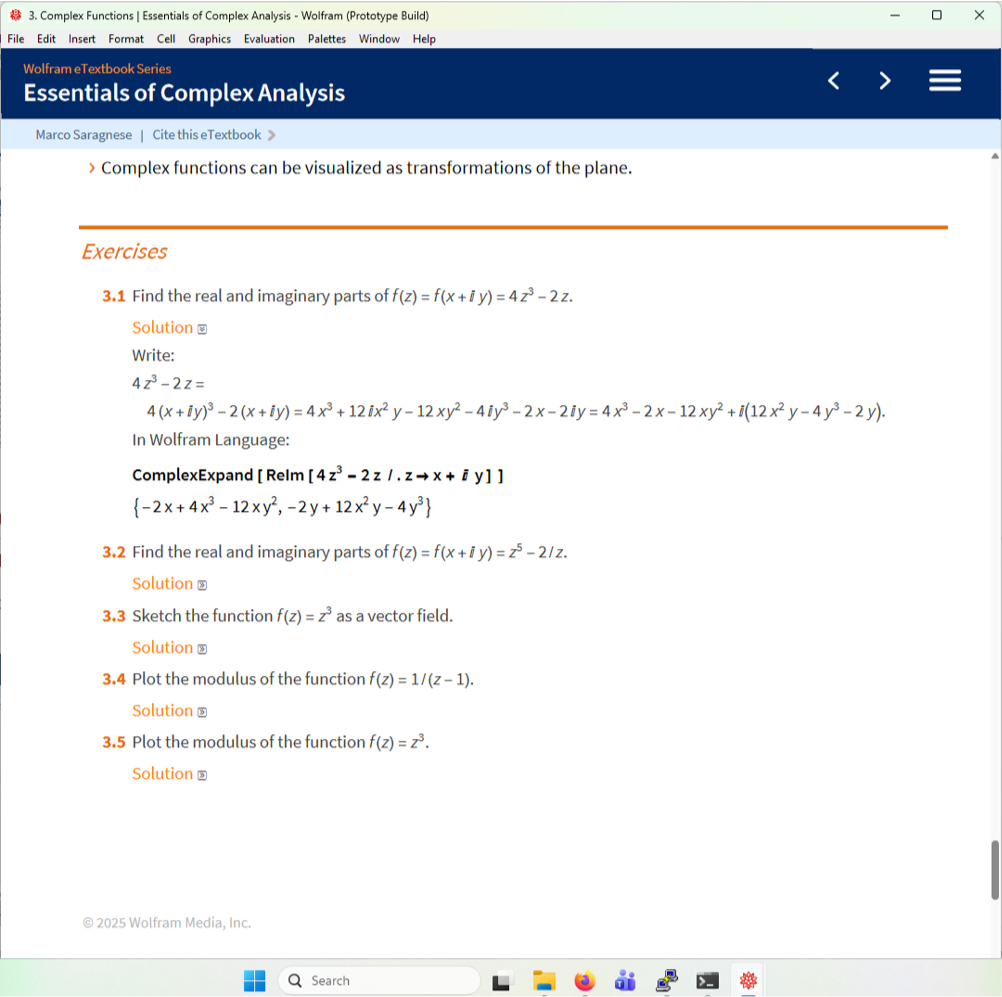
The topics covered are the same as in the Wolfram U course, sometimes expanded in greater detail.
The e-book contains many solved exercises, graphics and interactive demonstrations in Wolfram Language.
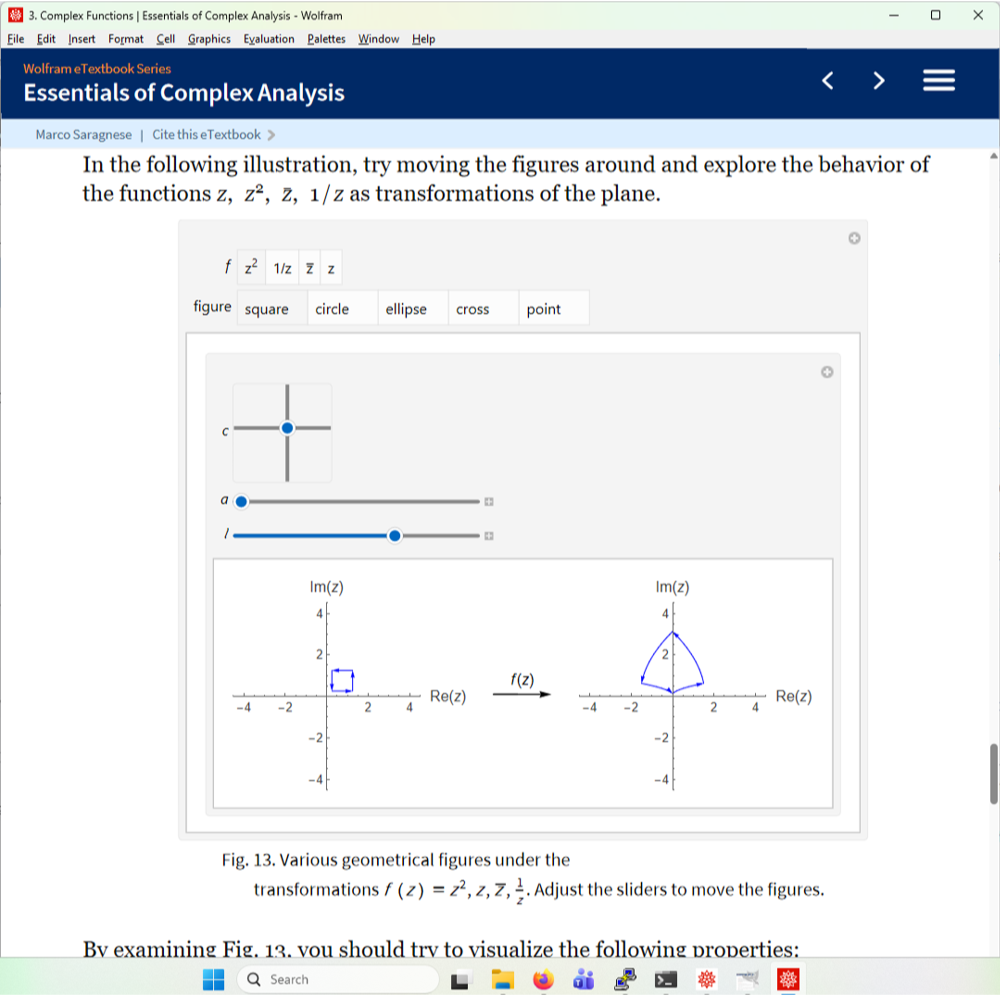
We hope that this e-book will inspire readers to delve further into the subject, while learning the tools that Wolfram Language offers them in this area of mathematics.
Book Introduction
Book Introduction
Complex analysis is a versatile tool that is used extensively in science, engineering and other fields. It is also a beautiful topic in itself. A course in complex analysis is a standard part of the curriculum for students of physics and engineering and a stepping stone for more advanced topics in mathematics.
This book is a basic introduction to the subject. It covers the elementary functions, the Cauchy–Riemann equations, complex integration, Cauchy’s theorem and the residue theorem. The emphasis is on visualization and hands-on exercises, rather than on comprehensive proofs.
The book makes extensive use of Mathematica, a powerful system originally designed by Stephen Wolfram as a “system for doing mathematics by computer.” Hence, Mathematica is ideally suited for topics in pure mathematics, such as complex analysis.
The reader will get exposure to the capabilities of Mathematica in this domain, and will appreciate the power of Mathematica to visualize all kinds of functions and contours, as well as its computational abilities. Tedious residue calculations or contour integrations or series expansions can quickly be solved by dedicated Mathematica functions so the reader can focus on the important points.
A first course in complex analysis is a necessary milestone for further studies. We hope that this book will be a good springboard to your next level of mathematical understanding.
Sample Chapter: 27 | Gamma Function
Sample Chapter:
27
| Gamma FunctionThis chapter presents the gamma function. Before that, you will see the concept of analytic continuation.
Overview
Overview
The factorial of a positive integer is defined by
n
n!=n·(n-1)·(n-2)…·3·2·1.
(
1
)The goal behind the definition of the gamma function was to interpolate the factorial, not just for real but for complex values. We will see that
Γ(n+1)=n!forn∈.
(
2
)In Wolfram Language, the factorial is available as the command or , and the gamma function through the command .
In Fig. 1, you can see how extends the factorials of the first few integers.
Γ(x+1)
Fig. 1. The functions Γ(x+1) and x!. |
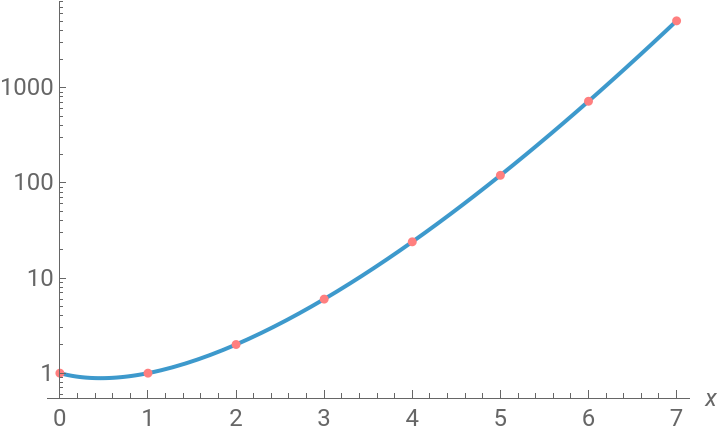


In a way, the gamma function is the smallest extension of the factorial that retains useful properties such as being meromorphic.
Before introducing the definition of the gamma function, it is necessary to see the concept of analytic continuation, which is closely related to interpolations in the complex plane.
Analytic Continuation
Analytic Continuation
Analytic continuation is one of those cases where real differentiable functions and complex analytic functions behave very differently, and where analyticity is a strong constraint on the behavior of analytic functions.
Suppose that is a real, differentiable function of the real variable , and that the values of for are known (Fig. 2). There are many different ways to continue this function for such that the resulting function is differentiable everywhere and agrees with in the original domain.
f(x)
x
f
-1<x<1
x>=1
f
Fig. 2. Different continuations of a real function into the real line. The same process is unambiguous for complex analytic functions. |
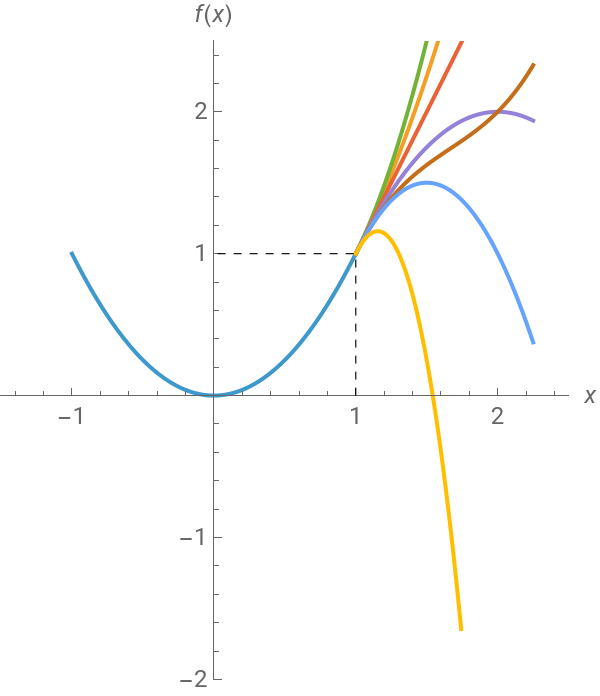
Instead, analytic functions behave very differently, and there is only one way to continue an analytic function. First, let’s define more formally what an analytic continuation is in complex analysis.
The theorem proves that the analytic continuation is unique, if it exists.
In the next section, you will see an example of analytic continuation, used to define the gamma function.
The Gamma Function
The Gamma Function
The motivation behind the definition of the gamma function is to analytically continue the factorial function
Consider the function
It is easy to calculate
Wolfram Language is aware of the integral in Eq. (4):
Using integration by parts:
So integration by parts leads to the formula
Notice that Eq. (5) and (8) imply that
Example 27.1
Example 27.1
Compute it with Wolfram Language:
More Properties of the Gamma Function
More Properties of the Gamma Function
Next, let’s see some further properties of the gamma function:
Repeating this process leads to the formula (10).
Another property is:
Another property is:
Other noteworthy identities, which we won’t prove here, are:
Many more identities about the gamma function can be found on the Wolfram Mathematical Functions Site.
Wolfram Language is aware of many properties of the gamma function, as you can check: for Eq. (11):
For Eq. (12):
For Eq. (13):
And you can compute residues with:
and residues of higher powers of the gamma function as well:
Example 27.2
Example 27.2
Definition as a Weierstrass Product
Definition as a Weierstrass Product
A second equivalent definition of the gamma function uses an infinite product representation due to Weierstrass:
where
Notice that the product in Eq. (13) has zeros at the negative integers and is an entire function.
Definition as a Contour Integral
Definition as a Contour Integral
A third definition of the gamma function is as a contour integral:
In Wolfram Language:
Summary
Summary
Exercises
Exercises
CITE THIS NOTEBOOK
CITE THIS NOTEBOOK
Essentials of complex analysis: a computational approach
by Marco Saragnese
Wolfram Community, STAFF PICKS, December 16, 2025
https://community.wolfram.com/groups/-/m/t/3592512
by Marco Saragnese
Wolfram Community, STAFF PICKS, December 16, 2025
https://community.wolfram.com/groups/-/m/t/3592512