Around Christmas of 2024, a new asteroid was discovered that has the media buzzing due to a reported possibility of a collision with Earth in 2032. Though these headlines sound scary, its important to remember that many small asteroids have been found to have a measurable risk of striking Earth in the future, never more than the low single digits in percentage, they are often ruled out later as the orbit is refined. So what do we know so far? Let’s start with some observational data.
First, lets define which entity we are referring to:
In[]:=
asteroid=Entity["MinorPlanet","MinorPlanetProvisional2024YR4"];
At the time of this post, the asteroid can be found in the constellation Canis Minor:
In[]:=
date=DateObject[{2025,2,7,19,0}];
In[]:=
asteroid[Dated["Constellation",date]]
Out[]=
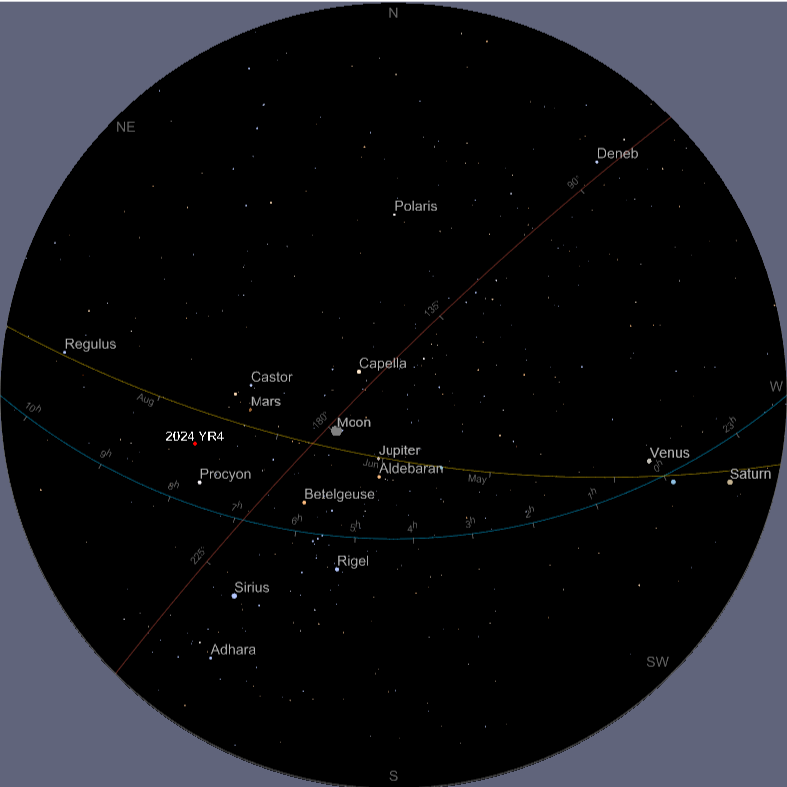
Noting that we can compute the altitude and azimuth of the asteroid at 7PM with:
In[]:=
ap=AstroPosition[asteroid,{"Horizon",date}]
Out[]=
AstroPosition

Here’s a sky map showing where to look in the sky at 7PM:
In[]:=
AstroGraphics[{Red,Point[ap],Text[Style[asteroid["Name"],White],ap,{0,-1}]},AstroReferenceFrame->{"Horizon",date},AstroRange->All]
Out[]=
But don’t get too excited to rush out and look for this asteroid with a telescope.
Let’s query for some physical and nomenclature data:
In[]:=
ev=EntityValue[asteroid,{"ProvisionalDesignation","IAUNumber","IAUName","Mass","Density","Diameter","Albedo","RotationPeriod"},"Dataset"]
Out[]=
First, let’s examine the name of the asteroid. It only has a provisional designation which encodes its date of discovery. Its orbit isn’t known well enough to obtain an official IAU number and hasn’t been given a proper/IAU name. This tells us that this is only a recent discovery and more information is needed before more complete nomenclature is given.
As for the physical data, we can convert the diameter into more relatable units for convenience:
In[]:=
UnitConvert[ev["Diameter"],{"Meters","Feet"}]
Out[]=
,
In[]:=
UnitConvert[ev["RotationPeriod"],"Minutes"]
Out[]=
It’s important to recognize that there are a lot of assumptions that go into these values. The observations simply show an unresolved point of light. The spectrum of the point of light indicates it is likely a stony-type asteroid with NASA assuming an albedo of 0.154 and an assumed density of about 2.6 . The albedo value puts it somewhere between worn asphalt and bare soil in reflectivity, so its rather dark. Light variation indicates a likely rotation period of about 19.5 minutes. All together these values lead to the assumed diameter of about 54 meters, or 180 feet across or so. If correct, this is much smaller than the asteroid that is thought to have provided the final blow for the dinosaurs, but more like the object thought to have struck Tunguska Siberia in 1908 which flattened an area of trees equivalent to about 2,150 (830 ), leaving no obvious crater. That object likely exploded in the air before striking the ground. This was not a small effect, especially if it impacted an area over a city, but far from a world ending event.
g
3
cm
2
km
2
mi
Why are we even talking about this asteroid possibly hitting Earth? Let’s start by discussing the discovery circumstances. It was discovered on 27 December, 2024, just after Christmas. Rough, early calculations showed that the asteroid had flown quite close to the Earth, within 828,800 kilometers or 515,000 miles, just two days prior on Christmas day. Let’s plot the orbit and position for Christmas day in 2024 based on mean orbital elements:
In[]:=
styledSun={Hue[.125,1,1],Lighting->{{"Ambient",GrayLevel[.3]},{"Directional",White,ImageScaled[{0,0,1}]}},Sphere[{0,0,0},.05]};
In[]:=
earth=Entity["Planet","Earth"];
In[]:=
asteroidPlot[date_DateObject,opts___]:=Module[{pos},pos=AstroPosition[asteroid,{"MeanEcliptic",date,"SSB"},"Cartesian"]["Data"];ResourceFunction["SolarSystemPlot3D"][{Red,Sphere[asteroid,.02]},date,opts,"IncludeSun"->True,"SunStyle"->styledSun,SphericalRegion->Sphere[pos,.9],Boxed->False,ViewPoint->{-1.42,2.44,2.13},PlotLabel->DateString[date,"DateShort"]]]
In[]:=
asteroidPlot[DateObject[{2024,12,25}]]
Out[]=

The plot above doesn’t show the Earth because at this resolution, the asteroid and Earth are on top of each other. Obviously, it didn’t collide, but had it done so, we would not have seen it coming since it wasn’t discovered until after it flew past Earth. Due to this close flyby, astronomers looked forward to see if there was likely going to be more close flybys or possible impacts in the future.
Keep in mind that at the time of this post, the asteroid has only been known for a little more than a month:
In[]:=
DateDifference[DateObject[{2024,12,27}],DateObject[{2025,2,7}]]
Out[]=
Astronomers had to measure as many positions as possible during this month in order to construct a complete orbit for the asteroid. At the time of this post this was about 325 observations, all along a small arc of the orbit as it was close enough to Earth to actually observe. Remember, this is a small dark object so as it gets further from Earth, observing it may become impossible. This lack of observation points along the full orbit leads to uncertainty in the derived orbital parameters.
So using the derived mean orbital elements, where does this solution predict the asteroid and Earth will be on Dec 22, 2032?
In[]:=
futureDate=DateObject[{2032,12,22,14,2,0},TimeZone->0];
In[]:=
asteroidPlot[futureDate]
Out[]=

Obviously they are not on top of each other in this plot. Something to keep in mind with plots generated using mean orbital elements is that the results get more unreliable the further you get from the date, or epoch, the orbit was computed for. At the time of this post, the most recent orbital elements from JPL were computed for Jan 16, 2025.
We shouldn’t put too much faith into precise predictions when trying to compute positions into the “far” future using such data. In reality, solar system objects don’t orbit on stable ellipses. The orbits most people think of are actually instantaneous fits to relatively recent positions. Over time, various other objects in the solar system tug on each other creating perturbations from the mathematically perfect elliptical orbit solution. A given ellipse is a best fit.
To try to do better, we need to take perturbations into account. This involves performing a n-body simulation using the equations of motion combined with the mass and an initial position and velocity for each body in the simulation. The best initial position and velocity can be obtained using the mean orbital elements on the epoch date of those elements which is done as follows.
First, let’s define the entities we want to use in the simulation.
Next, define the initial position of a body on a date in astronomical units in the mean ecliptic reference frame centered at the solar system barycenter:
Compute an n-body simulation of the Newtonian gravity of the system over an 8 year time span:
Extract the total simulation time:
Find the time value (in seconds) for the n-body simulation that corresponds to the date of the purported collision date with respect to the starting epoch date:
Define a factor to quickly convert between meters and astronomical units:
Construct a 3D scene with the path of each body shown in gray, Earth in blue, the 2024 YR4 in red, and Venus, Mercury, and Mars as smaller gray spheres:
The following plot shows the log distance between the Earth and the asteroid as a function of time (in seconds), where we can clearly see the eight years. Based on these results, the approach in four years will be about 24 times times the distance to the Moon, but in eight years the asteroid will get within a few times the distance to the Moon.
But this is based on our current knowledge of the preliminary orbit of the asteroid. There are two major complicating factors that make it difficult to predict the future location of small asteroids into the more distant future. The first is that their small size and dark surface makes it hard to observe them if they are not near Earth. This means its difficult to fit a precise orbit to the asteroid since there are only a handful of observations during a small narrow arc of the full orbit. The other major complicating factor is that these small bodies cross the orbits of other major bodies and are subject to a number of perturbations. As of early February of 2025, NASA is claiming a 2.3% chance that the asteroid will strike Earth on Dec 22, 2032. Time will tell, with further orbit refinements, if the chance of a collision will increase or decrease in the near future.
CITE THIS NOTEBOOK
CITE THIS NOTEBOOK
Is asteroid 2024 YR4 going to hit Earth in 2032?
by Jeffrey Bryant
Wolfram Community, STAFF PICKS, February 9, 2025
https://community.wolfram.com/groups/-/m/t/3389913
by Jeffrey Bryant
Wolfram Community, STAFF PICKS, February 9, 2025
https://community.wolfram.com/groups/-/m/t/3389913