Lie groups such as SO(n) are easily understood as rotational symmetries represented by orthogonal matrices. However, exceptional Lie groups such as do not allow a similarly intuitive interpretation. To highlight the intricate relationship between the Lie group and the octonionic algebra is the main objective of this discussion.We will show how the algebra appears as a derivation of the Octonions and we will indicate that the generalized cross-product in seven dimensions is only preserved by transformations instead by the full SO(7) group.Properties of the octonions and Lie groups are explained as far as needed during the discussion.
G
2
G
2
2
G
2
Octonions
Octonions
Complex numbers are tuples of real numbers (a,b) that are usually written in the form , where is the so-called imaginary unit that can be satisfies =-1. Quaternions can be understood as a tuple of complex numbers (a,b). They are conventionally expressed with three imaginary units . Again each imaginary unit squares to negative one. On top of this the imaginary units satisfy the algebra , which is equivalent to the statement that ** = and **=- and cyclic rotations. The double star emphasizes the non-commutativity of this multiplication. Finally, octonions can be understood as a tuple of quaternions (a,b). They are expressed with seven imaginary units, that are unconventionally labelled here with imaginary units through , i.e. . The relation between the imaginary units can be represented in the Fano plane, which is shown once the octonions have been constructed.
z=a+b
2
q=a+b+c+d
i
su(3)
[,]=
i
j
ϵ
ijk
k
o=a+b+c+d+e+f+g+h
Cayley-Dickson construction
Cayley-Dickson construction
The foundation for the construction of the octonions according to Cayley and Dickson is laid out by a set of operations defined for tuples of numbers :
(a,b)
◼
Conjugation: (,-b)
★
(a,b)
★
a
◼
Addition:
(a,b)+(c,d)(a+c,b+d)
◼
Subtraction:
(a,b)-(c,d)(a-c,b-d)
◼
Multiplication: and
(a,b)(c,d)(ac-b,da+b)
★
d
★
c
◼
Division: (remark: the denominator is just a real number and therefore just a rescaling of the conjugate element)
-1
(a,b)
1
(a,b)
★
(a,b)
★
(a,b)
The multiplication of octonions is generically non-commutative. We will make use of the NonCommutativeMultiply and redefine it over the reals and integers:
In[]:=
Unprotect[NonCommutativeMultiply];NonCommutativeMultiply[a_Integer,b_]:=a bNonCommutativeMultiply[a_Real,b_]:=a bNonCommutativeMultiply[a_,b_Real]:=a bNonCommutativeMultiply[a_,b_Integer]:=a bProtect[NonCommutativeMultiply];
Now the octonions are recursively constructed from a tuple of quaternions, which in turn is constructed from a tuple of complex numbers, which is finally constructed from a tuple of real numbers.
In[]:=
o/:o[a_,b_,c_,d_]:=o[o[a,b],o[c,d]];o/:o[a_,b_,c_,d_,e_,f_,g_,h_]:=o[o[a,b,c,d],o[e,f,g,h]];o/:λ_+o[a_,b_]:=o[λ+a,b];o/:λ_ o[a_,b_]:=o[λ a,λ b];o/:o[a_,b_]:=o[a,-b];o/:o[a_,b_]+o[c_,d_]:=o[a+c,b+d];o/:o[a_,b_]-o[c_,d_]:=o[a-c,b-d];o/:o[a_,b_]**o[c_,d_]:=o[a **c-(d **b),d** a+(b** c)];o/::=1/(o[a,b]**o[a,b])o[a,b]o/:rep[o[o[a_,b_],o[c_,d_]]]:=a+ b+c +d o/:rep[o[o[o[a_,b_],o[c_,d_]],o[o[e_,f_],o[g_,h_]]]]:=a+ b+c +d + e +f +g +h o/:vec[o[o[o[a_,b_],o[c_,d_]],o[o[e_,f_],o[g_,h_]]]]:={a,b,c,d,e,f,g,h}
-1
o[a_,b_]
The first two definitions just simplify inputs. The next two definitions allow for addition and multiplication with real scalars. The fifth line captures the important operation of conjugation. The following four lines provide the generalized operations for plus, minus, times and divide. And the last three lines are simply used to convert into various output forms.
Amazingly, this is all what is needed. When o contains two arguments, it is a complex number, when o contains four arguments, it is understood as a quaternion, e.g. let us quickly check that ** = and **=-:
In[]:=
rep[o[o[0,1],o[0,0]]**o[o[0,0],o[1,0]]]rep[o[0,0,1,0]**o[0,1,0,0]]
Out[]=
Out[]=
-
Note the two different input possibilities. It doesn’t matter, whether you provide the arguments in nested form or as a list. Finally, when the function o is invoked with eight arguments, it will be an octonion.
In order to convince ourselves that this indeed constructs the octonionic algebra, let us try to recover the Fano plane that illustrates the multiplicative relations between the seven imaginary unit octonions.
In[]:=
octUnits =o@@#&/@Permutations[{1,0,0,0,0,0,0,0}];negOctUnits = o@@#&/@Permutations[{-1,0,0,0,0,0,0,0}];octCodes =Union[Map[#[[1]]->#[[2]]&,Transpose[{octUnits[[2;;8]],{,,,,,,}}]],Map[#[[1]]->-#[[2]]&,Transpose[{negOctUnits[[2;;8]],{,,,,,,}}]],{o[o[o[-1,0],o[0,0]],o[o[0,0],o[0,0]]]->-}];rels=Catenate[Outer[{#1/.octCodes,#2/.octCodes}->(#1 **#2)/.octCodes&,octUnits[[2;;8]],octUnits[[2;;8]]]]
Out[]=
{{,}-,{,},{,}-,{,},{,}-,{,}-,{,},{,}-,{,}-,{,},{,},{,},{,}-,{,}-,{,},{,}-,{,}-,{,},{,}-,{,},{,}-,{,}-,{,}-,{,}-,{,}-,{,},{,},{,},{,},{,}-,{,},{,}-,{,}-,{,}-,{,},{,},{,},{,}-,{,}-,{,},{,}-,{,}-,{,}-,{,},{,},{,}-,{,}-,{,},{,}-}
In[]:=
height=2/Sqrt[3]+2; (*height of an equilateral triangle *)fano=Select[rels,MemberQ[{,,,,,,,},#[[2]]]&]; (*select only the positive results*)fanoGraph = Union[Catenate[{Sort@UndirectedEdge[#[[1,1]],#[[2]]],Sort@UndirectedEdge[#[[1,2]],#[[2]]]}&/@fano]];Graph[fanoGraph,VertexCoordinates->{->{-2,0},->{0,height},->{-1,height/2},->{2,0},->{0,0},->{1,height/2},->{0,height/3}},VertexLabelsPlaced[Automatic,Center],VertexSize .5]
Out[]=
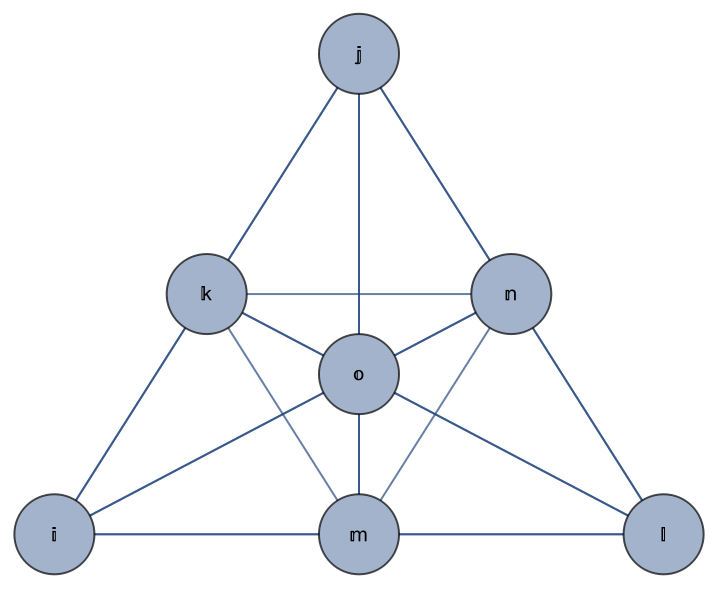
How can you read this graph? It contains seven lines. On each line there are three nodes. The internal triangle is interpreted as one line. The outer nodes multiplied give plus or minus the middle node. It can be made more precise, when arrows are added to the graph. But we skip these details here for the sake of simplicity. More details can be read off the multiplication table that is computed next.
Basis and product table
Basis and product table
A second possibility that fully describes the multiplicative action of the octonions is the multiplication table. The multiplication table is particularly useful to demonstrate the non-commutativity and non-associativity of the octonionic algebra. The non-associativity prevents the octonions from having a matrix representation and it is the reason, why they do not form a multiplicative group.
In[]:=
basis=MapApply[o,Permutations[{1,0,0,0,0,0,0,0}]];basis2symb=MapThread[#1->#2&,{basis,{1,,,,,,,}}];symb2basis=MapThread[#1->#2&,{{1,,,,,,,},basis}];basis=MapApply[o,Permutations[{-1,0,0,0,0,0,0,0}]];basis2symb=Union[basis2symb,MapThread[#1->-#2&,{basis,{1,,,,,,,}}]];productTable=Table[basis[[i]]**basis[[j]],{i,1,Length[basis]},{j,1,Length[basis]}]/.basis2symb;productTable//MatrixForm
Out[]//MatrixForm=
1 | | | | | | | |
| -1 | | - | | - | - | |
| - | -1 | | | | - | - |
| | - | -1 | | - | | - |
| - | - | - | -1 | | | |
| | - | | - | -1 | - | |
| | | - | - | | -1 | - |
| - | | | - | - | | -1 |
The multiplication table of the octonions. Please observe that the multiplication is non-associative, e.g. (**)** = **= and **(**) = ** = -. Note however, that the quaternionic sub-algebra (1, , , ) is associative but non-commutative. This table is just for illustration it will not be needed in the rest of the notebook.
WenowhaveanoperationaldefinitionoftheoctonionsandwearereadytouncovertheLiegroupasanautomorphismgroupthetheoctonions.ButletushavealookatafewpropertiesofLiegroupsfirst.
G
2
Lie groups
Lie groups
Instead of introducing standard properties of Lie groups at the beginning, they will be introduced on the fly, whenever they appear to be useful. Compact simple lie groups are fully classified. They appear in four families that can be related to symmetries of metric spaces and a few exceptionally groups. For completeness the families are named and shortly described. You can skip ahead, since it is not needed for the rest of the post:
The A-family: SU(n)
The A-family: SU(n)
The B-family: SO(2n+1)
The B-family: SO(2n+1)
The C-family: Sp(n)
The C-family: Sp(n)
The D-family: SO(2n)
The D-family: SO(2n)
The Smallest Exceptional Lie Group: G2
The Smallest Exceptional Lie Group:
G
2
If you want to know, what kind of symmetries are described by the exceptional Lie group , well, this is what this post is all about! Unlike the previous families, it seems not at all obvious, what objects would transform symmetrically under the action of . Also the fact that is not part of a family indicates that it must be good for something very particular. Of course, one quick look at the wiki page reveals the answer. It is the automorphism group of the octonions and it is a subgroup of SO(7). But what does this mean exactly? You will know the answer shortly!First however, let us have a look at the Dynkin diagram and the root lattice. The Dynkin diagram of the Lie algebra looks like:
G
2
G
2
G
2
2
There are 12 roots that are obtained from various reflections of the primitive roots.
The derivation of the octonions
The derivation of the octonions
Consider a linear map : . It is called derivation, when it satisfies the Leibnitz rule and additionally the subspace of real numbers is mapped to zero. For this to happen, the octonions are considered as an eight dimensional real vector space.
With these constraints the derivation only acts non-trivially on the seven dimensional sub-space orthogonal to the real numbers.
A slight difficulty arises from the non-associativity of the octonions. We have to make sure, that never more than two imaginary units appear in products to avoid ambiguities during simplifications.
The Computation of the Derivation
The Computation of the Derivation
The derivation can be expressed as a matrix of the following form
The unknown entries are determined from the Leibnitz rule. Therefore, an additional rule is added to the algebra of octonions that handles the linear map of the derivation.
The Leibnitz rule applied to the basis elements of the octonions leads to a set of linear equations. There are not sufficiently many constraints to determine a unique solution. Instead the solution can be described by matrices that are parameterized by 14 real parameters.
In order to establish the connection between the generators and the root lattice a few computations have to be performed. They can be summarized as follows:
◼
Find the Cartan sub algebra, that is the largest set of generators that mutually commute with each other.
◼
Transform all generators into a basis, where the Cartan generators are diagonal.
◼
Combine the remaining roots into eigen vectors with respect to the Cartan generators.
◼
The pairs of eigenvalues will form the root lattice of the algebra.
The Cartan generators
The Cartan generators
Without loss of generality the first generator can be an element of the Cartan sub algebra. A systematic scan through the set of generators selects all other generators that commute with the first one.
The Cartan matrix of the Cartan subalgebra and the corresponding eigenvalues
The Cartan matrix of these linear combinations should be diagonal and its entries on the diagonal should correspond to the eigenvalues 6 and 2.
These are the Cartan generators that diagonalize the Cartan matrix.
In the last step, we need to find the commutator eigenvectors of the non-Cartan generators [ℋ,ℰ]=r ℰ. We start with a general linear combinations:
From the algebra to the group
From the algebra to the group
To show the connection between Lie algebras and Lie groups, we start with the simplest example - the commutative Lie group SO(2). It only has one generator and no root lattice. A possible generator is given by the anti-symmetric matrix
The Generalized Cross Product
The Generalized Cross Product
When the cross product is used for imaginary quaternions only, the regular cross product is recovered:
The full seven dimensional cross product reads in components like this
However, this by itself is not a surprise yet. We still have to show, that the cross product is not preserved by a general SO(7) element. SO(7) elements are generated by arbitrary anti-symmetric matrices. Let us start with a simple generator
Bibliography
Bibliography
3
.John C. Baez, The Octonions, https://arxiv.org/abs/math/0105155
CITE THIS NOTEBOOK
CITE THIS NOTEBOOK
Octonions and the G2 - Lie group
by Johannes Martin
Wolfram Community, STAFF PICKS, August 5, 2023
https://community.wolfram.com/groups/-/m/t/2984144
by Johannes Martin
Wolfram Community, STAFF PICKS, August 5, 2023
https://community.wolfram.com/groups/-/m/t/2984144