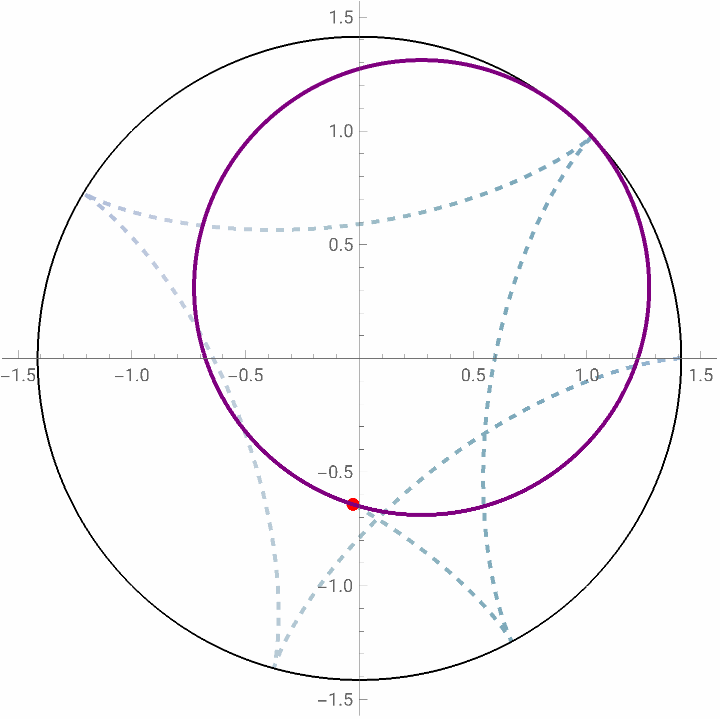
Hypocycloid::usage="A hypocycloid is a curve drawn by a point P on the circumference C of radius b when C rolls over the inside of a circle with a center in O and radius a. If the starting position of P is (a, 0) and the parameter θ is the angle that forms the vector radius of the circumference with the X axis, the equations are: x = (a - b) Cos[θ] + b Cosθ , y = (a - b) Sin[θ] - b Sinθ . References: Stewart, James. Cálculo de una variable. Trascendentes tempranas. 7a. Ed, Cengage Learning: pp. 644-645, 2012; Personal.";
a-b
b
a-b
b
In[]:=
Animatea=θ,(a-b)Sin[θ]-bSinθ/.θt1-0.01;g4=ParametricPlot(a-b)Cos[θ]+bCosθ,(a-b)Sin[θ]-bSinθ,{θ,0,t1},PlotStyleDashed,ColorFunction->"Aquamarine";Show[{g4,Graphics[{Red,Thick,PointSize[0.018],g3}],Graphics[{Black,g1}],Graphics[{Purple,Thick,g2}]},AxesTrue,AxesOrigin{0,0},BoxRatiosAutomatic,PlotRangeAll,PerformanceGoal"Quality"],{t1,0.01,20π,0.1},AnimationRunningFalse
2
;b=1;g1=Circle[{0,0},a];g2=Circle[{(a-b)Cos[θ],(a-b)Sin[θ]},b]/.θt1-0.01;g3=Point(a-b)Cos[θ]+bCosa-b
b
a-b
b
a-b
b
a-b
b
Out[]=
In[]:=
Animatea=-2;b=1;g1=Circle[{0,0},a];g2=Circle[{(a-b)Cos[θ],(a-b)Sin[θ]},b]/.θt1-0.01;g3=Point(a-b)Cos[θ]+bCosθ,(a-b)Sin[θ]-bSinθ/.θt1-0.01;g4=ParametricPlot(a-b)Cos[θ]+bCosθ,(a-b)Sin[θ]-bSinθ,{θ,0,t1},PlotStyleDashed,ColorFunction->"Aquamarine";Show[{g4,Graphics[{Red,Thick,PointSize[0.018],g3}],Graphics[{Black,g1}],Graphics[{Purple,Thick,g2}]},AxesTrue,AxesOrigin{0,0},BoxRatiosAutomatic,PlotRangeAll,PerformanceGoal"Quality"],{t1,0.01,40π,0.1},AnimationRunningFalse
a-b
b
a-b
b
a-b
b
a-b
b
Out[]=
Notes:
With a = , b = 1 and θ = 20π: A hypocycloid of many cusps is formed.
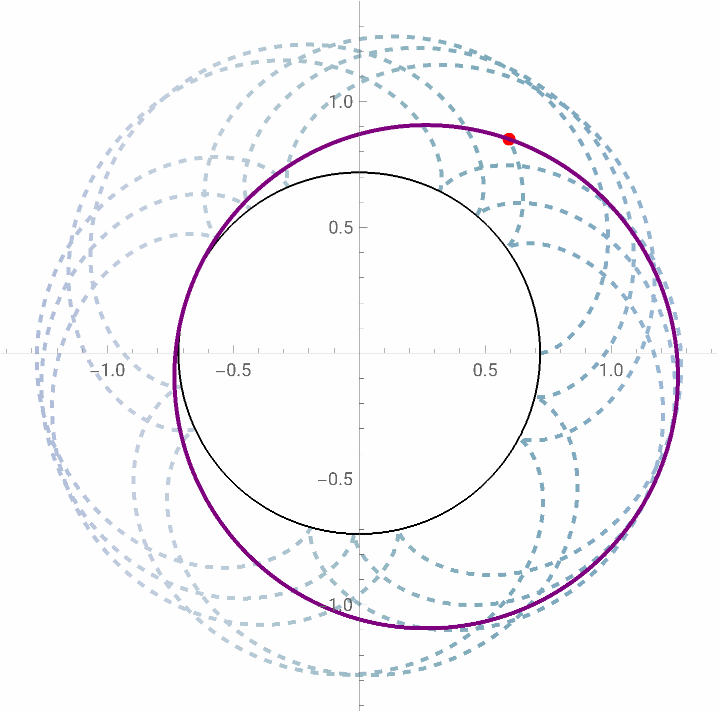
With a = - 2 , b = 1 and θ = 40π: A flower-like epicycloid with many petals is formed.
With a =
2
With a = - 2 , b = 1 and θ = 40π: A flower-like epicycloid with many petals is formed.