CITE THIS NOTEBOOK: Working through exercises in Giancoli's Physics chapter 6: work and energy by Peter Burbery. Wolfram Community NOV 25 2022.
I work through exercises in my favorite physics textbook Physics: Principles with Applications by Douglas C. Giancoli 7th edition.
https://www.amazon.com/Physics-Principles-Applications-Standalone-book/dp/0321625927
https://www.amazon.com/Physics-Principles-Applications-Standalone-book/dp/0321625927
Work and Energy chapter 6
Work and Energy chapter 6
Work done by a Constant Force 6-1
Work done by a Constant Force 6-1
Page 139
Page 139
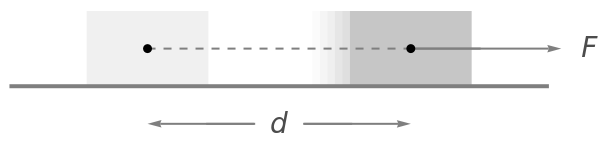
Work is the product of the magnitude of the displacement times the component of the force parallel to the displacement.
W=d
F
∥
(
1
)where is the component of the constant force parallel to the displacement .
F
∥
F
d
We can also write
W=Fdcos(θ)
where F is the magnitude of the constant force, d is the magnitude of the displacement of the object, and θ is the angle between the directions of the force and the displacement (Fig. 6-1). The cos θ factor appears in Eq. 6-1 [this is numbered 1 right now] because () is the component of that is parallel to . Work is a scalar quantity—it has no direction, but only magnitude, which can be positive or negative.
Fcosθ
=
F
∥
F
d
Gather data about work.
In[]:=
Out[]=
Lookup formulas for work.
In[]:=
FormulaLookup["Work"]
Out[]=
{{Work,Standard},{Work,Angle},{Work,Acceleration},{Work,Gravity},{Work,Torque}}
Find the formulas:
In[]:=
Table[FormulaData[formula],{formula,FormulaLookup["Work"]}]
Out[]=
,Cos[],,,
W
d
F
W
θ
d
F
W
a
d
m
W
h
m
W
θ
τ
Find the meanings of the symbols, the physical quantities they represent, and their dimensions:
In[]:=
Table[FormulaData[formula,"QuantityVariableTable"],{formula,FormulaLookup["Work"]}]
Out[]=
,
,
,
,
symbol | description | physical quantity | dimensions |
W | work | Work | {{LengthUnit,2},{MassUnit,1},{TimeUnit,-2}} |
d | distance | Distance | {LengthUnit,1} |
F | collinear force | Force | {{LengthUnit,1},{MassUnit,1},{TimeUnit,-2}} |
symbol | description | physical quantity | dimensions |
W | work | Work | {{LengthUnit,2},{MassUnit,1},{TimeUnit,-2}} |
θ | angle | Angle | {AngleUnit,1} |
d | distance | Distance | {LengthUnit,1} |
F | force | Force | {{LengthUnit,1},{MassUnit,1},{TimeUnit,-2}} |
symbol | description | physical quantity | dimensions |
W | work | Work | {{LengthUnit,2},{MassUnit,1},{TimeUnit,-2}} |
a | acceleration | Acceleration | {{LengthUnit,1},{TimeUnit,-2}} |
d | distance | Distance | {LengthUnit,1} |
m | mass | Mass | {MassUnit,1} |
symbol | description | physical quantity | dimensions |
W | work | Work | {{LengthUnit,2},{MassUnit,1},{TimeUnit,-2}} |
h | height | Height | {LengthUnit,1} |
m | mass | Mass | {MassUnit,1} |
symbol | description | physical quantity | dimensions |
W | work | Work | {{LengthUnit,2},{MassUnit,1},{TimeUnit,-2}} |
θ | angle | Angle | {AngleUnit,1} |
τ | torque | Torque | {{LengthUnit,2},{MassUnit,1},{TimeUnit,-2}} |
I need the quantity variables to be able to replace them with quantities later on (see below):
In[]:=
FormulaData[{"Work","Standard"},"QuantityVariables"]
Out[]=
{,,}
W
d
F
Query FormulaData for every known fact about this formula:
In[]:=
Table[FormulaData[{"Work","Standard"},property],{property,FormulaData["Properties"]}]
Out[]=
{Physics,{Physics,Mechanics}},,,{{{LengthUnit,2},{MassUnit,1},{TimeUnit,-2}},{LengthUnit,1},{{LengthUnit,1},{MassUnit,1},{TimeUnit,-2}}},{work,distance,collinear force},{Work,Distance,Force},{,,},
W
d
F
W
d
F
W
d
F
W
d
F
W
d
F
symbol | description | physical quantity | dimensions |
W | work | Work | {{LengthUnit,2},{MassUnit,1},{TimeUnit,-2}} |
d | distance | Distance | {LengthUnit,1} |
F | collinear force | Force | {{LengthUnit,1},{MassUnit,1},{TimeUnit,-2}} |
Make a function to get all the data for a formula:
In[]:=
FormulaDataPropertiesTable//ClearAllFormulaDataPropertiesTable[formulaID_]:=Table[FormulaData[formulaID,property],{property,FormulaData["Properties"]}]/;MemberQ[FormulaData[],formulaID]
Verify the function doesn’t evaluate for a formula ID that doesn’t exist.
In[]:=
FormulaDataPropertiesTable["Work"]
Out[]=
FormulaDataPropertiesTable[Work]
Verify the function works for a formula ID that does exist.
In[]:=
FormulaDataPropertiesTable[{"Work","Standard"}]
Out[]=
{Physics,{Physics,Mechanics}},,,{{{LengthUnit,2},{MassUnit,1},{TimeUnit,-2}},{LengthUnit,1},{{LengthUnit,1},{MassUnit,1},{TimeUnit,-2}}},{work,distance,collinear force},{Work,Distance,Force},{,,},
W
d
F
W
d
F
W
d
F
W
d
F
W
d
F
symbol | description | physical quantity | dimensions |
W | work | Work | {{LengthUnit,2},{MassUnit,1},{TimeUnit,-2}} |
d | distance | Distance | {LengthUnit,1} |
F | collinear force | Force | {{LengthUnit,1},{MassUnit,1},{TimeUnit,-2}} |
Make a function that gives an association.
In[]:=
FormulaDataPropertyAssociation//ClearAllFormulaDataPropertyAssociation[formulaID_]:=AssociationThread[FormulaData["Properties"]->Table[FormulaData[formulaID,property],{property,FormulaData["Properties"]}]]/;MemberQ[FormulaData[],formulaID]
In[]:=
FormulaDataPropertyAssociation[{"Work","Standard"}]
Out[]=
Classes{Physics,{Physics,Mechanics}},ExternalIdentifiers,Formula,QuantityVariableDimensions{{{LengthUnit,2},{MassUnit,1},{TimeUnit,-2}},{LengthUnit,1},{{LengthUnit,1},{MassUnit,1},{TimeUnit,-2}}},QuantityVariableNames{work,distance,collinear force},QuantityVariablePhysicalQuantities{Work,Distance,Force},QuantityVariables{,,},QuantityVariableTable
W
d
F
W
d
F
W
d
F
W
d
F
W
d
F
symbol | description | physical quantity | dimensions |
W | work | Work | {{LengthUnit,2},{MassUnit,1},{TimeUnit,-2}} |
d | distance | Distance | {LengthUnit,1} |
F | collinear force | Force | {{LengthUnit,1},{MassUnit,1},{TimeUnit,-2}} |
Let us consider the case in which the motion and the force are in the same direction, so θ=0 and cos θ=1; in this case W=Fd. For example, if you push a loaded grocery cart a distance of 50 m by exerting a horizontal force of 30 N on the cart, you do 30 N ×50m=1500N·m of work on the cart.
In[]:=
FormulaData[{"Work","Standard"},<|->,->|>]
d
F
Out[]=
W
Select the SI unit system:
In[]:=
FormulaData[{"Work","Standard"},<|->,->|>,UnitSystem->"SIBase"]
d
F
Out[]=
W
Apply Unit convert to both sides to quantity arguments:
In[]:=
ApplySides[Which[QuantityQ[#],UnitConvert[#,"Newtons""Meters"],!QuantityQ[#],#]&,FormulaData[{"Work","Standard"},<|->,->|>,UnitSystem->"SIBase"]]
d
F
Out[]=
W
Leverage the power of Wolfram Alpha:
In[]:=
work 30 N 50 m
As this example shows, in SI units work is measured in newton-meters (N·m). A special name is given to this unit, the joule (J); 1 J=1 N·m.
◼
Enter bulleted item text here.
Enter item paragraph text here.
◼
Enter subitem text here.
Enter item paragraph text here.
◼
Enter subitem text here.
Enter item paragraph text here.
Enter text here. Enter formula for display in a separate cell below:
1
.Enter numbered item text here.
Enter item paragraph text here.
1
.1
.Enter numbered subitem text here.
Enter item paragraph text here.
1
.1
.1
.Enter subitem text here.
Enter item paragraph text here.
Enter text here. Enter formula for numbered display in a separate cell below:
Enter text here. Enter Wolfram Language program code below.
Enter text here. Enter non-Wolfram Language program code below.
DLLEXPORT int fun(WolframLibraryData libData, mreal A1, mreal *Res)
{
mreal R0_0;
mreal R0_1;
R0_0 = A1;
R0_1 = R0_0 * R0_0;
*Res = R0_1;
funStructCompile->WolframLibraryData_cleanUp(libData, 1);
return 0;
}
{
mreal R0_0;
mreal R0_1;
R0_0 = A1;
R0_1 = R0_0 * R0_0;
*Res = R0_1;
funStructCompile->WolframLibraryData_cleanUp(libData, 1);
return 0;
}
Potential Energy 6-4
Potential Energy 6-4
Learn about potential energy:
View data for gravitational potential energy:
Use the resource function PhysicalQuantityLookup to see all physical quantities that are dimensionally equivalent to gravitational potential energy:
Make a graph of 10 random physical quantities with the same dimensions of energy where quantities with the same SI unit share an edge:
FormulaData gives data on different formulas for potential energy:
Exercises
Exercises
A 75.0 kg firefighter climbs a flight of stairs 28.0 m high. How much work does he do?
Make the replacement:
Give an answer with statistical uncertainty:
Change the units to N m:
SI base units:
Joules:
AroundReplace didn’t give a sensible answer for some reason.
3. (II) How much work did the movers do (horizontally) pushing a 46.0 kg crate 10.3 m across a rough floor without acceleration if the coefficient of friction was 0.50?
Take a list of formulas for friction:
Give the output to FormulaData to output the formulas:
Take the formula ID kinetic friction and enter it into my function:
Look up formulas for normal force:
Store a function to return an association of formulas with the formula IDs as keys:
Look up normal force on Wolfram Alpha:
In[]:=
normal force
Maybe I can apply a nondimensionalization transform to the equation:
Find dimensional combinations of mass and distance that give force if physical constants are included:
Include little g:
Go directly for work instead:
Input the quantities given:
Simplify the units:
Enter the coefficient of friction 0.5:
I decided to create a function to transform equations.
Here are some tests: