CITE THIS NOTEBOOK: Wormhole time machines and multiple histories by Barak Shoshany. Wolfram Community OCT 26 2021.
ORIGINAL ARTICLE: Shoshany, B., Wogan, J. Wormhole Time Machines and Multiple Histories. Gen Relativ Gravit 55, 44 (2023). https://doi.org/10.1007/s10714-023-03094-8. arXiv: arXiv:2110.02448v2 [gr-qc].
GITHUB: https://github.com/bshoshany/WormholeParadoxSimulation.
ORIGINAL ARTICLE: Shoshany, B., Wogan, J. Wormhole Time Machines and Multiple Histories. Gen Relativ Gravit 55, 44 (2023). https://doi.org/10.1007/s10714-023-03094-8. arXiv: arXiv:2110.02448v2 [gr-qc].
GITHUB: https://github.com/bshoshany/WormholeParadoxSimulation.
Article Abstract: In a previous paper, we analyzed a class of time travel paradoxes which cannot be resolved using Novikov’s self-consistency conjecture, meaning that the system is fundamentally and irreparably inconsistent. We proved that the paradoxes can nonetheless always be resolved, and the system made consistent, by assuming that traveling back in time creates a new independent history (or timeline), such that any changes to the past affect only the new history and not the original one. Therefore, we argued that if time travel is possible, that would necessarily imply the existence of multiple histories. However, our proof was obtained using a simplistic and unrealistic toy model, which was formulated using contrived laws of physics. The purpose of the present paper is to define and analyze a new model of time travel paradoxes, which is fully compatible with all known physics - provided, of course, that time travel itself is possible. This model consists of a wormhole time machine in 3+1 spacetime dimensions, which can be either permanent (existing eternally) or temporary (activated only for a short time). We define the spacetime topology and geometry of the model, calculate the geodesics of objects passing through the time machine, and prove that this model inevitably leads to paradoxes which cannot be resolved using Novikov’s conjecture, but can be resolved using multiple histories. This result provides more substantial support to our claim that time travel necessarily implies multiple histories.
Simulation of the model
Simulation of the model
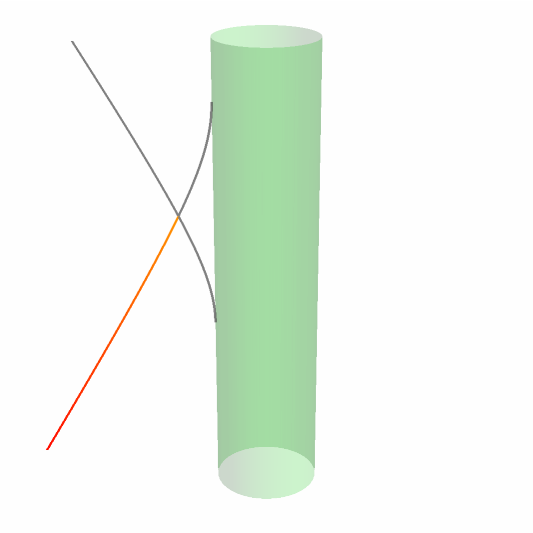
The permanent wormhole is represented by a green cylinder. Shown is a slice of the Morris-Thorne traversable wormhole spacetime with time as the vertical axis, the radial coordinate orthogonal to the axis, and the azimuthal angle going around the axis. The polar angle is suppressed, such that each circle in the cylinder represents a sphere at a particular instance in time. Note that in the Morris-Thorne spacetime, the region – the interior of the cylinder in the plot – is inaccessible.
The incoming and outgoing paths of the object are calculated using the geodesic equations. The colors along the paths indicate temperature, with red being the hottest. The object starts at the red temperature and approaches the wormhole. Upon traversal, the object exits the wormhole in the past, in the opposite spatial direction, and then collides with its past self.
With a single history, a paradox will always arise. This is indicated by the fact that some of the path is colored gray, which means there is no consistent choice of temperature along the path, hence there is a consistency paradox. By switching to multiple histories, we resolve the paradox. Two histories will be shown on the screen, with the first history on the left and the second (new) history on the right. The gray lines will disappear, and there will be a fully consistent temperature evolution along the paths, thus we have resolved the paradox.
The temporary wormhole is represented by the two yellow “bumps”, which can be thought of as slices of the green cylinder representing the permanent wormhole. The coordinate system is the same, with the polar angle suppressed, except that now the radial coordinate has a time-dependent range . The region – the interior of the two “bumps” – is inaccessible.
For more information, please see our paper “Wormhole Time Machines and Multiple Histories”.
t
r∈[,∞)
b
0
t
ϕ
t
θ
r∈[0,)
b
0
The incoming and outgoing paths of the object are calculated using the geodesic equations. The colors along the paths indicate temperature, with red being the hottest. The object starts at the red temperature and approaches the wormhole. Upon traversal, the object exits the wormhole in the past, in the opposite spatial direction, and then collides with its past self.
With a single history, a paradox will always arise. This is indicated by the fact that some of the path is colored gray, which means there is no consistent choice of temperature along the path, hence there is a consistency paradox. By switching to multiple histories, we resolve the paradox. Two histories will be shown on the screen, with the first history on the left and the second (new) history on the right. The gray lines will disappear, and there will be a fully consistent temperature evolution along the paths, thus we have resolved the paradox.
The temporary wormhole is represented by the two yellow “bumps”, which can be thought of as slices of the green cylinder representing the permanent wormhole. The coordinate system is the same, with the polar angle
θ
r
r(t)∈[b(t),∞)
r(t)∈[0,b(t))
For more information, please see our paper “Wormhole Time Machines and Multiple Histories”.
Out[]=
| ||||||||||||||||||||||||||||
Code
Code
In[]:=