This essay presents some tools that have been developed to help college students visualize and understand the concept of the center of mass. This is part of a longer project to write a teaching notebook and a student workbook for college mechanics, starting with the unit on the rotation of rigid bodies.
Introduction
Introduction
College introductory physics students experience a lot of conflicting misconceptions when they study Newtonian mechanics, which modeling instruction helps to address. The difficulty nevertheless compounds in the study of rotational kinematics and dynamics, with the addition of a new notation with vector products and vectors normal to the plane of rotation. It is here proposed to use the power of computational modeling through the Wolfram Language to facilitate the visualization and solving of rotational problems, in the hope that it brings a greater grasp of the concepts and a greater ability to go through the mathematics and focus on the physics. Furthermore, computational modeling is now an indispensable skill and component of scientific work, which complements the other two traditional components: experimenting and theorizing. Therefore, this project presents the start of the first edition of a Wolfram Language notebook to teach rotational kinematics and dynamics interactively while allowing students to play with demonstrations and use simple code to solve problems, bringing their attention to the conceptual setup rather than on the mathematical details that they will learn in their concomitant Calculus I course, and in their future Calculus II and Linear Algebra courses. Currently, only the first section introducing the concept of center of mass has been completed. Therefore, that's what you'll find presented in the next section.
Excerpts from teaching material on the center of mass
Excerpts from teaching material on the center of mass
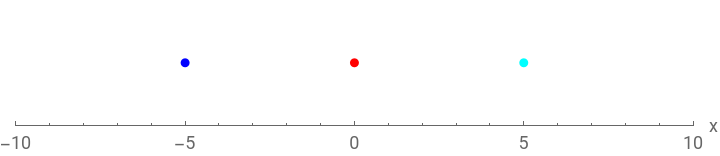
When introducing the concept of the center of mass as the average position for the distribution of mass through space, I like to start with the simplest case of two discrete point-like particles in one dimension. In such a case, the location of that center of mass is given by the following equation:
x
CM
m
1
x
1
m
2
x
2
m
1
m
2
This simulation clearly shows that the center of mass lies between the two masses, closer to the largest one.
Out[]=




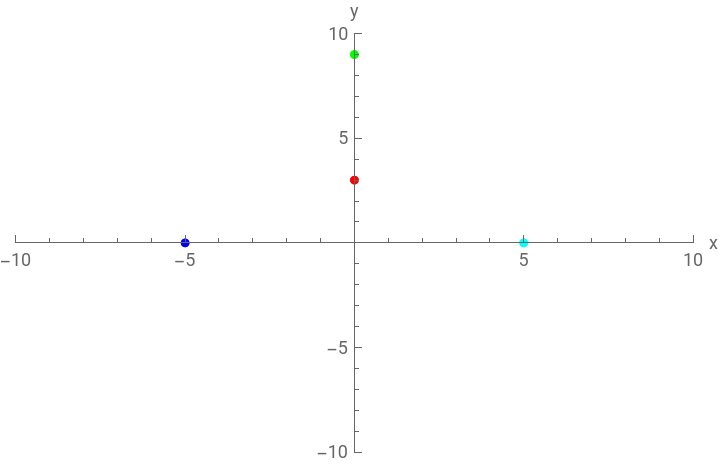
I then generalize to the case of three point-like particles in two dimensions and start using vector notation:
x
CM
m
1
x
1
m
2
x
2
m
3
x
3
m
1
m
2
m
3
and
y
CM
m
1
y
1
m
2
y
2
m
3
y
3
m
1
m
2
m
3
that is
r
CM
m
1
r
1
m
2
r
2
m
3
r
3
m
1
m
2
m
3
This interactive simulation further develop the intuition about the location of the center of mass, in 2D.
Out[]=


The equations can be further generalized to the case of an arbitrary number n of point-like particles in three dimensions:
x
CM
x
1
m
1
x
2
m
2
x
3
m
3
x
4
m
4
x
n
m
n
m
1
m
2
m
3
m
4
m
n
n
∑
i=1
x
i
m
i
M
tot
y
CM
y
1
m
1
y
2
m
2
y
3
m
3
y
4
m
4
y
n
m
n
m
1
m
2
m
3
m
4
m
n
n
∑
i=1
y
i
m
i
M
tot
z
CM
z
1
m
1
z
2
m
2
z
3
m
3
z
4
m
4
z
n
m
n
m
1
m
2
m
3
m
4
m
n
n
∑
i=1
y
i
m
i
M
tot
that is
r
CM
r
1
m
1
r
2
m
2
r
3
m
3
r
4
m
4
r
n
m
n
m
1
m
2
m
3
m
4
m
n
n
∑
i=1
r
i
m
i
M
tot
This interactive simulation further develop the intuition about the location of the center of mass, in 3D.
Out[]=
Number of particles | |||||||||||||||||||||||||||
| |||||||||||||||||||||||||||
|


The very next step is to study continuous distributions of mass by taking the limit when the number of point-like particles approach infinity, which means integrating over all infinitesimal elements of mass inside a body. In college mechanics, students have not yet studied integrals in their mathematics courses. Thus the concept is presented to foster connections to be made later between physics and math, but it is not focused on. The concept is used to go beyond the cases of simple shapes with a uniform distribution of mass for which the center of mass will be identified with the geometrical center. The Wolfram Language allows the teacher to explore the idea a bit further even though students may not yet master the minutia of the mathematical computations that are relevant.
This simulation shows the location of the center of mass for some simple continuous mass distributions that the teacher can modify .
Out[]=

Teaching notes are accompanied by exercises to train students in using the Wolfram Language to solve physics problems computationally. For example:
A 60.0-kg person is at the left end of a 5.00-m long canoe having a mass of 90.0 kg. She then moves to the right end of the canoe. In both cases, she is 60.0 cm from the end of the canoe. By how much has the canoe shifted if there is no friction between the canoe and the water?
Knowns, unknowns, and relations of the latter with the former are established.
{massPerson,massCanoe}={60.0,90.0};lengthCanoe=5.00;initialPositionCanoe=0;initialPositionPerson=initialPositionCanoe-lengthCanoe/2+0.600;finalPositionCanoe=initialPositionCanoe+shift;finalPositionPerson=finalPositionCanoe+lengthCanoe/2-0.600;initialCM=;finalCM=;soln=SolveValues[initialCM==finalCM,shift];shiftValue=soln[[1]];"Shift: "<>ToString[shiftValue]
massPersoninitialPositionPerson+massCanoeinitialPositionCanoe
massPerson+massCanoe
massPersonfinalPositionPerson+massCanoefinalPositionCanoe
massPerson+massCanoe
As a first exposure of students to the language, the teacher may provide a visual of the problem rather than ask students to do so.
Concluding remarks
Concluding remarks
This work was only a first step toward a complete revision of teaching notes for rotation in a college introductory mechanics course. The plan is to complete the set of notes, develop a student workbook to foster further engagement with the Wolfram Language, and test their use in an actual classroom, looking for positive effect on learning outcomes, before expanding the use of notebooks to all units of the course.