ABSTRACT (original article): We combine the ideas of a Weyl scaling invariant dark energy action, which eliminates black hole horizons, with the “gravastar’’ idea of a jump in the hole interior from a normal matter equation of state to an equation of state where pressure plus density approximately sum to zero. Using the Tolman-Oppenheimer-Volkoff equation, which requires continuous pressure, we present Mathematica notebooks in which the structure of the gravastar is entirely governed by the action and the equation of state, with the radii where structural changes occur emerging from the dynamics, rather than being specified in advance. The notebooks work even with zero cosmological constant, but when the cosmological constant is nonzero, there is a very small black hole “wind’’ that we calculate by a relativistic extension of standard pressure driven isothermal stellar wind theory. CITATION (original article): Stephen L. Adler, Dynamical Gravastars, Phys. Rev. D 106, 104061 (2022), https://doi.org/10.1103/PhysRevD.106.104061. arXiv:2209.02537.
GitHub: https://gitlab.com/stephenadler/Gravastar
GitHub: https://gitlab.com/stephenadler/Gravastar
I wish to thank Fethi Ramazanoglu for teaching me to use Mathematica for relativity calculations in the course of our working on our joint paper Int . J. Mod. Phys. D 24, 1550011 (2015), arXiv: 1308.1448. This explored a mechanism for eliminating horizons by using a modified cosmological constant action. My Dynamical Gravastars paper combined this idea with an alternative mechanism involving a jump in the interior matter density. The notebook below is simplification of the notebooks associated with the Dynamical Gravastar paper (which are at the URL: https://gitlab.com/stephenadler/Gravastar, and were written in Mathematica version 12.2), to the case of zero cosmological constant (lambda = 0) . So only the density jump mechanism is used in the demo notebook below . Including a cosmological constant makes a negligible correction to the plots from this demo notebook .
Extensive observations show that the universe contains a multitude of extremely compact objects, that are assumed to be mathematical black holes, as described in the monograph of Chandrasekhar [1]. Mathematical black holes are solutions of the vacuum Einstein field equations characterized by just two parameters, the mass and the angular momentum per unit mass. But the interpretation of astrophysical observations in terms of idealized mathematical black holes has been questioned from various points of view.
Several authors, as reviewed by Cardoso and Pani [2], have proposed interior solutions for so-called “exotic compact objects” that appear black-hole like from the outside, but have no horizons and no interior singularity.
In particular, the gravastars proposed by Mazur and Mottola [3] are based on assuming a discontinuous pressure jump in the interior black hole equation of state, from a normal matter equation of state to the equation of state proposed by Gliner [4], in which the pressure is minus the density .
The model developed in the following Mathematica notebook differs from that of Mazur and Mottola and the subsequent paper of Visser and Wiltshire [6] in several significant respects . First, we perform our entire analysis from the Tolman-Oppenheimer-Volkoff (TOV) equations for relativistic stellar structure (for a concise derivation see [7]).
Second, we note that the TOV equations require that the pressure must be continuous, whereas the energy density can have discontinuous jumps. So we implement the Gliner equation of state by a jump to negative energy density with positive pressure: at the pressure pjump the density jumps from a relativistic equation of state to an equation of state , with a parameter of the model. This of course violates the classical energy conditions, but from a semiclassical quantum matter point of view, the regularized energy density is known not to obey positivity conditions [5], [6].
Third, we avoid assuming designated radii at which transitions take place . In our model, transitions follow dynamically from the equations of motion and the assumed equations of state, hence the title of my paper “Dynamical Gravastars”. And fourth, we smooth the jump in the equation of state by using a sigmoidal function with a very small switching width parameter eps = .001 in place of a Heaviside step function, so there are no exact discontinuities and accompanying surface densities to be considered. Thus we have a differential equation system that can be solved by the Mathematica integrator NDSolve, which is powerful general tool for solving one dimensional differential equation systems, such as arise from our assumptions when restricted to spherical symmetry .
M
Several authors, as reviewed by Cardoso and Pani [2], have proposed interior solutions for so-called “exotic compact objects” that appear black-hole like from the outside, but have no horizons and no interior singularity.
In particular, the gravastars proposed by Mazur and Mottola [3] are based on assuming a discontinuous pressure jump in the interior black hole equation of state, from a normal matter equation of state to the equation of state proposed by Gliner [4], in which the pressure
p
ρ
The model developed in the following Mathematica notebook differs from that of Mazur and Mottola and the subsequent paper of Visser and Wiltshire [6] in several significant respects . First, we perform our entire analysis from the Tolman-Oppenheimer-Volkoff (TOV) equations for relativistic stellar structure (for a concise derivation see [7]).
Second, we note that the TOV equations require that the pressure
p
ρ
ρ3p
ρ+pβ
β<<1
Third, we avoid assuming designated radii at which transitions take place . In our model, transitions follow dynamically from the equations of motion and the assumed equations of state, hence the title of my paper “Dynamical Gravastars”. And fourth, we smooth the jump in the equation of state by using a sigmoidal function with a very small switching width parameter eps = .001 in place of a Heaviside step function, so there are no exact discontinuities and accompanying surface densities to be considered. Thus we have a differential equation system that can be solved by the Mathematica integrator NDSolve, which is powerful general tool for solving one dimensional differential equation systems, such as arise from our assumptions when restricted to spherical symmetry .
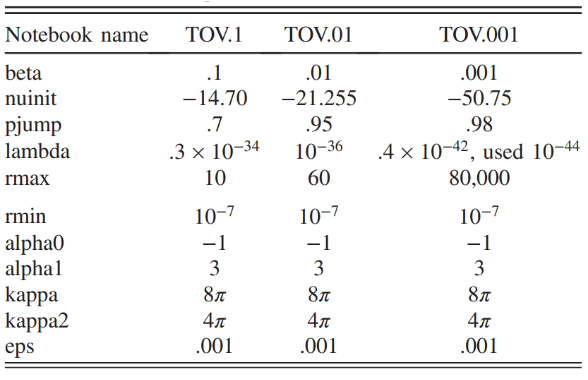
Sample Mathematica notebooks for our model, for parameter values , , and , can be downloaded at the URL given above. The programs begin with a list of numerical parameters, as shown for the three values in Table I.
β
β.1
β.01
β.001
β
In[]:=
beta=10^(-2);nuinit=-21.255;pjump=.95;rmax=60.0;rmin=10^(-7);alpha0=-1;alpha1=3;kappa=8*Pi;kappa2=4*Pi;eps=.001;
Following the initial parameter values list, there are three function definitions.The sigmoidal function is implemented by
In[]:=
theta[x_]:=1/(1+Exp[-x/eps]);
The switch in the equation of state is implemented by the functions
In[]:=
alphas[x_]:=alpha0*theta[x-pjump]+alpha1*theta[pjump-x];rho[x_]:=alphas[x]*x+beta*theta[x-pjump];
In using these functions in the differential equation solver, x will always be the pressure .
p[r]
After the function definitions, there follows setup of the system of differential equations to be solved. The variables nu[r], p[r], and em[r] correspond to , , and in the TOV equations which are:
ν(r)
p(r)
m(r)
dm(r)
dr
2
r
-λ(r)
e
2m(r)
r
dν(r)
dr
N
ν
1-2m(r)/r
N
ν
2
r
3
r
dp(r)
dr
ρ(r)+p(r)
2
dν(r)
dr
nu[r], p[r], and em[r] have respective initial values nuinit, 1, and 0 respectively, given in the first three lines within “system={....}”. The second three lines are the TOV differential equations, constructed using the functions defined in the preceding paragraph.
The integration range is taken to start from rather than to avoid zero divides
The integration range is taken to start from
r
-7
10
r0
In[]:=
system={nu[rmin]==nuinit,p[rmin]1,em[rmin]==0,em'[r]kappa2*r^2*rho[p[r]],nu'[r](2/r^2)*(em[r]+kappa2*r^3*p[r])/(1-2*em[r]/r),p'[r]-(1/2)*(p[r]+rho[p[r]])*nu'[r]};
Next comes the command NDSolve for the system of equations.
In[]:=
s=NDSolve[system,{nu,p,em},{r,rmin,rmax},PrecisionGoal13,AccuracyGoal13,MaxSteps10^10];
Next is extraction of the solution from the interpolating functions constructed by NDSolve, and computation of certain auxiliary quantities.
In[]:=
pout[r_]:=Evaluate[p[r]/.s];nuout[r_]:=Evaluate[nu[r]/.s];nuprimeout[r_]:=Evaluate[nu'[r]/.s];emout[r_]:=Evaluate[em[r]/.s];denomout[r_]:=(1-2*emout[r]/r);ennuout[r_]:=(2/r^2)*(emout[r]+kappa2*r^3*pout[r]);rhoout[r_]:=alphas[pout[r]]*pout[r]+beta*theta[pout[r]-pjump];Mout[r_]:=(1-Exp[nuout[r]])*r/2;
Finally, comes printing and plotting of output from the solution
In[]:=
Print[Exp[-2*nuout[49.5]]-1]
{7.9109}
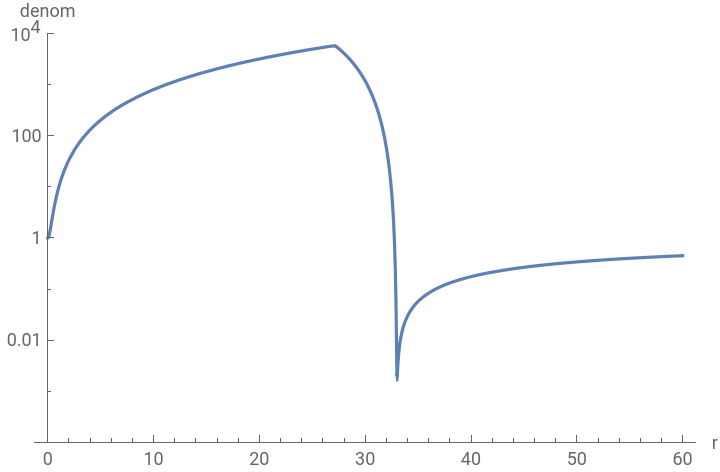
In[]:=
LogPlot[denomout[r],{r,rmin,rmax},PlotRange{10^(-4),10^4},AxesLabel->{"r","denom"}]
Out[]=
In[]:=
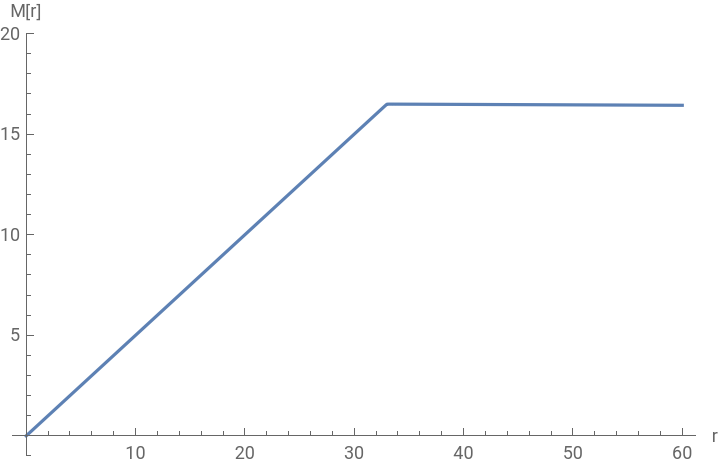
Plot[Mout[r],{r,rmin,rmax},PlotRange{-1,20},AxesLabel->{"r","M[r]"}]
Out[]=
In[]:=
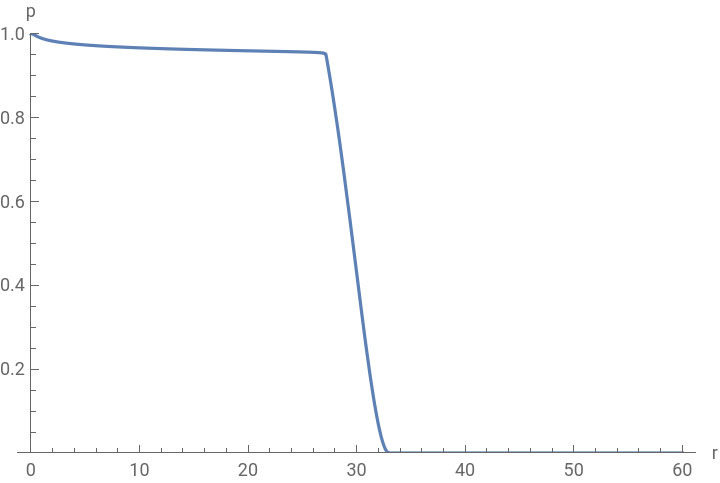
Plot[pout[r],{r,rmin,rmax},PlotRange{0,1},AxesLabel->{"r","p"}]
Out[]=
In[]:=
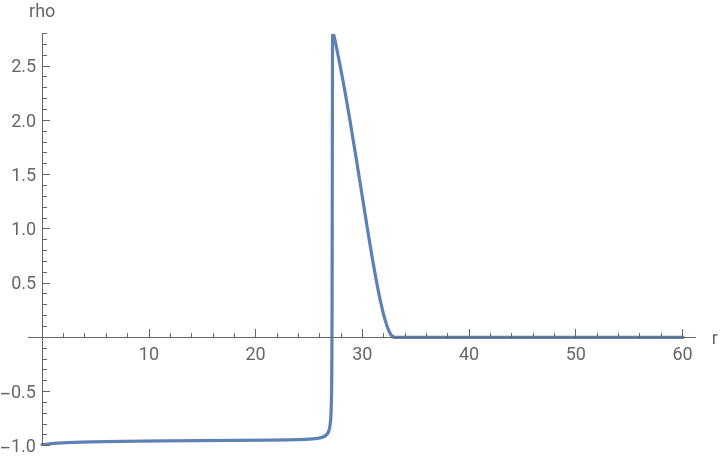
Plot[rhoout[r],{r,rmin,rmax},PlotRange{-1,2.8},AxesLabel->{"r","rho"}]
Out[]=
In[]:=
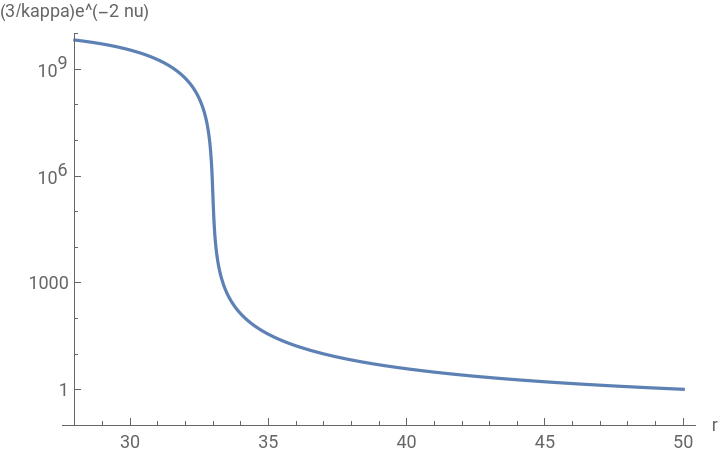
LogPlot[(3/kappa)Exp[-2*nuout[r]],{r,28,50},PlotRange{10^(-1),10^10},AxesLabel->{"r","(3/kappa)e^(-2 nu)"}]
Out[]=
References
References
[1] S. Chandrasekhar, The Mathematical Theory of Black Holes (Clarendon Press, Oxford, 1983 (1992, 2000)), especially Chapters 2 and 6.
[2] V. Cardoso and P. Pani, Living Rev. Relativity 22, 4 (2019), arXiv : gr-qc/1904.05363.
[3] P. O. Mazur and E. Mottola, "Gravitational Condensate Stars", arXiv: gr-qc/0109035 (2001). See also Proc. Nat. Acad. Sci. 101, 9545 (2004), arXiv: gr-qc/0407075.
[4] E. B. Gliner, J . Exptl . Theoret . Phys . 49, 542 (1965); translation in Sov . Phys . JETP 22, 378 (1966).
[5] R. M. Wald, "General Relativity", The University of Chicago Press (1984), p .410.
[6] C. Barcelo and M. Visser, Int. J. Mod. Phys. D 11, 1553 (2002), arXiv: gr-qc/0205066.
[7] Ya. B. Zeldovich and I. D. Novikov, Stars and Relativity, The University of Chicago Press (1971), pp .256 - 257.
CITE THIS NOTEBOOK
CITE THIS NOTEBOOK
Dynamical Gravastars
by Stephen Adler
Wolfram Community, STAFF PICKS, January 31, 2023
https://community.wolfram.com/groups/-/m/t/2820793
by Stephen Adler
Wolfram Community, STAFF PICKS, January 31, 2023
https://community.wolfram.com/groups/-/m/t/2820793