ABSTRACT(original article): We study the ‘number’ N of AdS vacua with a UV cut off . It has been proposed that this number is finite. We find evidence that N as for some constants and of in Planck units that may depend on dimension and the number of supercharges. For this result to hold it is crucial to integrate over the volume of massless and tachyonic directions of AdS which corresponds to the volume of the space of marginal and relevant deformations of the dual CFT. We are led to the surprising prediction that theories with large number of light moduli contribute very little to the volume measure among all theories. We also speculate about the dS case leading to the number of quasi-dS vacua of the order of for some parameter. CITATION (original article): Baykara, Z. K., Tomasiello, A., & Vafa, C. (2025). Counting AdS Vacua, arXiv:2512.04151. https://doi.org/10.48550/arXiv.2512.04151
Introduction
Introduction
This notebook contains the supplementary computations for the paper Counting AdS Vacua [arXiv:2512.04151]. The main goal is to make explicit the cutoff dependent counting of AdS vacua in quantum gravity. We study the quantity , interpreted as the number or volume of AdS vacua whose effective field theory remains valid above a UV cutoff . The expectation is that after including the appropriate volume factors from light scalar directions, the count grows as a power law (μ)∼aas for some and , rather than exponentially. We do the derivations by performing the algebraic reduction of cutoff inequalities, identifying redundant tower constraints, carrying out cylindrical decompositions of integration regions, and evaluating the resulting asymptotic counts. It also includes the numerical and asymptotic checks used in the analysis of the volume factor, where the role of tachyonic directions is especially important. The computations are organized as follows. The first section defines helper functions used throughout the notebook, including log-linearization of inequalities, irreducibility checks, cylindrical integration routines, and a Motzkin/Farkas implication test. The later sections apply these tools to the , , and examples.
N(μ)
μ
N
AdS
-b
μ
μ0
a
b
Ad
S
7
Ad
S
7
Ad
S
5
Ad
S
4
Package
Package
AdS7
AdS7
This section computes the discrete count for M-theory on . The discrete data are the flux integer , denoted by below, and the orbifold order . The goal is to impose the UV cutoff condition that all towers of states remain heavier than , determine the allowed region in , and integrate over this region to extract the leading small asymptotics. The result of this section is (μ).
Ad
S
7
Ad
S
7
4
S
Z
k
N
n
k
μ
(N,k)
μ
(Q8)
N
Ad
S
7
-5/2
∼μ
Here we define the regions of validity for variables. denotes the brane dimension, dimension of the cycle it wraps, and is a negative variable since μ is defined as the dimensionless cutoff relative to the Planck mass, which is always less than 1.
p
q
logμ
In[]:=
$Assumptions=p>q&&q>0&&(p==2||p==5)&&n>1&&k>1&&0<μ<1&&logμ<0;
Scales
Scales
We first encode the basic dimensionless scale relations. Here represents R, m7r represents R, and represents /, where is the -dimensional Planck mass and is the radius of the sphere. These follow from flux quantization and dimensional reduction for .
m11r
M
11
M
7
m7m11
M
7
M
11
M
d
d
R
Ad
S
7
4
S
Z
k
In[]:=
m11r=(nk)^(1/3);m7r=(n^3k^2)^(1/5);m7m11=n^(4/15)k^(1/15);
Mass towers
Mass towers
The cutoff condition is controlled by the lightest tower. We compare the Kaluza-Klein tower on the internal space with possible wrapped M2/M5-brane towers. If the wrapped brane tower scales are always parametrically heavier than the KK scale, then the KK inequality alone gives the nontrivial cutoff constraint.
KK tower scale:
In[]:=
kk=1/m7r//PowerExpand
Out[]=
1
2/5
k
3/5
n
Wrapped p-brane on a q-cycle scale:
In[]:=
brane=((m11r)^q/k)^(1/(p-q+1))/m7m11//PowerExpand
Out[]=
--+
1
15
1
1+p-q
q
3(1+p-q)
k
-+
4
15
q
3(1+p-q)
n
Exponents of both N and k of the brane tower scale are geq than the KK tower scale, so KK is lighter.
In[]:=
Simplify[Exponent[kk,k]≤Exponent[brane,k]]Simplify[Exponent[kk,n]≤Exponent[brane,n]]
Out[]=
True
Out[]=
True
Instanton scale
Instanton scale
Instanton scale is greater than 1.
In[]:=
Simplify[m11r^3/k>1]
Out[]=
True
Inequality Redundancies
Inequality Redundancies
We now reduce the cutoff conditions to the minimal inequality system. Since the relevant constraints are multiplicative monomials in , , and , it is convenient to pass to logarithmic variables. In log variables the inequalities become linear, making redundancy checks and cylindrical decomposition straightforward.
N
k
μ
In[]:=
logineqs=LogLinearize[{kk>μ,n>1,k>1}]
Out[]=
-->log[μ],log[n]>0,log[k]>0
2log[k]
5
3log[n]
5
Then take irreducible set, which turns out to be exactly KK and the positivity bounds.
In[]:=
IrreducibleIneqs[logineqs,log/@{n,k,μ}]
Out[]=
-->log[μ],log[n]>0,log[k]>0
2log[k]
5
3log[n]
5
Cylindrical Decomposition
Cylindrical Decomposition
The logarithmic inequalities define a polygonal region in . Cylindrical decomposition rewrites this region as nested bounds, first for and then for , which makes the final integration direct.
(logN,logk)
logN
logk
In[]:=
ads7bounds=Dropfirstineq@CylindricalDecomposition[And@@logineqs,{log[μ],log[n],log[k]}]
Out[]=
0<log[n]<-&&0<log[k]<(-3log[n]-5log[μ])
5log[μ]
3
1
2
Integrate
Integrate
Finally we integrate over the allowed region. Because the integration is performed in logarithmic variables, the measure changes by the Jacobian
(N,k)
dNdkd(logN)d(logk).
logN+logk
e
In[]:=
IntegrateCylindrical[Exp[log[n]+log[k]],ads7bounds]/.log[μ]->Log[μ]Asymptotic[%,μ->0]
Out[]=
1+-
2
5/2
μ
3
5/3
μ
Out[]=
2
5/2
μ
The resulting expression has leading small behavior (μ)∼2, so the scaling exponent is .
μ
(Q8)
N
Ad
S
7
-5/2
μ
5/2
AdS7 Volume Factor
AdS7 Volume Factor
In this section we study the volume factor associated with the vacua . For fixed discrete data , there are many Higgs branch vacua labeled by partitions of , or equivalently by nilpotent orbits of the flavor symmetry . A naive count of these partitions grows exponentially with , but the physically relevant measure should include the volume of the light scalar directions near each vacuum. The main lesson of this section is that vacua with many tachyonic or light directions occupy very small volume in high-dimensional field space. After including these volume effects, the partition sum is dominated by the vacuum with the fewest relevant directions, and the effective weight for each remains of order one .
Ad
S
7
(N,k)
k
SU(k)
k
(N,k)
The quantity is the quadratic Casimir associated with the embedding specified by a partition of . It controls the distance of the corresponding vacuum from the origin of the scalar manifold.
κ
SU(2)
k
In[]:=
kappa[ki_List]:=Sqrt[ki(ki^2-1)/12//Total]
The number of tachyonic directions is determined by the unbroken flavor symmetry. For a partition with repeated parts, the multiplicities determine the commutant subgroup, and the dimension of this residual symmetry gives the number of tachyonic modes.
In[]:=
tachyons[ki_List]:=Module[{tally=Tally[ki][[All,2]]},3(Total[tally^2]-1)]
For visualization, the partitions are ordered by length first. This groups the vacua according to the number of parts in the partition, denoted by in the paper .
M
In[]:=
SortPartitions[partitions_List]:=SortBy[partitions,{Length,Total[#^2]&,Max,CountDistinct,(-Length[#]&)}]
We set numerical values for k and N.
In[]:=
k_num=40;n_num=100;
The plot below shows that the number of tachyonic directions increases as one moves to partitions with more parts. Since the local ball volume decreases rapidly with dimension, these higher-dimensional regions are expected to contribute less to the total measure.
In[]:=
ListPlot[tachyons/@SortPartitions[IntegerPartitions[k_num]],AxesLabel->{"Partition","Tachyons"}]
Out[]=
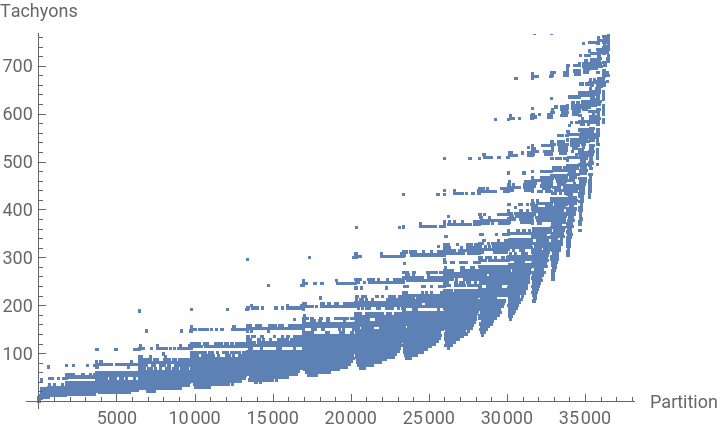
We now consider partial sums over all partitions with fixed lengthwhereThis is given explicitly in equation (4.65).
W(M)W(μ)
∑
ℓ(μ)M
W(μ).
Vol
(3,T)
B
δR(μ)
Vol()
H
Y
We now assign a local volume weight to each partition. For a given Higgsed vacuum, the relevant local directions are the tachyonic directions, while the quotient by the residual flavor symmetry removes gauge equivalent directions. The function below computes the residual gauge group volume factor associated with a partition .
In[]:=
(*ThevolumeofH_YasaproductofVol(SU(fd))*)gauge[list_]:=Module[{fdlist},fdlist=Tally[list][[All,2]];Exp[Sum[Log[BarnesG[fd+1]]-(fd^2/2+fd/2-1)Log[2π]-1/2Log[fd],{fd,fdlist}]]]
The ball volume formula involves the multivariate gamma function .
Γ
3
In[]:=
Gamma3[val_]:=π^(3/2)Gamma[val]Gamma[val-1/2]Gamma[val-1]
The function computes the contribution of a single partition. If there are no tachyonic directions, the local zero dimensional volume is set to one. Otherwise, the weight combines the high dimensional ball volume with the residual gauge group quotient.
weightW
W(μ)
In[]:=
weightW[partition_]:=Module[{tachyon=tachyons[partition],r=1/n_num},If[tachyon==0,Return@1];(*volumein0dimensions(T=0)is1*)Exp[3tachyon(1/2Log[π]+Log[r])-Log[Gamma3[tachyon/2]]-3Log[tachyon]+N@gauge[partition]]]
AdS5
AdS5
Scales
Scales
Mass towers
Mass towers
KK tower scale:
Motzkin Transposition Theorem
Motzkin Transposition Theorem
The Motzkin/Farkas test checks whether one linear inequality is implied by the others. We will use this to confirm that only the KK constraint and the shortest wrapped string constraint are needed for the leading AdS5 count .
The listed vectors correspond to the certificate λ, which tells us explicitly how to combine the inequalities one has to get the target implied inequality.
Inequality Redundancies
Inequality Redundancies
Transform to log variables.
Cylindrical Decomposition
Cylindrical Decomposition
Integrate
Integrate
The integration over the cylindrical region is performed below (can take a few minutes).
Special case (Q=8)
Special case (Q=8)
App A: Instantons
App A: Instantons
Demanding that they have action greater than 1, we get
We see that the F1/D1 instanton action inequality is stronger than the wrapped F1/D1 tower scale inequality. In fact, we can see this explicitly from the Motzkin certificate:
The integration region gets smaller with the stronger inequality.
And the final count from the integral is also smaller.
AdS4
AdS4
Scales
Scales
We first encode the dimensionless scale relations similarly to before .
Mass towers
Mass towers
In this AdS4 quotient, the KK tower gives one important constraint, but wrapped M2/M5-brane towers on short cycles of the orbifold can also give independent constraints .
KK tower scale:
Exponents of both N and k of the brane tower scale are geq than the KK tower scale, so KK is lighter.
These are potentially redundant, so we reduce them in the next step.
Inequality Redundancies
Inequality Redundancies
We collect the tower inequalities together with positivity and ordering constraints, then pass to logarithmic variables. In these variables all monomial cutoff conditions become linear inequalities.
The irreducibility check removes cutoff inequalities implied by the others. In this case, the minimal system consists of the KK inequality, the M2-brane inequality on a two-cycle, and the basic positivity and ordering constraints.
Cylindrical Decomposition
Cylindrical Decomposition
Integrate
Integrate
The integration over the cylindrical region is performed below (can take about 20 minutes on a 2018 model laptop).
Special case Q = 8
Special case Q = 8
We change the bounds and integration measure as follows:
Special case Q = 12
Special case Q = 12
App A: Instantons
App A: Instantons
The wrapped p-brane instantons have actions:
Demanding that they have action greater than 1, we get:
We see that M2 instanton inequality is more restrictive than the previous M2 on 2-cycle inequality.
The integration region gets smaller with the stronger inequality.
And the final counts for various supersymmetries are as follows
CITE THIS NOTEBOOK
CITE THIS NOTEBOOK
Counting AdS vacua
by Zihni Kaan Baykara, Alessandro Tomasiello, and Cumrun Vafa
Wolfram Community, STAFF PICKS, May 11, 2026
https://community.wolfram.com/groups/-/m/t/3714638
by Zihni Kaan Baykara, Alessandro Tomasiello, and Cumrun Vafa
Wolfram Community, STAFF PICKS, May 11, 2026
https://community.wolfram.com/groups/-/m/t/3714638