Introduction
Introduction
This document discusses number theory properties and relationships of the integer 2026.
The integer is semiprime and a happy number, with as one of its primitive roots. Although may not be particularly noteworthy in number theory, this provides a great excuse to create various elaborate visualizations that reveal some interesting aspects of the number.
2026
365
2026
Setup
Setup
In[]:=
(*PacletInstall["AntonAntonov/NumberTheoryUtilities"]*)Needs["AntonAntonov`NumberTheoryUtilities`"]
2026 Is a Happy Semiprime with Primitive Roots
2026 Is a Happy Semiprime with Primitive Roots
First, is obviously not prime—it is divisible by 2 —but dividing it by 2 gives a prime, :
2026
1013
In[]:=
PrimeQ[2026/2]
Out[]=
True
In[]:=
PrimeQ[1013,GaussianIntegers->True]
Out[]=
False
A happy number is a number for which iteratively summing the squares of its digits eventually reaches 1 (e.g., 13 → 10 → 1). Here is a check that 2026 is happy:
In[]:=
ResourceFunction["HappyNumberQ"][2026]
Out[]=
True
Here is the corresponding trail of digit-square sums:
In[]:=
FixedPointList[Total[IntegerDigits[#]^2]&,2026]
Out[]=
{2026,44,32,13,10,1,1}
Not many years in this century are happy numbers:
In[]:=
Pick[Range[2000,2100],ResourceFunction["HappyNumberQ"]/@Range[2000,2100]]
Out[]=
{2003,2008,2019,2026,2030,2036,2039,2062,2063,2080,2091,2093}
The decomposition of as means the multiplicative group modulo has primitive roots. A primitive root exists for an integer if and only if is , ,, , or , where is an odd prime and .
2026
2*1013
2026
n
n
1
2
4
k
p
2
k
p
k
k>0
We can check additional facts about 2026, such as whether it is "square-free" , among other properties. However, let us compare these with the feature-rich 2025 in the next section.
Comparison with 2025
Comparison with 2025
Here is a side-by-side comparison of key number theory properties for and .
2025
2026
Out[]=
# | Property | 2025 | 2026 | Notes |
1 | Prime or Composite | Composite | Composite | Both non-prime. |
2 | Prime Factorization | 3^4 × 5^2 (81 × 25) | 2 × 10¹³ | 2025 has repeated small primes; 2026 is a semiprime (product of two distinct primes). |
3 | Number of Divisors | 15 (highly composite for its size) | 4 (1, 2, 1013, 2026) | 2025 has many divisors; 2026 has very few. |
4 | Perfect Square | Yes (45^2 = 2025) | No | Major highlight for 2025—rare square year. |
5 | Sum of Cubes | Yes (1^3 + 2^3 + ... + 9^3 = (1 + ... + 9)^2 = 2025) | No | Iconic property for 2025 (Nicomachus's theorem). |
6 | Happy Number | No (process leads to cycle including 4) | Yes (repeated squared digit sums reach 1) | Key point for 2026—its main "happy" trait. |
7 | Harshad Number | Yes (divisible by 9) | No (not divisible by 10) | 2025 qualifies; 2026 does not. |
8 | Primitive Roots | No | Yes | This is a relatively rare property to have. |
9 | Other Notable Traits | {(20 + 25)^2 = 2025,Sum of first 45 odd numbers,Deficient number,Many pattern-based representations} | {Even number,Deficient number,Few special patterns} | 2025 is packed with elegant properties; 2026 is more "plain" beyond being happy. |
10 | Overall "Interest" Level | Highly interesting—celebrated in math communities for squares, cubes, and patterns | Relatively uninteresting—basic semiprime with no standout geometric or sum properties | Reinforces blog's angle. |
To summarize:
◼
2025 stands out as a mathematically rich number, often highlighted in puzzles and articles for its perfect square status and connections to sums of cubes and odd numbers.
◼
2026 , in contrast, has fewer flashy properties -- it's a straightforward even semiprime -- but it qualifies as a happy number and it has a primitive root.
Here is a computationally generated comparison table of most of the properties found in the table above:
In[]:=
Dataset@Map[<|"Function"->#1,"2025"->#1[2025],"2026"->#1[2026]|>&,{PrimeQ,CompositeQ,Length@*Divisors,PrimeOmega,EulerPhi,SquareFreeQ,ResourceFunction["HappyNumberQ"],ResourceFunction["HarshadNumberQ"],ResourceFunction["DeficientNumberQ"],PrimitiveRoot}]
Out[]=
Phi Number System
Phi Number System
In[]:=
ResourceFunction["PhiNumberSystem"][2026]
Out[]=
{15,13,10,6,-6,-11,-16}
Verification:
In[]:=
Total[GoldenRatio^%]//RootReduce
Out[]=
2026
Happy Numbers Trail Graph
Happy Numbers Trail Graph
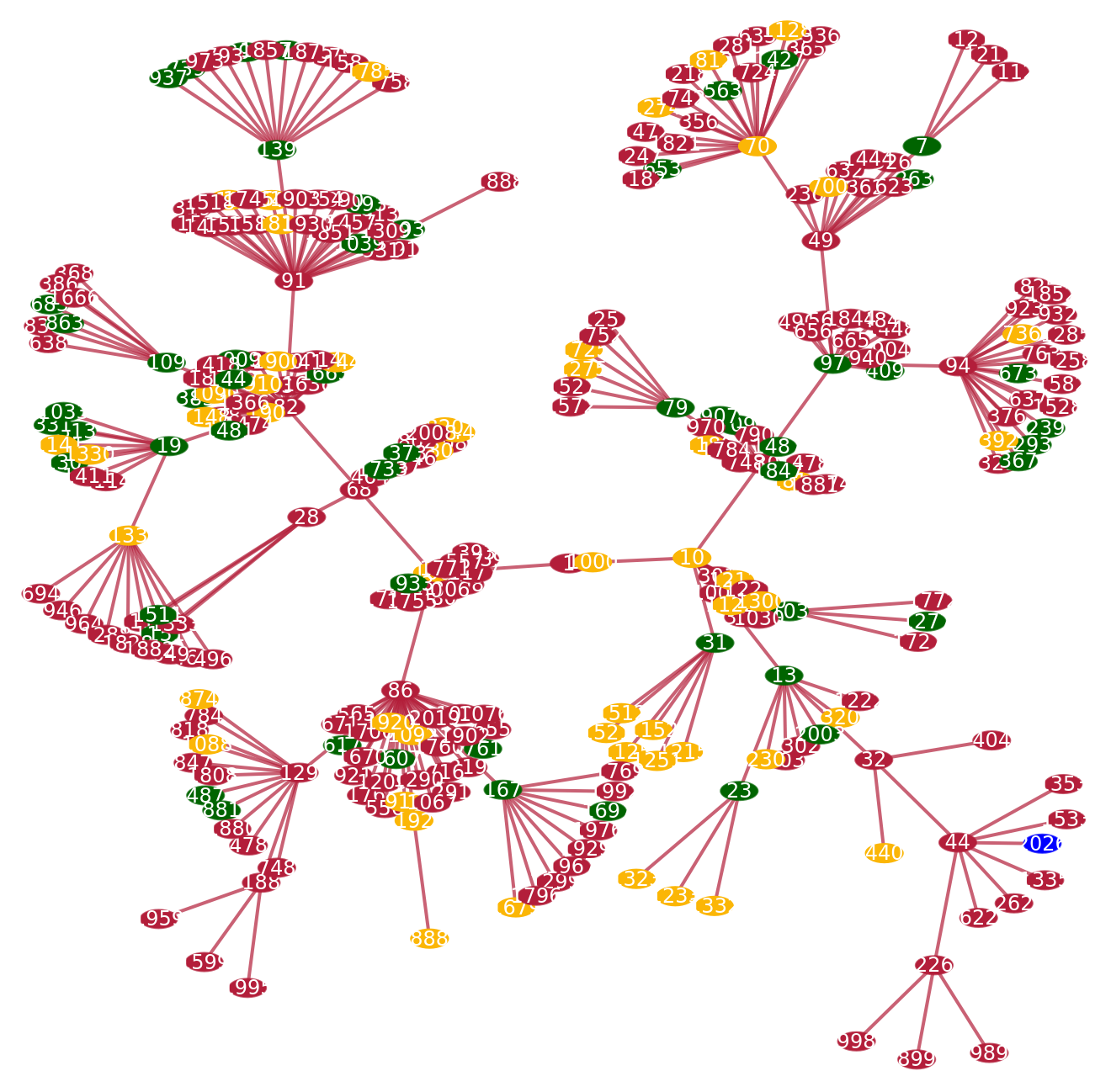
Let us create and plot a graph showing the trails of all happy numbers less than or equal to 2026. Below, we identify these numbers and their corresponding trails:
In[]:=
ns=Range[2,2026];AbsoluteTiming[trails=Map[FixedPointList[Total[IntegerDigits[#]^2]&,#,100,SameTest(Abs[#1-#2]<1*^-10&)]&,ns];]
Out[]=
{0.29022,Null}
Here is the corresponding trails graph, highlighting the primes and happy numbers:
In[]:=
happy=First/@Select[trails,#〚-1〛==1&];primeToo=Select[happy,PrimeQ];joyfulToo=Select[happy,ResourceFunction["HarshadNumberQ"]];aColors=Flatten@{Thread[primeToo->ResourceFunction["HexToColor"]["#006400"]],2026->Blue,Thread[joyfulToo->ResourceFunction["HexToColor"]["#fbb606ff"]],_->ResourceFunction["HexToColor"]["#B41E3A"]};edges=DeleteDuplicates@Flatten@Map[Rule@@@Partition[Most[#],2,1]&,Select[trails,#〚-1〛==1&]];vf1[{xc_,yc_},name_,{w_,h_}]:={(name/.aColors),EdgeForm[name/.aColors],Rectangle[{xc-2w,yc-h},{xc+2w,yc+h}],Text[Style[name,12,White],{xc,yc}]}vf2[{xc_,yc_},name_,{w_,h_}]:={(name/.aColors),EdgeForm[name/.aColors],Disk[{xc,yc},{2w,h}],Text[Style[name,12,White],{xc,yc}]}gTrails=Graph[edges,VertexStyle->ResourceFunction["HexToColor"]["#B41E3A"],VertexSize->1.8,VertexShapeFunctionvf2,EdgeStyle->Directive[ResourceFunction["HexToColor"]["#B41E3A"]],EdgeShapeFunction({ResourceFunction["HexToColor"]["#B41E3A"],Thick,BezierCurve[#1]}&),DirectedEdges->False,GraphLayout->"SpringEmbedding",ImageSize->1000]
Out[]=
Triangular Numbers
Triangular Numbers
There is a theorem by Gauss stating that any integer can be represented as a sum of at most three triangular numbers. Here we find an "interesting" solution:
Here, we verify the result:
Chord Diagrams
Chord Diagrams
Here are chord plots [AA2, AAp1, AAp2, AAv1] corresponding to a few selected primitive roots:
Remark: It is interesting that 365 (the number of days in a common calendar year) is a primitive root of the multiplicative group generated by 2026 . Not many years have this property this century; many do not have primitive roots at all.
The number 2026 appears in 18 results of the search "2026 graphs" in «The On-line Encyclopedia of Integer Sequences» . Here is the first result (from 2025-12-17): A033483 , "Number of disconnected 4-valent (or quartic) graphs with n nodes." Below, we retrieve properties from A033483's page:
Here, we just get the title:
Here, we get the corresponding sequence:
Here we find the position of 2026 in that sequence:
And here is another one:
Here, we check that all vertices have degree 4:
Remark: Note that although the plots show disjoint graphs, each graph plot represents a single graph object.
Additional Comments
Additional Comments
This section has a few additional (leftover) comments.
◼
After I researched and published the blog post "Numeric properties of 2025" , [AA1], in the first few days of 2025, I decided to program additional Number theory functionalities for Raku -- see the package "Math::NumberTheory" , [AAp1].
◼
◼
Number theory provides many opportunities for visualizations, so I included utilities for some of the popular patterns in "Math::NumberTheory", [AAp1] and "NumberTheoryUtilities".
◼
The number of years in this century that have primitive roots and have 365 as a primitive root is less than the number of years that are happy numbers.
◼
I would say I spent too much time finding a good, suitable, Christmas-themed combination of colors for the trails graph.
References
References
Articles, blog posts
Articles, blog posts
◼
◼
[AA2] Anton Antonov, "Primitive roots generation trails" , (2025), MathematicaForPrediction at WordPress .
◼
◼
Notebooks
Notebooks
◼
[AAn1] Anton Antonov, "Primitive roots generation trails" , (2025), Wolfram Community . STAFFPICKS, April 9, 2025.
◼
[EPn1] Ed Pegg, “Happy 2025 =1³+2³+3³+4³+5³+6³+7³+8³+9³!” , Wolfram Community , STAFFPICKS, December 30, 2024.
Functions, packages, paclets
Functions, packages, paclets
◼
◼
[AAp2] Anton Antonov, NumberTheoryUtilities, Wolfram Language paclet , (2025), Wolfram Language Paclet Repository .
◼
◼
◼
◼
◼
◼
◼
Videos
Videos
◼
[AAv1] Anton Antonov, Number theory neat examples in Raku (Set 3) , (2025), YouTube/@AAA4prediction .
CITE THIS NOTEBOOK
CITE THIS NOTEBOOK
Numerically 2026 is unremarkable yet happy: semiprime with primitive roots
by Anton Antonov
Wolfram Community, STAFF PICKS, December 22, 2025
https://community.wolfram.com/groups/-/m/t/3594686
by Anton Antonov
Wolfram Community, STAFF PICKS, December 22, 2025
https://community.wolfram.com/groups/-/m/t/3594686