Problem
Problem
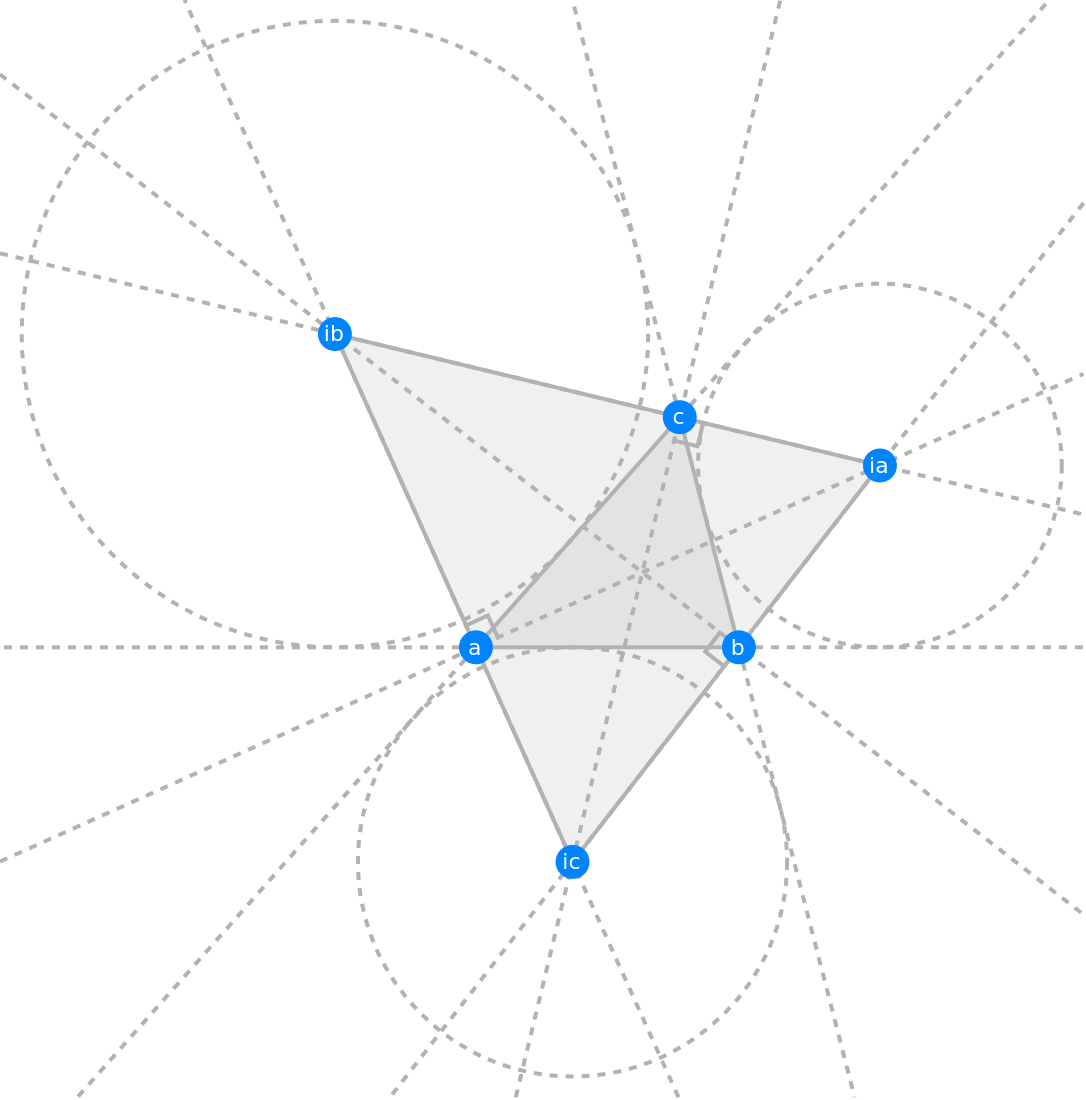
Let ABC be a triangle with , , and as excenters.
Prove that excentral triangle has orthocenter and that triangle ABC is its orthic triangle ( pedal triangle centered on orthocenter ).
I
A
I
B
I
C
Prove that excentral triangle
I
A
I
B
I
C
I
H
Geometric Scene Construction
Geometric Scene Construction
Though we can use GeometricScene to generate arbitrary triangle, we can specify some coordinates for our demo triangle to make the diagram with visually pleasant ratio.
This code is rather simple with repetitive TriangleCenter calls.
This code is rather simple with repetitive TriangleCenter calls.
gs=GeometricScene[{a{0,0},b{4,0},c{3.1,3.5},ia,ib,ic},{ia==TriangleCenter[{a,b,c},{"Excenter",a}],ib==TriangleCenter[{a,b,c},{"Excenter",b}],ic==TriangleCenter[{a,b,c},{"Excenter",c}],TriangleConstruct[{ia,ib,ic},"Orthocenter"]}]//RandomInstance;Framed[gs]
Out[]=
Proof by Angle Chasing
Proof by Angle Chasing
◼
Colinear property. WLOG, you only need sit on the same line. Notice that CA=CB. We can quickly check
I
B
C
I
A
∠I
B
∠I
A
∠I
B
1
2
PlanarAngle[{ib,c,a}]/.gs["Points"]
Out[]=
1.08252
and CB is (π-∠BCA)
∠I
A
1
2
PlanarAngle[{ia,c,b}]/.gs["Points"]
Out[]=
1.08252
which is very clear =CA+∠BCA+CB=π. Done.
∠I
A
CI
B
∠I
B
∠I
A
◼
Perpendicular property. WLOG, we only need line is perpendicular to .
This is simple because we know is excenter, it implies that is angle bisector of . =CA+CA=CB+CB=.
We also know+==π. Thus, =π/2. Done.
CI
c
I
A
I
B
This is simple because we know
I
C
CI
c
∠BCA
∠I
B
CI
C
∠I
B
∠I
C
∠I
C
∠I
A
∠I
B
CI
A
We also know
∠I
B
CI
C
∠I
C
CI
A
∠I
A
CI
B
∠I
B
CI
C
PlanarAngle[{ib,c,a}]+PlanarAngle[{ic,c,a}]/.gs["Points"]
Out[]=
1.5708
%/Degree
Out[]=
90.
Therefore we have ⊥ and ⊥. This implies triangle ABC is the orthic triangle of triangle .
BI
B
I
C
I
A
AI
A
I
C
I
B
I
A
I
B
I
C
◼
Additionally, we have some similarity property. WLOG, we only have to prove ∼.
We need one more angle equation besidesCA=CB. Notice that
CAI
B
BCI
A
We need one more angle equation besides
∠I
B
∠I
A
∠I
A
1
2
∠AI
B
1
2
∠I
B
∠I
B
1
2
1
2
1
2
1
2
1
2
∠I
A
Thus ∼. We can prove other similar triangle pairs in the same way.
Use FindGeometricConjectures to list them
CAI
B
BCI
A
Use FindGeometricConjectures to list them
FindGeometricConjectures[gs,_[__,"Similar"]]["Conclusions"]
Out[]=
{GeometricAssertion[{Triangle[{ia,b,c}],Triangle[{a,ib,c}],Triangle[{a,b,ic}],Triangle[{ia,ib,ic}]},Similar]}
Review
Review
◼
Use excenter’s definition and angle bisectors
◼
Arithmetic with neighboring angles to find perpendicular segments
◼
Find similar triangles with angular addition and interior angles in a triangle sum up to π
Other Geometry Problems
Other Geometry Problems