Reversible multiway systems generate exponentially growing collections of possible states from simple local rewriting rules, making their long-term behavior difficult to characterize directly. This work investigates whether such microscopic dynamics admit an effective continuum description through macroscopic observables. After constructing probabilistic multiway evolutions for several reversible string-rewriting rules, we first explored local density fields as candidates for continuum partial differential equations. Although these fields captured aspects of the dynamics, they did not produce robust continuum behavior across different rules and initial conditions. We then shifted focus to global observables, including Shannon entropy, mean particle position, variance, and energy. Surprisingly, these quantities consistently exhibited simple relaxation dynamics that were accurately described by low-dimensional exponential models despite the underlying combinatorial complexity. This suggests that effective macroscopic laws may emerge naturally from reversible multiway evolution, providing a promising bridge between discrete rewriting systems and continuum descriptions.
Introduction
Introduction
One of the central goals of theoretical physics is understanding how simple macroscopic laws emerge from complicated microscopic dynamics. Fluids, gases, and many-body systems are composed of enormous numbers of interacting components, yet their collective behavior is often described by relatively simple differential equations. Explaining how this transition from discrete microscopic rules to continuum descriptions occurs remains a fundamental challenge across physics and mathematics.
Multiway systems provide a natural setting for exploring this question. Beginning from a single initial state, a rewrite rule generates every possible successor state, producing an exponentially growing branching structure known as a multiway graph. Although each rewrite operation is local and deterministic, the global evolution rapidly becomes highly complex due to the enormous number of possible histories.
This project investigates whether reversible string-rewriting systems exhibit emergent continuum behavior. Rather than studying individual rewriting histories, we assign probabilities to every reachable state and examine how macroscopic observables evolve over time. The central question is:
Can the complex evolution of reversible multiway systems be described by simple continuum laws?
To answer this question, we first explored continuum descriptions based on local occupation probabilities and density fields. When these approaches proved insufficient, we shifted attention to global observables such as entropy, variance, mean particle position, and energy. Although the microscopic dynamics remained highly complex, these macroscopic quantities displayed remarkably simple relaxation behavior, suggesting that effective continuum laws may emerge even when local continuum descriptions fail.
Initialization
Initialization
From Local Rewrite Rules to Multiway Evolution
From Local Rewrite Rules to Multiway Evolution
Every multiway system begins with two ingredients: an initial state and a collection of rewrite rules. Whenever a substring matches one of the rules, it can be replaced, producing a new state. Because several replacements may be possible simultaneously, the evolution branches naturally into multiple computational histories.
To understand this process, we first consider a deliberately small example. Although the systems studied later contain 50-bit strings and millions of states, this toy example illustrates the essential ideas.
To understand this process, we first consider a deliberately small example. Although the systems studied later contain 50-bit strings and millions of states, this toy example illustrates the essential ideas.
In[]:=
(*Defineasimplereversiblerewriteruleandashortinitialstring*)toyRule={"001"->"100","100"->"001"};toyInitial="001001";(*Generatethefirstthreegenerationsofthemultiwayevolution*)toyGraph=ResourceFunction["MultiwaySystem"][toyRule,toyInitial,3,"StatesGraph"];Graph[toyGraph,GraphLayout->{"LayeredDigraphEmbedding","Orientation"->Top},ImageSize->Small]
Out[]=
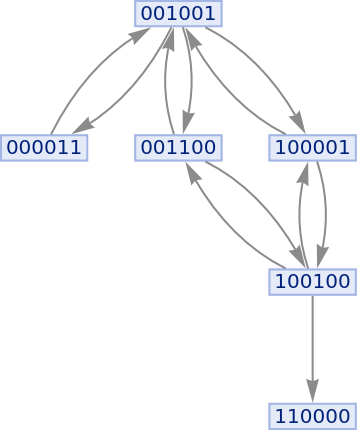
The graph illustrates two characteristic features of multiway evolution. First, a single state may branch into several descendants whenever multiple rewrites are possible. Second, distinct computational histories may later merge back into the same state. This combination of branching and reconvergence produces a rich computational structure that rapidly becomes too large to analyze visually.
To appreciate this growth, we now compare the toy example with one of the larger systems used throughout the remainder of this essay.
To appreciate this growth, we now compare the toy example with one of the larger systems used throughout the remainder of this essay.
(*Definethe50-bitinitialstring*)initial="01001000010011000101110110000101010101101001000011";rule={"001"->"100","100"->"001"};(*Generatethestategraph*)largerGraph=ResourceFunction["MultiwaySystem"][rule,initial,4,"StatesGraph"];(*Displayonlythegraphstructure*)GraphVertexList[largerGraph],EdgeList[largerGraph],
Out[]=
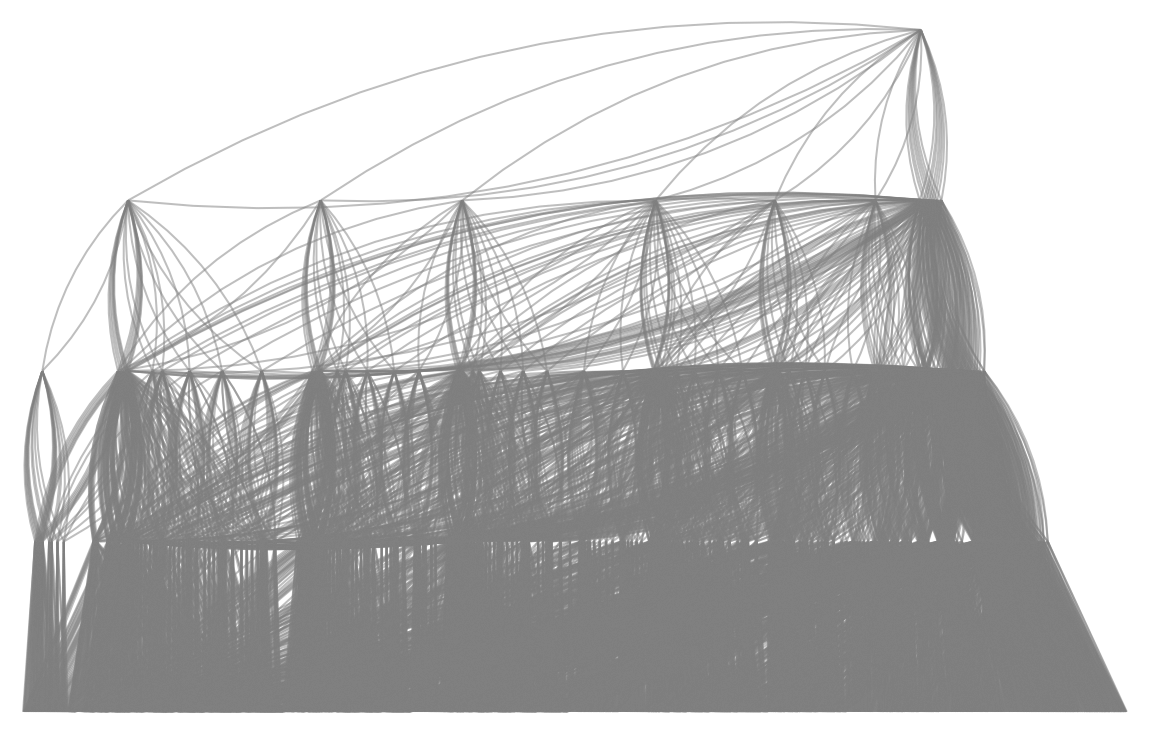
Even after only a few generations, the number of reachable states increases rapidly, while the branching structure becomes increasingly dense. Although the multiway graph provides a complete description of the computation, it quickly becomes too large to visualize or analyze directly. Rather than tracking millions of individual computational histories, we instead seek a macroscopic description that captures the collective behavior of the entire ensemble of reachable states.
This shift in perspective naturally leads to a probabilistic formulation. By assigning probabilities to each reachable state at every generation, we replace the overwhelming combinatorial complexity of the multiway graph with a probability distribution whose evolution can be studied through statistical observables such as entropy, mean position, variance, and energy. These observables provide a bridge between the microscopic rewrite dynamics and an emerging continuum description.
This shift in perspective naturally leads to a probabilistic formulation. By assigning probabilities to each reachable state at every generation, we replace the overwhelming combinatorial complexity of the multiway graph with a probability distribution whose evolution can be studied through statistical observables such as entropy, mean position, variance, and energy. These observables provide a bridge between the microscopic rewrite dynamics and an emerging continuum description.
From Multiway Graphs to Probability Distributions
From Multiway Graphs to Probability Distributions
The multiway graph provides a complete description of every possible computational history generated by a rewrite rule. However, as demonstrated in the previous section, the number of reachable states grows rapidly even for simple reversible rules. Beyond only a few generations, following every branch individually becomes impractical.
Rather than tracking individual computational paths, we instead adopt a statistical viewpoint. At each generation, the collection of reachable strings is regarded as an ensemble, and each state is assigned a probability. The evolution of the computation is therefore described by the evolution of a probability distribution over the multiway graph rather than by individual trajectories.
This shift from individual states to probability distributions forms the foundation of the continuum description developed throughout the remainder of this essay.
Why Equal Probabilities?
Why Equal Probabilities?
A probability distribution requires a rule for assigning probability to newly generated states.
In this work, we make the simplest possible assumption: every rewrite event originating from a given state is considered equally likely. If a state has b(s) possible rewrites, then its probability is divided equally among its successors. This assumption is analogous to the principle of equal a priori probabilities in classical statistical mechanics, where every accessible microscopic configuration is assumed equally probable in the absence of additional information.
Although simple, this choice produces a well-defined stochastic dynamics on the multiway graph while remaining entirely determined by the underlying rewrite rule.
Probability Flow on the Multiway Graph
Probability Flow on the Multiway Graph
Suppose that the probability of state at generation t is denoted by: (t).If state has outgoing rewrites, each successor receives an equal share of its probability, (t).When multiple computational histories reach the same state, their contributions are added together. Consequently, the probability of a state at the next generation is: (t+1)=(t), where the sum runs over every predecessor of . Since probability is only redistributed between states, the total probability remains normalized, (t)=1, for every generation.Rather than following individual strings through the computation, we therefore study the flow of probability across the multiway graph.
s
i
P
i
s
i
b
i
P
i
b
i
P
j
∑
ij
P
i
b
i
s
j
∑
i
P
i
Using weightedSlices, the probability distribution is evolved over successive generations.
A Simple Example
A Simple Example
To illustrate the algorithm, we again consider the small reversible rewrite system introduced in the previous section.
In[]:=
toyRule={"001"->"100","100"->"001"};toyInitial="001001";weights=weightedSlices[toyRule,toyInitial,10];
Initially, all probability is concentrated on a single state,
In[]:=
weights[0]
Out[]=
0010011.
giving P(001001) = 1
After one rewrite, the probability has been divided equally among the three reachable states,
In[]:=
weights[1]
Out[]=
1000010.333333,0000110.333333,0011000.333333
As the evolution continues, different computational histories may reach the same string. Whenever this occurs, their probabilities are added together automatically, reflecting the fact that distinct branches of the multiway graph have merged.
This probabilistic description retains all of the information required to study the computation while avoiding the need to analyze millions of individual paths.
This probabilistic description retains all of the information required to study the computation while avoiding the need to analyze millions of individual paths.
From Probability Distributions to Macroscopic Observables
From Probability Distributions to Macroscopic Observables
Once the probability distribution over the multiway graph has been constructed, the system can be characterized through ensemble-averaged quantities. If a state is assigned a value , the corresponding macroscopic observable is: .The same probability distribution can therefore produce several complementary descriptions of the evolving system.
s
i
O
i
〈O〉(t)=(t)
∑
i
P
i
O
i
The observables considered in this work are summarized below: • Shannon entropy measures how broadly probability is distributed over the reachable states, • Mean particle position measures the average location of the ones within the binary strings. • Variance measures the spatial spread of the particles. • Magnetization measures the imbalance between zeros and ones after mapping the binary strings onto Ising spins. • Energy is computed using the nearest-neighbor Ising interaction and provides a simple measure of local ordering.Although these quantities describe different physical properties, they are all computed in exactly the same way: each is an expectation value over the evolving probability distribution.
H(t)=-(t)log(t)
∑
i
P
i
P
i
Using the functions defined in Initialization, we now compute the weighted evolution and its macroscopic observables for the 50-bit system introduced earlier.
In[]:=
Clear[weights,obs];steps=10;weights=weightedSlices[rule,initial,steps];obs=computeObservables[weights,steps];GraphicsGrid[Partition[observablePlot/@observableNames,2],ImageSize->Large]
Out[]=
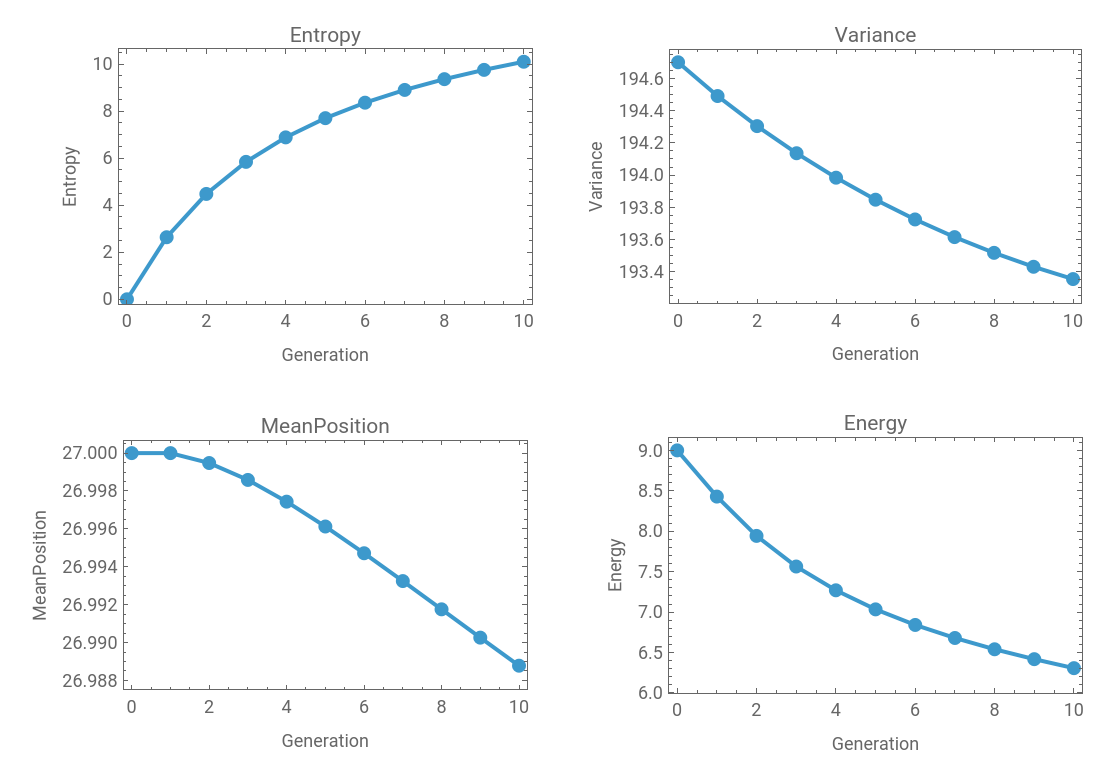
The figure above shows the evolution of four representative macroscopic observables computed from the probability distribution. Although these quantities measure different properties of the evolving ensemble, they all vary smoothly despite the rapidly increasing complexity of the underlying multiway graph. This immediately raises an interesting question: are these smooth curves governed by simple dynamical laws?
Searching for Continuum Behavior
Searching for Continuum Behavior
We next investigated whether these dynamics admit a continuum description.
The central idea was to identify quantities whose evolution becomes simpler as the number of reachable states increases. Throughout the project, several candidate continuum descriptions were explored. Some focused on the microscopic spatial structure of the binary strings, while others considered only ensemble-averaged quantities. Although many of these approaches ultimately proved unsuccessful, each provided insight into the relationship between the underlying rewrite dynamics and the emergent statistical behavior.
The following sections summarize the progression of these investigations.
Attempt 1: The Occupancy Probability Field
Attempt 1: The Occupancy Probability Field
Our first approach was motivated by classical continuum mechanics. If each binary string is interpreted as a one-dimensional lattice, with a 1 representing an occupied site and a 0 an empty site, then instead of following individual strings we may ask:
What is the probability that a particular lattice site is occupied at generation t?
This leads naturally to the definition of the occupancy probability field,
P(x,t), where P(x,t) denotes the probability that lattice site x contains a 1 after t generations of the multiway evolution.
Unlike entropy or energy, which reduce the entire ensemble to a single number, the occupancy field preserves spatial information while averaging over the exponentially many computational histories. If a continuum limit exists, P(x,t) appeared to be the most natural candidate for a field satisfying a partial differential equation.
Using occupancyField, we compute the sitewise occupation probabilities.
To visualize the evolution, we plot the occupancy profiles at several generations.
Although ensemble averaging replaces the binary values of individual strings with probabilities between zero and one, the resulting field remains highly structured. Peaks and valleys persist throughout the evolution, and neighboring lattice sites often evolve quite differently. Instead of approaching a smooth continuum profile, the field continues to reflect the microscopic details of the underlying rewrite rules.
Consequently, the occupancy probability did not exhibit the simple transport or diffusion behavior we initially hoped to uncover. This suggested that the microscopic spatial field retained too much information from the discrete dynamics to admit a straightforward continuum description.
Rather than abandoning the continuum perspective altogether, we next investigated whether removing some of this microscopic detail through coarse-graining would reveal simpler large-scale behavior.
Attempt 2: Spatial Coarse-Graining
Attempt 2: Spatial Coarse-Graining
The irregular structure of the occupancy probability field suggested that the microscopic lattice retained too much information from the underlying rewrite dynamics. In many areas of statistical physics, continuum behavior only becomes apparent after averaging over length scales larger than the microscopic spacing. Motivated by this idea, the next step was to spatially coarse-grain the occupancy field.
Instead of considering the occupancy probability at a single lattice site, we averaged neighboring sites within a sliding window. This produces a smoothed field,
U(x,t), which suppresses short-wavelength fluctuations while preserving the large-scale spatial structure.
If the microscopic oscillations were merely lattice-scale artifacts, then the coarse-grained field would be expected to evolve more smoothly and potentially satisfy a simple partial differential equation.
Visualize the coarse-grained field at several generations.
The smoothing procedure significantly reduced the local oscillations present in the original occupancy field. The resulting profiles appeared substantially more regular, and their large-scale features became easier to identify.
This improvement initially suggested that a continuum description might indeed emerge after sufficient coarse-graining. Encouraged by these smoother profiles, we attempted to model the evolution of U(x,t) using finite-difference approximations to common transport equations.
This improvement initially suggested that a continuum description might indeed emerge after sufficient coarse-graining. Encouraged by these smoother profiles, we attempted to model the evolution of U(x,t) using finite-difference approximations to common transport equations.
Attempt 3: Fitting a Continuum Partial Differential Equation
Attempt 3: Fitting a Continuum Partial Differential Equation
Finally, fit the PDE
The fitted model produced the coefficients
The figure below compares the predicted time derivative with the measured values. If the continuum model were an accurate description, the data would cluster closely around the diagonal y=x. Instead, the points form a broad cloud with substantial scatter, indicating that the fitted equation reproduces only general trends rather than the detailed dynamics.
The residuals, shown below, likewise exhibit significant structure rather than behaving as random fluctuations. This suggests that the discrepancies arise from systematic features omitted by the model rather than from numerical noise alone.
These negative results proved to be just as informative as the successful ones. Rather than revealing a universal continuum field theory, they demonstrated that coarse-graining the spatial density alone is insufficient to eliminate the microscopic dependence on the underlying rewrite dynamics. This prompted a change in perspective. Instead of seeking continuum equations for the spatial field itself, we returned to the macroscopic observables introduced in earlier sections and investigated whether those quantities exhibited simpler and more universal dynamical behavior.
Macroscopic Dynamics and Emergent Continuum Behavior
Macroscopic Dynamics and Emergent Continuum Behavior
Although the coarse-grained density evolves smoothly, the previous section demonstrated that its local dynamics cannot be captured by a single universal partial differential equation. The fitted coefficients depended strongly on the underlying rewrite rule and coarse-graining procedure, and the resulting models showed limited predictive power. This suggests that the microscopic field retains significant information about the discrete rewriting process, even after averaging.
Rather than continuing to model the full spatial density, using the observables introduced previously, we now investigate their long-time dynamics.
Rather than continuing to model the full spatial density, using the observables introduced previously, we now investigate their long-time dynamics.
Computing the Observables
Computing the Observables
Evolution of the Macroscopic Observables
Evolution of the Macroscopic Observables
The figure above shows the evolution of the four observables throughout the simulation.
Unlike the microscopic field examined in the previous section, these quantities evolve smoothly over time. The mean position changes gradually, indicating coherent transport of the ensemble. The variance also evolves continuously, reflecting the changing spatial extent of the occupied region. The Shannon entropy provides a measure of the distribution’s information content, while the entropy production rate quantifies the rate at which this disorder changes from one generation to the next.
Although the precise numerical values depend on the particular rewrite rule, the same qualitative behavior was observed across all rules investigated. In every case, the macroscopic observables exhibited considerably simpler dynamics than the underlying spatial field.
This contrast is significant. While the microscopic density retains detailed signatures of the discrete rewriting process that prevent a universal continuum PDE from emerging, the collective observables appear largely insensitive to these microscopic details. Their evolution is smooth, reproducible, and robust under changes of rewrite rule, suggesting that continuum behavior emerges more naturally at the level of global statistical quantities than at the level of the microscopic density itself.
We set out to derive a continuum PDE from discrete multiway dynamics. While that goal proved unsuccessful, the failure itself revealed where continuum behavior actually emerges—not in the microscopic density field, but in macroscopic observables. This mirrors the philosophy of statistical mechanics, where simple deterministic laws arise from averaging over complex microscopic processes.
Entropy as a Universal Macroscopic Observable
Entropy as a Universal Macroscopic Observable
The analysis of the previous sections showed that the coarse-grained spatial field does not admit a robust local partial differential equation. The fitted coefficients depended strongly on the rewrite rule, coarse-graining scale, and initial condition, and the resulting models had limited predictive power.
The macroscopic observables behaved more simply, but they were not equally universal. Mean position and variance often displayed smooth trajectories, yet their detailed behavior changed substantially between initial strings. Entropy was different. Across the initial conditions tested, its long-time evolution was consistently captured by the same qualitative law: relaxation toward a limiting value.
This makes entropy the strongest candidate for a universal macroscopic observable in the probabilistic multiway system.
Exponential Relaxation of Entropy
Exponential Relaxation of Entropy
The resulting entropy was fitted with an exponential relaxation model.
A good fit indicates that the complicated branching evolution of the multiway system can be reduced, at the level of entropy, to a simple first-order relaxation equation.
Entropy Change per Generation
Entropy Change per Generation
with the numerical results obtained from
The two fits can be shown together:
Markov-Chain Interpretation
Markov-Chain Interpretation
This provides a theoretical explanation for the relaxation law observed in the entropy data.
Entropy is not a linear function of the probability vector, so the eigenvalue argument is not exact in the same way it would be for a linear expectation value. However, once the distribution is sufficiently close to its long-time form, entropy can be expanded around that limiting distribution. Its leading correction is then governed by the same slowly decaying modes of the Markov process. The observed exponential fit should therefore be interpreted as a late-time effective law rather than an exact identity at every generation.
Entropy is not a linear function of the probability vector, so the eigenvalue argument is not exact in the same way it would be for a linear expectation value. However, once the distribution is sufficiently close to its long-time form, entropy can be expanded around that limiting distribution. Its leading correction is then governed by the same slowly decaying modes of the Markov process. The observed exponential fit should therefore be interpreted as a late-time effective law rather than an exact identity at every generation.
Testing Different Initial Strings
Testing Different Initial Strings
To test sensitivity to the initial condition, seven random 30-bit strings were generated, each containing 17 ones. Fixing the string length and particle number isolates the effect of spatial arrangement while keeping the computation manageable.
The entropy trajectory was then computed for each initial string using the same rewrite rule and number of generations.
Plot the entropy trajectories together:
Overlay the fits
Interpretation
Interpretation
Concluding Remarks
Concluding Remarks
Acknowledgements
Acknowledgements
I would like to express my sincere gratitude to my mentor, Nik Murzin, for his guidance, and thoughtful feedback throughout this project. His support was invaluable in shaping both the direction of the research and its presentation. I am also deeply grateful to Xerxes Arsiwalla for helping to identify and refine the research direction at the beginning of the project and for his insightful discussions along the way. Finally, I would like to thank Stephen Wolfram and the entire Wolfram Summer School team for creating such an inspiring research environment and for their support in developing and pursuing this project.
References
References
1
.S. Wolfram (2002), A New Kind of Science. Wolfram Media.
2
.S. Wolfram (2020), “Weighted Multiway Graphs,” Wolfram Physics Project Technical Introduction. https://www.wolframphysics.org/technical-introduction/the-updating-process-for-string-substitution-systems/weighted-multiway-graphs/
3
.S. Wolfram (2020), “Typical Multiway Graph Structures,” Wolfram Physics Project Technical Introduction. https://www.wolframphysics.org/technical-introduction/the-updating-process-for-string-substitution-systems/typical-multiway-graph-structures/
4
.S. Wolfram (2020), “The Relationship between Graphs and the Multiway Causal Graph,” Wolfram Physics Project Technical Introduction. https://www.wolframphysics.org/technical-introduction/the-updating-process-for-string-substitution-systems/the-relationship-between-graphs-and-the-multiway-causal-graph/
5
.J. Gorard (2021), “Growth Functions, Rates and Classes of String-Based Multiway Systems,” arXiv:2102.03321. https://arxiv.org/abs/2102.03321
6
.J. Gorard (2021), “Homotopies in Multiway (Non-Deterministic) Rewriting Systems as n-Fold Categories,” arXiv:2105.10822. https://arxiv.org/abs/2105.10822
AI Disclosure
AI Disclosure
The following generative AI tool was used in this project: ChatGPT (GPT-5.5). It was used for editing prose and code formatting. All content was reviewed and approved by the author.
CITE THIS NOTEBOOK
CITE THIS NOTEBOOK
Emergent Continuum Behavior in Reversible Multiway Systems
by Muhammad Awal Tahiru
Wolfram Community, STAFF PICKS, July 16, 2026
https://community.wolfram.com/groups/-/m/t/3761847
by Muhammad Awal Tahiru
Wolfram Community, STAFF PICKS, July 16, 2026
https://community.wolfram.com/groups/-/m/t/3761847