Precipitation reactions are often introduced using chemical equations, making it difficult for students to understand the molecular processes occurring in solution. This project uses Wolfram Language to model and simulate the precipitation reaction between silver nitrate and sodium chloride. I developed molecular visualizations and simulations showing crystal dissolution, ion hydration, and silver chloride crystal growth. By combining molecular graphics, and animation, this project provides a more intuitive representation of precipitation reactions and demonstrates how Wolfram Language can support the teaching of General Chemistry.
Introduction
Introduction
Precipitation reactions are among the most common reactions taught in General Chemistry and are often introduced through balanced chemical equations. While these equations describe the overall reaction, they do not reveal what happens at the molecular level before a visible precipitate forms. In reality, ionic compounds dissolve into their constituent ions, water molecules surround and stabilize these ions, and the ions move continuously throughout the solution. When oppositely charged ions encounter one another under favorable conditions, they begin to form small clusters that eventually grow into a solid crystal.
In this project, I model the precipitation reaction between silver nitrate and sodium chloride using the Wolfram Language. Rather than focusing only on the chemical equation, I build a molecular animation that illustrates each stage of the reaction, including crystal dissolution, ion hydration, nucleation, and silver chloride crystal growth. By combining molecular models, and animation, this project provides an interactive way to explore how precipitation reactions occur at the microscopic level.
The Wolfram Language code used to construct the molecular models and visualizations is provided in the accompanying code sections.
Modeling Aqueous Ionic Solutions
Modeling Aqueous Ionic Solutions
The first step in modeling a precipitation reaction is constructing realistic aqueous ionic solutions. Since precipitation occurs after ionic compounds dissolve in water, it is important to represent the dissolved ions and surrounding water molecules before simulating the reaction itself. Rather than placing every molecule manually, I use the MoleculeComplex paclet, which provides tools for building molecular systems and generating physically reasonable solution models.
Use the MoleculeComplex paclet to create the molecular model:
In[]:=
PacletInstall["RobertNachbar/MoleculeComplex"]
Out[]=
PacletObject


In[]:=
Needs["RobertNachbar`MoleculeComplex`"]
After loading the paclet, I create molecular representations of water, silver ions, nitrate ions, sodium ions, and chloride ions. These molecular objects serve as the building blocks for the remainder of the project, where they are assembled into aqueous solutions, hydrated by water molecules, and ultimately used to simulate the precipitation of silver chloride.
In[]:=
water=Molecule["water"]
In[]:=
nitrate=Molecule["Nitrate"]
In[]:=
silver=Molecule["Silver"]
In[]:=
chloride=Molecule["[Cl-]"]
In[]:=
sodium=Molecule["[Na+]"]
Before modeling precipitation, the reactants must first be represented as aqueous solutions. In water, silver nitrate dissociates completely into silver ) and nitrate ) ions, which become dispersed throughout the solvent. To model this environment, I use Packmol to generate a three-dimensional solution containing water molecules, silver ions, and nitrate ions. Packmol distributes the molecules randomly within a defined simulation box while preventing unrealistic overlaps, providing a physically reasonable starting point for the subsequent simulation.
(
+
Ag
(
-
NO
3
In[]:=
agSolution = Packmol[{Association["Molecule" -> silver, "Count" -> 5, "Region" -> Cuboid[{0, 0, 0}, {50, 50, 4}]], Association["Molecule" -> nitrate, "Count" -> 5, "Region" -> Cuboid[{0, 0, 0}, {50, 50, 4}]], Association["Molecule" -> water, "Count" -> 530, "Region" -> Cuboid[{0, 0, 0}, {50, 50, 4}]]}]
agSolution["Molecules"];
The visualization below illustrates that the silver nitrate crystal has completely dissociated into individual (Grey) and (Red and Blue) ions. Rather than remaining associated as neutral units, the ions are dispersed throughout the solvent, consistent with the behavior of a strong electrolyte in water. Water molecules surround the dissolved ions, representing the hydration shells that stabilize them in solution through ion–dipole interactions. This hydrated aqueous solution serves as one of the reactants for the precipitation reaction modeled in the following sections.
+
Ag
-
NO
3
AgNO
3
Out[]=

To complete the precipitation model, a separate aqueous sodium chloride solution is generated using the same approach. In water, sodium chloride dissociates completely into sodium ) and chloride ) ions, which become hydrated and dispersed throughout the solvent. Using Packmol, sodium ions, chloride ions, and water molecules are randomly distributed within a three-dimensional simulation box, providing the second reactant solution required for the precipitation reaction.
(
+
Na
(
-
Cl
clSolution=Packmol[{<|"Molecule"->sodium,"Count"->5,"Region"->Cuboid[{0,0,0},{50,50,4}]|>,<|"Molecule"->chloride,"Count"->5,"Region"->Cuboid[{0,0,0},{50,50,4}]|>,<|"Molecule"->water,"Count"->530,"Region"->Cuboid[{0,0,0},{50,50,4}]|>}]
clSolution["Molecules"];
Out[]=

The visualization shows the aqueous sodium chloride solution after dissociation in water. The chloride ions (green) and sodium ions (purple) are dispersed throughout the solvent rather than remaining associated as NaCl units, demonstrating the complete dissociation of sodium chloride in water. The surrounding water molecules represent the hydration environment that stabilizes the dissolved ions in solution. Similar to the silver nitrate solution, the ions remain separated and are free to move within the solvent. This hydrated sodium chloride solution serves as the second reactant in the precipitation reaction.
Modeling Crystal Dissolution
Modeling Crystal Dissolution
Dissociation of NaCl Crystal
Dissociation of NaCl Crystal
Before the precipitation reaction can occur, it is useful to understand how sodium chloride dissolves in water. Solid sodium chloride consists of an ordered arrangement of sodium and chloride ions held together by electrostatic forces. When placed in water, the polar water molecules interact with ions at the crystal surface, gradually weakening these ionic interactions. As a result, sodium and chloride ions become hydrated and leave the crystal, producing an aqueous sodium chloride solution.
The four snapshots summarize the molecular events involved in the dissolution of a sodium chloride crystal. Initially, the ions are held together within the crystal lattice by electrostatic attractions. As water molecules approach the crystal surface, their polar nature causes them to orient according to the ionic charges, with the oxygen atoms directed toward ions and the hydrogen atoms toward ions. These interactions weaken the electrostatic forces holding the lattice together. As hydration becomes more favorable, individual ions detach from the crystal surface and become fully solvated by water molecules, producing an aqueous sodium chloride solution.
+
Na
+
Cl
Out[]=
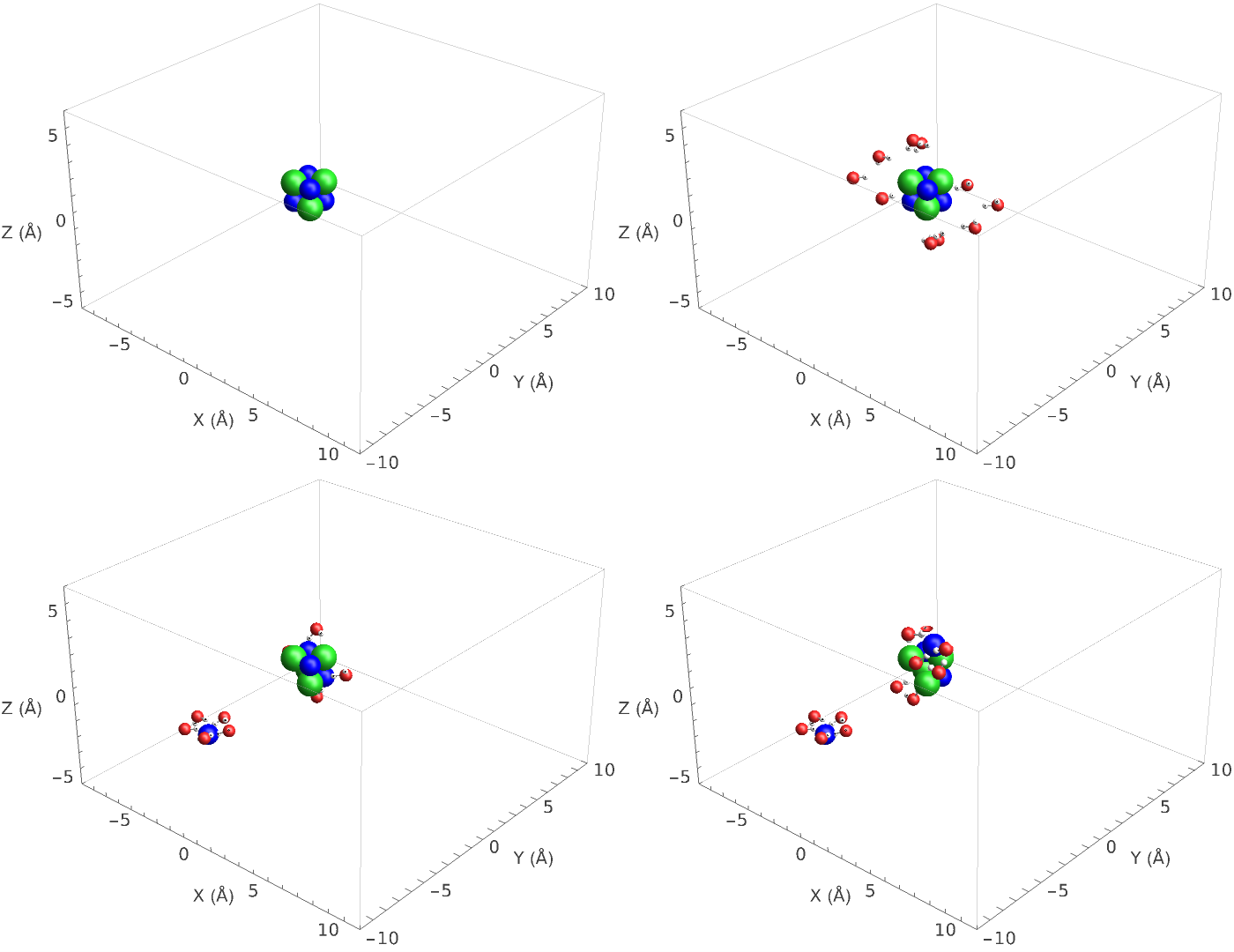
Static images capture key stages of the dissolution process, but they cannot fully convey the continuous molecular motion occurring in solution. The animation below illustrates the dynamic nature of ion hydration and crystal dissolution, allowing the progression of the reaction to be observed step by step.
Out[]=

The animation demonstrates the progressive rather than instantaneous nature of crystal dissolution. Water molecules continuously reorient around the ions according to their polarity, stabilizing the dissolved ions and preventing them from immediately recombining. This hydrated solution provides the starting point for the subsequent precipitation reaction when chloride ions are introduced.
Dissociation of crystal
AgNO
3
The sequence above highlights the major stages of dissociation. Initially, the ions remain part of the crystal lattice. As water molecules interact with the crystal surface, the electrostatic attractions holding the ions together are weakened. Individual silver and nitrate ions then detach from the crystal and become surrounded by water molecules, forming hydrated ions in solution.
While the static images illustrate the key stages of dissociation, the continuous molecular motion is more clearly observed through animation. The animation below demonstrates how water molecules dynamically reorient around the ions as they leave the crystal and become hydrated.
The animation emphasizes that dissociation is a continuous molecular process rather than an instantaneous event. Water molecules continuously reorganize around the ions according to their polarity, producing stable hydration shells that prevent the ions from immediately recombining. These hydrated ions remain free to diffuse through the solution and participate in the subsequent precipitation reaction.
Modeling the Mixing of the Solutions
Modeling the Mixing of the Solutions
When the two solutions are mixed, the boundary between them gradually disappears as the hydrated ions and water molecules diffuse throughout the solution. This diffusion is driven by the continuous thermal motion of molecules and the tendency of the system to reach a uniform distribution of dissolved species. During this stage, the ions remain fully hydrated and move independently through the solvent. The solution therefore becomes a homogeneous mixture in which silver, chloride, sodium, and nitrate ions are free to encounter one another. These molecular encounters provide the necessary conditions for the precipitation process that follows.
The variable dynamicSolutionSequence contains the complete sequence of frames generated during the mixing simulation. Each frame represents the positions and orientations of the hydrated silver, nitrate, sodium, chloride ions, and surrounding water molecules at a particular stage of the mixing process. Passing this sequence to ListAnimate creates an interactive animation that allows the molecular dynamics to be viewed continuously rather than as individual snapshots.
The animation illustrates the mixing of aqueous silver nitrate and sodium chloride solutions at the molecular level. Initially, the hydrated ions are shown in separate regions of the solution. As the animation progresses, the ions are represented as becoming more uniformly distributed throughout the solvent, illustrating the mixing process that occurs when the two solutions are combined. The hydration of the ions is maintained throughout the visualization to emphasize their stabilization in water. Although the animation is intended as a conceptual representation rather than a molecular dynamics simulation, it provides a useful visualization of how dissolved ions become intermixed before precipitation begins.
Modeling Silver Chloride Nucleation and Crystal Growth
Modeling Silver Chloride Nucleation and Crystal Growth
To visualize these microscopic processes, I developed a computational model in the Wolfram Language that numerically represents the interactions between the dissolved ions over time. Rather than reproducing every physical interaction occurring in solution, the model provides a chemically informed visualization of nucleation and crystal growth. This approach makes it possible to observe the progressive formation of a silver chloride precipitate at the molecular level, offering an intuitive representation of a process that cannot be directly observed in a typical General Chemistry laboratory.
Silver chloride nucleation
Silver chloride nucleation
The interaction model combines two potential energy functions. A Coulombic potential accounts for the electrostatic attraction between charged ions, while a van der Waals (MMFF-style) potential provides the short-range repulsive interaction that prevents unrealistic atomic overlap, the function form and parameters for these forces came from MMFF to be consistent with Wolfram Language functions such as MoleculeValue..
The interaction energies are converted into forces by taking the negative derivative of each potential with respect to the interatomic distance. These forces determine the motion of the particles during the simulation.
This simplified model illustrates one of the fundamental principles of crystal growth:once a stable nucleus exists,additional ions from solution can attach to its surface,causing the crystal to increase in size.While the simulation represents only a small portion of the process,the same mechanism is repeated many times during precipitation to produce the macroscopic AgCl precipitate observed experimentally.
Simulate the motion of the ions and surrounding water molecules using the defined interaction law and initial conditions.
This simplified model illustrates one of the fundamental principles of crystal growth: once a stable nucleus exists, additional ions from solution can attach to its surface, causing the crystal to increase in size. While the simulation represents only a small portion of the process, the same mechanism is repeated many times during precipitation to produce the macroscopic AgCl precipitate observed experimentally.
Acknowledgements
Acknowledgements
I sincerely thank my mentors, Robert Nachbar, for his guidance and unwavering support throughout this project, and David DeBrota, for his valuable contributions . I am also grateful to Stephen Wolfram for providing such an inspiring project topic and to the Wolfram Summer Research Institute (WSRI) for this life-changing opportunity to expand my knowledge of computation and chemistry.
CITE THIS NOTEBOOK
CITE THIS NOTEBOOK
Modeling and Visualizing of Microscopic Precipitation Reactions with the Wolfram Language
by Ukasha Hamza
Wolfram Community, STAFF PICKS, July 16, 2026
https://community.wolfram.com/groups/-/m/t/3762820
by Ukasha Hamza
Wolfram Community, STAFF PICKS, July 16, 2026
https://community.wolfram.com/groups/-/m/t/3762820