Approximating the Riemann Zeta Function with Continued Fractions
Approximating the Riemann Zeta Function with Continued Fractions


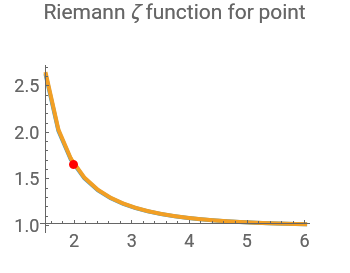
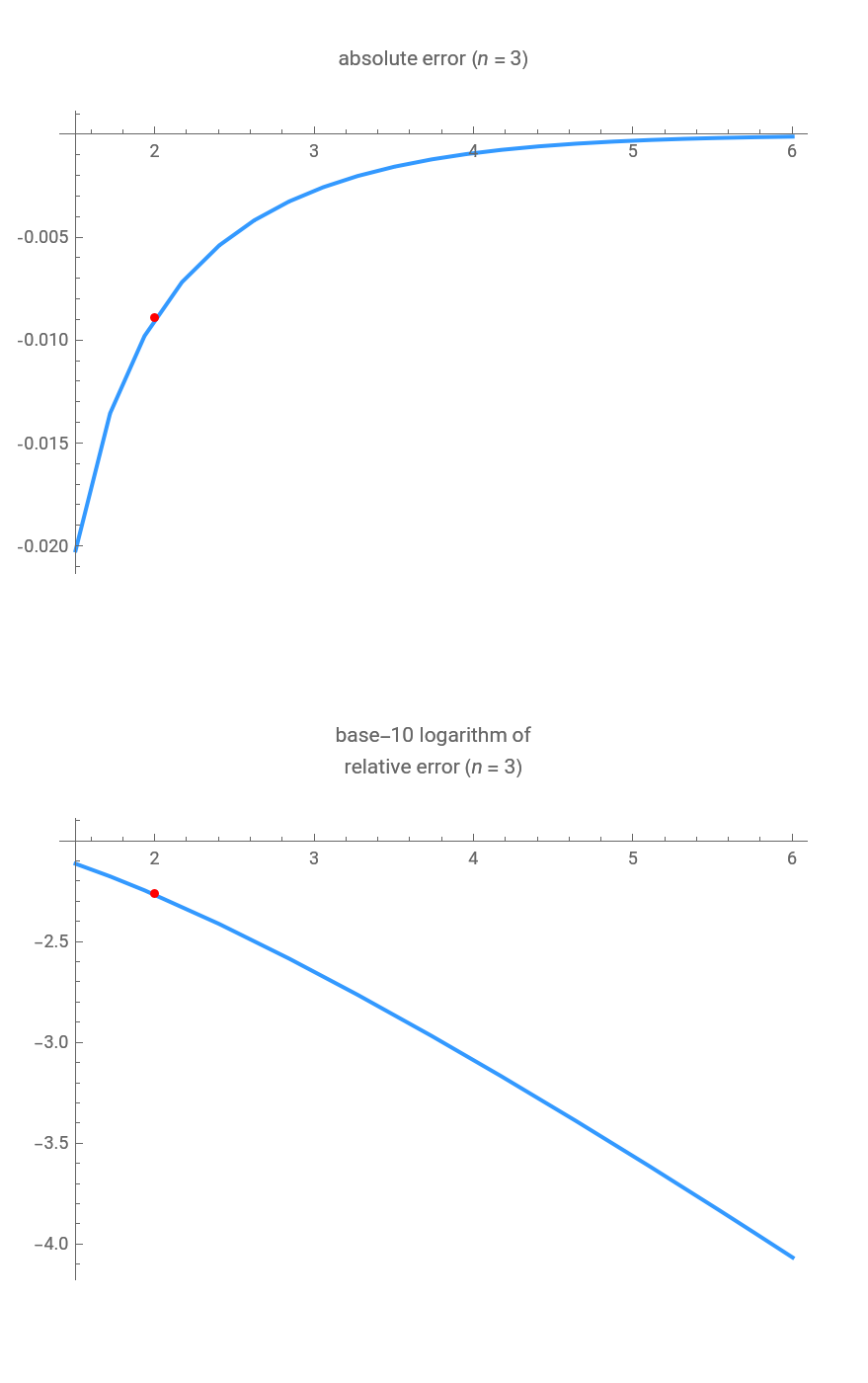
Continued fractions provide a very effective toolset for approximating functions. Usually the continued fraction expansion of a function approximates the function better than its Taylor or Fourier series. This Demonstration shows the high quality of a continued fraction expansion to approximate the Riemann ζ function.
The selected point (red), for which the continued fraction expansion is performed, must be between the two limits on the axis. The number of terms used in the continued fraction expansion is .
x
n
This continued fraction expansion is only correct for real numbers greater than 2; it cannot be used for general complex numbers.
The formula of the continued fraction expansion in this Demonstration is truncated when it would be too big to display.
Details
Details
This is a special case of a continued fraction expansion for the polylog function, as (1) is .
Li
n
ζ(n)
With the definitions
(r)
A
m
1≤i,j≤m
and
a
n,1
a
n,2m
(1)
A
m
(0)
A
m-1
(0)
A
m
(1)
A
m-1
a
n,2m+1
(1)
A
m-1
(0)
A
m+1
(0)
A
m
(1)
A
m
the continued fraction approximation for the polylog function can be written as
-(-z)=z
Li
n
∞
Κ
k=1
a
n,k
1
In particular, for ,
z=1
ζ(n)=
1
(1-)
1-n
2
∞
Κ
k=1
a
n,k
1
as well as
log2=
∞
Κ
k=1
a
1,k
1
External Links
External Links
Permanent Citation
Permanent Citation
Andreas Lauschke
"Approximating the Riemann Zeta Function with Continued Fractions"
http://demonstrations.wolfram.com/ApproximatingTheRiemannZetaFunctionWithContinuedFractions/
Wolfram Demonstrations Project
Published: March 7, 2011