This is part of live presentation series called Mathematical Games in which we explore a variety of games and puzzles using Wolfram Language. In this episode, we explore polygons and polynomials.
demonstrations.wolfram.com
demonstrations.wolfram.com
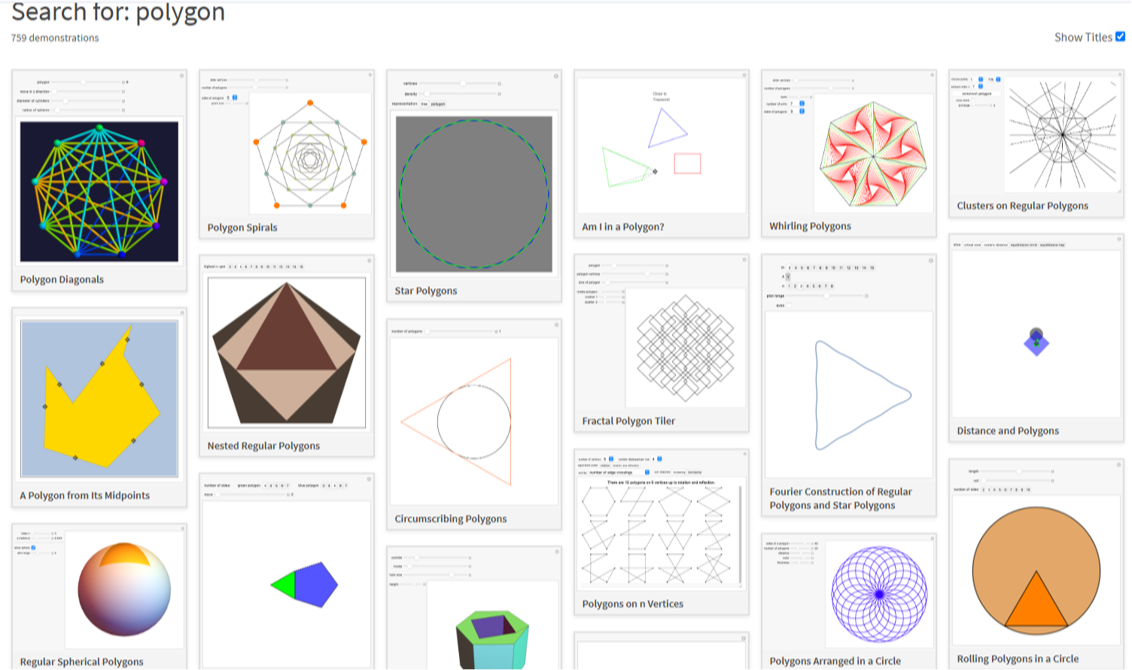
Many Demonstrations involve polygons...
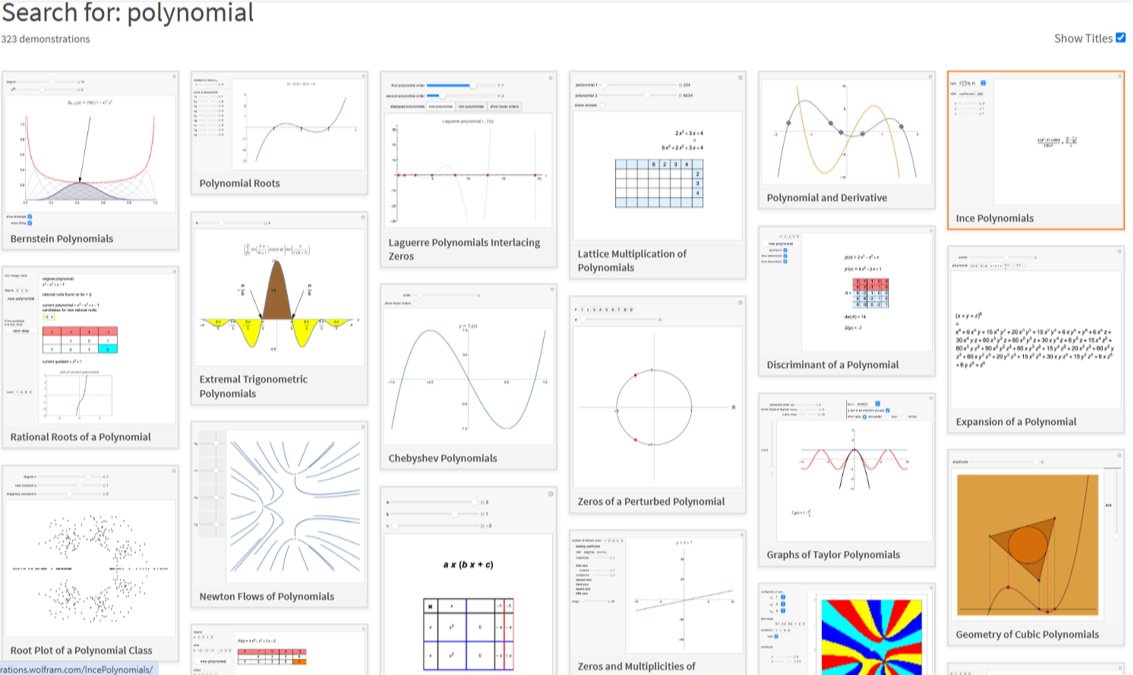
... or polynomials
The Second Book of Mathematical Puzzles and Diversions
The Second Book of Mathematical Puzzles and Diversions
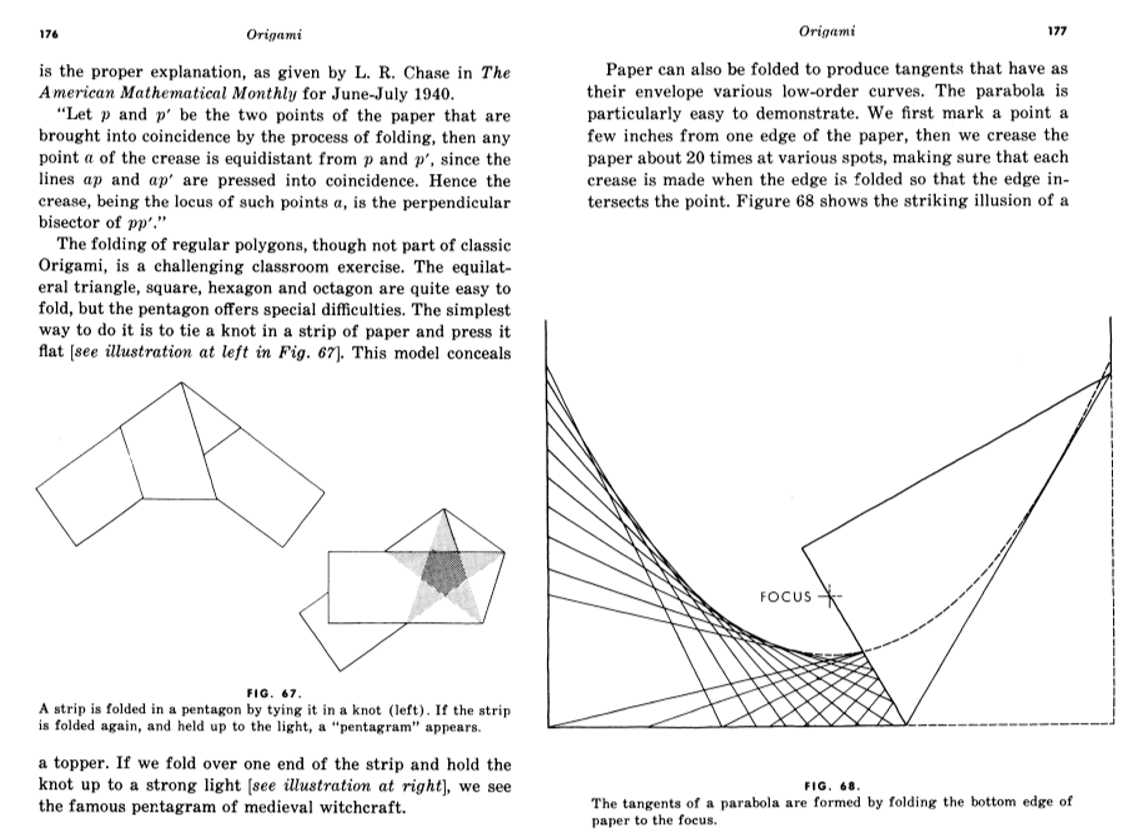
Gardner discussed polygons extensively. For example, you can fold a pentagon with a knot in a strip of paper.
Folding a Strip to Form Regular Odd n-Gons
Folding a Strip to Form Regular Odd n-Gons
By Izidor Hafner
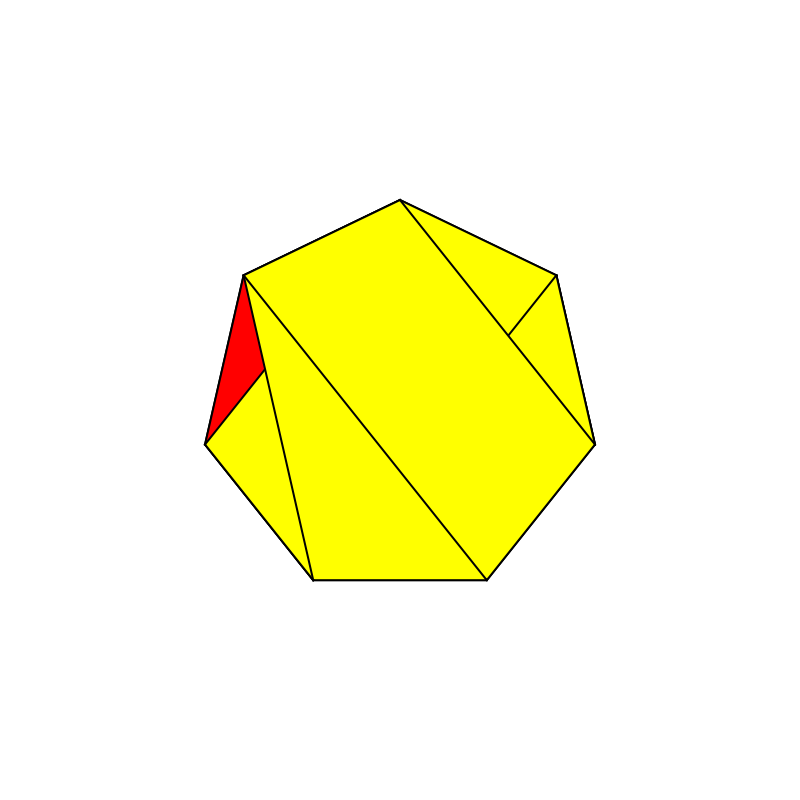
This Demonstration shows a method of folding a strip to form a heptagon. This folding method is valid for regular polygons with an odd number of sides; the strip is made of a sequence of the largest trapezium whose legs are the sides of the polygon. For other than a regular heptagon (), only the first two steps are shown.
n=7
Out[]=


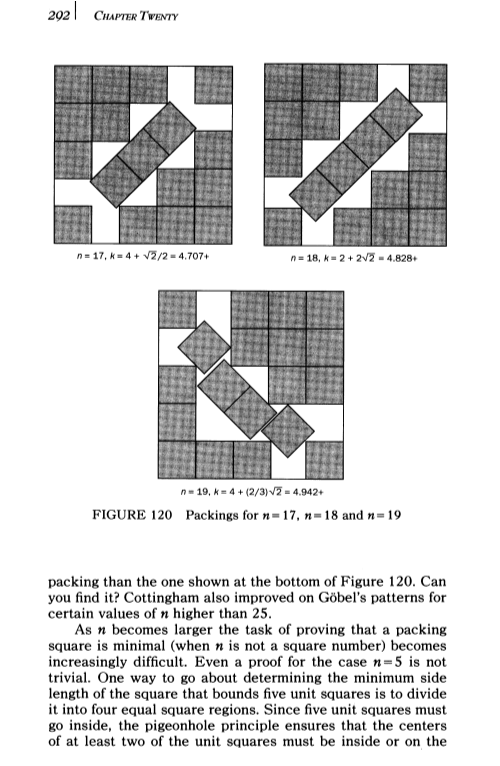
Packing one shape into another
Packing one shape into another
AlphaEvolve improves Hexagon packing
AlphaEvolve improves Hexagon packing
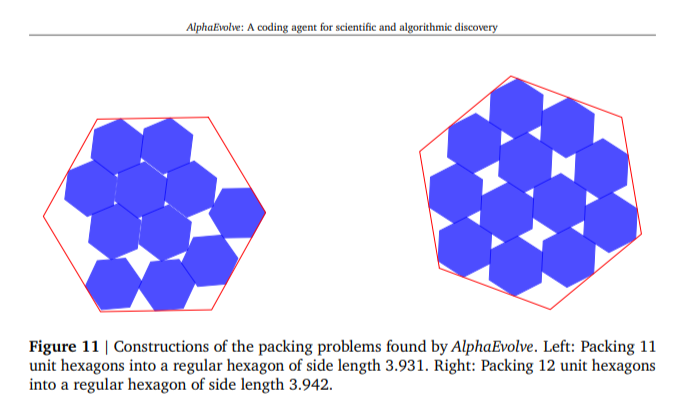
And here’s the diagram for it.
New Mathematical Diversions
New Mathematical Diversions
Gardner introduced me and many others to semi-regular tessellations:
Hinged Tessellations
Hinged Tessellations
by Borut Levart
Some tessellations you can open out and close up.
The Unexpected Hanging
The Unexpected Hanging
Episode 8: Polygon Dissections
Episode 8: Polygon Dissections
Sixth Book of Mathematical Diversions
Sixth Book of Mathematical Diversions
Braced Polygon
Braced Polygon
In the original column the square was braced:
The vertices all have constructable roots:
The pentagon is harder:
I had no idea that it would be me that solved bracing the heptagon.
Euclid’s Elements (c. 300 BCE)
Euclid’s Elements (c. 300 BCE)
Constructed regular polygons up to the 15-gon; foundational for classical geometry and early compass-straightedge constructions.
With a ruler and compass, an eye is easy to construct, leading to a regular pentagon construction. First draw a unit circle centered at O, the pupil. With centers at the top and bottom of the pupil, draw two circles of radius 2 to form the eyelids. Using the top of the pupil (A) as the center, draw an arc of radius 1 (AO) to intersect the upper eyelid at B. With C as the left corner of the eye, draw an arc with radius OC, and then a larger arc with radius BC. Draw a final arc with radius BC centered at O. Connect the intersection points for the pentagon.
Mathematical Circus
Mathematical Circus
Gardner looked at restricted constructions:
Monge also found a tetrahedron center.
Time Travel and Other Mathematical Bewilderments
Time Travel and Other Mathematical Bewilderments
The Grünbaum-Rigby Configuration
The Grünbaum-Rigby Configuration
Many years after the configuration was found, someone finally had the idea to add a point at the center.
A polynomial relating to heptagons
If the discriminant of a cubic is 49, it relates to heptagons
All the coordinates involve order 6 and order 3 polynomials
However, if you square everything, they are all in the space of the given polynomial
Hero of Alexandria (c. 100 CE)
Hero of Alexandria (c. 100 CE)
Explored angle trisection and early methods involving cubic equations, touching on limits of constructibility.
Unfortunately, ruler and compass cannot trisect an angle.
If we square the values, everything fits in the algebraic space:
You can also fold a nonagon, but I’ll get to that.
Euler’s Formula (1748)
Euler’s Formula (1748)
Gauss Constructs the 17-gon (1796)
Wantzel’s Theorem (1837)
Gauss Constructs the 17-gon (1796)
Wantzel’s Theorem (1837)
Wantzel’s Theorem (1837)
Gauss showed a regular 17-gon is constructible, linking geometry to number theory.
Wantzel proved that a regular polygon is constructible with compass and straightedge if and only if the number of sides is a product of a power of 2 and distinct Fermat primes.
Gauss also introduced cyclotomic polynomials, a key to understanding constructible polygons through roots of unity.
Pisot, Salem and Cyclotomic Polynomials
Pisot, Salem and Cyclotomic Polynomials
This Demonstration features polynomials of each type, for polynomials with a reasonable number of terms and the real root less than 2. The roots are shown along with the unit circle and a vertical line at 2. The polynomial is shown under the graphic along with a plot of the coefficients.
Chebyshev Polynomials (1850s)
Chebyshev Polynomials (1850s)
The Beloch Fold
The Beloch Fold
In origami, their are seven Huzita–Hatori axioms:
1. Fold through two points (line through two points).
2. Fold a point onto another point (perpendicular bisector).
3. Fold a line onto a line (angle bisector).
4. Fold through a point perpendicular to a line (line through a point perpendicular to a line).
5. Fold a point onto a line, passing the crease through another point (tangent to a parabola).
6. Fold a point onto a line and another point onto another line (common tangent to two parabolas).
7. Fold a point onto a line, making the crease perpendicular to another line (tangent to a parabola perpendicular to a line).
1. Fold through two points (line through two points).
2. Fold a point onto another point (perpendicular bisector).
3. Fold a line onto a line (angle bisector).
4. Fold through a point perpendicular to a line (line through a point perpendicular to a line).
5. Fold a point onto a line, passing the crease through another point (tangent to a parabola).
6. Fold a point onto a line and another point onto another line (common tangent to two parabolas).
7. Fold a point onto a line, making the crease perpendicular to another line (tangent to a parabola perpendicular to a line).
The sixth axiom was found in 1936 by Margherita Beloch. This fold is now named the Beloch fold, and can be used in origimi to solve various problems that cannot be solved with ruler and compass.
We can make a fold for a heptagon:
We can fold a nonagon:
We can fold the cube root of 2:
Regular Polygons of Edge Length Two
Regular Polygons of Edge Length Two
Annulus for a Regular Polygon
Annulus for a Regular Polygon
Polygon Triangulations and the Japanese Theorem
Polygon Triangulations and the Japanese Theorem
The Japanese theorem for cyclic polygons states that no matter how a cyclic convex polygon is triangulated, the sum of the inradii of the triangles remains constant. This Demonstration shows random triangulations of regular polygons inscribed in a unit circle and the sum of the inradii of the triangles.
There are 2 triangulations for a square, 5 for a pentagon, 14 for a hexagon, 42 for a heptagon, and 132 for an octagon.
The numbers 2, 5, 14, 42, 132,..., are the Catalan numbers.
The numbers 2, 5, 14, 42, 132,..., are the Catalan numbers.
Manipulate
Manipulate
Diagonals of a nonagon
Diagonals of a nonagon
Most intersections use an order 6 polynomial
Not all the points are at convenient angles:
With barycentrics, you can get down to cubics:
With Square Root space, Everything is expressible as rational numbers:
With this optimization, the graph distance matrix looks nice. The graph is locally
With just the edge list, the graph looks messy.
If we look at half of the graph, it has a nice structure that can be enhanced by polygons and polynomial roots. The other half of the graph looks identical. To see it, calculate 73-x for each vertex.
With a bit of work, both halves of the graph can be put together.
CITE THIS NOTEBOOK
CITE THIS NOTEBOOK
Mathematical Games: polygons and polynomials
by Ed Pegg
Wolfram Community, STAFF PICKS, May 22, 2025
https://community.wolfram.com/groups/-/m/t/3466084
by Ed Pegg
Wolfram Community, STAFF PICKS, May 22, 2025
https://community.wolfram.com/groups/-/m/t/3466084