Has the idea of “Planet 9” been ruled out? What does “Planet 9” refer to? To try to answer these questions requires us to step back and get a better understanding of the outer solar system beyond Neptune. Within our solar system, most people know about the planets, asteroids, comets and moons found throughout. The asteroids are commonly thought of as being between the orbits of Mars and Jupiter. But the true picture isn’t so simple. Yes, the main asteroid belt and its sub-parts are found mostly between the orbits of Mars and Jupiter, but there is a less commonly recognized group of minor planets beyond Neptune. Once again, the naive astronomer thinks of the Kuiper Belt, a more distant sibling of the asteroid belt between Mars and Jupiter. And, once again, this picture isn’t so simple. The Kuiper Belt is found from the orbit of Neptune at about 30 astronomical units (AU) from the Sun and going out to about 50 AU from the Sun, making it larger volumetrically compared to the main asteroid belt and, in fact, its likely far more massive. The inner main asteroid belt is mostly composed of rocky materials while the outer bodies beyond Neptune are more icy. Beyond Neptune, bodies can be divided into one or more groups of objects including the Kuiper Belt, the Scattered Disk, Detached Objects, and Sednoids. All are grouped within the Trans-Neptunian Objects, or TNOs. A new study has identified a potential candidate for Planet 9 at a distance of 500 to 700 AU from the Sun, though its full orbit remains undetermined. https://doi.org/10.1017/pasa.2025.10024
Kuiper Belt
Kuiper Belt
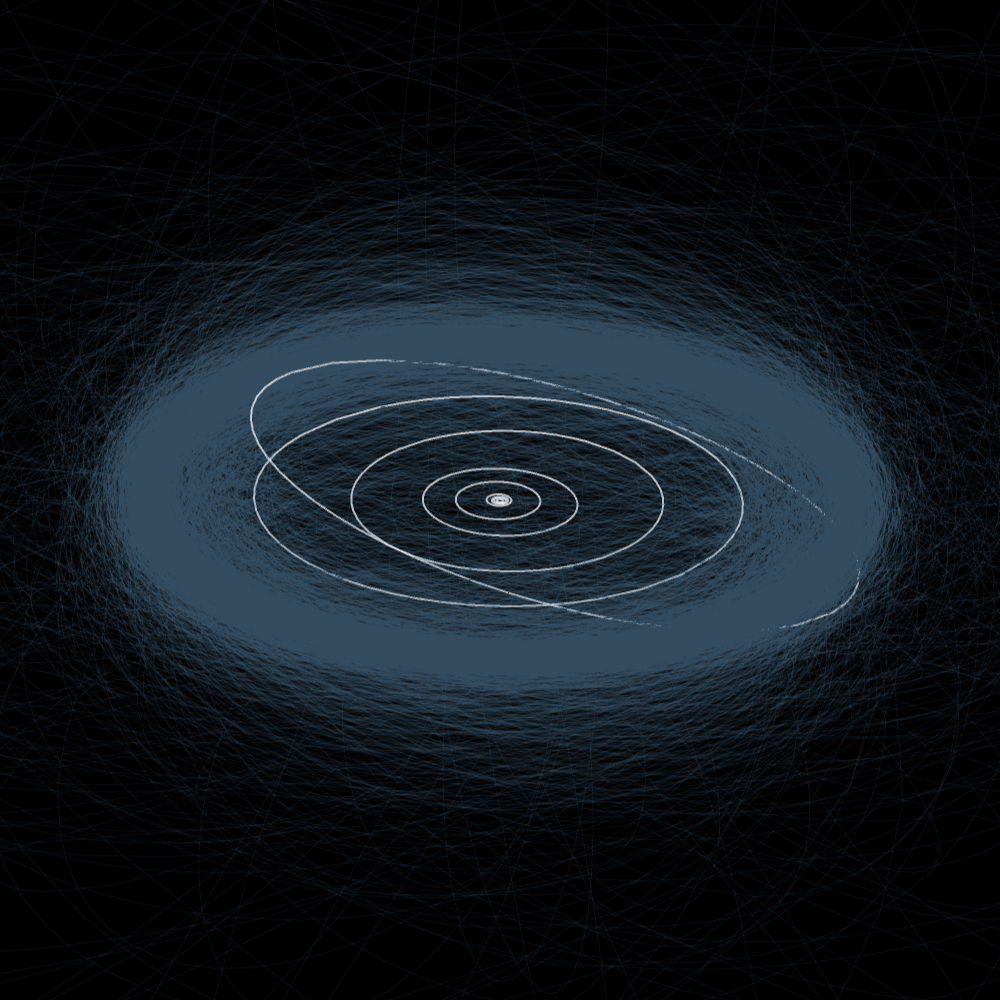
The greatest density of TNOs is in the Kuiper Belt, just beyond the orbit of Neptune. Even plotting all of the TNOs shows the great density of orbits just beyond Neptune, but its not a hard cutoff.
Graphics3DGrayLevel[1,.75],Thickness[.002],["OrbitPath"],["OrbitPath"],Opacity[.1],Hue[.58,.5,.7],["OrbitPath"],

Out[]=
Scattered Disk
Scattered Disk
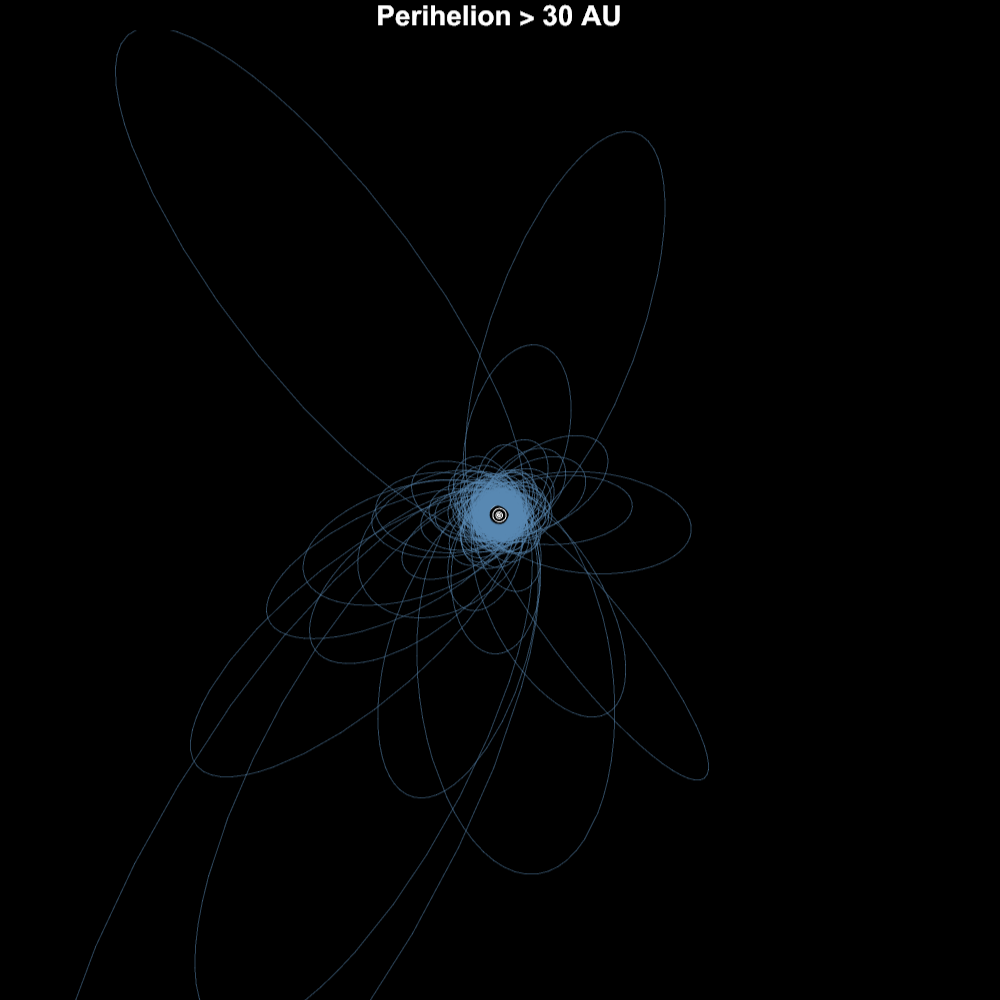
The scattered disk is a subset of the TNOs that have perihelion distances (closest distance to the Sun) above 30 AU and their orbits can extend far beyond Neptune, possibly far beyond 100 AU.
scattereddisk=EntityClass"MinorPlanet",GreaterThan;
In[]:=
scattereddiskorbits=scattereddisk[{"OrbitPath","Name"}];
The planets are shown in white near the center for scale.
Graphics3DWhite,["OrbitPath"],Opacity[.5],Hue[.58,.5,.7],Tooltip[#[[1]],#[[2]]]&/@scattereddiskorbits,
Out[]=
Detached Objects
Detached Objects
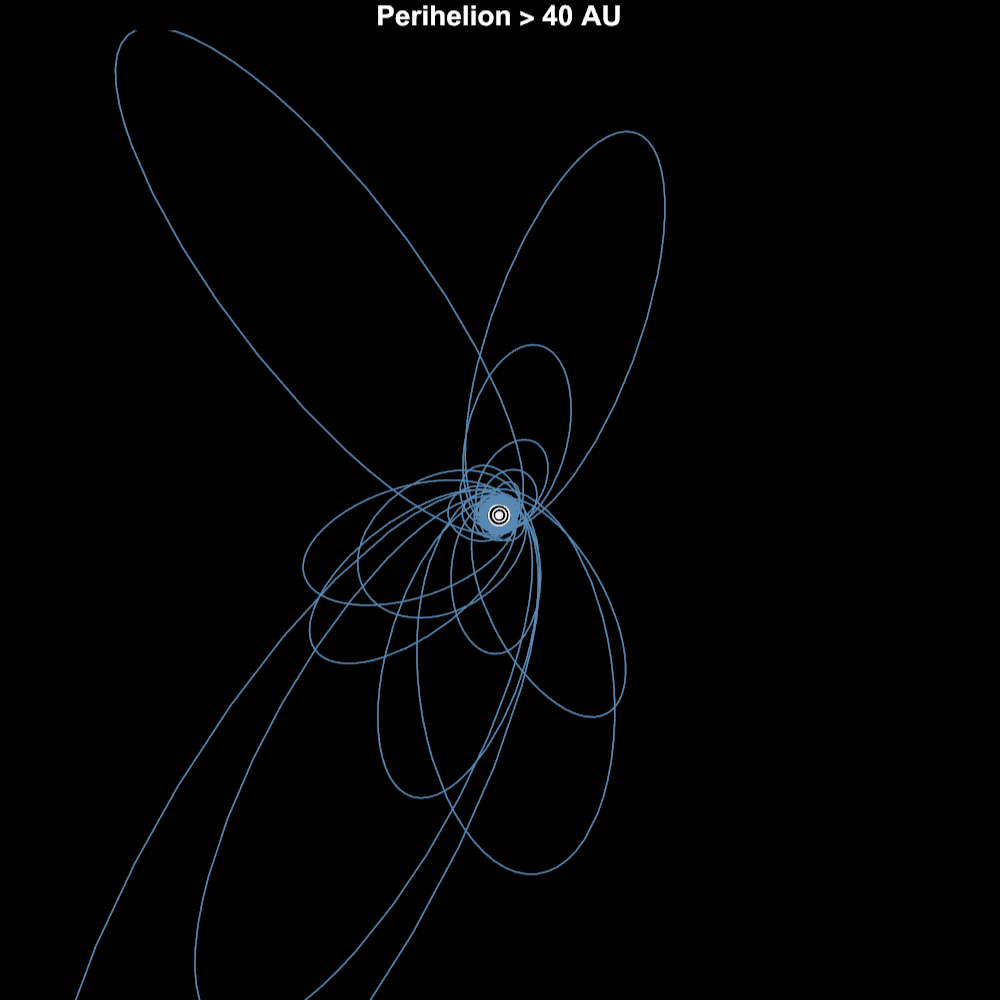
Detached objects are a subset of objects in the scattered disk, but the distinction is not well defined. Generally detached objects include all minor planets with a periapsis greater than 40 Astronomical Units (AUs). This places them well beyond the major gravitational effects of Neptune and the other planets. They tend to have highly eccentric orbits.
detatchedobjects=EntityClass"MinorPlanet",GreaterThan;
In[]:=
detatchedobjectsorbits=detatchedobjects[{"OrbitPath","Name"}];
The planets are shows in blue near the center for scale.
Graphics3DWhite,["OrbitPath"],Hue[.58,.5,.7],Tooltip[#[[1]],#[[2]]]&/@detatchedobjectsorbits,
Out[]=
Sednoids
Sednoids
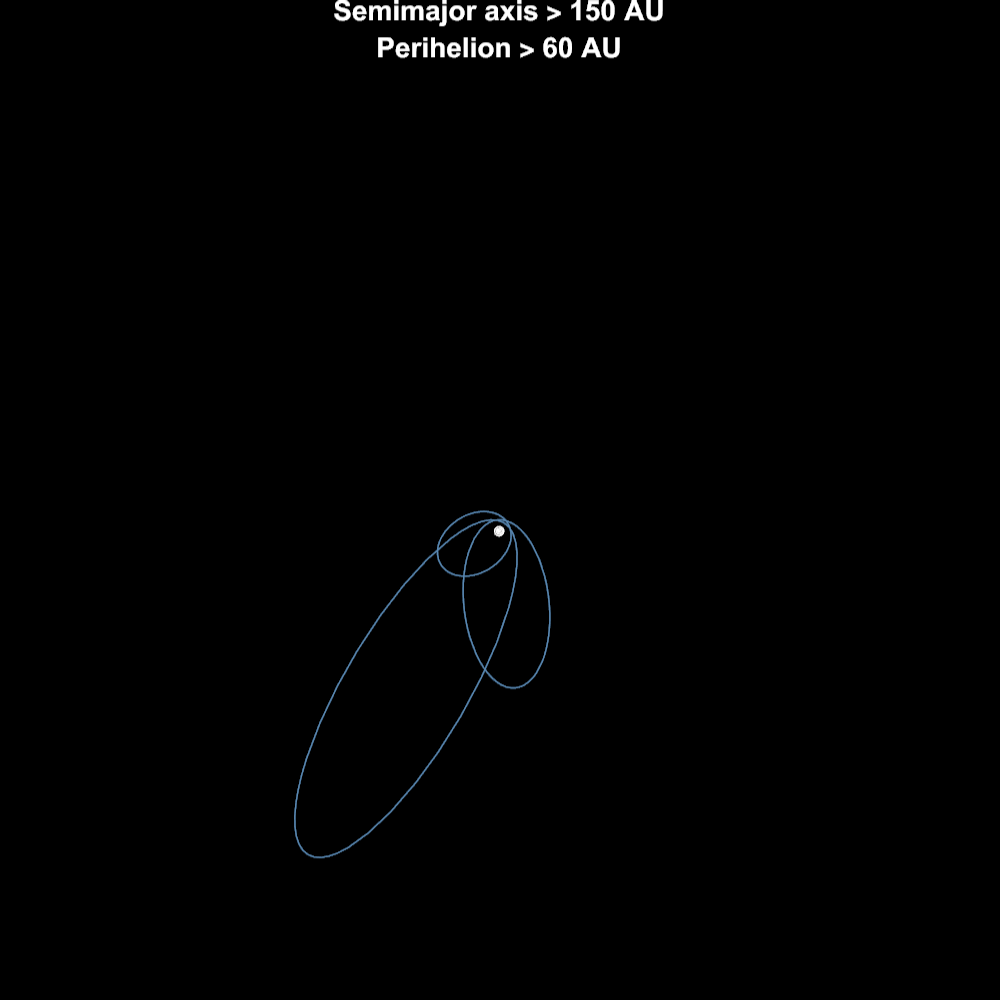
Sednoids have perihelia even further beyond Neptune, beyond 60 AU (though not well defined), but also have semimajor axes greater than 150 AU so they have very eccentric orbits.
sednoids=EntityClass"MinorPlanet",GreaterThan,GreaterThan;
In[]:=
sednoidorbits=sednoids[{"OrbitPath","Name"}];
The planets are shows in white near the center for scale.
Graphics3DWhite,["OrbitPath"],Hue[.58,.5,.7],Tooltip[#[[1]],#[[2]]]&/@sednoidorbits,
Out[]=
Hints of “Planet 9”
Hints of “Planet 9”
When examining the orbits of the most extremely distant minor planets, an apparent bias was observed. At least until the recent discovery of 2017 OF201. Before talking about this newly discovered minor planet in more detail, lets take a step back and look at the known objects before the new discovery.
Here is the newly discovered minor planet (we’ll revisit it later):
To examine things before its discovery, we can remove it from the list of available objects:
Until recently, once you restrict the perihelion distance to only those beyond about 44 AU the remaining objects appear to have orbits that are constrained in a particular region. The planets are shows in white near the center for scale and are barely visible when extending the range to 1750 AU.
In the above view, these objects all appear to orbit in a particular direction. This type of bias was odd and one theory is that this is due to the objects being perturbed by an unknown massive object in the outer solar system, “Planet 9”. Many models and searches are being explored looking for where such a distance world might be. This far out, even a large object would reflect very little light and would move incredibly slow. Only the most sensitive infrared detector stood a realistic chance, but the search area was enormous.
Now returning to 2017 OF201, we include it in the scene and see how things look, starting with a zoomed-in view.
Zooming out slowly gives an even better sense of scale.
Your average person thinks of Pluto as being on the fringes of the solar system. The following graphic provides some additional context. The planets are shown in white, Pluto is shown in yellow, Sedna another extreme object previously discovered is in light blue, and 2017 OF201 is shown in red. At this scale, Pluto and the solar system planets are hard to differentiate.
Zooming in a bit we can see that, at its closest, 2017 OF201 comes into the solar system at about Pluto’s orbit. But Sedna never gets that close.
This prevents 2017 OF201 from being considered a Sednoid since Sednoids have a periapsis that is 60 AU or greater.
2017 OF201 comes a close as 50AU (so not a Sednoid), but has an apoapsis much further than Sedna.
Zooming out of the graphic showing all objects, with the orbit of 2017 OF201 included, the strong bias in orbital directions appears much reduced (though not absent). In the following view, there are still no known objects orbiting “to the right”.
Any massive “Planet 9” would likely perturb these objects, but with there now being closer to a uniform distribution of orbits, the case for a “Planet 9” is greatly reduced.
Though on the other end of the “Planet 9” debate, a team of researchers went looking for objects lying between 500 and 700 AU from the Sun, with a mass between 7 and 17 Earth masses. Any such object would move very slow and would be very faint. They searched through older IRAS data and compared that to newer AKARI data (23 years apart) and looked for objects that moved between 42 and 69.6 arcseconds, the range expected for an object at that distance, between data sets. They only found one potential object.
But, this object only has 2 data points which is not enough to extrapolate an orbit so followup observations are required to say more about this object.
Exploring the Kuiper Belt
Exploring the Kuiper Belt
Members of the Classical Kuiper Belt (KBO) all have orbital periods larger than Neptune’s.
In general, KBOs are free from significant resonance effects with Neptune, but there are exceptions represented by a few families that have orbital resonances with Neptune. This mean the ratio of the orbital period of the KBO and the Neptune is some small integer fraction. Many of these are not well defined and subject to ambiguity.
Plutinos have a 2:3 orbital resonance with Neptune (orbit period is about 3/2 times Neptune), like Pluto does.
Twotinos have a 1:2 orbital resonance with Neptune (orbit period is about 2 times Neptune).
Cubewanos are named after 1992 QB1 (i.e. “QB1-os”), whose full modern name is 15760 Albion (1992 QB1). These are bounded by the Plutinos and the Twotinos and generally includes all KBOs that don’t have a strong resonance with Neptune.
Plotting pairs of orbital parameters can reveal families of objects. Groups of objects tend to cluster together and indicate circumstances such as orbital resonances with Neptune. In the following plot, eccentricity vs . perihelion distance is represented.
The variation in orbital inclination vs orbital semimajor axis can also be explored similarly.
CITE THIS NOTEBOOK
CITE THIS NOTEBOOK
Is Planet-9 still viable? A new trans-Neptunian object challenges the orbital bias behind the theory
by Jeffrey Bryant
Wolfram Community, STAFF PICKS, June 4, 2025
https://community.wolfram.com/groups/-/m/t/3474157
by Jeffrey Bryant
Wolfram Community, STAFF PICKS, June 4, 2025
https://community.wolfram.com/groups/-/m/t/3474157