Update: On SEP 9, 2025 for just the second time, the NYT Spelling Bee editor included an “S” among the 7 Spelling Bee letters.
Update: On SEP 9, 2025 for just the second time, the NYT Spelling Bee editor included an “S” among the 7 Spelling Bee letters.
Why did the NYT editors decide to omit S from Spelling Bee puzzles? Did they look at any data? Or did they just go by instinct?
They might have considered a basic high-school math counting principle tells us that including S increases the possible combinations of 7 letters from 480,700 (25 choose 7) to 657,800 (26 choose 7) -- an increase of 37%. But how many of those combinations are valid puzzlecombos (i.e., 7 letter combinations that yield a pangram)?
I used Mathematica to dig into the problem and determine the actual effects of including S in Spelling Bee. As it turns out, the number of puzzlecombos jumps from 4802 (with no S) to 9482, an increase of 97%. So adding S to the mix has an outsized effect on increasing the number of available puzzlecombos. This makes intuitive sense when you consider how many words contain S.
Effect of S on the Spelling Bee puzzle universe
Effect of S on the Spelling Bee puzzle universe
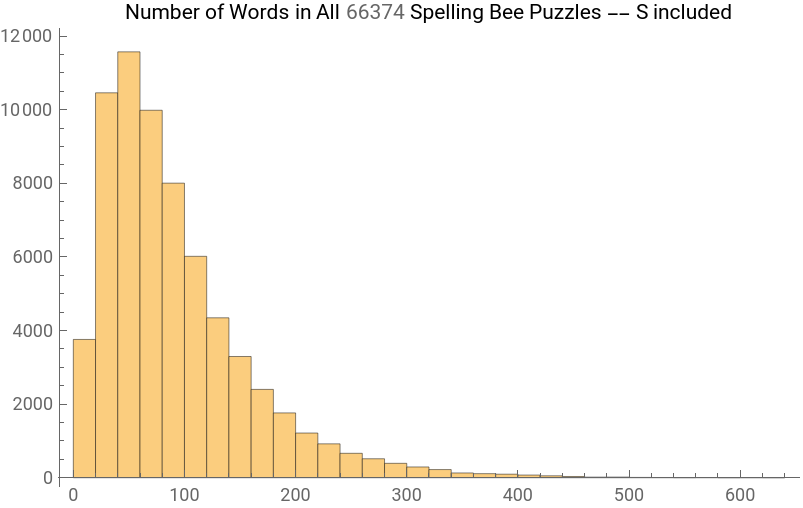
I asked Mathematica to solve all 66,374 puzzles (i.e., 7 x 9482) that are possible when including S. (I set it to work before I went to bed, and while I slept, it solved all those puzzles!) The histogram below shows the results. As I expected, the shape of the histogram is the same as the one with S omitted, but it’s scaled up: the bars are higher, the tail is longer (one of the puzzles has 630 possible words!).
Out[]=
A reminder from my previous blog that NYT has not (to date) published any puzzles with fewer than 21 words or more than 81 words. If we apply these two bounds to the data above, we get the histogram below.
Out[]=
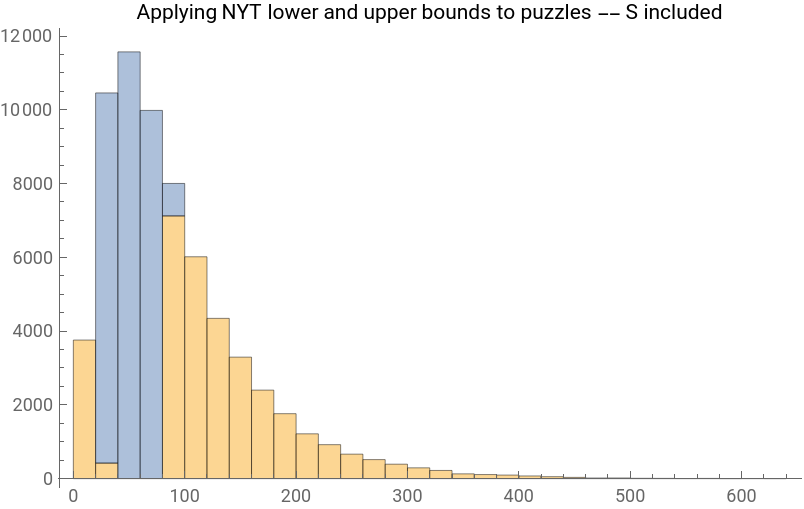


Applying these bounds causes more than half of the possible puzzles to be omitted! The upper bound, in particular, takes a big bite out of the available puzzles (29,727 to be exact, vs. only 4179 for the lower bound).
Below is the same histogram for puzzles that do NOT include S. The blue bars -- which represent the “within bounds” puzzles -- total 20,819. The corresponding blue bars above total 32,468. Including S yields 56% more possible puzzles even after applying the upper and lower bounds. So the NYT could introduce more variety into the puzzles by including S and just enforcing their lower and upper bounds.
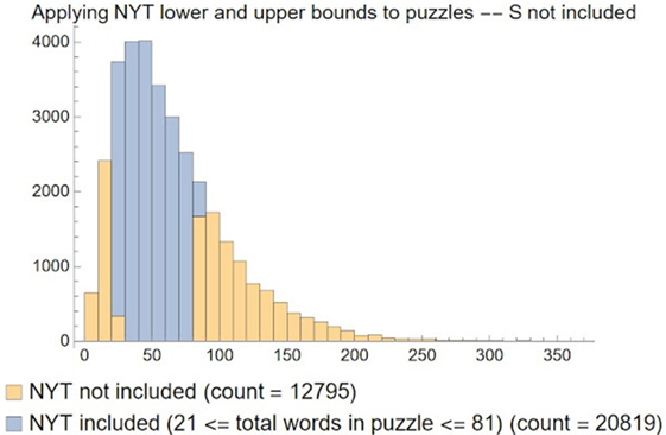
One guess at how the NYT arrived at their current situation is this: First, they decided to omit S from the puzzles, thinking “this will take care of the ‘too many words in a puzzle’ problem.” Then someone discovered that even with omitting S, some puzzles still fell into the “too many words” trap. So they started enforcing a de facto upper bound. It was too late for them at that point to just say, “let’s include S and just take care of the ‘too many words’ issue through an upper bound.”
But all those damn plurals
But all those damn plurals
An alternative narrative to the one I pose above is that removing S from the game is worthwhile because puzzle doers will find the process of adding S to so many words just plain tedious. “Plurals are boring, so let’s get rid of them.” Okay, maybe there’s a point to be made there. So what if we replaced the rule “No words contain S” with “No words end with S”? How would that affect things?
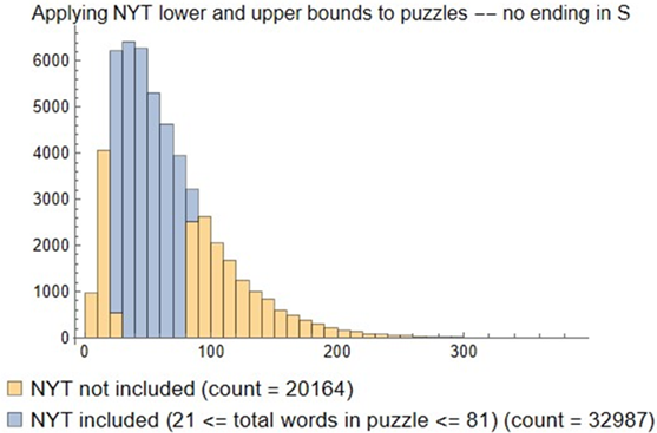
As it turns out, when you apply the rule “no words end with S,” the resulting data is remarkably similar to the data for “no words containing S.” In both cases, 38% of the puzzles are “within NYT bounds.” Compare the graph below with the one immediately above. They look almost identical except for the scale of the vertical axis. The big advantage of the rule “no words end with S” over the current “no words contain S” is that it yields 58% more possibilities for valid puzzles.
Hey, NYT Puzzle Editors!
Hey, NYT Puzzle Editors!
Here’s my recommendation to the NYT puzzle editors: Change your rule “no words containing S” to “no words ending in S.” Doing so would open the game up to a greater variety of puzzles (welcome to the game, S!), and would maintain the same sweet spot of “interesting without being too challenging or tedious” that they’ve built a reputation for.
Back to unicorns and other extremes
Back to unicorns and other extremes
In my previous blog, I introduced the notion of a unicorn -- i.e., puzzles with only 1 solution (the pangram). Adding S to the mix actually gives us 3 more unicorns! So here they are -- all the pangrams from unicorn puzzles:
◼
amphibian
◼
foxhound
◼
jukebox
◼
pharynx
◼
sixfold
◼
smallpox
◼
snuffbox
◼
viburnum
I think it’s cool that there are only 9 words in the English language that have this property.
And what about the opposite of a unicorn? That would be this particular puzzle: adeirst (the underscored letter is the middle letter). It has a whopping 630 solution words. Some day if the NYT is feeling really cheeky, they might publish this one . . . maybe just for an hour on April Fools Day to drive the famous Steve G from Sound Beach, NY into fits. (Steve G publishes hints for all solution words every day in the comments section of Spelling Bee.)
The “stingiest” puzzlecombo is bejkoux, which has only 28 solution words in all 7 of its puzzles. At the other extreme is aeiprst, which has 3544 solution words in all 7 of its puzzles and features all of the following pangrams:
asperities, aspirate, aspirates, parasite, parasites, parities, parties, pastier, pastries, patisserie, patisseries, piaster, piasters, pirates, raspiest, repatriates, separatist, separatists, striptease, stripteaser, stripteasers, stripteases, tapestries, traipse, traipses
I hope my explorations have been interesting. I welcome your feedback and ideas for future exploration!
Supporting Wolfram calculations
Supporting Wolfram calculations
The code highlighted in pink is necessary to get results. The rest is just there to help understand more about what’s going on.
We start by coming up with a list of all possible pangram words, which have 7 distinct characters. We include the letter “S” among possible letters, unlike what is normally done in Spelling Bee.
In[]:=
wordlist=DictionaryLookup[];
shorterdictionary=Select[wordlist,SubsetQ[Alphabet[],Characters[#]]&&(*allcharactersinlowercase*)
StringLength[#]>6&&(*wordswith7ormoreletters*)
Length[Union[Characters[#]]]==7&];(*wordswith7distinctcharacters*)
For each pangram word, we list the “puzzlecombo” that generated it. A puzzlecombo is a string of 7 distinct characters. Here each puzzlecombo is given alphabetically.
In[]:=
pairs={StringJoin[Sort[Union[Characters[#]]]],#}&/@shorterdictionary
Out[]=
For each puzzlecombo, create a list of all possible pangram words that can be made from it.
In[]:=
sortedpairs=GatherBy[pairs,First]
Out[]=
In[]:=
possibleSB={#[[1,1]],#[[All,2]]}&/@sortedpairs
Out[]=
The result is a list of all possible Spelling Bee puzzles that can be made.
In[]:=
nopossible=Length[possibleSB](*notnecessaryforthecodetorun;calculatedforcuriositysake*)
Out[]=
9482
Now we turn to solving all of those possible Spelling Bee puzzles.
In[]:=
vettedwordlist=Select[DictionaryLookup[],(*startbywinnowingdownthedictionaryabit*)
StringLength[#]>3&&(*4ormorecharacters*)
SubsetQ[Alphabet[],Characters[#]]&];(*charactersinthelowercasealphabet*)
This code solves all possible Spelling Bee puzzles and produces an organized list of results.
Analyzing number of solutions to all possible puzzles
Analyzing number of solutions to all possible puzzles
Now we turn to looking at the raw numbers of solutions to all the possible puzzles.
NYT lower and upper bounds on number of words, by PUZZLE
NYT lower and upper bounds on number of words, by PUZZLE
Now we apply the upper bound (less than or equal to 81) and lower bound (greater than or equal to 21) to the number of solutions found.
NYT bounds by PUZZLECOMBO
NYT bounds by PUZZLECOMBO
Digging into the results above to find interesting statistics for the blog:
The results: There are far more puzzlecombos that are omitted because of the upper bound (17.2%) than the lower bound (0.7%).
Finding special puzzlecombos and puzzles
Finding special puzzlecombos and puzzles
Dig into the extreme cases -- lowest and highest number of words that can be made.
Below are some additional results that didn’t “make the cut” for including in the blog, but which I found interesting nonetheless.
CITE THIS NOTEBOOK
CITE THIS NOTEBOOK
Only 2nd time in 11 years debated S enters NY times spelling bee—data spells the verdict
by Jeff Weidenaar
Wolfram Community, STAFF PICKS, September 5, 2025
https://community.wolfram.com/groups/-/m/t/3541055
by Jeff Weidenaar
Wolfram Community, STAFF PICKS, September 5, 2025
https://community.wolfram.com/groups/-/m/t/3541055