one who sets out to write a universal grammar would do well in going from the essence of languages to their existence, comparing the grammars of several languages (...), looking for parallels (...), as that would give the occasion to the author to notice many considerations, which otherwise would scape them.
G.W. Leibniz, 1704 (my translation)
Introduction
Introduction
Linguistic Typology is the branch on linguistics that deals with the comparison of human natural languages, studying them according to their features.
One of the main driving forces of typology is the search for Language Universals, which are statements that attempt to predict what features a language will have, for example:
◼
All languages have nouns and verbs
Some known Language Universals were first proposed by the US-American linguist Joseph Greenberg (based on 30 languages!). Though many of them have been disproven, the race to collect more data on language structures has shown that Language Universals provide a window into the tendencies of the human language potential.
In this work, I am interested in Universals that are formulated based in terms of features a language is already known to have, for example:
◼
Languages with nasal vowels have the corresponding non-nasal vowels.
To do this, I ran a Bayesian analysis on data from World Atlas of Language Structures. This resulted in hundreds of candidates for language universals. After having done some cleaning, I will present those results that are known, interesting, or just bizarre.
Data source
Data source
The World Atlas of Language Structures is a valuable resource that aims to register structural properties of human languages. It accomplishes this by revising thousands of reference grammars and filling the WALS database, allowing for computational analysis.
For example, by considering languages by their place of origin, one can look at the world distribution the languages registered by WALS
Import["https://wals.info/feature/81A.flat.geojson","GeoJSON"]
Out[]=
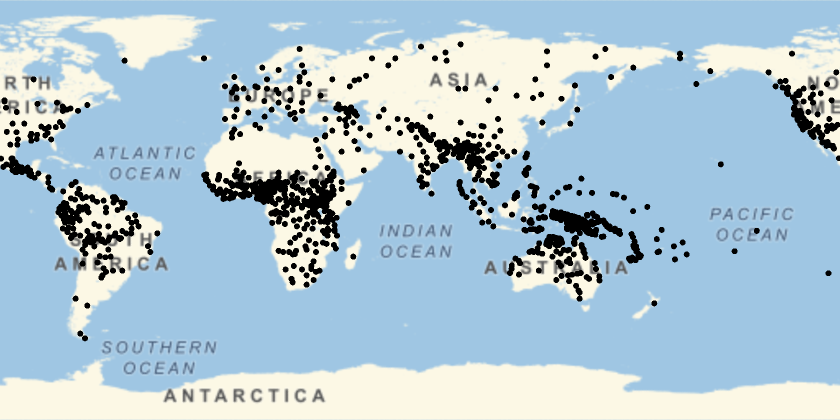
The data from WALS is under a Creative Commons License, so we’re safe to import and process it.
As of April 20201, WALS has 2660 languages registered, and lists up to 192 features
Caveats
Caveats
◼
The data included in WALS corresponds to dominant features of languages, that is, those features that are widely attested. Thus, languages could have secondary, vestigial, or non dominant features not listed by WALS.
◼
For example, a sentence like “A computational essay is what I am writing”, which has an Object + Subject + Verb order, is perfectly acceptable in English, yet one is far more likely to find sentences in English with Subject + Verb + Object order, like “I am writing a computational essay”, and that dominant order would be registered by WALS.
◼
WALS does not include data on dead languages, even well documented ones like Latin or Ancient Hebrew.
◼
Most languages do not have their 192 features filled, nor are even close.
◼
The mean is 28 features, with a standard deviation of 32, that is, the data is somewhat sparse.
◼
Some features are over represented because different recent dialects of a language are listed as different languages in WALS, for example, there are 17 registered dialects of German in WALS, apart from standard German.
Preliminaries
Preliminaries
This Bayesian analysis consists of generating all possible conditioning features, and for each one, analyze whether or not a majority of languages satisfying them also satisfy another target feature.
For this work, I have generated all possible conditionings by one or two features.
For example, the following conditioning tuple:
<|"Conditions""85A"2,"82A"1,"Target""87A"|>
means to search all those languages whose feature 85A has the second value AND feature 82A has the first value, and among them look for the distribution of the values of feature 87A
With 192 features, the number of possible tuples of two or three features is:
Permutations[Range[192],{2,3}]//Length
Out[]=
7004352
From these tuples, the last will be the target features, and the others the conditioning tuple.
Because of this huge number of tuples, I have restricted the search to two conditions:
◼
Only consider those conditioning tuples and target features such that at least 100 languages have data on all those features.
◼
Only consider those tuples and targets such that at least 90% of languages satisfying the conditions cluster around one of the values of the target feature.
Results
Results
Exploring all the possible conditioning tuples took my computer around twelve hours, and gave me results in need of cleaning.
rawResults//Length
Out[]=
2267
Sample raw results:
makeSummaryAssoc/@RandomChoice[rawResults,2]//Dataset
Out[]=
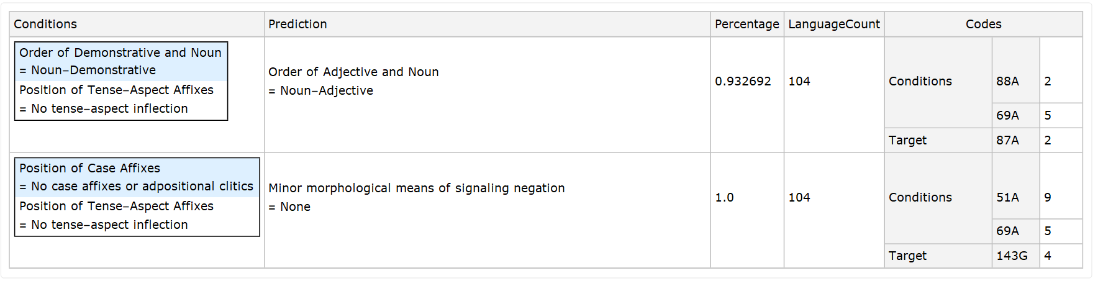
(Just below is the explanation on how to read these tables.)
The trivial results
The trivial results
Some results were trivially true, because either
◼
Most languages already satisfy one value of the target feature.
This is similar to the case in Logic where “If p then q” is true just because q is a tautology.
This is similar to the case in Logic where “If p then q” is true just because q is a tautology.
For example, most languages (~80%) have the Subject come before the Verb, and so, many candidates with that target feature have to be discarded:
makeSummaryAssoc/@trivialResults[[1;;-3]]//Dataset
Out[]=
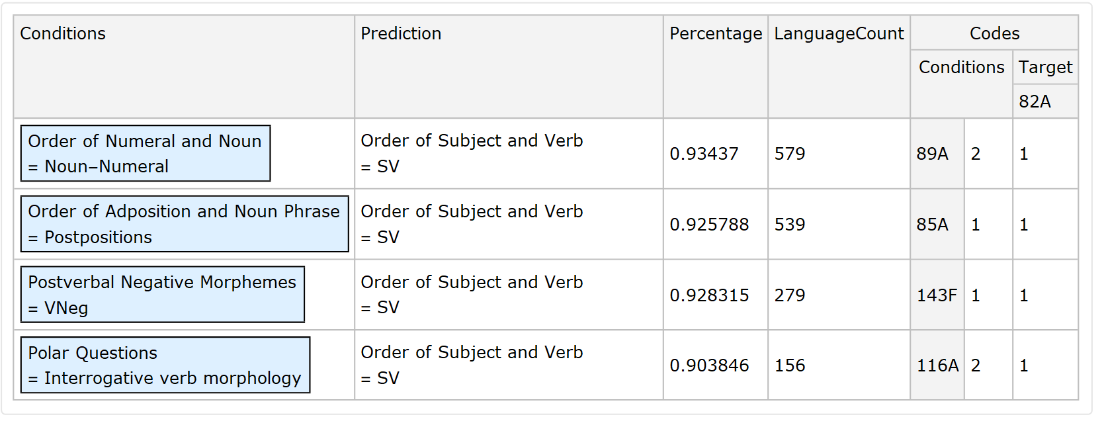
Entries in this table should be read as
makeSummaryLine@First@trivialResults
Out[]=
IF Order of Numeral and Noun = Noun-Numeral THEN Order of Subject and Verb = SV FOR 93.44% of 579 languages
◼
The conditioning features logically imply the target feature.
For example: if Subject comes before Verb, and Verb before Object, then the relative order is first Subject, then Verb, then Object.
makeSummaryAssoc/@{Last@trivialResults}//Dataset
Out[]=
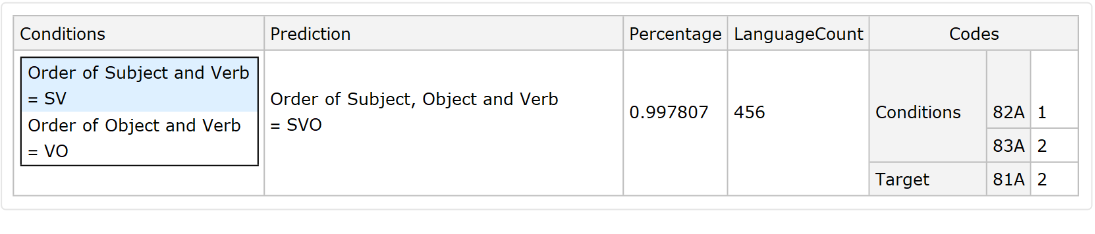
makeSummaryLine@Last@trivialResults
Out[]=
IF Order of Subject and Verb = SV AND Order of Object and Verb = VO THEN Order of Subject, Object and Verb = SVO FOR 99.78% of 456 languages
The trivial results are uninteresting, and thus are filtered out.
The known results
The known results
Some of the candidates found by the analysis are well-known in the literature. In science, replication is a good signal!
makeSummaryAssoc/@knownResults//Dataset
Out[]=
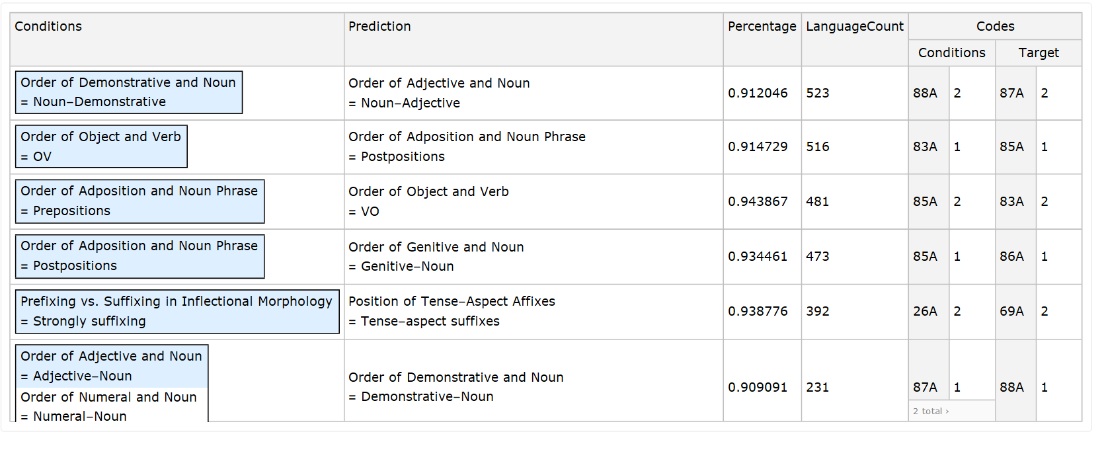
Analyses:
Analyses:
◼
Most languages with nouns coming before demonstratives (“that”, “this”, “those ones”) , also have the noun come before the adjective.
◼
This may show that speakers in those languages prefer first knowing the noun in question and then knowing how it is being modified.
◼
Most languages with Adjective + Noun ordering AND Numeral + Noun ordering, have Demonstrative + Noun ordering.
◼
Thus it seems that the converse of the previous language universal is not immediately true.
◼
Languages where inflection takes place generally by suffixing, will also use suffixing for verbal tense/aspect conjugation.
◼
This is as expected, considering conjugation is a type of inflection.
◼
The following have analyses outside the scope of this work, but have been already treated by Greenberg:
◼
Use of Prepositions implies Verb + Object ordering
◼
Object + Verb ordering implies use of Postpositions.
◼
Use of Postpositions implies that genitives come before nouns.
◼
English is an example of a language where genitives can come before nouns (“my friend’s laptop”) but does not use postpositions.
A nice characteristic of language universals is that they can be “composed”, for example:
Since Object + Verb ordering implies use of Postpositions and that implies that genitives come before nouns, we conclude that
◼
Object + Verb ordering implies that genitives come before nouns.
The interesting results
The interesting results
I found these candidates interesting, and could not readily find literature that includes them
Analyses:
Analyses:
◼
Object + Verb order implies Subject + Object + Verb order.
◼
I found this surprising because the implication is that the other logical possibility, Object + Verb + Subject, is not preferred.
◼
If a languages signals negation using affixes, then suffixes are preferred.
◼
In general, an affix is an additional element attached to a root, at the beginning (prefix), end (suffix), phonologically (tone), etc.
◼
Use of Prepositions AND Subject + Verb order implies Subject + Verb + Object order
◼
This is a consequence of “Preposition implies Verb + Object”
◼
Relative clause + Noun order implies Subject + Object + Verb order
◼
relative clauses (in English) are sentence of the form: “the fish, which is blue, swims happily”
◼
This universal has a very low language count (120), so it should be taken with a grain of salt
◼
If negation comes after the verb, then verbal tense and/or aspect are signaled by suffixes
◼
Apparently languages that have the negation after the verb will put most of the information about the verb after it!
The bizarre results
The bizarre results
Some results seem to be due to historical chance, because they have no apparent relationship between their conditioning features and their target feature.
Just enunciating them may leave one very perplexed:
◼
Use of Prepositions implies different words for finger and hand.
◼
Noun + Adjective order implies absence of uvular consonants (for example the Quechua “q’ ”, the French “r”)
◼
Subject + Verb order AND Noun + Numeral order implies lack of uvular consonants.
◼
This can be seen as somewhat related to the previous universal, because in many languages where the numeral follows the noun, the adjective does as well.
◼
Subject + Verb order implies lack of possessive nouns (English apostrophe + “s” construction does not satisfy this universal )
◼
Verb + Object order implies lack of front rounded vowels (like French “eu”, “oe”, German “ü” )
Conclusion
Conclusion
In this work I have filtered hundreds of candidates for language universals that were obtained by Bayesian analysis with data from WALS. Subsequently, I’ve offered analyses of some remarkable candidates, either because they replicate known results, are interesting in their own right, or appear to be rare historical coincidences.
The most important future work is to continue WALS’s mission: to abstract common characteristic from particular descriptions of human languages. This implies writing reference grammars, which needs field work.
Inspiration for this work came after reading a paper from Hal Daumé III and Lyle Campbell, who ran a more elaborated Bayesian analysis is run on ~3500 possible conditions with WALS data from 2007.
I’ll be adding the results and some tools to this community post, if someone wants to play with it.
References
References
◼
Hal Daumé III and Lyle Campbell, A Bayesian Model for Discovering Typological Implications, Conference of the Association for Computational Linguistics (ACL), 2007, Prague, Czech Republic
◼
Dryer, Matthew S. & Haspelmath, Martin (eds.) 2013.
The World Atlas of Language Structures Online.
Leipzig: Max Planck Institute for Evolutionary Anthropology.
(Available online at http://wals.info, Accessed on 2021-04-14)
The World Atlas of Language Structures Online.
Leipzig: Max Planck Institute for Evolutionary Anthropology.
(Available online at http://wals.info, Accessed on 2021-04-14)
◼
Leibniz, Gottfried Wilhelm, Freiherr von, 1646-1716 , Nouveaux essais sur l’entendement humain
◼
Greenberg, J. H. (1963). Some universals of grammar with particular reference to the order of meaningful elements. In J. H. Greenberg (Ed.), Universals of Language (pp. 40-70). Cambridge, MA: MIT Press.
◼
Linguistic Typology Wikipedia Article
◼
List of Greenberg’s Universals