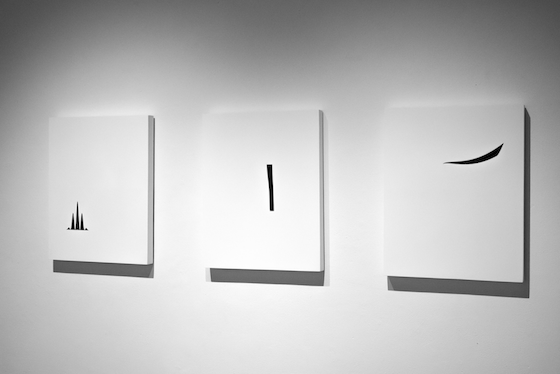
Currently on exhibit in the D+M biennial , 1 + 1 = 22, at the Sol Koffler Gallery in Providence RI through Feb 27 2022.
Gallery photos: https://www.flickr.com/photos/risdexhibitions/albums/72177720296353216
High res photos: https://jmadden.artstation.com/projects/b5r3Kg
Gallery photos: https://www.flickr.com/photos/risdexhibitions/albums/72177720296353216
High res photos: https://jmadden.artstation.com/projects/b5r3Kg
see Equation...
see Equation...
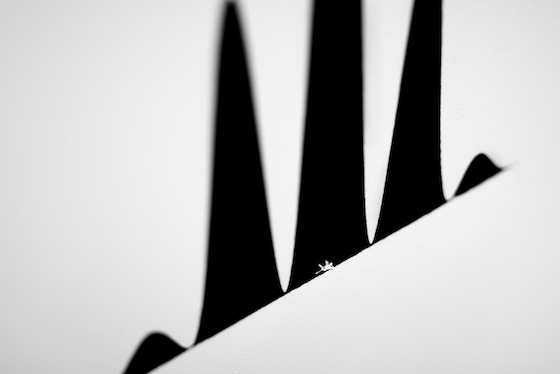
This series of three 16x20 panels uses scale, depth, contrast, and a little Mathematica to help visualize the tension between our collective capability to describe the universe and the individual capacity to internalize that information. Shown below, I generated the curves in Mathematica based on equations from textbooks and papers. From Mathematica the figures were exported to Illustrator to prepare files for a laser cutter. The panels were cut and meticulously painted for a smooth matte finish. The inner edges of the panel were hand painted before each panel was backed with light absorbent velvet to create a blackbody cavity.
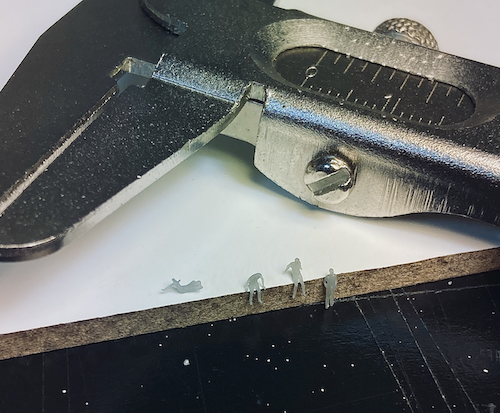
Unpainted examples of the 1:400 scale human figures printed on a FormLabs resin printer using 3D scans of myself.
see Equation 6.32
see Equation 6.32
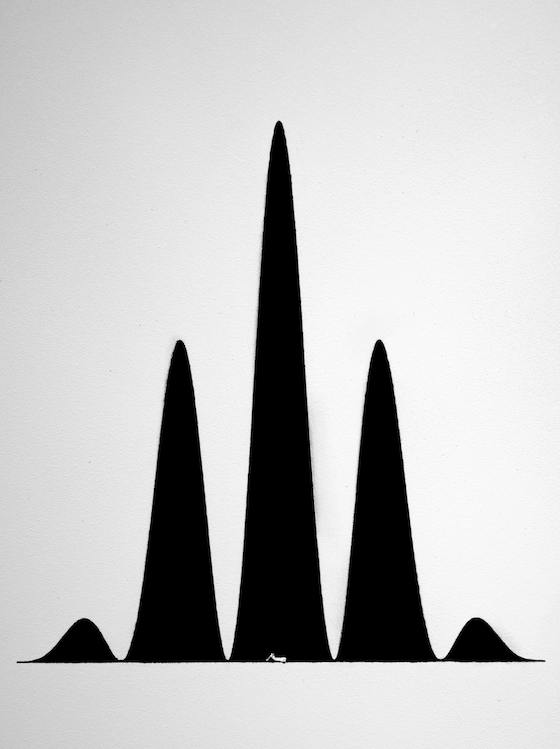
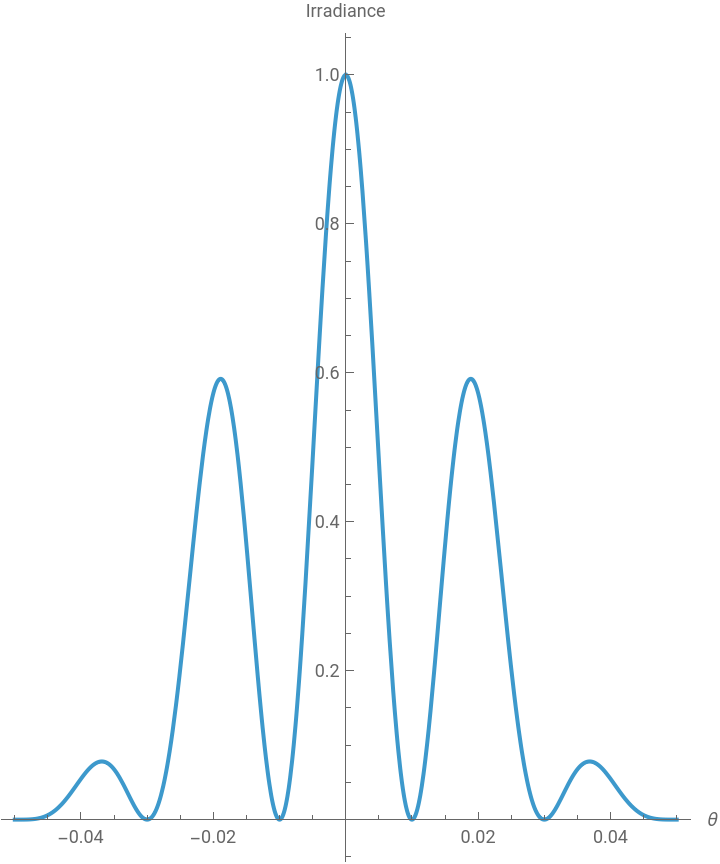
This curve represents the irradiance pattern of light passing through a double slit, revealing its wave-like nature. Strangely, this pattern appears for single photons and even single electrons hinting at the deep quantum mechanical complexity of matter and energy. Trying to make sense of quantum mechanics is a great example of how scale defines our most fundamental intuitions and expectations.
Equation reference: Bennett C.A. Principles of Physical Optics. Wiley 2008
For the final plot I picked a=20, d=50, and w=0.05.
Equation reference: Bennett C.A. Principles of Physical Optics. Wiley 2008
For the final plot I picked a=20, d=50, and w=0.05.
In[]:=
ManipulatePlot,{θ,-w,w},PlotRangeFull,AspectRatio1.2,AxesLabel{"θ","Irradiance"},{{a,20,"a/λ"},0.1,30},{{d,50,"d/λ"},10,100},{{w,0.05},0.01,π}
2
Cos[πdSin[θ]]
2
Sin[πaSin[θ]]
πaSin[θ]
Out[]=


see Equation 4
see Equation 4
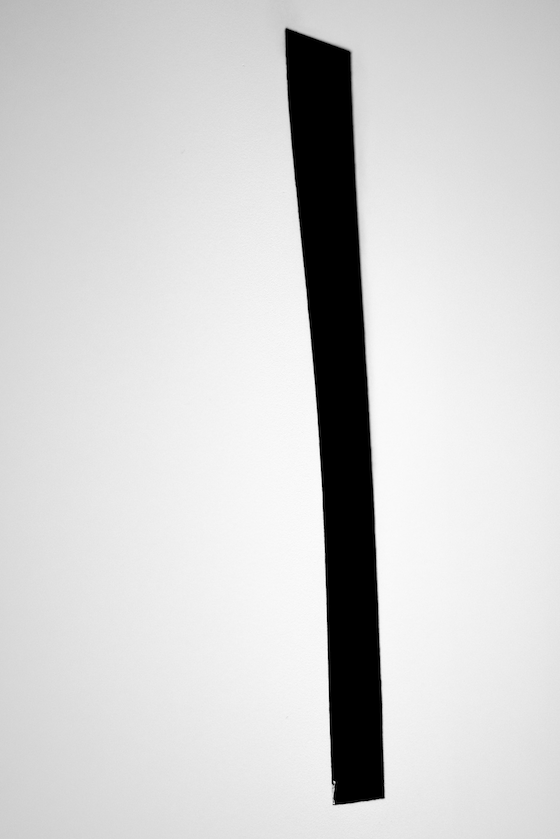
This set of two parametric equations describes the inner and out edge of the habitable zone from running 1D climate simulations. All life as we know it needs liquid water in some capacity. We will most likely confirm we are not alone in the universe by searching in the region depicted here. Set between cosmology and quantum mechanics, understanding life has been so challenging to science that we take for granted that the classification of ‘non-scientific’ can even exist.
This function is distinctly empirical compared to the other two. Like climate systems, the complexity of life can make it scientifically opaque b.
Equation reference: Kopparapu R. et al. Habitable Zones Around Main-sequence Stars: Dependence on Planetary Mass. ApJL, 787:L29, 2014
This function is distinctly empirical compared to the other two. Like climate systems, the complexity of life can make it scientifically opaque b.
Equation reference: Kopparapu R. et al. Habitable Zones Around Main-sequence Stars: Dependence on Planetary Mass. ApJL, 787:L29, 2014
see Equation 29.131
see Equation 29.131
This curve shows the past and future expansion of the whole universe. Factoring in the play between matter and dark energy, we can model the overall expansion of space, to first order, using a relatively simple function. The ease of deriving, plotting, confirming, and predicting billions of years of history can disconnect us just as much as it connects us to reality.
Equation reference: Carroll B. & Ostlie D. An Introduction to Modern Astrophysics. 2nd ed. Pearson 2007
For the final plot I picked a range from 0 to π then copied and rotated the curve to create a solid shape.
Equation reference: Carroll B. & Ostlie D. An Introduction to Modern Astrophysics. 2nd ed. Pearson 2007
For the final plot I picked a range from 0 to π then copied and rotated the curve to create a solid shape.
An equation scribbled on a blackboard might hold immense insight to the fundamental nature of our reality but we are seldom given the space to internalize that achievement. Like a stratum of rock, this dynamic relationship between deep forces, elegant equations, glossing recitation, and what’s fathomable represents a tough barrier to dig through in order to connect our individual humanity to nature. We can measure beyond our ability to sense and internalize our findings. This creates scientific absurdity where our seeking of knowledge is in tension with our relative inability to be changed by it.