Can a convex 3D polyhedron completely surround itself if it cannot fill space? One requirement for filling space is that a shape have a Dehn invariant of zero.
1. The Heesch problem
1. The Heesch problem
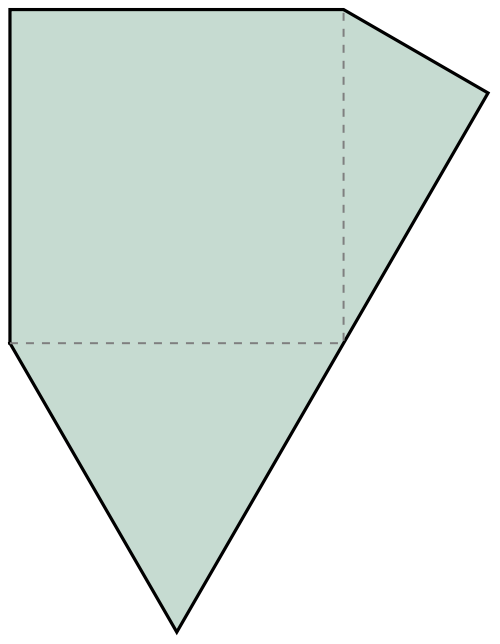
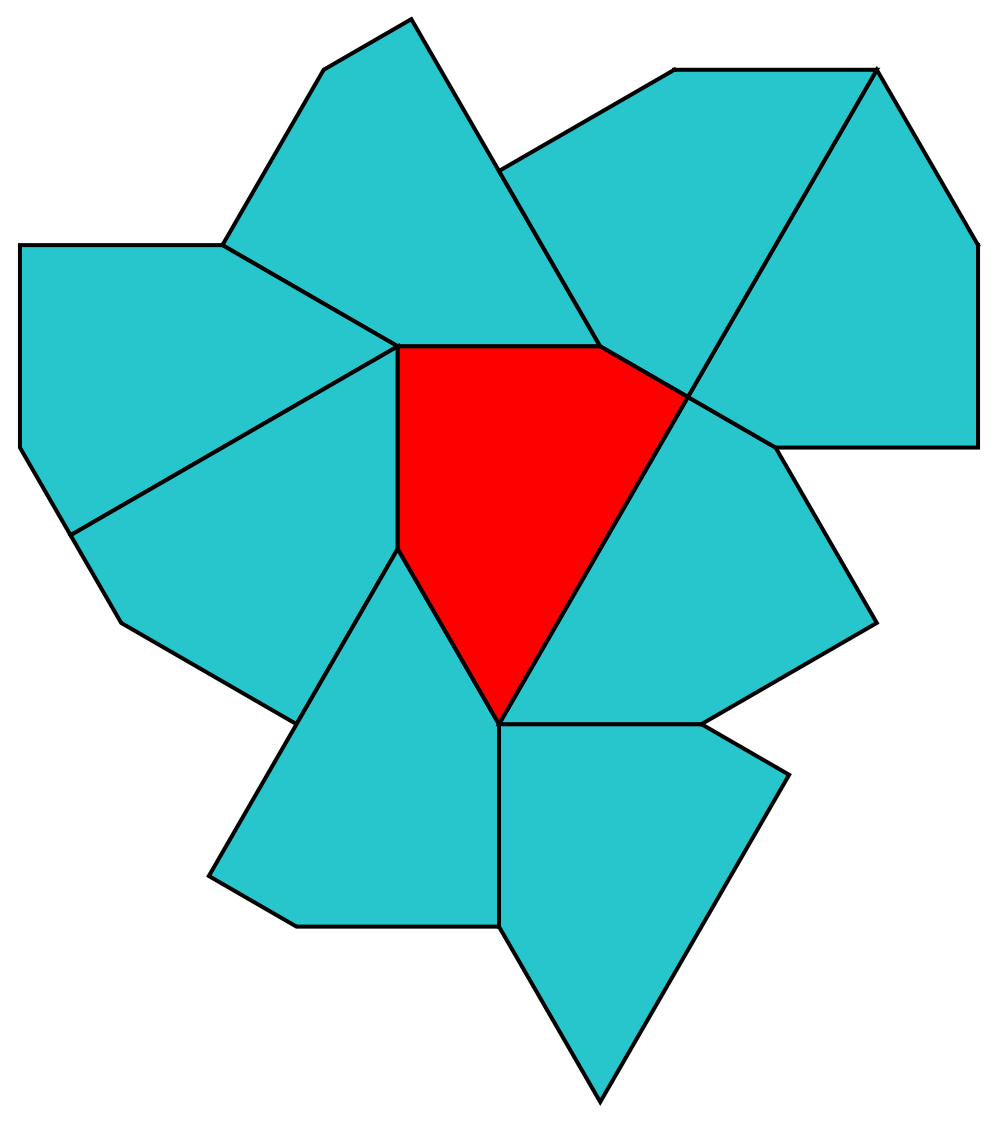
A Heesch polygon can surround itself, but cannot tile space. Heinrich Heesch introduced the problem in 1968 and exhibited a convex pentagon with Heesch number 1. Heesch’s original pentagon can be decomposed into a square, an equilateral triangle, and a 30-60-90 triangle.
Out[]=
The tile can completely surround itself.
Out[]=
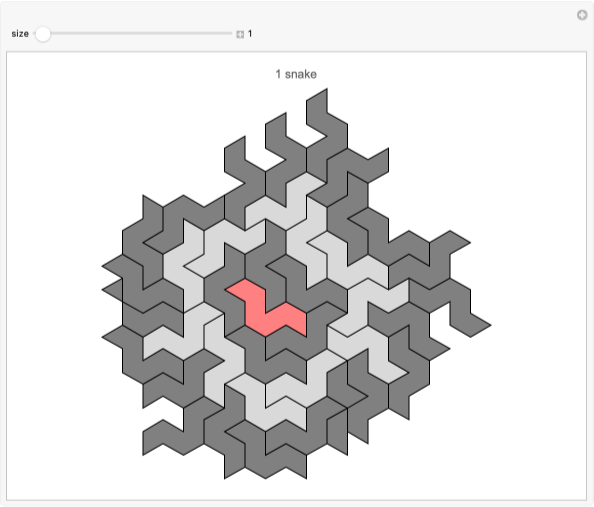
Craig S. Kaplan gives a particularly accessible introduction here: Heesch numbers, Part 1. One infinite class of Heesch-3 polygons I helped to identify are now called the Pegg Snakes. For many years the largest known finite Heesch number was 5, from work of Casey Mann. In 2020 Bojan Bašić found a figure with Heesch number 6, published in 2021. The general problem remains open. Useful starting points are MathWorld: Heesch Number, Bašić’s Heesch-6 paper, and Craig Kaplan’s Heesch-number data.
Craig S. Kaplan has carried out extensive computational work on Heesch numbers, including exhaustive searches of large families of polyforms using SAT methods. His 2021 paper and dataset are linked above. His earlier experiments with surrounding shapes also led to the puzzle game Good Fences, in which copies of a kernel must form a complete fence around it. Kaplan notes that the game grew directly out of his work with coronas. When David Smith began experimenting with the shape that became the Hat, it was not initially clear whether it tiled the plane at all. One plausible possibility was that it was a non-tiler with a surprisingly high Heesch number. Smith sent the shape to Craig Kaplan, and the subsequent investigation led instead to the first aperiodic monotile. Kaplan recounts the story in Scientific American and on the Hat project page.
In three dimensions there is an additional obstruction unavailable in the planar problem: the Dehn invariant. Every polyhedron that tiles Euclidean 3-space has Dehn invariant 0. The converse is false: D=0 is necessary, not sufficient, for space filling. Sydler’s theorem says that volume together with the Dehn invariant completely characterizes scissors congruence in Euclidean 3-space. See MathWorld: Dehn Invariant.
This gives a useful target for a genuinely three-dimensional Heesch example: construct a polyhedron with a complete corona but a provably nonzero Dehn invariant. Then it cannot tile space.
There are several comparatively easy ways to manufacture 3D analogues of a first Heesch corona. One can extrude a planar Heesch polygon into a prism and extrude a planar corona with it. One can also begin with cubes and add complementary bumps and recesses so that a central copy can be surrounded while a counting imbalance (for example, more protrusions than holes) obstructs indefinite face matching. These constructions are useful intuition, but they are not the point of the example below: prism constructions usually have Dehn invariant 0, and a clean global non-tiling proof still has to be supplied.
Code for Cubes
Code for Cubes
Graphic
Graphic
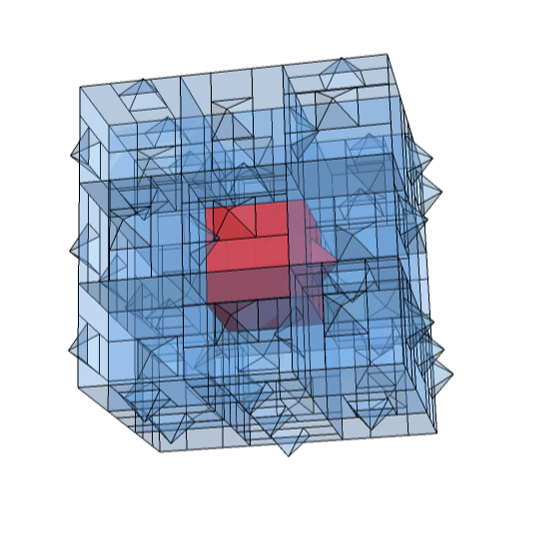
The space-filling truncated tetrahedron
The space-filling truncated tetrahedron
Start with the regular tetrahedron with vertices {1,1,1}, {1,-1,-1}, {-1,1,-1}, and {-1,-1,1}, and truncate every edge one quarter of the way from each endpoint. This is the space-filling truncated tetrahedron appearing in the beta-tin packing described by Damasceno, Engel, and Glotzer; see ACS Nano 6 (2012), 609-614.
Out[]=

Start Since the shape fills space, it has Dehn invariant 0. The regular tetrahedron has a non-zero Dehn invariant. If we add it to the beta-tin, we get a heptahedron that cannot fill space. Taking one third of the heptahedron gives the Heesch hemiobelisk. The hemiobelisk is one of the seven hexahedra.
Out[]=


A Corona for the Heesch Hemiobelisk
A Corona for the Heesch Hemiobelisk
Originally, I planned on just using the heptahedrons. I completely surrounded a beta-tin space-filling truncated tetrahedron. For all those on the outside, I converted them into heptahedra. Then I removed 1 of them to expose a triangular cell. To that, I added a tetrahedron, to make the central cell a heptahedron. Then I tried to completely surround it. I ran into some problems. Second, the yellow shape intersected with one of the outer heptahedra I needed. At that point, I had the idea of dividing the heptahedron into three parts.
In the figure below, each of the three inner cells has a single problem point.
Out[]=

It turns out that point p can be fixed. We can also clear away extra hemiobelisks.
We can build a contact matrix. 4=solid intersection, 3=face intersection, 2=edge intersection, 1=point intersection, 0 = no intersection.
The nearest uncovered point is at {18/13,18/13,16/13}, so we can cut a solid around the central cell at a depth of 1/13 and calculate the volume of the intersection. If all the surrounding shapes add up to the correct volume, then the complete surround is confirmed.
And we can show that intersection at a depth of 1/13. Is it okay that I really like how that looks?
It does not yet prove that the exact three-dimensional Heesch number is 1. To make that stronger statement, every possible second corona would need to be found, and then it would need to be shown that none of these coronas could be completely surrounded. This construction establishes a genuine finite-Heesch phenomenon in 3D in the natural sense of a non-space-filling solid with a complete corona.
Is that the simplest example? Maybe. It is possible that one of the non-tiling rational tetrahedra is 1-Heesch. All of these have Dehn invariant 0.
What is the tightest corona for the Heesch hemiobelisk? I have no idea.
Another question. Is it possible for a space-filling polyhedron to have a finite Heesch polygon in a cross-section? I don’t know the answer to that, either.
References and links
References and links
◼
Craig S. Kaplan, Heesch numbers, Part 1 — introduction and Heesch's original example.
◼
Craig S. Kaplan, Heesch Numbers of Unmarked Polyforms — computational classification and SAT methods.
◼
Craig S. Kaplan, Good Fences — geometric puzzle game based on surrounding a kernel.
◼
Bojan Bašić, A Figure with Heesch Number 6 — current planar finite record.
◼
Smith, Myers, Kaplan, Goodman-Strauss, An aperiodic monotile — Hat resources.
◼
MathWorld, Dehn Invariant — background on Dehn invariants and scissors congruence.
◼
Damasceno, Engel, Glotzer (2012) — truncated tetrahedra and the beta-tin space-filling structure.
CITE THIS NOTEBOOK
CITE THIS NOTEBOOK
The 3D Heesch Hemiobelisk: a nonzero-Dehn-invariant hexahedron with a complete corona
by Ed Pegg
Wolfram Community, STAFF PICKS, September 14, 2026
https://community.wolfram.com/t/the-3d-heesch-hemiobelisk-a-nonzero-dehn-invariant-hexahedron-with-a-complete-corona/28014
by Ed Pegg
Wolfram Community, STAFF PICKS, September 14, 2026
https://community.wolfram.com/t/the-3d-heesch-hemiobelisk-a-nonzero-dehn-invariant-hexahedron-with-a-complete-corona/28014