Spectra of the D-Lines of Alkali Vapors
Spectra of the D-Lines of Alkali Vapors
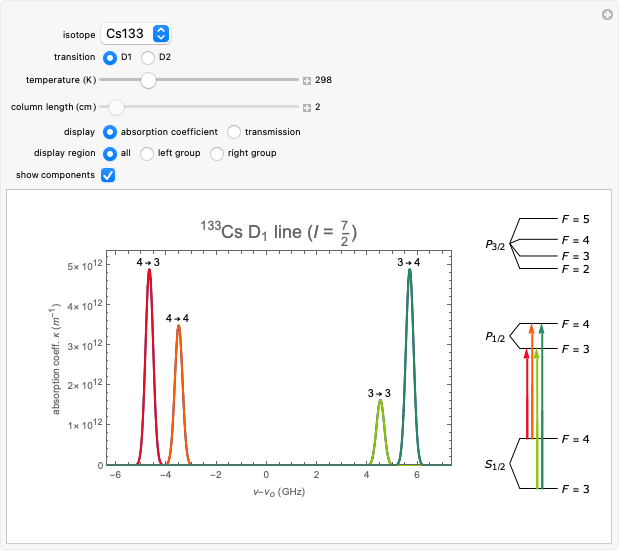
This Demonstration represents the spectra of alkali atoms, that is, the frequency dependence of the optical absorption coefficient and the transmission of a vapor column (length ). Spectra are shown for light tuned near the () and () transitions for the most abundant alkali isotopes. The calculation takes the hyperfine structure into account and assumes a pure Doppler broadening of the lines. You can vary the column length as well as the atomic density, which is controlled via the temperature-dependent saturated vapor pressure. The level scheme on the right shows the involved (allowed) individual hyperfine transitions that contribute to the spectrum.
κ(ν)
T(ν)=
-κ(ν)L
e
L
D
1
nS
1/2
nP
1/2
D
2
nS
1/2
nP
3/2
L
Details
Details
The power of a light beam traversing an atomic vapor is attenuated to a value . The transmission can be parametrized in terms of the absorption coefficient and the vapor column length according to the Lambert-Beer law as .
P
0
P
T=P/
P
0
κ
L
T=
-κL
e
The absorption coefficient depends on the detuning of the light frequency from the atomic resonance frequency . Under the assumption of pure Doppler broadening, the absorption coefficient near the resonance frequency of a transition from a ground state to an excited state is given by
κ=κ(⋁)
⋁
⋁
0
n,F〉
S
1/2
n',F'〉
P
J'
κ(⋁)=3g(n,Fn',F')
1
8
3/2
π
n
at
2
λ
τΔ
⋁
D
S
1/2
P
J'
exp- 2 ⋁- ⋁ 0 Δ ⋁ D | (1) |
where is the atomic density, the wavelength of the transition, the lifetime of the excited state, and the Doppler width is
n
at
λ
τ
Δ=
⋁
D
1
λ
2T
k
B
m
at
with the vapor temperature T and the atomic mass , and where
m
at
g(n,Fn',F')=
S
1/2
P
J'
(2J'+1)(2F+1)(2F'+1)
2I+1
2
1 | 0 | 1 |
J | J' | 1/2 |
2
J' | J | 1 |
F | F' | I |
are the relative intensities of the hyperfine components with being the nuclear spin. The symbols on the right of the last equation represent Racah 6- symbols.
I
j
The atomic density is inferred from the vapor pressure by assuming the ideal gas relations. The vapor pressure is parametrized in the Clausius-Clapeyron form =exp(-A/T), which assumes a thermodynamic equilibrium between the bulk metal and its vapor, and where the constants and depend on the isotope and on the state of aggregation (solid or liquid) of the bulk (see Vapor Pressure and Density of Alkali Metals for details).
p
vap
p
vap
p
0
p
0
A
Spectra are then obtained by summing the contributions (1) of all allowed hyperfine components of the transition with resonance frequencies given by the hyperfine structure of the coupled states.
F'-F=-1,0,+1
External Links
External Links
Permanent Citation
Permanent Citation
Gianni Di Domenico, Antoine Weis
"Spectra of the D-Lines of Alkali Vapors"
http://demonstrations.wolfram.com/SpectraOfTheDLinesOfAlkaliVapors/
Wolfram Demonstrations Project
Published: March 7, 2011