The less I say, the more you think.
Generalized Continued Fraction
Generalized Continued Fraction
First turn two lists into a generalized continued fraction.
In[]:=
generalfraction[x_,{a_,b_}]:=
a
b+x
In[]:=
ContinuedFractionKList[a_List,b_List]:=Fold[generalfraction,0,Reverse[Transpose[{a,b}]]]
Example:
In[]:=
ContinuedFractionKList[{a,b,c,d,e,f},{p,q,r,s,t,u}]
Out[]=
a
p+
b
q+
c
r+
d
s+
e
t+
f
u
This can also be achieved with ContinuedFractionK:
In[]:=
ContinuedFractionK[letter[k],letter[k+15],{k,1,6}]
Out[]=
a
p+
b
q+
c
r+
d
s+
e
t+
f
u
Euler E123 Observations on continued fractions
Euler E123 Observations on continued fractions
In Euler’s E123 Observations on continued fractions Euler turns in §2 an alternating series into a generalized continued fraction:http://download.uni-mainz.de/mathematik/Algebraische%20Geometrie/Euler-Kreis%20Mainz/E123RevisedVersion1.pdf
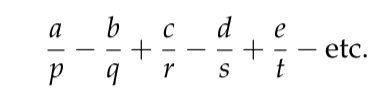
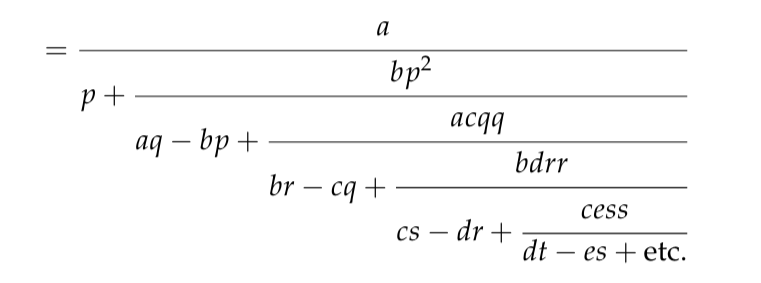
This can be implemented in Mathematica:
Out[]=
a
p
b
q
c
r
d
s
e
t
a
p+
b
2
p
-bp+aq+
ac
2
q
-cq+br+
bd
2
r
-dr+cs+
ce
2
s
-es+dt
In §3 Euler gives a convincing example for log(2):
Out[]=
1-+-+ ∓ etc
1
2
1
3
1
4
1
5
1
1+
1
-1+2+
2
2
-2+3+
2
3
-3+4+
2
4
-4+5
The right hand side is:
Out[]=
1
1+
1
1+
2
2
1+
2
3
1+
2
4
1+
2
5
And now we can check for log(2):
Out[]=
1
1+
∞
k=1
2
k
1
If you know the log(1+x) series, log(2) is by no surprise:
Out[]//TraditionalForm=
log(x+1)x-+-+-+-+-+O()
2
x
2
3
x
3
4
x
4
5
x
5
6
x
6
7
x
7
8
x
8
9
x
9
10
x
10
11
x
Setting gives the above alternating series value:
x=1
In[]:=
Log[1+1]
Out[]=
Log[2]
In §4 Euler gives another convincing example for and therefore explaining Brouncker’s generalized continued fraction in Wallis’s Arithmetica Infinitorum from 1655:https://en.wikipedia.org/wiki/John_Wallishttps://en.wikipedia.org/wiki/William_Brouncker,_2nd_Viscount_Brouncker
π
4
Out[]=
1-+-+ ∓ etc
1
3
1
5
1
7
1
9
1
1+
1
-1+3+
2
3
-3+5+
2
5
-5+7+
2
7
-7+9
The right hand side is:
Out[]=
1
1+
1
2+
2
3
2+
2
5
2+
2
7
2+
2
9
2
And now we can check for π/4:
Out[]=
1
1+
∞
k=1
2
(-1+2k)
2
π
4
If you know the arctan series, π/4 is by no surprise:
Out[]//TraditionalForm=
-1
tan
3
x
3
5
x
5
7
x
7
9
x
9
11
x
Setting gives the above alternating series value:
x=1
In[]:=
ArcTan[1]
Out[]=
π
4
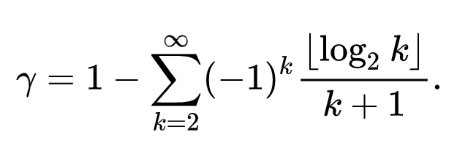
Turning Nielsen’s and Vacca’s alternating series for γ into a generalized continued fraction with an intriguing pattern:
Turning Nielsen’s and Vacca’s alternating series for γ into a generalized continued fraction with an intriguing pattern:
Nielsen 1897:https://en.wikipedia.org/wiki/Euler%27s_constant
=1-++2-+-++3-+-+-+-++...
1
3
1
4
1
5
1
6
1
7
1
8
1
9
1
10
1
11
1
12
1
13
1
14
1
15
1
16
Written with Mathematica:
Out[]//TraditionalForm=
1-+-+-+-+-+-+-+-
1
3
1
4
2
5
2
6
2
7
2
8
3
9
3
10
3
11
3
12
3
13
3
14
3
15
3
16
4
17
Turning with Euler the alternating series of Nielsen into a generalized continued fraction:
Out[]=
1-
1
3+
2
3
1+
1×2
2
4
-3+
1×2
2
5
2+
2
2
2
6
2+
2
2
2
7
2+
2×3
2
8
-6+
2×3
2
9
3+
2
3
2
10
3+
2
3
2
11
3+
2
3
2
12
3+
2
3
2
13
3+
2
3
2
14
3+
2
3
2
15
3+
3×4
2
16
-13+
3×4
2
17
4+
2
4
2
18
4
This can be implemented with ContinuedFractionK:
Out[]=
1-
1
3+
2
3
1+
1×2
2
4
-3+
1×2
2
5
2+
2
2
2
6
2+
2
2
2
7
2+
2×3
2
8
-6+
2×3
2
9
3+
2
3
2
10
3+
2
3
2
11
3+
2
3
2
12
3+
2
3
2
13
3+
2
3
2
14
3+
2
3
2
15
3+
3×4
2
16
-13+
3×4
2
17
4+
2
4
2
18
4+4
2
19
2,2+4,2+4+8,2+4+8+16, ... will pass
Compare to EulerGamma:
Turning with Euler the alternating series of Vacca into a generalized continued fraction:
This can be implemented with ContinuedFractionK:
CITE THIS NOTEBOOK
CITE THIS NOTEBOOK
A generalized continued fraction for the Euler-Gamma constant with an intriguing pattern
by Oliver Seipel
Wolfram Community, STAFF PICKS, March 10, 2024
https://community.wolfram.com/groups/-/m/t/3138141
by Oliver Seipel
Wolfram Community, STAFF PICKS, March 10, 2024
https://community.wolfram.com/groups/-/m/t/3138141