Rotation of Feynman Diagrams around an Electron-Photon Vertex
Rotation of Feynman Diagrams around an Electron-Photon Vertex

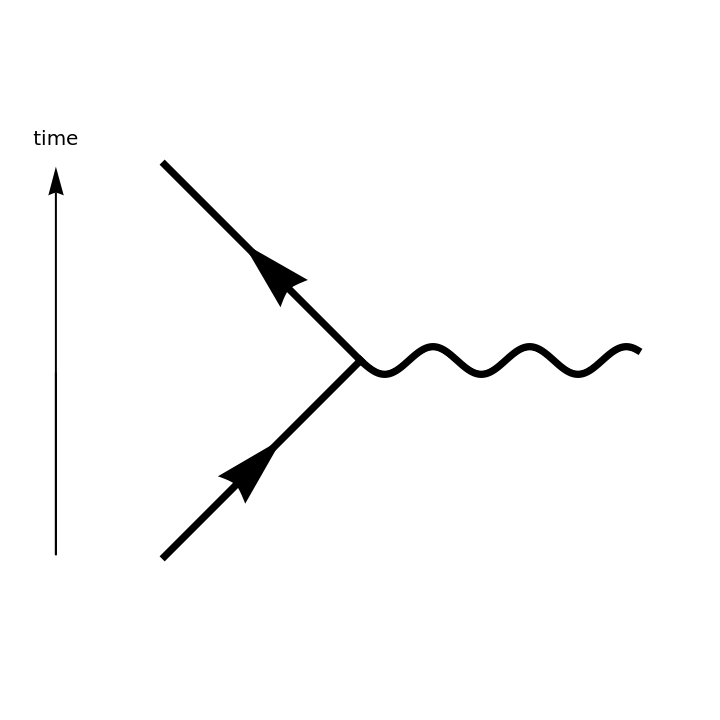
Feynman diagrams are symbolic representations for interactions among elementary particles. An interaction occurs when particle trajectories intersect at a vertex. The fundamental vertex in quantum electrodynamics involves a photon γ, represented by a wavy line, and two electrons e, entering and exiting the vertex, represented by solid lines. Arrows oriented in the positive-time direction identify the particles as negatively charged electrons . Arrows oriented in the negative-time directions represent antiparticles, positrons propagating forward in time. Each Feynman diagram can be interpreted as an integral which contributes to the quantum-mechanical amplitude of a process, via a set of Feynman rules. Remarkably, different orientations of a Feynman diagram can represent alternative sequences of spacetime events. You can rotate an vertex into eight different orientations, each describing a completely different physical process. Included are electron-positron creations and annihilations, which contain the essence of Einstein's mass-energy relation .
-
e
+
e
eeγ
E=m
2
c
External Links
External Links
Permanent Citation
Permanent Citation
S. M. Blinder
"Rotation of Feynman Diagrams around an Electron-Photon Vertex"
http://demonstrations.wolfram.com/RotationOfFeynmanDiagramsAroundAnElectronPhotonVertex/
Wolfram Demonstrations Project
Published: November 5, 2007