Energies for Particle in a Gaussian Potential Well
Energies for Particle in a Gaussian Potential Well


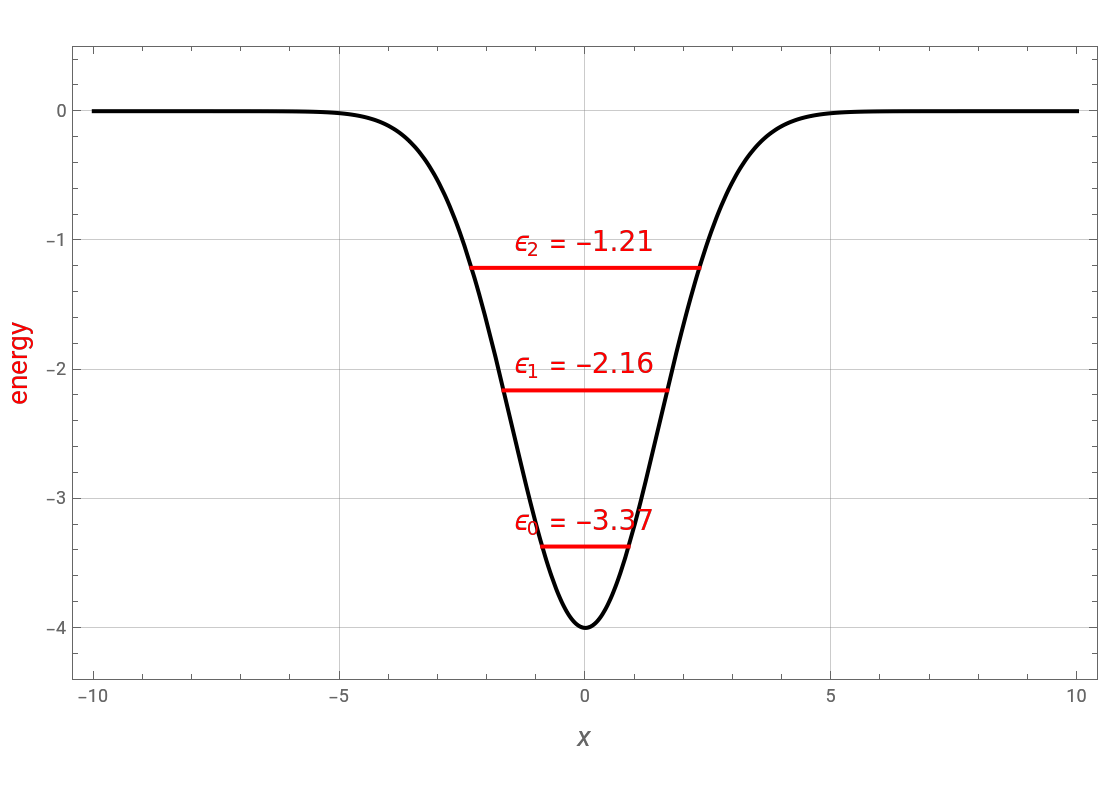
The Schrödinger equation for a particle in a one-dimensional Gaussian potential well , given by , has never been solved analytically. This Demonstration derives an approximation for the first few bound-state energies, <0, using the linear variational method. The wavefunction is approximated by a linear combination . It is convenient to take the basis functions (x) as the corresponding orthonormalized eigenfunction of the linear harmonic oscillator: (x)=n!(, where is the Hermite polynomial and is a scaling constant to be determined variationally. After evaluating the matrix elements =(x)-+V(x)(x)dxover the selected set of basis functions, Mathematica can calculate the eigenvalues in a single step, from which we select only those with negative values. For convenience, we set , so that all distances are expressed in bohrs (Bohr radii) and energy quantities in hartrees.
V(x)=-
V
0
-/2
2
x
2
σ
e
-ψ''+V(x)ψ(x)=ϵψ(x)
2
ℏ
2m
(x)
ϵ
n
ψ(x)=(x)
N-1
∑
n=0
c
n
ϕ
n
ϕ
n
ϕ
n
1
n
2
1/4
α
π
-α/2
2
x
e
H
n
α
x)H
n
th
n
α
H
nm
∞
∫
-∞
ϕ
n
1
2
2
d
d
2
x
ϕ
m
N
N
ℏ=m=1
The graphic shows the computed energy levels for selected values of , , , and , superposed on the potential energy function. By an estimation based on the WKB method, the number of bound states is approximated by .
V
0
σ
α
N
floor4σ+
V
0
2π
1
2
References
References
D.A. McQuarrie, Quantum Chemistry, Sausalito, CA: University Science Books, 1983, pp. 266-275. Or numerous other texts on quantum mechanics or quantum chemistry.
External Links
External Links
Permanent Citation
Permanent Citation
S. M. Blinder
"Energies for Particle in a Gaussian Potential Well"
http://demonstrations.wolfram.com/EnergiesForParticleInAGaussianPotentialWell/
Wolfram Demonstrations Project
Published: August 14, 2012