Series Solution of a Cauchy-Euler Equation
Series Solution of a Cauchy-Euler Equation


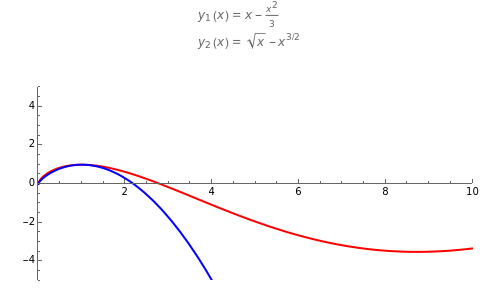
This Demonstration shows the solution to the Cauchy–Euler equation with initial conditions and and approximations to it using truncated series.
2y''(x)-xy'(x)+(1+x)y(x)=0
2
x
y(1)=1
y'(1)=0
Assume solutions have the form
y=+x++…=
r
x
a
0
a
1
a
2
2
x
r
x
∞
∑
n=0
a
n
n
x
Take the first and second derivatives of this equation and substitute back into the original equation. If the equation is to be satisfied for all , the coefficient of each power of must be zero. This gives a quadratic equation in with roots and . Then the coefficients , , , … can be determined. The two solutions for are:
x
x
r
r=1
r=1/2
a
0
a
1
a
2
x>0
y
1
∞
∑
n=1
n
(-1)
n
2
(2n+1)!
n
x
y
2
1/2
x
∞
∑
n=1
n
(-1)
n
2
(2n)!
n
x
The final solution (plotted in blue) has the form , where and are determined by the initial conditions. With not too many terms it serves as a good approximation to the exact solution (plotted in red).
y=(x)+(x)
c
1
y
1
c
2
y
2
c
1
c
2
Details
Details
This example comes from Chapter 8 of[1] on series solutions and the Cauchy–Euler equation.
References
References
[1] J. R. Brannan and W. E. Boyce, Differential Equations with Boundary Value Problems: An Introduction to Modern Methods and Applications, New York: John Wiley and Sons, 2010.
External Links
External Links
Permanent Citation
Permanent Citation
Stephen Wilkerson
"Series Solution of a Cauchy-Euler Equation"
http://demonstrations.wolfram.com/SeriesSolutionOfACauchyEulerEquation/
Wolfram Demonstrations Project
Published: December 23, 2010